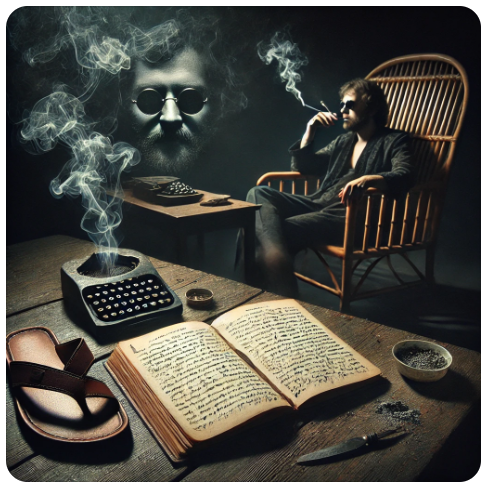
The other day, I spoke with my friend who wore sunglasses, even at night. They were not just any sunglasses; they had thick, tinted lenses that turned his eyes into secrets. He sat in his bamboo chair, curled like an embryo in a second womb, and waited for the silence between songs on the record. When it came, he tilted his head, aiming his gaze—hidden behind the black glass—at me.
“Your passage shows a definite poetic sensitivity, an emotional quality that strikes one—but what does it mean?” he asked, words biting the quiet. “You are trying to communicate?” He leaned on the last syllable of “communicate,” stretching it thin, squeezing it like elegant toothpaste. “Aren’t you?”
I felt the weight of his question sink into my chest, leaving behind a sharp, echoing hollowness. I glanced at the poem I had laid bare on the table between us, exposed like a wound. His words transformed before my eyes into writhing maggots, their white bodies squirming towards the ink. Without thinking, I took off my shoe—a thin, worn sandal—and slammed it down. The thud startled the silence; the maggots burst, leaving wet smears across the wooden surface.
I didn’t speak for a moment. I scraped their remnants into an ashtray, their tiny corpses mixing with the charred remnants of past thoughts and past sins. I dropped my sandal to the floor. He laughed, a dry, brittle sound that cracked in the dimness. He crossed his legs, the fabric of his pants whispering like a taunt. The damage had been done—a single maggot had escaped my fury and burrowed, unseen, into my ear. I could feel it crawling, tiny feet clinging to the tender skin before settling into the cavity of my heart. It pulsed there, secret and vile. He knew it. His smirk was the proof.
Now I write to pull it out, strand by bloody strand, from my heart. I know that only when I spit it out, stained and gasping, will I be free.
This maggot is unlike the others; it shifts and moulds itself, a grotesque mimicry of thoughts, without shedding its true nature. Later, it transformed as I read Dostoevsky’s The Devils, a cigarette balanced between my fingers and a small, gleaming grain of eternity in the palm of my other hand. Between puffs and between sentences, I noticed that the grain had grown in weight. Kirilov had just explained why man must commit suicide to proclaim his freedom from fear. He was called a madman. I thought he made sense. I looked at my hand and saw that the grain had grown into a crumb. Realizing that Dostoevsky was performing the alchemy in person, I continued to read and commune with him.
The grain in my palm felt heavier, its edges pressing into my skin. My mind wasn’t playing tricks. It had grown into a dense and insistent crumb. I realized then that Dostoevsky had performed this alchemy, transmuting despair into something tangible, a weight that dragged at the fabric of the world. I kept reading, feeling the maggot shift inside me, watching with its eyeless stare as I communed with a man long dead but never silent.
The record ended while the needle turned and turned on the dead wax, and I looked up. My friend still sat there, sunglasses glinting darkly in the thin light, the smirk on his lips a question left unsaid. I inhaled, the smoke and the maggot’s secrets filling me to the brim.
 Welcome — I’m glad you’re here.
 Journeys and Star Gazing