The Swirl of Coffee and Questions

November 21, 2024

I was having coffee with a friend who happens to be a teacher. I watched the steam spiral as my companion clinked her spoon against the porcelain, stirring her cup absently. As these coffee conversations do, we meandered from the mundane to the metaphysical. From the internet we went to the meaning of life. My friend has a knack for asking the right questions at the right time.

“So, tell me – what’s the point of it all?” she asked as she gazed through the cafe window where a woman passed by pushing a pram.

“I don’t know. When I die, when you die, my and your senses are dead, so we’re not here. So much for the factual world,” I replied, trying to remember which philosopher said something like that.

She smiled and, looking directly into my eyes, replied, “But you believe in reincarnation, don’t you? Isn’t that laden with purpose?”

I shrugged, “Sure it’s romantic to believe in some kind of afterlife. But, look around – does this scream purpose to you?”

She brushed her hair away from her forehead then her eyes wandered to the window again. A street performer decided to stand in front of the window and perform some clumsy juggling.

“Religion tries to make sense of it all,” I pressed on, “But even the high priests of science kneel before an empty throne. Their emptiness includes weirdo quarks, quantum realms and even god-particles – they say forces beyond our comprehension. It kinda sounds poetic that Tao dances in the heart of the matter, even beautiful. But sacred? No way.”

Her brow furrowed. “So science is the new religion?”

I leaned in, gesturing toward the phone lying between us. “No, not science. Scientism. It replaces reverence with results, mystery with measurability, quality with quantity.” I picked up the phone, “And it’s not just the gadgets.” My voice softened, “It’s the mindset: sharp edges, hard lines, reducing everything – life, death, the cosmos itself – to equations and particles. Even love is written off as a bunch of chemicals sloshing in the brain.” I shook my head, placing the phone on the table. “Wow, what are we left with?”

Her silence invited me to continue.

“Don’t you see?” my voice quickening. “We’re told we’re nothing but the products of chemical accidents on a spinning rock around a Type G star. What is prayer? It’s just some sound waves pushing through the air. Yep, random collisions of chemicals over the millenniums mutated into creatures who love, create, play and pray. OK, the ancient gods may have been illusions, but at least they offered dignity. What does scientism give us? Purpose replaced by algorithms, reverence and a sense of the sacred by replicable results.”

I stopped and leant back in my chair. Took another sip of my coffee. Her hands folded, her expression thoughtful. “But isn’t technology also liberating. It connects us and makes life easier.”

“Ah,” I said, raising a finger. “I love what science has given us. Science didn’t just discover miracles; it made them. Instead of AD – as our way of marking history, I would like to see AP – After Penicillin. I love that technology has freed us from chores. But that freedom might also free us from the planet. No, not sending seed ships on interplanetary and galactic colonization trips. I mean a final liberation – our extinction.”

Now, I was on a roll. I couldn’t stop the impetus of my talking, “Science didn’t just explain lightning; it gave us bombs more destructive than Zeus’s wrath. It replaced the sacred with equations, prayer with noise, and purpose with randomness.”

She frowned and looked at her near-empty cup of coffee. “You make it sound hopeless.”

“Maybe it is,” I admitted. “Scientism is a product of rigid thinking and religious fundamentalism has the same rigidity. You know – dogma in robes and dogma in lab coats. The kind of thinking that says it has the answers but does not know how to listen.”

She studied me for a long moment. “So what’s your solution?”

I smiled, took another sip of my coffee and looked out the window at the juggler. “I don’t know if there is a solution. Maybe we don’t need one. Maybe we just need to live without demanding it be solved. To sit with the questions, like we’re doing now.”

She chuckled softly. “Sounds like you just reinvented faith.”

I laughed. “Maybe, but I like to see scientists do a bit of Zen Koan thinking. You know, like wonder what is the sound of one hand clapping and have their logic scrambled just for a short while.”

What’s left for us, I asked my friend, when both gods and reason fail? My coffee had gone cold by then. The swirling depths had disappeared, as had the steam. But the question lingered, unanswered.

And maybe that’s all it ever will be—a question.


My Mother’s Anatolian Icon

December 19, 2023

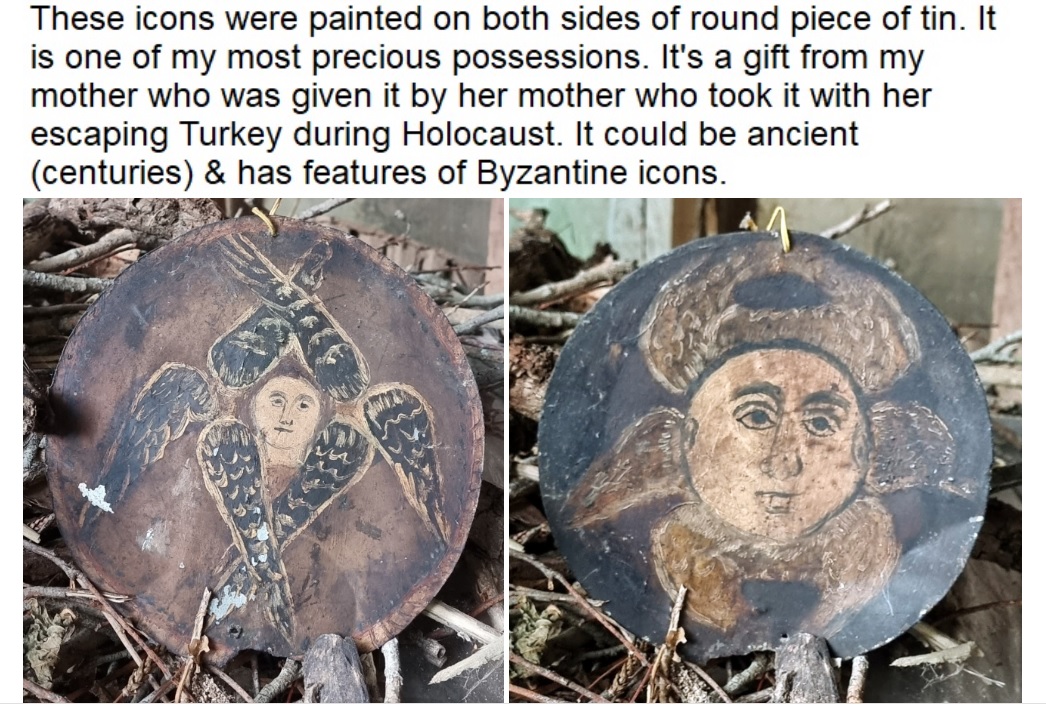
On a quiet Sunday, December 10, 2023, my mother left this world. A cherished relic, once belonging to my grandmother, had become my mother’s dearest possession. It rested faithfully by her bedside, accompanied by the constant glow of an olive oil lamp, flickering day and night.

In her room, when I visited, she would present the icon for me to kiss and cross myself.

This icon held profound significance for my family, hailing from Pontic Greeks who endured the harrowing attempted genocide in the 1920s. Known as the Great Disaster among Greeks, my grandparents faced unspeakable challenges during their escape, carrying with them this sacred icon. In those trying times, my grandmother, a beacon of strength, invoked the Mother of God, Theotoko, for solace and sustenance.

Picture a group of weary children and adults, huddled around a fire by the roadside, hungry and desperate. My grandmother, with unwavering faith, would bring out the cherished icon. She urged the children to kiss it and make the sign of the cross. Then, with profound devotion, she raised the icon to the heavens, repeating the ritual three times—for the Father, the Son, and the Holy Ghost—beseeching Theotoko for divine intervention. Each time before she raised it to the star filled sky, she brought it back to her heart.

Amidst the crackling of the fire, my grandmother, holding the icon aloft, turned to share its grace with the circle of souls around her. She dipped the icon into a vessel of water three times, each motion filled with fervent prayer. As the icon emerged for the last time, she declared that the Mother of God had provided. The once-hungry children filled their cups, drank deeply, and found their hunger miraculously satisfied.

This faded icon, a witness to survival and faith, now holds a special place in my heart, connecting me to a resilient past and to my mother and her mother and to the Mother of God.

I’ve included this story in the book I’m writing which I am dedicating to my mother.

Below is a two faced icon also given to me by my mother. I thought I’d include it here. Found out through Twitter that it is a Byzantine Fan used in Liturgy and is called a ripidion, or hexapterygon.


The veritable basis of symbolism – Rene Guenon

January 26, 2013

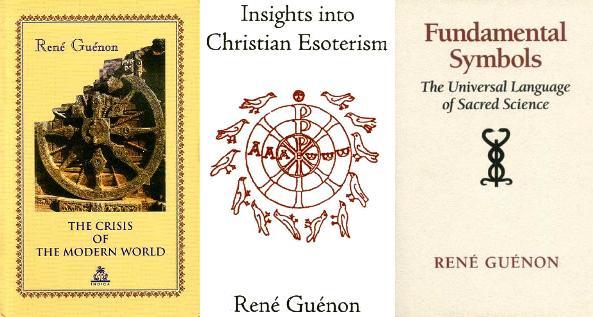
All that exists, in whatever mode this may be, necessarily participates in universal principles, and nothing exists except by participation in these principles, which are the eternal and immutable essences contained in the permanent actuality of the Divine Intellect. Consequently, it can be said that all things, however contingent they may be in themselves, express or represent these principles in their own way and according to their order of existence, for otherwise they would be purely and simply nothingness. Thus, from one order to another, all things are linked together and correspond, to come together in total and universal harmony, for harmony is nothing other than the reflection of principial unity in the manifested world; and it is this correspondence which is the veritable basis of symbolism.

Rene Guenon, Autorite spirituelle et pouvoir temporel ( from studies in symbolism compiled by Michel Valsan in the posthumous book “Fundamental Symbols – The Universal Language of Sacred Science.”)

guenon


George Orwell >> Notes on the Way

April 16, 2010

Notes on the Way – George Orwell

Reading Mr Malcolm Muggeridge’s brilliant and depressing book, The Thirties, I thought of a rather cruel trick I once played on a wasp. He was sucking jam on my plate, and I cut him in half. He paid no attention, merely went on with his meal, while a tiny stream of jam trickled out of his severed œsophagus. Only when he tried to fly away did he grasp the dreadful thing that had happened to him. It is the same with modern man. The thing that has been cut away is his soul, and there was a period — twenty years, perhaps — during which he did not notice it. 

George Orwell

It was absolutely necessary that the soul should be cut away. Religious belief, in the form in which we had known it, had to be abandoned. By the nineteenth century it was already in essence a lie, a semi-conscious device for keeping the rich rich and the poor poor. The poor were to be contented with their poverty, because it would all be made up to them in the world beyound the grave, usually pictured as something mid-way between Kew gardens and a jeweller’s shop. Ten thousand a year for me, two pounds a week for you, but we are all the children of God. And through the whole fabric of capitalist society there ran a similar lie, which it was absolutely necessary to rip out. 

Consequently there was a long period during which nearly every thinking man was in some sense a rebel, and usually a quite irresponsible rebel. Literature was largely the literature of revolt or of disintegration. Gibbon, Voltaire, Rousseau, Shelley, Byron, Dickens, Stendhal, Samuel Butler, Ibsen, Zola, Flaubert, Shaw, Joyce — in one way or another they are all of them destroyers, wreckers, saboteurs. For two hundred years we had sawed and sawed and sawed at the branch we were sitting on. And in the end, much more suddenly than anyone had foreseen, our efforts were rewarded, and down we came. But unfortunately there had been a little mistake. The thing at the bottom was not a bed of roses after all, it was a cesspool full of barbed wire. 

It is as though in the space of ten years we had slid back into the Stone Age. Human types supposedly extinct for centuries, the dancing dervish, the robber chieftain, the Grand Inquisitor, have suddenly reappeared, not as inmates of lunatic asylums, but as the masters of the world. Mechanization and a collective economy seemingly aren’t enough. By themselves they lead merely to the nightmare we are now enduring: endless war and endless underfeeding for the sake of war, slave populations toiling behind barbed wire, women dragged shrieking to the block, cork-lined cellars where the executioner blows your brains out from behind. So it appears that amputation of the soul isn’t just a simple surgical job, like having your appendix out. The wound has a tendency to go septic. 

The gist of Mr Muggeridge’s book is contained in two texts from Ecclesiastes: ‘Vanity of vanities, saith the preacher; all is vanity’ and ‘Fear God, and keep His comandments: for this is the whole duty of man’. It is a viewpoint that has gained a lot of ground lately, among people who would have laughed at it only a few years ago. We are living in a nightmare precisely because we have tried to set up an earthly paradise. We have believed in ‘progress’. Trusted to human leadership, rendered unto Caesar the things that are God’s — that approximately is the line of thought. 

Unfortunately Mr Muggeridge shows no sign of believing in God himself. Or at least he seems to take it for granted that this belief is vanishing from the human mind. There is not much doubt that he is right there, and if one assumes that no sanction can ever be effective except the supernatural one, it is clear what follows. There is no wisdom except in the fear of God; but nobody fears God; there fore there is no wisdom. Man’s history reduces itself to the rise and fall of material civilizations, one Tower of Babal after another. In that case we can be pretty certain what is ahead of us. Wars and yet more wars, revolutions and counter-revolutions, Hitlers and super-Hitlers — and so downwards into abysses which are horrible to contemplate, though I rather suspect Mr Muggeridge of enjoying the prospect. 

It must be about thirty years since Mr Hilaire Belloc, in his book The Servile Sate, foretold with astonishing accuracy the things that are happening now. But unfortunately he had no remedy to offer. He could conceive nothing between slavery and a return to small-ownership, which is obviously not going to happen and in fact cannot happen. There is [little] question now of averting a collectivist society. The only question is whether it is to be founded on willing cooperation or on the machine-gun. The Kingdom of Heaven, old style, has definitely failed, but on the other hand ‘Marxist realism’ has also failed, whatever it may achieve materially. Seemingly there is no alternative except the thing that Mr Muggeridge and Mr F.A. Voigt, and the others who think like them, so earnestly warn us against: the much-derided ‘Kingdom of Earth’, the concept of a society in which men know that they are mortal and are nevertheless willing to act as brothers. 

Brotherhood implies a common father. Therefore it is often argued that men can never develop the sense of a community unless they believe in God. The answer is that in a half-conscious way most of them have developed it already. Man is not an individual, he is only a cell in an everlasting body, and he is dimly aware of it. There is no other way of explaining why it is that men will die in battle. It is nonsense to say that they do it only because they are driven. If whole armies had to be coerced, no war could ever be fought. Men die in battle — not gladly, of course, but at any rate voluntarily — because of abstractions called ‘honour’, ‘duty’, ‘patriotism’ and so forth. 

All that this really means is that they are aware of some organism greater than themselves, stretching into the future and the past, within which they feel themselves to be immortal. ‘Who dies if England live?’ sounds like a piece of bombast, but if you alter ‘England’ to whatever you prefer, you can see that it expresses one of the main motives of human conduct. People sacrifice themselves for the sake of fragmentary communities — nation, race, creed, class — and only become aware that they are not individuals in the very moment when they are facing bullets. A very slight increase of consciousness and their sense of loyalty could be transferred to humanity itself, which is not an abstraction. 

Mr Aldous Huxley’s Brave New World was a good caricature of the hedonistic Utopia, the kind of thing that seemed possible and even imminent before Hitler appeared, but it had no relation to the actual future. What we are moving towards at this moment is something more like the Spanish Inquisition, and probably far worse, thanks to the radio and the secret police. There is very little chance of escaping it unless we can reinstate the belief in human brotherhood without the need for a ‘next world’ to give it meaning. It is this that leads innocent people like the Dean of Canterbury to imagine that they have discovered true Christianity in Soviet Russia. No doubt they are only the dupes of propaganda, but what makes them so willing to be deceived is their knowledge that the Kingdom of Heaven has somehow got to be brought on to the surface of the earth. We have not to be the children of God, even though the God of the Prayer Book no longer exists. 

The very people who have dynamited our civilization have sometimes been aware of this, Marx’s famous saying that ‘religion is the opium of the people’ is habitually wrenched out of its context and given a meaning subtly but appreciably different from the one he gave it. Marx did not say, at any rate in that place, that religion is merely a dope handed out from above; he said that it is something the people create for themselves to supply a need that he recognized to be a real one. ‘Religion is the sigh of the soul in a soulless world. Religion is the opium of the people.’ What is he saying except that man does not live by bread alone, that hatred is not enough, that a world worth living in cannot be founded on ‘realism’ and machine-guns? If he had foreseen how great his intellectual influence would be, perhaps he would have said it more often and more loudly. 

1940 

THE END 

____BD____
George Orwell: ‘Notes on the Way’
First published: Time and Tide. — GB, London. — March 30 and April 6, 1940.  

Reprinted:
— ‘The Collected Essays, Journalism and Letters of George Orwell’. — 1968.