I first came across Basarab Nicolescu in “In the Valley of Astonishment, an interview with Basarab Nicolescu” by Jean Biès, in Parabola, Vol.XXII, No.4, Winter 1997, New York. Parabola is one of those magazines / journals which have the power to connect one with ideas that go beyond the “daily times”. Since then, I read an essay of his in Gurdjieff: Essays and Reflections on the Man and His Teachings, called “Gurdjieff’s Philosophy of Nature.”
I find him an incredibly interesting thinker who is both a scientist and (he may not like this word) “mystic”. In fact, I am now waiting on delivery of his book titled “Science, Meaning, & Evolution: The Cosmology of Jacob Boehme”. (I can’t believe that I just bought th is book for 0.01 cents at Amazon, but the postage was $12.50…. still an amazing bargain!) Jacob Boehme was a German Christian mystic who was considered an original thinker within the Lutheran tradition. He is also a true “theosophist” from the Greek “theosophia” – knowledge of things divine.
The following interview excerpts I have included in “Journeys and Star Gazing” because he touches on the “journey” from specificity…the specialised field of knowledge to the world of transdisciplinarity. I work as an educator in the field of Multicultural Education (see my article A Ganma Odyssey). Nicolescu’s answer to a question on Education below gives, to my eyes, a crucial insight into how to work in the incredibly complex field of teaching non literate African refugees the English language.
Anyway, I hope the teachers which I have emailed with this link find it useful. I did.
stavros
An Excerpt from an Interview with Basarab Nicolescu
From Ad Astra – Young Romanian Scientists’ Journal 2002 www.ad-astra.ro
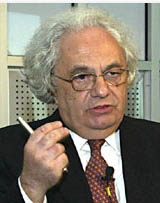
Basarab Nicolescu
Liviu Giosan: Dr. Nicolescu, your name cannot be easily dissociated from the concept of “transdisciplinarity”. Let us start by citing from the Moral Project of the International Center for Transdisciplinary Research (http://perso.club-internet.fr/nicol/ciret/) that you co-founded in 1987: “its principal task is the elaboration of a new language, a new logic, and new concepts to permit the emergence of a real dialogue between the specialists in the different domains of knowledge…”. What was the trajectory that led you from physics to transdisciplinarity? Did your background as a scientist educated in a repressive communist society play any role in imagining and developing this project?
Basarab Nicolescu: When I was a student, I followed the debates between the fathers of quantum mechanics: Werner Heisenberg, Wolfgang Pauli, Niels Bohr, Max Planck. It was then that I learned that in fact most metaphysical questions are not disconnected from scientific research. First I read their books and articles. After some years I discovered that their correspondence was much more down-to-earth than the published scientific works. It is there that one can follow the genesis of their ideas. Strikingly, there is an incredible link between the quantum world and our day-to-day, macrophysical world, although they might seem disconnected.
For a physicist, the quantum world is a real world; I work inside it and I know that we can test it, we can experiment with it. So my first big intuition, only a long time after I arrived at a certain formalization of it, was the idea of the discontinuity between general concepts in quantum mechanics, or I would say, by extension, in quantum physics, and classical physics. Discontinuity does not mean contradiction. It means simply that different laws are at work in each domain, in such a way that you cannot move in continuity, in
the mathematical sense of the word, from the laws of quantum mechanics to the laws of classical mechanics. Now, of course, this was at the heart of the physicists’ quest at the beginning of the last century. In a sense, it is quite astonishing that almost all great personalities in physics were cultured people and they always tried to incorporate information from physics into their philosophical beliefs. Early in my career, around 1975, I began to realize that science contributes new information to philosophy,
but perhaps there is no philosophy that can integrate all new scientific ideas. Only by using concepts from various philosophical systems could you describe science. In this, I am in accordance with Bohr, Pauli, and Heisenberg’s ideas, expressed clearly in the latter’s Manuscript of 1942, that the main assumption of modern metaphysics is not valid in quantum physics. It is applicable in classical physics however. I use the word “metaphysics” in its academic sense, meaning the complete separation between subject and object. In the quantum world, we cannot reduce our study to either the subject or the object because we are faced with an interaction between the two. This idea is shared by philosophers like Husserl, Heidegger, or Cassirer. It is this interaction that leads us to the question of regions or levels of reality that are united through the coherence of our world. It might be called unity, but I prefer to use the word “coherence”. The coherence laws are not of a mathematical nature, that is the point. They are not quantitative, but law-like in the symbolic sense. Science alone is unable to describe this relationship due to the scientific methodology. Exact science by itself is imitation, it deals with that which can be replicated. It concerns not individual events but collective ones, large number of individual events that can be described probabilistically.
Humanistic sciences on the other hand deal with individual events. Unfortunately, contemporary humanistic sciences try to mimic exact science, and here is where they fail. This does not necessarily mean that science has limitations in itself, but there is a limitation of methodology. And this is normal, because exact science describes a well-defined region of reality. This region is accessible through this type of
methodology, but others might not be. To believe that exact science can describe everything is equivalent to saying that what we think today was always thought in the same way!
Transdisciplinarity is imagined as a solution to these types of problems, because it is able to describe the relationship between fields, or levels, or disciplines, as a whole. We use the term “transdisciplinarity” as an attempt to provide a very general framework for discussing the relationship between these various discontinuous parts of our experience, and indeed of reality itself. The idea of levels of reality can be a pillar of this new type of knowledge, a starting point for any attempt at unifying different fields. The other
principles include a new, non-classical logic and the principle of complexity. These three principles can be expressed as follows: 1. There are in Nature, and in our knowledge of Nature, different levels of Reality, and, correspondingly, different levels of perception; 2. The passage from one level of Reality to another is insured by the logic of the included middle; 3. The structure of the totality of levels of Reality or perception is a complex structure: every level is what it is, because all the levels exist at the same time. These three principles correspond to Galileo’s postulates for the modern science approach: 1. There are universal laws of a mathematical character; 2. These laws could be discovered by scientific experiment; 3. Such experiments could be perfectly replicated.
Coming to the second part of your question, I could say that indeed being educated in a repressive society influenced the development of my ideas. Repression generates a desire for transgression. And in fact, transdisciplinarity is a kind of generalized transgression. More generally, it is obvious for me that all great Romanian creators such as Brancusi, Eliade, Lupasco, Cioran, Tzara, Gherasim Luca, Andrei Serban went beyond boundaries between domains of knowledge and between cultures. Psychoanalyzing the Romanian
soul is not the scope of our discussion, but I wonder if the cruelty of History did not push Romanians to “invent” a genius of transgression for settling the scores.
Razvan Florian: Is the concept of “transdisciplinarity” applicable in education? What would be itsbenefits over more “classical” teaching and learning methods? Could this concept be of use in the day-today scientific research as well?
Basarab Nicolescu: I studied this problem for a long time (see my “Manifesto of Transdisciplinarity”which will be published by SUNY Press in February 2002), and in spite of the vast diversity of the education systems from one country to another, the globalization of challenges in our times require global solutions for education problems. Periodic upheavals in education in various countries are symptoms of the same flaw: a disharmony that exists between values and realities of a planetary life in a process of change.
The UNESCO report of the “Commission internationale sur l’éducation pour le vingt et unième siècle”, chaired by Jacques Delors, underlined four principles that we could use to build a new kind of education upon: learning to know, learning to do, learning to live together with, and learning to be. In this context, a transdisciplinary approach could make important contributions to reforms in the educational system.
First of all, “learning to know” involves training people to distinguish the real from the illusory. This simple ability, if learned properly, will provide the student with intelligent access to the fabulous knowledge of our age. The scientific spirit, one of the most important characteristic of the human spirit, is indispensable in this venture. It is not the assimilation of an enormous mass of scientific knowledge which gives access to the scientific spirit, but the quality of the scientific information acquired by the student that
leads him or her into the very heart of the scientific approach: a permanent questioning in relation to facts, images, representations, and formalizations. “Learning to know” also includes learning the skill to build bridges – between different disciplines, between various meanings, and between all these and our inner abilities. A transdisciplinary approach is an indispensable complement to the disciplinary approach, because it leads to the emergence of continually connected human beings, that are able to adapt to changing demands of professional life, and who are endowed with flexibility in renewing their interior potential.
“Learning to do” certainly implies acquiring a profession, process which includes a phase of specialization. However, in our tumultuous world, where recent changes induced by the computer revolution are but the portent of large scale social changes to come, strict specialization can be dangerous. It could lead to unemployment, exclusion, or even to a debilitating alienation. If one truly wants to reconcile the demands of competition with the concern for equal opportunity, every profession should be woven into the whole of
human occupations. Of course, this is not simply a question of learning different skills at the same time. A flexible, knowledge core that could quickly facilitate reorientation to another occupation should be accepted as a teaching philosophy. In this context, the transdisciplinary approach is invaluable. In nuce, “learning to do” is an apprenticeship in creativity. The emergence of authentically transdisciplinary individuals requires a favorable environment for a maximal realization of their creative potentialities. The
social hierarchy, so frequently arbitrary and artificial, should be replaced by cooperation at new structural levels, for the advantage of personal creativity.
“To live together with” does not mean simply tolerating differences of opinion, skin color, and beliefs; submission to the exigencies of power; negotiating between the in’s and out’s of innumerable conflicts; definitively separating interior from exterior life. A transdisciplinary attitude can be learned, to the extent that each being possesses an innate, sacred, intangible core of transcultural, transreligious, transpolitical and transnational values. Yet, if this innate attitude is only potential, it can forever remain hidden, absent in act. To insure that community norms are respected, they must be validated by the interior experience of each being. In the end, the transdisciplinary attitude allows us to better understand our own culture, to better defend our national interests, to better respect our own religious or political convictions. As in all
relationships between Nature and Knowledge, open unity and complex plurality are not antagonistic.
At first, “learning to be” seems an insoluble enigma. We exist, but how can we learn to be? Understanding this principle involves discovering our conditioning, the harmony or disharmony between our individual and social lives, and testing the foundations of our convictions. In short, it means to always question everything. In this quest, the scientific spirit is again a precious guide. “Learning to be” presumes a permanent two-way communication where the teacher enlightens the student as much as the student
informs the teacher. Any training period inevitably passes through a transpersonal dimension and any disregard for this dimension goes a long way toward explaining the fundamental tension between the material and the spiritual realms, that is felt by our contemporaries.
There is one very obvious interrelation between the four principles of the new system of education: how to learn to do, while learning to know, and how to learn to be while learning to live together with? In the transdisciplinary view, there is a transrelation which connects the four principles. Any viable system of education should aim for an integral education that will activate all human potential and not just some of its components. At present, education favors the intellect relative to the body and sensibility. This was certainly fruitful in the past, leading to an upsurge in knowledge, but it cannot continue without sweeping us away in the mad logic of efficiency for efficiency’s sake that could lead to self-destruction.
Experiments performed by the Nobel Prize-winning physicist Leon Lederman with children from disadvantaged neighborhoods of Chicago demonstrate this point: knowledge is assimilated faster and better when intellect, body, and feelings are all simultaneously addressed. This is a prototype of the new education that our modern society could use to reconcile effectiveness and affectivity. It is quite obvious
that specific differences among knowledge fields and experiences call for a diversity of transdisciplinary methods. And because transdisciplinary education is a long-term, global process, it is important to establish institutions that will help initiate this process and insure its development. On the other hand, universal sharing of knowledge cannot be functional without the emergence of a new type of tolerance founded on a transdisciplinary attitude that implies an active use of the transcultural, transreligious,
transpolitic, and transnational vision. Of course, if only to perform our everyday science, we do not need transdisciplinarity. On the other hand, transdisciplinarity, even if not identified as such, has always been an essential condition for great discoveries, for unified theories.


 Posted by stavr0s
  Welcome — I’m glad you’re here.
 Journeys and Star Gazing