The Folly of Creation

November 7, 2024

How do you record a moment of recognition? How do you capture moments of lost time and fill them with flowers? How do you grow a second self, one with ink for blood and paper for bones? By writing, of course.

Why attempt such folly as reshaping the world within your mind just to watch it transform again outside? It’s absurd, isn’t it? But if you’re not breaking down the world, how do you build anything new?

I’m making payments to the wind and sacrifices to the moon. Writing demands these offerings—it asks you to confront what threatens everything you hold dear.

If I understand you, then yes—now is the time. The time has come for flesh and blood to transmute into paper and ink. The only problem is, paper burns. But then again, man rots.

In that fleeting moment of recognition, we glimpse our own folly in this battle with mortality.


When the World Gazes Back

November 5, 2024

The old man feathered the last moments of his career with stories, tales that drifted through the room like the whisper of wings. Each word held the weight of years, worn smooth with retelling but still gleaming. He could sense the dual reactions in his listeners—frustration and unexpected tenderness as if his presence coaxed them to teeter between exasperation and compassion. It amused him how people sought certainty and tried to pin down meaning like an insect under glass. Did they not know that meaning moved? That it was as alive and elusive as breath?

How far, he mused, does coincidence extend its net of significance? He had asked himself this a thousand times in the quiet hours before dawn. Could one take any number of random events—snatches of conversation, objects forgotten on a windowsill—and draw them into a pattern that whispered truth? He knew the answer now, in his final years: yes. But not in the way the young or the impatient might think. The act of seeking, the mind’s restless weaving, made meaning spring forth. It was the seeking that revealed the hidden architecture beneath.

As his voice filled the room, he considered the balance between what he called the ‘real’ world and the world of omens, the oracular glimpses he’d chased in private. To him, there was no hierarchy between them. Each world was as substantial, as fleeting, as the next. The mindless churning of existence, with its nerves and synapses, was only one half of the story. The oracular world, though—ah, that required a different lens, a careful marriage of heart and mind until something else appeared, a perception that belonged neither entirely to reason nor to intuition. It was a simple shift, not mystical or eerie. The world turned inside out, and suddenly, what was hidden became visible.

He remembered trying to explain this once to a friend. They had stared at him as if he had grown another head, their eyes blinking slowly as though trying to adjust to a sudden light. “It’s not about predicting the future,” he had said. “It’s about seeing the shape of things as they are, from seed to blossom to decay. Each moment is a whole, a micro aeon within the larger arc. The hexagram from yarrow stalks is just a fingerprint, a snapshot of that whole.”

He paused in his storytelling, looking into the expectant eyes across the table. Why did people seek meaning in things as simple as sticks or numbers? Why did 2 + 2 need to equal 4 for them to feel anchored? “Perhaps it is childish,” he thought. Yet, as he spoke again, he felt the familiar electric hum in the air, the moment when observation shifted. When the seeker stopped being the observer and became observed when the world turned inside out and gazed back with its own eyes.

That was when history became soft, dissolving into a bouquet of time’s petals. All the crimes, victories, and forgotten moments of humankind—each one a petal on a single, magnificent flower—the old man wondered if beneath each word, beneath each silence, there were universes folded up like secret notes, crystalline palaces shining their light inward, into the very marrow of him.

Expression, he thought, was a prison of sorts. Words carved meaning in stone, but the stone always fell short, chipped and weathered. Truth was a living thing, alive only when veiled in a lie beautiful enough to reflect its facets. The more exquisite the lie, the closer it came to capturing the truth’s pulse. Was that not why nature adorned herself with roses, daffodils, swaying palms—her final goal reached in beauty? He realized then, as he looked out at his listeners, that the truth lay not in what was said but in what shimmered in the silence, what was caught between the eye and the breath.

And the old man, with all his stories and musings, felt the joy of the garden before him—a place where the botanist’s microscope held no power, and each listener stood barefoot, waiting to sense the bloom.


Secrets Behind Sunglasses: A Poetic Conversation

November 1, 2024

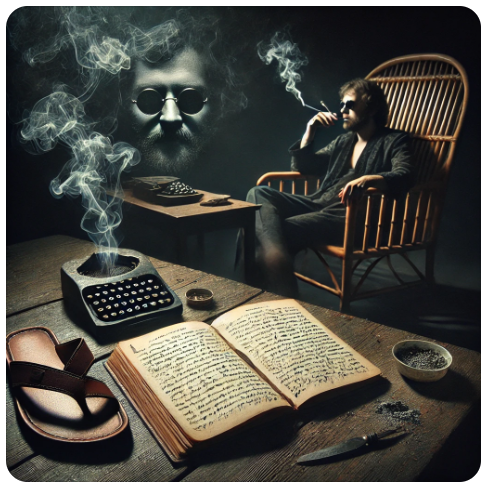
The other day, I spoke with my friend who wore sunglasses, even at night. They were not just any sunglasses; they had thick, tinted lenses that turned his eyes into secrets. He sat in his bamboo chair, curled like an embryo in a second womb, and waited for the silence between songs on the record. When it came, he tilted his head, aiming his gaze—hidden behind the black glass—at me.


“Your passage shows a definite poetic sensitivity, an emotional quality that strikes one—but what does it mean?” he asked, words biting the quiet. “You are trying to communicate?” He leaned on the last syllable of “communicate,” stretching it thin, squeezing it like elegant toothpaste. “Aren’t you?”


I felt the weight of his question sink into my chest, leaving behind a sharp, echoing hollowness. I glanced at the poem I had laid bare on the table between us, exposed like a wound. His words transformed before my eyes into writhing maggots, their white bodies squirming towards the ink. Without thinking, I took off my shoe—a thin, worn sandal—and slammed it down. The thud startled the silence; the maggots burst, leaving wet smears across the wooden surface.


I didn’t speak for a moment. I scraped their remnants into an ashtray, their tiny corpses mixing with the charred remnants of past thoughts and past sins. I dropped my sandal to the floor. He laughed, a dry, brittle sound that cracked in the dimness. He crossed his legs, the fabric of his pants whispering like a taunt. The damage had been done—a single maggot had escaped my fury and burrowed, unseen, into my ear. I could feel it crawling, tiny feet clinging to the tender skin before settling into the cavity of my heart. It pulsed there, secret and vile. He knew it. His smirk was the proof.


Now I write to pull it out, strand by bloody strand, from my heart. I know that only when I spit it out, stained and gasping, will I be free.


This maggot is unlike the others; it shifts and moulds itself, a grotesque mimicry of thoughts, without shedding its true nature. Later, it transformed as I read Dostoevsky’s The Devils, a cigarette balanced between my fingers and a small, gleaming grain of eternity in the palm of my other hand. Between puffs and between sentences, I noticed that the grain had grown in weight. Kirilov had just explained why man must commit suicide to proclaim his freedom from fear. He was called a madman. I thought he made sense. I looked at my hand and saw that the grain had grown into a crumb. Realizing that Dostoevsky was performing the alchemy in person, I continued to read and commune with him.


The grain in my palm felt heavier, its edges pressing into my skin. My mind wasn’t playing tricks. It had grown into a dense and insistent crumb. I realized then that Dostoevsky had performed this alchemy, transmuting despair into something tangible, a weight that dragged at the fabric of the world. I kept reading, feeling the maggot shift inside me, watching with its eyeless stare as I communed with a man long dead but never silent.


The record ended while the needle turned and turned on the dead wax, and I looked up. My friend still sat there, sunglasses glinting darkly in the thin light, the smirk on his lips a question left unsaid. I inhaled, the smoke and the maggot’s secrets filling me to the brim.

I asked AI to make an image based on the writing. This is it.