Ink and Invitation

October 31, 2025

“We call things into being long before we realise what we have invited.”

Some people will say I’m strange for noticing this — but lately I’ve been unsettled by how many walk the streets carrying death and darkness on their skin.
Skulls grinning from shoulders.
Demons curled along arms.
Faces twisted in torment inked into chests and backs.

They remind me of some very bad acid trips I had in the early 1970s — when the veil tore too far, and I didn’t know how to close it again.

People say, “It’s just art.”
But I’ve lived long enough to know symbols aren’t neutral.
They call. They invite. They open doors.

I’m always reminded, when I see rebellious young Greeks covered in tattoos, that in ancient Greece these stigmata were not marks of identity or defiance.
They were punishments — burned or cut into criminals, slaves, and prisoners of war. A permanent sign of ownership — of being claimed.
Our ancestors believed that what was carved into the skin also carved its meaning into the soul.

For thousands of years, humans carried symbols for blessing — crosses, icons, beads, prayers folded into pockets, saints’ names whispered under breath.
We understood that what we placed close to the body had power.
We understood to be careful.

I carry a cross given to me by my mother when I was a child.
She told me it held a tiny splinter of the real cross Jesus was crucified on.
She warned me never to open the locket because the splinter was so fine my breath might blow it away.
So I never opened it.
And I wear it every day.

People ask if I was never curious.
But if it was real — and I breathed it away — what then?

Wearing a cross around the neck is not the same as inscribing a cross into the skin.

I’m not judging anyone.
I’ve walked my own shadowed paths.
I know what it is to open a door without realising what enters with it.
So when I say these images feel like invitations to something dark — I say it softly, from remembering, not from any desire to be right.

Some will disagree. Some will shake their heads.
That’s fine.

But I won’t place an image alongside these words.
I have no wish to give those symbols more room than they already take.
To show them would be to help them travel.

So I speak quietly here, without pictures:

There are forces we forget at our own cost.
And disbelief does not protect us from what we call forth.

No argument here — only a feeling I could not ignore.

That is all.


The Bucket and the Sea

October 11, 2025

Written two decades after the Flotillas of Hope voyage — a small act on a wide sea that still echoes today.

The Bucket and the Sea

They call it a bucket list now — a catalogue of things to consume before death. Mountains to be conquered, rivers to be cruised, skydives to prove we were here. It sounds brave until you see the queues — climbers waiting their turn to summit Everest like shoppers at a checkout. Even the gods must turn away.

My own list was never written. It unfolded quietly, without permission. One day it became a voyage — a small flotilla bound for Nauru, its sails stitched from conscience rather than canvas. I had never sailed before, but joined those who had — experienced skippers who trusted purpose as much as compass. We went not for glory, but to bear witness — to shame our own government into releasing those who had been forgotten.

We never reached the island. Navy boats met us on the horizon, their warnings slicing through wind and salt. We turned back, our message carried instead by waves and news wires. And somehow, impossibly, it worked: seventy-seven refugees were released. Not because we were powerful, but because the sea has a way of amplifying truth.

There were no medals at the end, no television crews waiting on shore. Just salt on our lips and a strange, enduring silence — the kind that follows when the world briefly tilts toward justice.

So when I see others chasing their “bucket lust,” when they pay for their Everest or their Rhine cruise, I remember how it felt to sail into the unknown with nothing to sell and everything to lose. That was the real summit — a crossing not upward, but outward, beyond the self and into something vast, unforgiving, and sacred.

Some journeys are not about ascent. They are about surrender — and the rare, salt-stung moments when the wind itself seems to whisper: You’ve already arrived.


Flotillas of Hope was a 2004 Australian humanitarian voyage protesting the offshore detention of asylum seekers on Nauru. Although the boats were turned back by naval patrols, the action drew international attention — and soon after, of the hundreds detained, seventy-seven refugees were released.


The Stone Seeker: A Myth of the Wandering Soul

October 2, 2025

A departure from my usual posts — this one takes the form of myth, an inner journey written as an allegory. I offer it as a companion to my ongoing stories.

He was called Stavros, which means Cross, and that was his burden — and his path.

One day, in a time that was no time, he heard the silent summons. Not from the sky, but from the pulse within the earth. He set out, carrying nothing but his breath and the ache of questions. He climbed the ancient spine of Sinai without sleep, ascending stone upon stone, as if walking up the ribs of a forgotten god. At the summit, the sun did not answer him — but it showed him he was not alone.

The descent was harder. That is the truth of all peaks. He reached the foot of the mountain and sat by the monastery of Katherine, where silence grows like lichen on old stone. There he met the Gatekeeper — a monk whose heart had fossilised into ritual. Stavros spoke the sacred tongue, but the Gatekeeper did not recognise him. He uttered the Word — “Yunan” — and dismissed him like a leaf blown against the stone walls.

So the Seeker left the sacred walls and returned to the road. It was on this road that he met the Trickster Guide — a Bedouin named Mohamed, who spoke through music and mischief. He offered herbs not for healing but for vision. He rolled a joint while guiding the chariot at great speed. Smoke curled like a serpent toward the heavens, and the desert began to shimmer.

Mohamed showed him the living map: dunes that were coastlines, mountains that were camels in repose. “This is Sinai,” he said, “and there is the Red Sea.” In that moment, the Seeker saw geography become prophecy. The land was not just land — it was a scroll unrolling.

Mohamed led him to a mosque, a café, a grove of planted trees. “We are of the 15 tribes,” the Guide said. “We plant what will shade the unborn.” The Seeker ate with him, drank the dark tea of mystery, and vanished into moonlit streets.

Then came the Labyrinth.

In the night city, he was lost among alleyways, where cats whispered secrets and doors led nowhere. He emerged by chance, or fate, and met the Scribe, who wrote his name in the language of the ancestors. “All men have three names,” said the Scribe, “but only one is true.”

The Seeker travelled again — across waters, under stars, on feluccas that rocked like cradles of time. He met companions with names like runes: Linda, Olga, Shayari. Together they smoked, drank rakii, and watched angels dissolve into the air like incense.

He arrived at a threshold: the City of Columns. There, under a sky bleached of memory, he sat on sand and turned a plastic bottle into a shrine. He waited for a chariot to carry him across the Nile of forgetting. Someone called him “the Greek with eight children,” and he laughed. He had none — and yet carried thousands within him.

Then came the Two Georges.

One was a Potter. One was a Priest of the Inner Fire. They saw in Stavros something he had hidden from himself. “You evoke the honour of Christ in others,” they said. “You wear innocence like armour.” They fed him macaroni and truth. In return, they asked for stories.

And so he spoke.

And in speaking, he remembered.

Dialogue became divination. Each question was a key. Each story a lost scroll. “In dialogue,” said George, “there is living transmission. The book you write is not of ink. It is breath, shared.”

They spoke of the monk on Athos who gave him a stone. “Leave this on the mountain,” he had said. And so Stavros carried it until the burden became a prayer. They spoke of karma, of grace, of gifts that are given but never earned.

Then came the desecration.

He passed through Luxor and saw the sign — McDonald’s, Temple of Luxor Street. The Golden Arches beside eternal stone. He took a photo, not to remember, but to mourn. Some desecrations are not loud. Some come wrapped in convenience.

And still, a stranger in Cairo whispered: “Welcome.” One word, like a flame in the dust.

The Seeker came to understand: giving and receiving were not separate acts. He had received shelter, food, names, music, silence. He had given stories, listening, laughter, witness. There was no accounting. Only flow.

He saw now that the journey had not been from place to place, but from self to soul. He gave before he received. He received before he gave. It was not barter. It was the hidden law.

And then — the Word.

“Sorry,” they said, “is just a word.” But he knew better. The Word began the world. Words held power, memory, vibration. Words could curse. Words could carry. Words could redeem.

He left the stone on the mountain.

He returned carrying only light.


Near Shore, Far Out

October 1, 2025

I keep reading about experienced sailors dying close to shore. Not in the middle of the Pacific, not after months at sea — but within sight of land. And each time, something stirs uneasily inside me.

Because I once sailed four thousand kilometres there and back to Nauru. And I had no experience. None. No yachtmaster’s ticket, no decades at the helm. Just a call, a cause, and an instinct that said: go.

I wasn’t alone, though — I joined experienced skippers and crew who knew the sea far better than I did. My leap was into their world, not a solo crossing.

At the time, it felt like courage, or maybe necessity. Looking back now, it feels different. It feels like standing on the edge of a cliff without knowing if the parachute on my back would open. I tremble at the thought. I used Astrology for both my horoscope and the horoscope of the Flotillas of Hope to justify the decision to send the Call to Action to Nauru. To justify my, now in retrospect – my need, to stretch my ‘being’.

But here’s the truth: trembling in hindsight is not the same as folly at the time. What we see later is always coloured by what we know now. Back then, I lived as I always have — by leaps. Leaps into the unknown, trusting that my Guardian Angel working behind the scenes of life would catch me.

Others trained, charted, prepared. I leapt. And somehow, I survived. Not because I was wise, not because I was skilled, but because something — call it fate, protection, or really that Angel — carried me through.

Now, when I hear of sailors lost near shore, my heart aches. It reminds me that the sea has no favourites, and that my survival was never guaranteed. It humbles me. It makes me bow my head, not boast.

But it also tells me something else: my life has always been this way. Not straight, not cautious, but here, there and anywhere. Risk and recovery, fall and renewal. And even the trembling I feel now is part of the me that survived — the deepening that comes after the leap.


America After the Threshold: Resistance, Power, and the Divided Republic

June 21, 2025

I play around with Astrology not because I believe that Stars and Planets direct or control events in personal lives or global political events. I think there are invisible concurrent events in the collective unconscious of humanity. So, rather than causation I think there may be a correlation between invisible unconscious movements and the celestial. So, how do we ‘see’ these invisible vibrations? Through symbolism. Just like our dreams may be symbolic of events I think the archetypal symbolism as shown through various systems that assist the invisible to become visible may also be symbolic of events.

So, this is just my reading of symbols that may help me make some sense of the incredible events happening now.

=========================================================

We are now living in a new chapter of American history. We are also living in a new chapter in Global history.

With Donald Trump inaugurated for a second term in January 2025, the United States has entered uncharted and deeply polarized territory. The promises made on the campaign trail are no longer rhetoric—they are rapidly becoming reality.

Mass deportations have begun, with ICE and other federal agencies empowered to conduct wide-scale raids that tear families apart. Sanctuary cities face threats of defunding or legal dismantling. Journalists and political opponents are under open scrutiny. The line between democratic governance and authoritarian rule is blurring in real time.

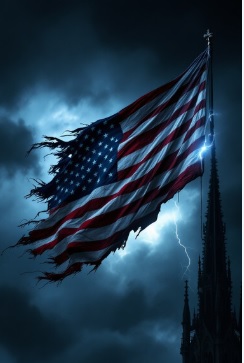
Trump’s team has already invoked or signaled the potential use of the Insurrection Act to quell dissent, and floated the Alien Enemies Act as a tool to target immigrants. These aren’t theoretical threats—they are moves drawn from a growing authoritarian playbook that challenge foundational American principles. I hear the hum of fascism. Was it the same hum heard just as Nazis took over Germany?

What happens now, as resistance begins to emerge more openly? In blue cities and states, governors and mayors are testing the limits of federal defiance. Communities are organizing, shielding vulnerable members from raids, launching legal battles, and reviving underground networks of care and dissent. But will such resistance provoke a federal crackdown? Will the desire to restore “order” become the pretext for escalated force?

Beneath the policy headlines, a deeper fracture is becoming undeniable. Two Americas are crystallizing—not just politically, but almost civilizationally. On one side, a multiracial, urban, forward-looking nation trying to hold on to democracy. On the other, a reactionary movement rooted in grievance, nostalgia, and power consolidation. The social, legal, and cultural divide is widening into something more dangerous—something that history warns us about.

The last time America reached this level of internal rupture, it exploded into civil war. That memory, often romanticized or dismissed, is beginning to feel less like history and more like a warning flare.

Astrology, often dismissed by the rational mind, provides a fascinating lens for examining recurring historical cycles. The planetary alignments of 2025 bear striking echoes of those in 1859–1861, just before the Civil War began. Let’s explore how the skies may be mirroring our collective crisis.


Astrological Forecast: Echoes of the Past, Portents for the Present (Mid–Late 2025)

Astrologically, 2025 is charged with revolutionary tension. We are living under skies that call for transformation—and test the foundations of nations.

Pluto in Aquarius (2023–2043): Revolution of Power and Structure

Pluto’s move into Aquarius signals the collapse and reconstruction of collective systems. In 2025, its early degrees are already pressuring global power structures, exposing the authoritarian use of technology and the manipulation of mass movements.

The last time Pluto was here was during the American and French Revolutions. The questions return: What is freedom? Who holds power over the collective?

Uranus in Taurus square Pluto in Aquarius (Exact October 2025)

This rare clash between Uranus and Pluto is the year’s seismic pulse. Uranus disrupts; Pluto transforms. When they square off, systems collapse and something entirely new begins to rise.

Expect:

  • Economic unrest (currency shocks, digital bank failures)
  • Technological rebellions (AI regulation backlash, digital sabotage)
  • Civil disobedience on a mass scale, potentially met with federal force.

This square recalls the Uranus–Pluto conjunction of the 1960s—a time of protest, civil rights, and violent backlash.

Neptune at 29° Pisces: The Fog Before the Storm

Neptune now lingers at the final degree of Pisces—the anaretic degree, also known as the “degree of fate.” This amplifies illusion, spiritual yearning, and mass deception.

We may see:

  • Propaganda disguised as truth
  • Escalation of conspiracy cults
  • Emotional and spiritual burnout

But also a search for meaning, for soul, for deeper truth.

Saturn in Pisces: Holding the Line

Saturn seeks structure in Pisces’ oceanic waters. It teaches quiet endurance, inner anchoring, and the need to build unseen resilience. Its presence here stabilizes those working in dreams, healing, and faith. But it also punishes denial and escapism.

The Shadow of the U.S. Pluto Return

Although exact in 2022, the aftershocks of America’s Pluto return are reverberating through 2025. The old system is dying—but what is being born remains uncertain.

The Pluto return marks the end of a cycle begun in 1776. The soul of the republic is on the line. The soul of United States of America is on the line. Is there a crack along that line?


Forecast by Season: June to December 2025

▶ June–August

  • Mass protests and resistance movements gain momentum.
  • Economic strain begins to show: housing pressure, job insecurity, localized shortages.
  • Escalation of federal actions draws international scrutiny.

▶ September–October

  • Uranus square Pluto hits exact. Expect sudden, disruptive events: blackouts, market drops, tech collapses, or policy overreach.
  • Civil disobedience may meet aggressive federal pushback.
  • Courts, especially the Supreme Court, become major flashpoints.

▶ November–December

  • Neptune’s final passage through Pisces intensifies the search for clarity. Expect scandals, revelations, spiritual awakenings, and psychological fatigue.
  • Possibility of a cultural or symbolic turning point.
  • Saturn begins to separate from Neptune, helping us rebuild from the emotional wreckage.

Conclusion: What Now?

We are living through a slow earthquake. The world as we knew it is not returning. But destruction and renewal are twins. The astrology of this era asks each of us to become participants, not spectators, in the unfolding of history.

If history is written in cycles, then perhaps prophecy is found in pattern. And if the stars are a mirror, they are reflecting our choices back to us.

The question isn’t whether the storm is coming.

It’s who we choose to become within it.


Why I Walk the Way I Do

May 5, 2025

I don’t walk to train. I don’t walk for records, medals, or to impress anyone. I walk because it steadies me. It carries my thoughts, my breath, my prayers. It opens the body and quiets the mind. It’s the simplest thing I can do every day to remember who I am.

In September 2021, I was diagnosed with Type 2 diabetes. The numbers were clear, the warnings louder. I was offered medication—but something in me wanted to try another path first. I chose to walk. To eat differently. To live more deliberately.

Since then, I’ve walked almost every day—briskly, with intention, usually around 5 kilometres. I changed what I ate. I simplified. I gave my body a rhythm it could rely on. Over time, without medication, my blood glucose stabilised. I lost 18 kilograms, dropping from 88kg to 70kg, and I’ve now been in constant remission for over three years.

Alongside walking, I began doing simple resistance exercises — bodyweight movements like push-ups, squats, step-ups, planks, and curls with light dumbbells. I spread them throughout the day. No gym, no machines, no memberships. Just consistent effort in my own time and space. It’s nothing fancy — but it’s steady, and it works.

Recently, I discovered something else: my resting heart rate is 47 beats per minute — a number typically found in elite endurance athletes. For comparison, the average resting heart rate for a man in his 70s is around 70–75 bpm. Mine has averaged between 47 and 50 over the past year.

I’m 73. I’ve never run a marathon. I smoked in my youth. I’ve lived an ordinary, frugal, imperfect life. And yet, my heart beats like someone who trained for gold.

I don’t share this to boast. I share it because I find it mysterious. Beautiful. A quiet reward I never aimed for.

Most afternoons, I walk along the riverbank near where I live. Over the years, I’ve taken hundreds of photos — of the sky, the water, the shifting moods of light, and the quiet animals I encounter along the way: water dragons, ibises, ducks, and others. I share some of these images on my Bluesky account, and many are gathered here:

Photos from a River Bank & a Flood Plain:
https://dodona777.com/photos-from-a-river-bank-a-flood-plain/

It’s become a kind of visual journal of stillness in motion.

I walk because walking helps me listen. I walk with purpose, with rhythm, sometimes with prayer. I walk west in the afternoons, as the sun leans into shadow. There is a place along the path where I stop to breathe and pray. Then I return east—to the place of beginning, where the sun rises. It’s not exercise. It’s something older than that.

I believe the body remembers truth. And perhaps, over time, it reshapes itself around that truth. My heart doesn’t beat slower because I’m extraordinary. It beats slower because I made space for stillness every day, for years.

That’s why I walk the way I do.

This reflection came to me not while walking, but while lying still, listening—on a day I chose to rest.


The Unbranded Way: How I Reclaimed Strength and Clarity at 73

April 25, 2025

I didn’t set out to become fit, or to impress anyone. I just wanted to keep walking without falling, stay sharp enough to finish the books I’d started to write, and live each day without the fog that sometimes creeps in with age.

At 73, I’m not chasing youth – I’m cultivating presence.

Now, six days a week, I walk. I breathe with awareness. I chant silently at sacred spots on my path. And nine months ago, I added resistance training-push-ups, planks, step-ups, squats, rows-interspersed through the day. Just two months, I added short bursts of High-Intensity Interval Training (HIIT). I do them twice a week, guided by the terrain of my walk: downhill, uphill, then level. On Mondays I just do the downhill burst. Wednesdays, I do the full trio. It’s a ritual now. It makes me feel alive.

My balance has improved. My mind feels clearer. This is no longer ‘exercise’-it’s my ritual of self-respect.

My Weekly Flow

Monday: Full Resistance x 2 + Brisk Walk + Short HIIT (Downhill only)

Tuesday: Moderate Walk only

Wednesday: Brisk Walk with Full HIIT (Downhill > Uphill > Level)

Thursday: Resistance x 1 + Gentle Walk or Mobility

Friday: Full Resistance x 2 + Brisk Walk

Saturday: Moderate Walk + Spiritual Walk or Breathwork

Sunday: Full Rest – regeneration, stillness

Exercises I Do

  • Push-ups (standard & inclined) – upper body & core strength
  • Plank (1-minute) – core, posture, breath control
  • Step-ups – leg strength, joint health, mobility
  • Squats – total lower body strength
  • Toe-ups – calf & balance strength
  • Dumbbell Curls/Rows – arms and back
  • One-leg Balance – fall prevention
  • Farmers Carry – grip, core, posture
  • Ankle/Reaction Drills – agility and coordination
  • Spiritual walking – silent prayer or chanting during walks

Why Weekly Rhythm, Not Daily Routine?

“I train by the week, not by the day – each step a note in the symphony of staying.”

  • Recovery is sacred – Effort and stillness must dance together.
  • It builds sustainability – A weekly rhythm avoids burnout.
  • It respects cycles – Like moon phases or seasons.
  • It fosters joy, not guilt – Each day plays a role, even rest.

For Anyone Wondering If It’s Too Late

  • Start with walking.
  • Add one strength move.
  • Rest often.
  • Make it yours.
  • Make it sacred

A Belated New Year’s Message: May the Rose of the Heart Bloom

April 12, 2025

The calendar may have turned months ago, but the true moment to plant seeds of intention can arrive at any time. This short reflection came to me on New Year’s Day, though I didn’t share it then. Perhaps I wasn’t ready—or perhaps the Rose within needed time to unfurl.

As the seasons shift and the year continues its unfolding, I offer this now—not as a resolution but as a quiet invocation. May it speak to your own rhythm, your own turning.

==================================================================

Today, the first day of a new year, is a perfect time to plant seeds of hope in the furrows of one’s life line. What will these seeds become? Which will flourish, and which will be consumed by the worm of impatience? Which will endure, drawing strength to be eternally regenerated within one’s being?

Among all that may grow, there is one plant above all others with the power to truly live: the Rose.

Rooted through the layers of one’s life, it reaches the Source of everything—the Heart of the Universe. Its color is the color of blood, flowing through every creature, through humanity itself. Its hue reflects its Origin: the Heart.

Seeds planted in the intellect may sprout for a time but will wither without sustenance. Only those sown in the Heart grow forever, nourished by an infinite wellspring of meaning and vitality.

Jesus spoke of the mustard seed—comparing it to the seed of faith. Mustard or Rose—the name matters less than the meaning. Both are symbols of potential, resilience, and sacred transformation.

This year, may the Rose take root deep in the Heart.
May it grow and flourish, weathering calamity, weakness, and the weeds that crowd the soil of the soul.
May its petals bloom as Art,
its stem rise as Beauty,
and its fragrance drift as Truth.

Let its Ambrosia nourish the spirit of others,
its perfume remain untainted,
and its dew glisten clear in the morning light.

In this turning of the year,
may the Rose of the Heart flourish—
uniting us in the eternal rhythm of hope and renewal.

Stavros


The Fractured Cosmos: Crime and Capitalism Unveiled

December 10, 2024

The monster lives—a being of primal, vestigial flesh, ancient yet evolving. It is our charge to nurture it, to coax its grotesque beauty into full bloom. This is no ordinary monster, for it is not of the material world alone. It embodies all that is untamed within us: the rage, the lust, the fleeting glimpses of transcendence. Our task is not to suppress it but to help it grow, for only through its growth can we understand the fractures within ourselves and the universe we inhabit.

We do not dwell on the petty crimes of the cradle—the foolish missteps of a fledgling species. Such crimes are symbols of a planet still finding its place in the greater cosmic order. They are phases, reflections of a culture struggling to reconcile its roots in the soil with its dreams of the stars. The criminal mind, at its core, is narcissistic—a mirror too focused on itself to see the vastness beyond.

But even as we wrestle with our own shadows, the angelic influence stirs the heavens. It is said that once, in an act of rebellion or grace, an angel threw the moon toward the Earth, setting it into motion. The tides rose, the rhythms of life were born, and yet, with this gift came the seeds of discord. Every cycle of creation invites a counterforce, and we now stand at the precipice of The Last Days, where the battle lines are drawn between mammals and machines.

The Pole Shift looms on the horizon, a magnetic upheaval echoing the chaos within. It is not just a geophysical event but a metaphor for the inversion of values, the tilting of the moral axis. What was once revered is now reviled, and what was once reviled is now celebrated. This shift connects to the crimes of our age, each a wound inflicted upon the fabric of existence.

Crime and Capitalism: are they one and the same? The boy who stole from the computer hackers their gift of hacking—was he a criminal, or was he simply redistributing stolen fire? Capitalism, with its rising tide of insecurity, extracts not just the essence of labour but the very essence of the sea, of the Earth, of the soul.

The Flower-Telepathic Computer: a marvel of sentience and sensitivity, it blooms in the minds of those who dare to connect. Yet, its very existence exposes a cascade of crimes—against family, against nature, against space and time. What is the theft of a wallet compared to the theft of an epoch? What is a lie told to a friend compared to the lies encoded into the nervous system of our galaxy?

Holo-Crime: crimes against the holographic unity of the one. These are the incursions into the sacred matter of space, the violations of the thin, shimmering membrane that separates what is from what could be. The maniac who murdered—did he act alone, or was his hand guided by the collective desperation of a species that has forgotten how to dream without violence?

The Essence of the Sea: shell extraction, the taking of the ocean’s soul. As we strip the Earth of its treasures, we strip ourselves of meaning. What rises in its place is a tide not of water but of fear, insecurity, and longing.

The crimes mount, layer upon layer, until they form a tower that scrapes the edge of understanding:

The crime against the family, for it severs the roots.

The crime against nature, for it poisons the soil.

The crime against angels, for it mocks their grace.

The crime against demons, for it denies their necessity.

The crime against the planet, the sun, the nervous system of the galaxy.

Each crime is a fracture, yet within each fracture lies a seed of potential—a lesson, a call to reconciliation. If the monster within us is to grow, if we are to nurture it into something more than the sum of its appetites, we must confront these crimes not as judges but as witnesses. We must see them for what they are: the echoes of a species learning how to wield its power.

And what of Capitalism?

Is it truly the villain or merely the mask we have chosen for our shadow? Like the essence of humanity, the nature of crime is neither fixed nor simple. It is a hologram that reflects the one fractured into infinite pieces. To heal, we must not only piece together what is broken but also embrace the fractures as part of the whole.

In the end, angelic influence will not save us, nor will the machines, nor the rising tide. Only the monster—the raw, unfiltered essence of ourselves—holds the key. To nurture it is to nurture the cosmos, for we and it are not separate. The crimes against the sun, the moon, the Earth, and the stars are crimes against ourselves. And in their reconciliation lies our redemption.


The Apple and the Cosmos: A Dance of Reality

December 9, 2024

Before me sits an apple, ordinary yet radiant, its waxy surface catching a sharp glint of light from a lamp above. It is tangible, immediate—its crispness confirmed as I lift it to my lips, its flavour vibrant and undeniably real. Beside it rests a protractor, leaning against a globe, and an astrological chart sprawled across my desk. These objects—tools of measurement and mapping—whisper of realities far removed from the apple’s tangible presence. The apple anchors me in the here and now while the instruments gesture toward the distant, the abstract, the infinite.

The apple is a feast for the senses. I can touch it, taste it, smell it, and see it. Though its atoms appear tightly packed, they are, in truth, vast spaces of energy and vibration. Magnify one of its atoms, and its solidity dissolves into a void where particles exist only as probabilities, dancing in fields of energy. Yet, this solid illusion sustains my bite, my taste, and my knowing.


The horoscope beside it lacks the apple’s tangibility. It cannot be bitten or held, but it represents something equally profound: a symbolic map of the cosmos. Where the apple’s reality is immediate, the horoscope projects patterns of meaning across time and space, binding celestial rhythms to the human story. These two things—apple and horoscope, immediate and archetypal—remind me that reality is both seen and imagined, both concrete and infinite.


This paradox of perception defines our existence. The apple, so close I can taste it, is not as solid as it seems. And the stars, so distant their light has travelled for millennia to reach me, are not as unreachable as they seem. Between the apple and Alpha Centauri lies an unfathomable gulf, yet they are part of the same web of existence, bound by the laws of physics and the rhythms of the cosmos.


Newton, watching the fall of an apple, saw the invisible thread connecting Earth and sky. Einstein deepened this insight, showing that space and time are inseparable and that matter and energy are two forms of the same thing. Quantum physics has unravelled the idea of separateness, revealing that particles are not isolated entities but relationships—waves of possibility collapsing into form through interaction.


David Bohm’s theory of implicate order expands this vision further, suggesting that the universe is a seamless whole where every fragment reflects the entirety, like a hologram. In a hologram, each fragment contains the whole image, even when divided into pieces. Similarly, the universe is encoded in every part of itself. The apple before me is not merely an apple; it is a microcosm of the cosmos, its atoms vibrating with the same energies that fuel the stars.


The horoscope, too, speaks to this interconnectedness. It is not about planets and rocks but about relationships, patterns, and cycles. The zodiac mirrors the rhythms of life, like the apple tree that blossoms, bears fruit, and eventually returns to the Earth. The horoscope encodes the rhythms of the cosmos in symbols, reminding us that the patterns above are reflected in the patterns within.


This interconnectedness challenges the illusion of separation. The apple and the stars, the immediate and the eternal, are not opposites but facets of the same reality. Our senses, while invaluable, reveal only a sliver of the whole. Light, for instance, is just one octave in a vast electromagnetic spectrum, and beyond the visible lies a universe of energies—X-rays, gamma rays, cosmic rays—that remain unseen but ever-present.


Similarly, the frameworks of language and culture limit how we perceive and interpret the world. But within these limits lies a profound truth: we are not separate observers of the universe; we are participants in its creation. As physicist John Wheeler suggested, the act of observation itself shapes reality, collapsing waves of probability into patterns of existence. Our consciousness, like a hologram, reflects the universe within it.


The apple before me, the stars above, and the chart on my desk are all threads in this web of unity. The apple speaks of immediacy, the stars of eternity, the chart of the connections that bridge the two. At this moment, I recall a walk in an orchard with my father years ago. He handed me an apple, freshly picked, and told me to hold it carefully as though it contained the world. I didn’t understand him then, but now I see his wisdom. The apple was the world, the stars, and myself—all woven together.


So, as I bite into the apple now, tasting its crispness and feeling its tang, I know it is real. But I also know that in this simple act, I am connected to the stars, to the atoms that form both fruit and flesh, to the patterns that govern the universe.


In the apple, I taste the infinite, and in the infinite, I find myself.