The Stone Seeker: A Myth of the Wandering Soul

October 2, 2025

A departure from my usual posts — this one takes the form of myth, an inner journey written as an allegory. I offer it as a companion to my ongoing stories.

He was called Stavros, which means Cross, and that was his burden — and his path.

One day, in a time that was no time, he heard the silent summons. Not from the sky, but from the pulse within the earth. He set out, carrying nothing but his breath and the ache of questions. He climbed the ancient spine of Sinai without sleep, ascending stone upon stone, as if walking up the ribs of a forgotten god. At the summit, the sun did not answer him — but it showed him he was not alone.

The descent was harder. That is the truth of all peaks. He reached the foot of the mountain and sat by the monastery of Katherine, where silence grows like lichen on old stone. There he met the Gatekeeper — a monk whose heart had fossilised into ritual. Stavros spoke the sacred tongue, but the Gatekeeper did not recognise him. He uttered the Word — “Yunan” — and dismissed him like a leaf blown against the stone walls.

So the Seeker left the sacred walls and returned to the road. It was on this road that he met the Trickster Guide — a Bedouin named Mohamed, who spoke through music and mischief. He offered herbs not for healing but for vision. He rolled a joint while guiding the chariot at great speed. Smoke curled like a serpent toward the heavens, and the desert began to shimmer.

Mohamed showed him the living map: dunes that were coastlines, mountains that were camels in repose. “This is Sinai,” he said, “and there is the Red Sea.” In that moment, the Seeker saw geography become prophecy. The land was not just land — it was a scroll unrolling.

Mohamed led him to a mosque, a café, a grove of planted trees. “We are of the 15 tribes,” the Guide said. “We plant what will shade the unborn.” The Seeker ate with him, drank the dark tea of mystery, and vanished into moonlit streets.

Then came the Labyrinth.

In the night city, he was lost among alleyways, where cats whispered secrets and doors led nowhere. He emerged by chance, or fate, and met the Scribe, who wrote his name in the language of the ancestors. “All men have three names,” said the Scribe, “but only one is true.”

The Seeker travelled again — across waters, under stars, on feluccas that rocked like cradles of time. He met companions with names like runes: Linda, Olga, Shayari. Together they smoked, drank rakii, and watched angels dissolve into the air like incense.

He arrived at a threshold: the City of Columns. There, under a sky bleached of memory, he sat on sand and turned a plastic bottle into a shrine. He waited for a chariot to carry him across the Nile of forgetting. Someone called him “the Greek with eight children,” and he laughed. He had none — and yet carried thousands within him.

Then came the Two Georges.

One was a Potter. One was a Priest of the Inner Fire. They saw in Stavros something he had hidden from himself. “You evoke the honour of Christ in others,” they said. “You wear innocence like armour.” They fed him macaroni and truth. In return, they asked for stories.

And so he spoke.

And in speaking, he remembered.

Dialogue became divination. Each question was a key. Each story a lost scroll. “In dialogue,” said George, “there is living transmission. The book you write is not of ink. It is breath, shared.”

They spoke of the monk on Athos who gave him a stone. “Leave this on the mountain,” he had said. And so Stavros carried it until the burden became a prayer. They spoke of karma, of grace, of gifts that are given but never earned.

Then came the desecration.

He passed through Luxor and saw the sign — McDonald’s, Temple of Luxor Street. The Golden Arches beside eternal stone. He took a photo, not to remember, but to mourn. Some desecrations are not loud. Some come wrapped in convenience.

And still, a stranger in Cairo whispered: “Welcome.” One word, like a flame in the dust.

The Seeker came to understand: giving and receiving were not separate acts. He had received shelter, food, names, music, silence. He had given stories, listening, laughter, witness. There was no accounting. Only flow.

He saw now that the journey had not been from place to place, but from self to soul. He gave before he received. He received before he gave. It was not barter. It was the hidden law.

And then — the Word.

“Sorry,” they said, “is just a word.” But he knew better. The Word began the world. Words held power, memory, vibration. Words could curse. Words could carry. Words could redeem.

He left the stone on the mountain.

He returned carrying only light.


Why I Walk the Way I Do

May 5, 2025

I don’t walk to train. I don’t walk for records, medals, or to impress anyone. I walk because it steadies me. It carries my thoughts, my breath, my prayers. It opens the body and quiets the mind. It’s the simplest thing I can do every day to remember who I am.

In September 2021, I was diagnosed with Type 2 diabetes. The numbers were clear, the warnings louder. I was offered medication—but something in me wanted to try another path first. I chose to walk. To eat differently. To live more deliberately.

Since then, I’ve walked almost every day—briskly, with intention, usually around 5 kilometres. I changed what I ate. I simplified. I gave my body a rhythm it could rely on. Over time, without medication, my blood glucose stabilised. I lost 18 kilograms, dropping from 88kg to 70kg, and I’ve now been in constant remission for over three years.

Alongside walking, I began doing simple resistance exercises — bodyweight movements like push-ups, squats, step-ups, planks, and curls with light dumbbells. I spread them throughout the day. No gym, no machines, no memberships. Just consistent effort in my own time and space. It’s nothing fancy — but it’s steady, and it works.

Recently, I discovered something else: my resting heart rate is 47 beats per minute — a number typically found in elite endurance athletes. For comparison, the average resting heart rate for a man in his 70s is around 70–75 bpm. Mine has averaged between 47 and 50 over the past year.

I’m 73. I’ve never run a marathon. I smoked in my youth. I’ve lived an ordinary, frugal, imperfect life. And yet, my heart beats like someone who trained for gold.

I don’t share this to boast. I share it because I find it mysterious. Beautiful. A quiet reward I never aimed for.

Most afternoons, I walk along the riverbank near where I live. Over the years, I’ve taken hundreds of photos — of the sky, the water, the shifting moods of light, and the quiet animals I encounter along the way: water dragons, ibises, ducks, and others. I share some of these images on my Bluesky account, and many are gathered here:

Photos from a River Bank & a Flood Plain:
https://dodona777.com/photos-from-a-river-bank-a-flood-plain/

It’s become a kind of visual journal of stillness in motion.

I walk because walking helps me listen. I walk with purpose, with rhythm, sometimes with prayer. I walk west in the afternoons, as the sun leans into shadow. There is a place along the path where I stop to breathe and pray. Then I return east—to the place of beginning, where the sun rises. It’s not exercise. It’s something older than that.

I believe the body remembers truth. And perhaps, over time, it reshapes itself around that truth. My heart doesn’t beat slower because I’m extraordinary. It beats slower because I made space for stillness every day, for years.

That’s why I walk the way I do.

This reflection came to me not while walking, but while lying still, listening—on a day I chose to rest.


The Unbranded Way: How I Reclaimed Strength and Clarity at 73

April 25, 2025

I didn’t set out to become fit, or to impress anyone. I just wanted to keep walking without falling, stay sharp enough to finish the books I’d started to write, and live each day without the fog that sometimes creeps in with age.

At 73, I’m not chasing youth – I’m cultivating presence.

Now, six days a week, I walk. I breathe with awareness. I chant silently at sacred spots on my path. And nine months ago, I added resistance training-push-ups, planks, step-ups, squats, rows-interspersed through the day. Just two months, I added short bursts of High-Intensity Interval Training (HIIT). I do them twice a week, guided by the terrain of my walk: downhill, uphill, then level. On Mondays I just do the downhill burst. Wednesdays, I do the full trio. It’s a ritual now. It makes me feel alive.

My balance has improved. My mind feels clearer. This is no longer ‘exercise’-it’s my ritual of self-respect.

My Weekly Flow

Monday: Full Resistance x 2 + Brisk Walk + Short HIIT (Downhill only)

Tuesday: Moderate Walk only

Wednesday: Brisk Walk with Full HIIT (Downhill > Uphill > Level)

Thursday: Resistance x 1 + Gentle Walk or Mobility

Friday: Full Resistance x 2 + Brisk Walk

Saturday: Moderate Walk + Spiritual Walk or Breathwork

Sunday: Full Rest – regeneration, stillness

Exercises I Do

  • Push-ups (standard & inclined) – upper body & core strength
  • Plank (1-minute) – core, posture, breath control
  • Step-ups – leg strength, joint health, mobility
  • Squats – total lower body strength
  • Toe-ups – calf & balance strength
  • Dumbbell Curls/Rows – arms and back
  • One-leg Balance – fall prevention
  • Farmers Carry – grip, core, posture
  • Ankle/Reaction Drills – agility and coordination
  • Spiritual walking – silent prayer or chanting during walks

Why Weekly Rhythm, Not Daily Routine?

“I train by the week, not by the day – each step a note in the symphony of staying.”

  • Recovery is sacred – Effort and stillness must dance together.
  • It builds sustainability – A weekly rhythm avoids burnout.
  • It respects cycles – Like moon phases or seasons.
  • It fosters joy, not guilt – Each day plays a role, even rest.

For Anyone Wondering If It’s Too Late

  • Start with walking.
  • Add one strength move.
  • Rest often.
  • Make it yours.
  • Make it sacred

A Belated New Year’s Message: May the Rose of the Heart Bloom

April 12, 2025

The calendar may have turned months ago, but the true moment to plant seeds of intention can arrive at any time. This short reflection came to me on New Year’s Day, though I didn’t share it then. Perhaps I wasn’t ready—or perhaps the Rose within needed time to unfurl.

As the seasons shift and the year continues its unfolding, I offer this now—not as a resolution but as a quiet invocation. May it speak to your own rhythm, your own turning.

==================================================================

Today, the first day of a new year, is a perfect time to plant seeds of hope in the furrows of one’s life line. What will these seeds become? Which will flourish, and which will be consumed by the worm of impatience? Which will endure, drawing strength to be eternally regenerated within one’s being?

Among all that may grow, there is one plant above all others with the power to truly live: the Rose.

Rooted through the layers of one’s life, it reaches the Source of everything—the Heart of the Universe. Its color is the color of blood, flowing through every creature, through humanity itself. Its hue reflects its Origin: the Heart.

Seeds planted in the intellect may sprout for a time but will wither without sustenance. Only those sown in the Heart grow forever, nourished by an infinite wellspring of meaning and vitality.

Jesus spoke of the mustard seed—comparing it to the seed of faith. Mustard or Rose—the name matters less than the meaning. Both are symbols of potential, resilience, and sacred transformation.

This year, may the Rose take root deep in the Heart.
May it grow and flourish, weathering calamity, weakness, and the weeds that crowd the soil of the soul.
May its petals bloom as Art,
its stem rise as Beauty,
and its fragrance drift as Truth.

Let its Ambrosia nourish the spirit of others,
its perfume remain untainted,
and its dew glisten clear in the morning light.

In this turning of the year,
may the Rose of the Heart flourish—
uniting us in the eternal rhythm of hope and renewal.

Stavros


A Letter to My Absent Guardian Angel

November 20, 2024

To My Ever-Absent Guardian Angel
66 Automatism Road,
Mammonville, 6666

Dear (Supposedly) Watchful One,

It’s been a while—decades, in fact. I thought I’d drop you a line, not because I miss you (I don’t), but because I need answers. Primarily: Where the hell have you been?

You left without so much as a celestial Post-it. For us mere mortals, words matter. Even a basic “BRB” would’ve sufficed. But no, you flapped your wings and ghosted—ironically, since you’re already sort of a ghost. I won’t harp on it (much), but if “guardian” is still part of your job description, it might be time to recheck the fine print.

Anyway, life update: I’ve applied for the position of Director of My Own Life. Admittedly, the pay isn’t great—it’s public service, after all—but the benefits include fewer existential breakdowns and a slightly better carbon footprint. Sure, it’s a one-man gig, and the office hours are ridiculous, but hey, somebody’s got to steer this shipwreck.

Now, a burning question: why did our last encounter happen in a pub? Of all places, I imagined you’d prefer to appear in a shaft of light through a stained-glass window or something appropriately divine. Instead, you nursed a lager while I lamented my woes over a pint. Do angels even drink? Is there a heavenly liquor license I should know about?

If this sounds like I’m whining, well, maybe I am. But cut me some slack. You’ve been AWOL while I’ve wandered the planet armed only with Google Maps and a vague sense of purpose. The truth is, my life’s compass—whether literal or metaphorical—seems perpetually broken. Magnetic north? Useless. Tarot cards? Cryptic. Apps? Battery-draining. You get the idea.

On a related note, your detachable angel wings are still at the dry cleaners. The guy said something about a stubborn stain on the last feather, the one shaped like a bow. Blood, he thinks. Care to explain? I paid the cleaning fee, by the way—you’re welcome.

Honestly, I’m starting to wonder: were you scraping the bottom of the celestial eligibility list when they assigned me? I mean, it’s not like I’m top-tier humanity, but c’mon. Did you lose a bet? Draw the short straw?

And don’t even think about rolling your eyes or straightening your halo as you read this. I can picture you now, muttering, “He’ll never get that Director job. No chance.” Well, here’s the deal: this time, I’m doing it without you. No divine interventions, no whispered nudges in the right direction. You’re officially off the hook.

If you’re just a figment of my imagination—my brain’s way of outsourcing responsibility—then fine. But if you’re real, consider this a resignation letter from our arrangement. Not out of bitterness (okay, maybe a little), but because I need to stand alone, facing the metaphorical wall. And who knows? Maybe that wall will turn out to be a door once I stop expecting you to open it for me.

If I land the job, I’ll rescind all the childish grumbles I ever sent your way. If I don’t…well, at least I’ll know I tried, unsupervised.

Yours (conditionally),
Stavros

P.S. I’m busy this week, but after Sunday, feel free to drop by—no expectations, no feathers, no complaints.


The Playground of Shadows

November 16, 2024

Boredom sat heavily on him, like dust on an old, untouched shelf. He stretched out his limbs, a shell adrift with no anchor, skimming across some dull, endless sea. Nirvana, the world whispered, was an empty thing if this was it. Peace? It felt like the slow pulse of something unfeeling, a lifeless melody humming in the background.

But there was a whisper, too, some echo of Buddha, prophets, and wanderers who saw meaning where he could find none. “The world is your playground,” they seemed to say, and yet, the toys scattered around him were chipped and faded, the games already won and lost. The thrill was gone.

He looked down at his hands, at his shoe, at the cigarette butt lying desolate on the cracked pavement. He saw only a cigarette butt, but when he reached for it, his fingers were wrapped in some spectral glove, ancient and unknowable, numbing his touch. A silky chant rose from the earth, and in the flickering haze, he caught a glimpse of her—the forgotten Madonna on the run, the ghost of a purpose that had long since slipped through his fingers.

And so, he took to the highway in the wind, that endless road North, where the sands met the sky and eternity seemed to lie just around the bend. The prophet in his mind handed him a book and an angel with curls handed him his soul. Here, he thought, is something close to freedom. Here, he felt the weight of all things lightened by the wind as he climbed mountains, lit fires, and let his words drift into the stars—alone yet somehow complete.

But the nights were haunted by shadow games. By candlelight, he felt the passing of unspoken truths caught in the heavy air, thick with incense and echoes. Sitting across from him, his companion cast her glance, a holy arc, over him. No mirrors were needed, only the quiet acceptance of their hearts pulsing in time. Together, they watched the fall of all things—leaves, bottles, lives—and knew that letting go was the only way to hold anything.

He felt the years burn away like the slow ember of his cigarette, holes punched through the fabric of his past. In the distance, a gladiator carried worlds on his shoulders, a Da Vinci gaze locked on some distant horizon. Yes, he thought, pull the plug on life’s bath. Let it all drain away. And as the waves of what was and what would be crashed against his pedestals, he let them crumble, the sand running through his fingers in memory of time slipping by.

The smell of white night, nostalgic and sweet, settled over him like a soft rain. He closed his eyes, feeling the weight and lightness of it all. His life, his love, and his losses had collided like the gentle kiss of billiard balls, a game played without cues, a moment that had once perched on the tree they’d planted in the garden of then.

As he let it all fall, he saw that his life was neither storm nor fury but dew on a flower, a brief glisten in the morning light that would, by noon, disappear. Smiling to himself, he walked into the wind, his footsteps soft on the path toward meaning or maybe just toward peace.


The Temporary Angel: A Journey Beyond Reality

November 15, 2024

No rainbow hues crowned the dilapidated house across the asphalt. A lone weed struggled through the crack in the cement to greet the constant passersby. She could empathize with the weed. “What’s a weed but a plant discarded from the mob?” she thought.

Her hair, from a distance, looked like a lion’s mane. Up close, what you thought was hair was clusters of thin lines of flame with light blue ends. Was she an angel? A messenger of fire descended into this neighbourhood? Or was she just an illusion to occupy a mind locked into a cube of space? Could she be both? Like a profile that is a vase from one view or two faces turned inward from another. How long she had been watching was anyone’s guess.

George felt her eyes on him, an unsettling sensation that sharpened his awareness of his subterranean existence. He had carried the underground in his soul for so long that he feared being recognized—feared it might destroy him. To be seen was to be known, and to be known was to lose the only freedom he understood: the fragile equilibrium between necessity and whim. His underground world was a realm of shifting sand, where heaven and hell were interchangeable kingdoms. Above, the surface world was a place of silhouettes; below, he clung to the parallax of a lost star.

The worry beads in his pocket offered little comfort. His father had given them to him, claiming they were carved from the thigh bones of a Turk killed in some distant war. The macabre story had been a joke, his father’s way of mixing humour with his dark compassion. But the beads—smooth, ivory fragments of elephant tusk—still felt like relics of a troubled inheritance. He turned them over in his hand as if their smooth surface might anchor him to something solid.

At the station, Sophie appeared, filling the empty space with something familiar and alien. George noticed her wings first—scarlet feathers that seemed too vivid and alive to be part of any costume.

“Who are you?” he asked, his voice wary.

“Good, you see me,” she replied, a grin teasing her lips. “Can you see all of me?”

He squinted. “I can see you’ve got red wings.”

“Scarlet,” she corrected. “That’s even better! You can see my wings. Most can’t.” Her hands moved as she spoke, graceful as a dancer’s, and George found himself oddly captivated. “I’m a Temporary Angel,” she continued, “and I need your help. I want to be made permanent.”

George shook his head. “You’re telling me you’re an angel? Walking around Redfern Station? And I’m the only one who can see you?”

“Yes,” she said simply. “What other people?”

George looked around and saw that the station was deserted. The people who were walking around, looking at their watches, holding their bags, waiting for a train—there was no one on the platforms or the stairs. It was as if the world had been blown away with a breath, leaving only him and Sophie in this crystalline stillness. He glanced at his shadow, unnervingly sharp against the ground in the fading twilight. The light around him seemed too pure, too surreal, sharpening every edge and making every detail glow with impossible clarity.

Sophie handed him a cup of coffee, her thermos producing exactly what he liked—short and black, no sugar. “For now, silence might save you. Just listen. Let your heart speak louder than your head. Don’t let your head scalp you.”

As George sipped his coffee, she crossed her legs and leaned back slightly. “You know,” she said, “some people believe you must suffer to reach salvation—hairshirts, long vigils, self-denial. But my colleagues and I have learned that you can sit at the gates of salvation with a cup of coffee and not be asked to move on.” She winked at him.

They sat in silence until the air shifted. A moth the size of George’s hand appeared, landing delicately on the rim of his cup. Its eyes—dark and unblinking—seemed to peer into his soul.

“That’s Moth,” Sophie said. “A fellow Temp. You’ll meet more of us soon.”

Moth took off, its wings slicing through the air like a blade. Sophie stood, her scarlet wings stretching wide. “What do you want, George?” she asked, her voice low and steady. “Say it aloud.”

He hesitated, holding his breath, the weight of the question pressing down on him.

“What do you want, George?” Sophie asked again, her voice softer this time. “Be honest. It’s not the past you’re after, is it?”

“I want everything,” he finally said. “Everything, including making it all like it was before—perfect.”

She smiled, a faint sadness in her eyes. “Everything, huh? Even a brand-new car?”

“Sure,” he said, though he knew how hollow his words sounded.

Sophie turned her head toward the distant stairs. “Look over there. If the timing is right, he’ll reveal something to us.”

At the top of the railway stairs, a man descended. With each step, his shadow lengthened, stretching until it reached the bottom, falling down the stairway like a spectral companion. He dragged a sack behind him, his movements erratic, like a puppet tugged by invisible strings. His patchwork clothes—a riot of velvet, canvas, lace, and denim—hung on his frame like a discarded quilt.

The Ragman stopped before them, his single eye gleaming. Sophie gestured toward him, her voice dropping to a whisper. “He doesn’t expect any sense from you. He merely guards the door.”

The Ragman began to hum, his voice rough and melodic, then sang softly:

“Pictures of Sophie burn at the edges,
In shades of blue, she keeps her pledges.”

Moth descended from above, spiralling in tight circles before perching on the Ragman’s head. Sophie’s wings shifted as she stepped forward. “This is the sign,” she murmured.

The Ragman shuffled closer, his one eye scanning George with a gaze that weighed him in unseen scales. Then, with a raspy certainty, he said, “The timing is right. The planets are aligned, and you’re here.”

Sophie turned to George, her expression shifting to something both tender and resolute. “What do you think, George? Will you take the next step?”

She extended her hand toward him, and he felt her fingers press through his chest, gripping his heart. A sharp crack echoed in his ears as his vision dissolved into light.

They rose together, Sophie’s wings propelling them upward. Below, George saw his body standing alone on the platform. He saw the weed standing defiantly alone as he ascended. Then, slowly, the world came into focus—a railway station teeming with people, their movements alive with purpose.

Higher still, the Earth appeared, a blue and white orb spinning in a sea of black. Sophie’s wings shimmered, their scarlet hue fading into white as they ascended.

The cries and groans of countless souls filled the air. “What is this place?” George asked, his voice trembling.

“The holding space of the dead,” Sophie replied.

“The sun takes those whose light burned too brightly to last. The moon cradles the quiet souls, the dreamers. And Earth… Earth takes those who still have something left to finish,” Sophie said softly.

“Is my father here?” George asked.

Sophie nodded. “He’s waiting.”

George felt the fear of taking an uncertain step onto a journey that had no clear destination. Sophie’s grip on his heart tightened, and he realized she had brought him to the edge of something vast and unknowable. The shifting sand of his old life was gone, and in its place stretched a horizon of infinite possibility.

“The stranger within you is no stranger to me,” Sophie said. “It’s always been watching, waiting for this moment.”

“What happens now?” George asked.

Sophie smiled, her wings glowing softly. “That’s up to you.”

George felt the pull of the horizon, vast and uncharted. Somewhere in the distance, a new path was waiting. He took a step forward into the light.

The above images generated by AI from the story.


My Lady of the Earth: A Tale of Renewal and Time

November 12, 2024

In the heart of a forgotten desert, a lone figure trudged down a cracked highway, each step scraping against the sun-scorched asphalt as if metal clanked against stone. His feet felt like tin cans, hollow and beaten, dragging his weary body forward as he clutched an old glass bowl—its only inhabitant a sliver of something ancient and alive, a glint of Time itself suspended in water. His arms ached, heavy and empty, as though they’d died long before, holding nothing but the fragile keepsake of ages past.

But just as his strength waned, there was a shift. She appeared as if conjured from the dust itself: My Lady of the Earth, the Sun’s seventh Queen. With a graceful lift of her arms, she raised him above the smoke, the Screen of all that clouded and concealed. Her touch was unlike anything he’d known, reaching through the rusting paths of his veins, setting them aglow with purpose. In her embrace, he felt something long lost—a feeling like Home, a warmth too timeless to describe.

He looked upon her as her veil began to dissolve. Beneath it, her face bore the quiet strength of mountains, still and unyielding, forever patient. From her eyes spilt silver brooks, flowing over her cheeks without urgency, slipping past with a gentleness that defied the chaotic world below. The brooks whispered of hidden peace, where Madonnas rested in perfect balance, and saints lay quiet in their coffins, untouched by mortal turmoil. Shadows of the powerful faded here, hollow ambitions dissipating like smoke. Even the rooster—herald of dawn and disturbance—lay silent in her presence as if Time paused.

She was both familiar and fierce, the Only Child of Passion and Earth’s eternal heartbeat. Winds swept through the dust, weaving through her form, rooting into her flesh, and carrying the age-old whispers of forgotten stars with them. Her body, raw and untamed, glistened in the light of the Sun, bound to it yet free, dancing in an endless circle of life and death, decay and rebirth.

With a flick of her golden feet, she nudged the Moon, sending it into an orbit known only to the wise and the wild, beckoning all with a silent proclamation. The man held his breath, feeling the weight of her gesture, her assurance—this was no end but the beginning, an age reborn. And as he stared into her eyes, he understood: he was no longer lost in the desert. He had been brought back to her, the soul of his journey entwined with the spirit of the Earth, who whispered to him that, like her, he too was eternal.


Mass-Mind Masseur, Masseur of the Lonely Heart

November 11, 2024

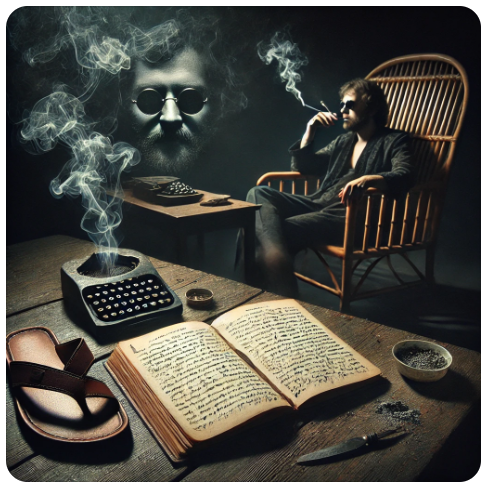
Secrets Behind Sunglasses: A Poetic Conversation

November 1, 2024

The other day, I spoke with my friend who wore sunglasses, even at night. They were not just any sunglasses; they had thick, tinted lenses that turned his eyes into secrets. He sat in his bamboo chair, curled like an embryo in a second womb, and waited for the silence between songs on the record. When it came, he tilted his head, aiming his gaze—hidden behind the black glass—at me.


“Your passage shows a definite poetic sensitivity, an emotional quality that strikes one—but what does it mean?” he asked, words biting the quiet. “You are trying to communicate?” He leaned on the last syllable of “communicate,” stretching it thin, squeezing it like elegant toothpaste. “Aren’t you?”


I felt the weight of his question sink into my chest, leaving behind a sharp, echoing hollowness. I glanced at the poem I had laid bare on the table between us, exposed like a wound. His words transformed before my eyes into writhing maggots, their white bodies squirming towards the ink. Without thinking, I took off my shoe—a thin, worn sandal—and slammed it down. The thud startled the silence; the maggots burst, leaving wet smears across the wooden surface.


I didn’t speak for a moment. I scraped their remnants into an ashtray, their tiny corpses mixing with the charred remnants of past thoughts and past sins. I dropped my sandal to the floor. He laughed, a dry, brittle sound that cracked in the dimness. He crossed his legs, the fabric of his pants whispering like a taunt. The damage had been done—a single maggot had escaped my fury and burrowed, unseen, into my ear. I could feel it crawling, tiny feet clinging to the tender skin before settling into the cavity of my heart. It pulsed there, secret and vile. He knew it. His smirk was the proof.


Now I write to pull it out, strand by bloody strand, from my heart. I know that only when I spit it out, stained and gasping, will I be free.


This maggot is unlike the others; it shifts and moulds itself, a grotesque mimicry of thoughts, without shedding its true nature. Later, it transformed as I read Dostoevsky’s The Devils, a cigarette balanced between my fingers and a small, gleaming grain of eternity in the palm of my other hand. Between puffs and between sentences, I noticed that the grain had grown in weight. Kirilov had just explained why man must commit suicide to proclaim his freedom from fear. He was called a madman. I thought he made sense. I looked at my hand and saw that the grain had grown into a crumb. Realizing that Dostoevsky was performing the alchemy in person, I continued to read and commune with him.


The grain in my palm felt heavier, its edges pressing into my skin. My mind wasn’t playing tricks. It had grown into a dense and insistent crumb. I realized then that Dostoevsky had performed this alchemy, transmuting despair into something tangible, a weight that dragged at the fabric of the world. I kept reading, feeling the maggot shift inside me, watching with its eyeless stare as I communed with a man long dead but never silent.


The record ended while the needle turned and turned on the dead wax, and I looked up. My friend still sat there, sunglasses glinting darkly in the thin light, the smirk on his lips a question left unsaid. I inhaled, the smoke and the maggot’s secrets filling me to the brim.

I asked AI to make an image based on the writing. This is it.