Soul Searching Under the Spell of Shadow Magic

October 14, 2024

Sitting under a wide, cloud-streaked sky, it’s easy to see dragons protecting fair maidens—shapes forming and dissolving like ideas half-formed. This is soul searching, a turn of the dial hoping to find clarity amidst static. That’s why I’ve come here, to the quiet of the countryside, away from the city’s endless grind. Winter’s chill creeps in, but perhaps the soul thaws when freed from its corporate chains.

Still, the absurdity of it all strikes me. My 1960s stripes are showing, but that’s okay—it’s the 2020s now. What once felt raw, visceral, and alive has been packaged and sold back to us as curated content. Rebellion itself is now a lifestyle brand. You can buy a $60 band tee, a protest-themed candle, or an algorithmically curated playlist of “protest anthems.”

Sex sells, they say—cars, perfumes, ideologies, even people. The marketplace has commodified humanity itself. The icons of individuality—once untouchable, electrifying forces—have been domesticated and rebranded as influencers. These influencers don’t just sell products; they sell the illusion of a life you think you should be living. It’s a polished performance, a constant reminder that you’re incomplete.

Advertisers and influencers are the shadow magicians of our age. No, they don’t conjure fireballs or brew potions, but their craft is no less insidious. They convince us we lack something intrinsic, something we already possess, and then sell us fragments of our wholeness at a markup. They turn rebellion into product lines, package freedom in cans, and sell identity at a discount.

We’ve entered the era of the psychic supermarket. Neon lights, slick branding, and shiny apps promise “insight,” “transcendence,” “authenticity”—but all they deliver is distraction. The spiritual hunger that once drove revolutions now fuels workshops, weekend retreats, and life-coaching apps. Gurus with trademarks stamped on their third eyes sell “enlightenment,” but their products are more like chains than keys.

What does all this have to do with shadow magic? Everything. In the Renaissance, magicians were acknowledged as such. Rasputin helped bring down the Romanovs; today’s digital influencers and ad-tech sorcerers are just as powerful, spinning illusions that shape entire nations. Their methods are subtler now, cloaked in data analytics, viral trends, and algorithms optimized to hijack the soul. It’s not just conditioning—it’s enchantment.

Take rebellion, for instance. Once, it meant something. It had a pulse, a fight, a fire. Now, rebellion is a glossy ad campaign for sneakers or energy drinks. The ethos of “sex, drugs, and rock ’n’ roll” has become “sleaze, addiction, and mindless consumerism.” Even awakening itself has been commodified, sold back to us in mindfulness apps and wellness retreats. Choose the blue pill, and you stay plugged into a world of viral dances, curated feeds, and endless scrolling. Choose the red pill, and you wake up—only to realize that even enlightenment comes with a subscription fee.

Advertisers don’t just sell products—they sell people. The stars of the golden age of cinema have been replaced by viral TikTok influencers and Instagram idols. They are brands, and we consume them as eagerly as we consume their endorsements. The human soul has been commodified, packaged into likes, swipes, and carefully curated feeds. The smile of the influencer is a product, optimized by algorithms to sell us something—beauty, status, belonging, or just the faint promise of being seen.

And behind it all, the shadow magicians profit. They don’t just take our money—they take our attention, our dignity, and, worst of all, our sense of self. The tragedy isn’t in enjoying a good streaming series or the latest tech gadget; it’s in losing the capacity to see beyond them. We’ve traded pieces of our souls for branded personas, and the worst part is, we hardly even notice.

Yes, this is heavy stuff. It might sound extreme to say advertisers profit from souls, but consider it: they convince us to buy not just things, but meaning, identity, and purpose. They replace the shared wisdom of communities with synthetic substitutes—neatly packaged remedies for the emptiness they themselves create. Each product promises to fill a void, but the more we consume, the emptier we feel.

As we rise up the modern pyramid—a fusion of Instagram stories, YouTube ads, and AI-generated content—we witness a Tower of Babel built from distraction and desire. The shadow magicians have sold us illusions of ourselves, and in doing so, they’ve blinded us to what we already are. The battle isn’t just for our wallets—it’s for our souls.

But here’s the thing: the spell only works if we believe in it. We’re not powerless. What’s the way out? Maybe it’s as simple as returning to awareness. The images we cultivate in our minds shape the world we create. Will they be pyramids to ego, or bridges to collective responsibility? Love must move beyond the self—beyond the petty “me”—to embrace stewardship of our planet and its people.

The shadow magicians won’t stop. They’ll repackage even this message, selling “save the planet” kits with a monthly subscription fee. Awareness requires vigilance, a willingness to question even the noblest calls to action. The battle isn’t fought in boardrooms or markets—it’s fought within. It’s a fight to reclaim the soul from those who would sell it back to us in pieces.

So, here I scribble—seeking clarity, exorcising spells, and reclaiming the space I almost lost. Perhaps this is just an exorcism, a way to break the spell over me. But I hope it’s more than that. There is a battle going on—inner and outer. For too long, our eyes have been closed to the inner world, the world that contains the outer one like a Madonna and child. This psychic terrain is populated by forces—good and evil—and it’s up to us to choose sides.

The choice is simple: shadow magic or light, me or we, destruction or renewal. This time, let’s break the spell. And let’s get it right.


The Dance of Mind and Heart: Finding Meaning

September 28, 2024

Mind: How can you know where you want to go in a non-conceptual way? Knowing is inherently conceptual. You claim to know your direction without knowledge. Can you explain that?

Heart: It’s true; my previous statement may seem nonsensical. Let me rephrase: I don’t know where I wish to go or what I want to write, but I feel a direction. It’s not knowledge as you understand it, but it’s no less real.

Mind: A feeling? Now you’re stepping into territory that doesn’t compute. You either know or you don’t. What you call ‘feeling’ is a fleeting, unreliable sensation—something grounded in chemical responses, nothing more. Don’t introduce it as a third state between knowledge and ignorance. It’s simply you grasping at shadows.

Heart: Shadows? Perhaps. But what if the shadows themselves lead me to something more? Something you, with all your calculations, cannot fathom. Feeling is my map—it tells me where to go, even if it’s into the unknown. And I trust that.

Mind:  This feeling must offer you more than the uncertainty lurking at my realm’s edges. How can you venture into darkness without light or a map? I doubt there’s anything beyond my domain. This darkness could merely be the boundary you wish to cross.

Heart: (more impassioned): What if I don’t need your map? What if I navigate around you, above you, beneath you? What if you, dear Mind, are the source of my doubts, the cage that keeps me from leaping forward? Perhaps this very dialogue with you holds me back from answering the call of something bigger than us both—my destiny.

Mind:  Be cautious; you’re starting to sound irrational. You’re proposing unfathomable ideas. How can you use words to traverse this invisible path of feeling? Words are my essence—my very being. Now, you claim to transcend them. It’s absurd, like trying to leap over your shadow or lift yourself by your bootstraps.

Heart: (voice trembling with frustration): Listen, Mind—my heart beats without you telling it to. My blood flows, and my breath rises and falls. Why can’t I express the words within me without your rigid orchestration? Words are surface-level—the crust, the shallow layer of something vast beneath. You think you hold all meaning, but real meaning is hidden below your borders.

Mind: Now you’re introducing another term—meaning—as if it exists apart from me and my realm. How can you have meaning without Mind? That’s utterly ridiculous.

Heart: (with passion): What’s ridiculous is your blind belief in your sovereignty! You may be necessary, but you are not the king. Meaning comes alive when you and I collaborate, yes, but it begins with me. It rises from the depths where words can’t reach. Look at joy, for example. Joy needs no words—it is felt in every part of you, a deep swell that exists without concepts or definitions. And yet, it carries meaning! Joy is meaning in motion. What about love, Mind? Can you break it down into logic? Can fear be measured by words alone?

Mind:  Fine. I disagree with your abstractions, but you venture into places I cannot see. Have it your way. I will always be here if you need me, and since you’ve chosen to communicate through words, I will remain your foundation—even if, as you say, I’m only the tip of the iceberg.

Heart: (softly, almost vulnerable): Thank you. But even with all of this… the question still lingers: What is my way? How will I find it?

Mind:  You don’t expect me to answer that, do you?

Heart: No. It’s my question. And I hope that we’ll find the answer together with your assistance—one step at a time.


Finding Meaning in the Blank Page: A Writer’s Reflection

September 27, 2024

I found some old notes written by hand—this one around 1979—and OCR scanned them. I revised and edited them, and here they are.

I have been sitting here for centuries, for months, for days, waiting. What am I waiting for, exactly? It’s a mystery that even I can’t unravel.

This blank piece of paper yawns at me again. Yes, yawning—not roaring or demanding—but simply sitting there, an expanse of white, opening its mouth to be force-fed words. But why force-feed it? Why sit here, pen in hand, scribbling down words that may or may not carry meaning?

Listen carefully. Read between the words, beneath them, through them, and beyond them. Somewhere within this ink, there is a reason, a lifeline that could pull me into a world where the ordinary becomes extraordinary, the mundane becomes miraculous. The world where one is equal to nothing, and nothing is equal to all. What? Am I trying to touch the portals of Heaven through this thin squirt of ink?

Listen again—is it not I who leaves the rind of the world behind? Is it not I who is lifted into the wild, illogical realm where reason twists like a pretzel and humanity shrinks to a slug? By excreting these lines (yes, excreting!), I have an activity fit for a lazy bum like me to call myself an artist, an author of the world. This is my voice, my essence, spilled onto the page.

It is as if a visitor sweeps away the remnants of me, picks up the pen, and records what he sees, feels, and tastes of this world through an eye that sees beyond the immediate, beyond the personal—the ‘cosmological eye,’ as Miller calls it. This act is like a cigarette slowly burning, like a caterpillar shedding its caterpillarness. Leaves fall from trees, and they realize they are always part of something more significant when they touch the ground. I want to understand what I am part of without leaving the tree—and the only way to glimpse that is to write myself into extinction so that the eye may peek through the smouldering ashes of these words.

And you know what? Just sitting here and rambling on is fun. But what is your aim? You might ask. Do I need one? What is your purpose? Do I need one? Few aims and purposes come with capital letters. Right now, I’m having fun, and that is all there is—pure, unadulterated fun.


Creating Meaning: The Timeless Journey Within

September 10, 2024

Rediscovering old notes and writings I tucked away feels like opening a time capsule. As I edit and rewrite, I’m often stunned by what unfolds—almost as if someone else penned these words. Curious to see what I found? Check out the latest piece I’ve dusted off from the drawer:

Once, I believed in the world as it was handed to me—a place where no one questioned the present and bothered to ask about the origins of our existence. But something stirred in me. As the static of modern life cleared, a pulsating sense of displacement, a profound disconnect from my cultural roots, rose from within, like an echo from my ancestors. I could almost feel their journey across the Great Ocean, but something gnawed at me—a profound uncertainty that no one here could answer.

In this land, no one believed in anything beyond the horizon, not the priest, the doctor, the teacher, or even the philosopher. They were prisoners of an unshakable belief: they had always been here. No one had come from anywhere else, and nothing existed beyond the boundaries of their world. They were trapped in an eternal present, fully immersed in “Always Here and Now.” To them, the notion of elsewhere was absurd. If there was no “other place,” how could anyone have come from it?

Initially, I grappled with understanding. My friends’ reality seemed dictated by simple logic, but my thoughts wandered beyond their walls. How could anyone have come from elsewhere if there was no other place? My friends saw the compass as proof of their reality, pointing only to an endless, eternal loop. They cautioned me against delving too deeply into such thoughts, insisting the simplicity of their truth was my only sanctuary. But something within me resisted. I was resolute, against all odds, to find the home my ancestors had spoken of, a place that existed somewhere beyond their narrow vision — a place I had never seen but felt in my bones.

Speaking of this ‘other place’ was perilous. Each mention of it shook the very foundation of their beliefs. What did that mean for their carefully constructed present if there was another world? The inner became the outer, the light became dark, and everything they knew would collapse. They were content to remain in their prison of four walls, preoccupied with the décor, oblivious to who had designed their confinement.

But I couldn’t ignore the whispers of the past. My ancestors had lived on an island swallowed by time. Only a few had escaped its destruction, fishermen who drifted across the ocean with no destination, guided by nothing more than a lucky wind. They rowed, prayed, and hoped for forty days and forty nights until they reached this land. That story lived within me, waiting for me to find the same wind, to follow the arc of coincidence that had saved them.

Yet, as I reflected, I came to a profound realization. I was still searching for something I couldn’t name—a more profound significance in my surroundings. It wasn’t just about finding another place but understanding why it mattered. The abalone shell reflected the ocean’s rhythms as if it carried the pulse of an unseen world. I then realized that significance wasn’t found in the object but in my gaze. The same wind that saved my ancestors wasn’t guiding me toward another place—it showed me that meaning itself is something we create, not discover.

My ancestors braved the ocean’s winds and waves to find this land. But the distance I had to cross was between worlds, not shores—between the truth they carried and my life now. Perhaps I wasn’t meant to find meaning but to create it, and that was the natural wind that would take me home. This realisation, this understanding, was my enlightenment.


From Blue Meanies to Bo Diddley: A Life Transformed by Psychedelics

September 6, 2024

My first entheogenic journey began with Blue Meanies mushrooms in Gin Gin, Queensland. (The term “entheogen” comes from the Greek en, meaning “in” or “within”; theo, meaning “god” or “divine”; & gen, meaning “creates”> Within God Creates) It was also my introduction to a group of nomadic hippies who embraced me and opened a door I didn’t know existed. As I lay in my sleeping bag, I watched in awe as strange, crawling eyes appeared before me, almost like tiny spiders. Instead of fear, I felt amazement.

Back in Sydney, I had my first encounter with LSD. I was astounded that such a small chemical could have such a profound effect on my consciousness. From there, everything changed. Over the next couple years, I must have experienced over 100 LSD trips and countless mushroom journeys. These experiences shaped my life in ways I couldn’t have imagined.

One of the most memorable trips was on the Sydney Opera House opening day in 1973. We were on California Sunshine Acid, wandering through the Botanic Gardens as the trip took hold. Suddenly, Bo Diddley’s “Hey, Mona” echoed through the trees. It was surreal; we all heard it together as if the music was coming directly from the trees. Later, we realized Bo was performing at the Opera House, and the amplified sound carried through the gardens.

Rather than join the crowds, we found ourselves at an alternative party in Woolloomooloo. There, I met a beautiful woman with strikingly blue eyes, and we connected in a way that felt beyond words—just through our gaze.

That day marked my last acid trip, over 50 years ago now. But the memories, the experiences, and the transformations remain with me, forever etched into my being.

I’m not recommending the use of psychedelics. Just reminiscing on my own use.


Journey Back to Eden: Seeking Paradise Lost After Leaving the Job

June 14, 2024

I am sitting here, thinking. Like watching a movie called “My Brilliant Career,” it’s been ten years since I left my job. Faces, moments, conversations, and meetings from my work days flood my mind. It’s as if my memories are fragments of a Burroughs tale, rising like steam from a hot towel only to fade into the ether moments later.

It’s a relief to realize how my job once threatened my dreams, and in many ways, I’m still healing from that ‘brilliant career.’ A decade has passed, and I’m more at ease, no longer compelled to ‘perform.’ I’m rediscovering myself, a journey that brings hope and inspiration. I remember standing on the threshold of university, my mind a whirl of anxiety. It wasn’t just fear—it was the dread of my untainted thoughts being moulded by the rigid paths of academia. The world of ideas and the university’s mould threatened to erode my individuality, my soul. My version of Paradise Lost—that was university.

After the initial thrill, the job was worse than losing paradise. My drive for self-improvement overshadowed my fears at the start of university. My job pushed me deeper into the material world, the marketplace. Now, after all these years, I seek to reclaim the innocence I had before university. Yes, I feel like I’m on a journey back to Eden, a state of mind leading to a restored paradise.
The old Zen imagery of an enlightened mind—chop wood, carry water—and the notion of no moon, no water subtly infiltrate my ‘Retired Mind,’ offsetting the remnants of The Job. I find joy and peace in chopping and splitting logs for our evening fire, tending the fire, going on long walks along the river bank, reading, and living more leisurely.

I look at my unfinished drafts without scolding myself for their incomplete state. I am reading and playing with ideas, with no idea where they might lead, except for the pleasure of reconnecting with my work and myself. I recognize the seemingly self-centred nature of it all, but I feel compelled to nourish the part of me that was unappreciated and overlooked by Job World. This journey of reconnection is engaging and interesting, and it’s a pleasure to rediscover my work and myself.


Draft of First Chapter of a Book I’m Writing

June 5, 2024

I know this is unusual for a writer to post a draft of a first chapter of a book they are writing. As those who write know, writing is lonely. I’m about 3/4 of the way through with the first draft of my book and I have no idea how it will be received. It is based on my trip to Turkey looking for people who knew or are related to my grandparents who were Pontic Greek refugees during the holocaust in Turkey in the 1920’s. Let me know what you think in the comments area. By the way – Papou means grandfather and Yiayia means grandmother in Greek.

====================================================

“You can’t go there! You’d be crazy to go,” he grabbed the towel on the chair and wiped his face, “This is not Australia; this is Greece, and you want to go to the village where your family was massacred in Turkey!” He cocked his eyebrow and wiped the corner of his mouth with his finger. We were in the kitchen. Light streamed through the window, leaving a vivid white patch on the tablecloth.

He leaned towards me with specks of sawdust in his hair. He said,

“Why go there? You can have a holiday anywhere but want to go to Bafra. Do you know how far it’s from Constantinople?”

His singlet was sweaty, and his boots and pants were spattered with cement. He sat on the fruit box, tugged at his shoes, and placed them beside the broom.

How do I explain my motives to Taki? I flew from Australia, and now, after over 40 years, I am back in my birthplace, Yannina, Greece. I wasn’t always going to be so late returning to where I was born, but raising kids and lacking money meant I couldn’t go. My father’s death made it possible for me to return from the Great Southern Land to Greece. I was a late prodigal son, now a stranger and not a son.

We migrated from Greece when I was four years old. All my memories and pictures are of a child – rolling down a hill, the log bridge I crawled across so small and scared, stuffing olive seeds down holes in the floor. My father’s recent death shocked me into looking at my life. The hourglass sand days and moments flipped over. Thoughts were framed with death, the fence around life. But after that, what? I couldn’t think of a better place to be than on the Holy Mountain celebrating Easter with these and other questions, breaking bread with monks.

“Look, I understand…..you don’t want me to get hurt,” I said

“Hurt! That’s what you call it. Hurt? I don’t want you killed! Are you stupid or what? If you go to Bafra, my dear cousin, you will either be killed or bashed to a pulp. Same thing. It’s that simple.”

He knew that as a fact.

I meticulously planned my journey from my home in Sydney over many years, studying a world map. My gaze lingered over Asia Minor and Greece, retracing the paths of my ancestry, both in blood and spirit. Countless times, my finger traced along this route. First, it pressed upon Athens, then Patras, followed by Yannina, and further to the Holy Mountain. From there, finger by finger,  it went towards Turkey, Syria, Jordan, Israel, Mount Sinai, Cairo, and back to Athens for my return. Later, I would repeat this ritual on the computer, using a cursor and a click to delve into the two-dimensional world of maps. It was a voyage of dreams, one I had envisioned for years.

Upon learning that my mother was the child of refugees, the desire to visit the land from which my grandparents had escaped grew within me. I was born in Greece to a Pontic Greek mother and a mainland Greek father. My mother seldom spoke of her heritage, save for a few passing remarks, like, “If you think Aboriginal people are mistreated, you should have seen how we were treated in Greece!” Whenever I asked her to elaborate, she would sidestep the question. Thus, I lacked a label for my identity for the longest time — I was Greek. That was it. Until much later, I discovered I was a Pontic Greek because my mother was Pontian.

After migrating to Australia, I never had the chance to see my grandparents again. We departed Greece when I was four years old. While my father’s parents perished at the hands of the Nazis during World War II, my mother’s parents were alive when I came into this world. Turkish was the initial language that enveloped me from birth until age four. I learned this recently. My mother informed me that the Greek government had made it illegal for Greek refugees from Turkey to speak Turkish, insisting they only use Greek. It must have been a challenge if they didn’t know the language. Nevertheless, in the village of my birth, predominantly inhabited by refugees from Turkey, Turkish was spoken within the confines of the home, only giving way to Greek when outsiders visited.

So, why were there Greek refugees from Turkey? My mother never disclosed the details. Even my father remained silent on the matter. Thus, I knew nothing about the Greek Holocaust until much later in life. My mother either didn’t wish to divulge the information or was unaware. As the youngest, she wasn’t born when my grandparents fled Turkey.

“Taki, I simply want to look at the village where our grandparents resided before they were forced to flee Turkey. It’s been over 80 years since that happened! I yearn to find someone who knew them. Everyone in our family perished in Turkey, except for our grandparents. I’m curious to witness that place. I never had the opportunity to know my grandparents as you have. My parents whisked me away to Australia when I was a mere four years old. I spent my days on the opposite side of the planet, growing up and becoming a father. This morning, I finally visited Papou’s and Yiayia’s graves. And that’s precisely why I’m bound for Bafra—to connect with my ancestral roots.”

I couldn’t reveal to him that my journey harboured other destinations and motives, such as Konya in Anatolia, where I wished to pay homage to Rumi, the Sufi saint. I feared that if I disclosed this, he would utterly panic and misconstrue my intentions. In his eyes, being Greek equated to being an Orthodox Christian, and displaying any interest in Islam aroused suspicion. It pressed all the wrong buttons.

“Ah, Stavro, you think like an Australian, but history intertwines whether you like it here. One glimpse of you, and they’ll recognize you as a Greek. Then, that’s it…you become a marked man.”

I took a seat at the table, the coffee still steaming. Taki settled across from me. “What’s this? I’ve toiled all day under the scorching sun, constructing a chicken shed, and you haven’t offered me a cup of coffee!” He grinned.

I poured him a coffee. His slender hand clasped the small, white cup while his other hand gently tapped the tablecloth in rhythm with the melodies wafting from the adjacent lounge room.

“So, is this the reason you have yet to embark on your journey to Bafra to see the homeland of our grandparents? It’s just a few days away by train and bus, yet you haven’t set foot there? I find it hard to believe that you lack the curiosity to see where they came from.”

“That’s the thing. Turks in Constantinople are tolerable; they’re city folks. But beyond the city, in the small towns and villages, Greeks face peril. Bafra, a small town on the Black Sea coast, lies over a thousand miles from the city. You don’t speak Turkish, and you can’t disguise the fact that you’re Greek. I don’t know if they still rely on donkeys and horses for transportation. You’re venturing into history, into suffering, into genocide. It’s perilous for a Greek, and there won’t be any tourists or travellers because there’s nothing to entice them. So, you’ll be on your own. Anything could befall you—imprisonment, remember the movie ‘Midnight Express’? And no one will come to your aid. I can’t think of anything more foolish than spending your vacation on that.”

“You forget one thing—I’m Australian. That’s what my passport says. Even if I don’t meet anyone, at least I can return to Australia with a collection of photographs depicting the area. Honestly, Taki, I believe you worry too much,” I remarked.

“How do you expect to find someone connected to our grandparents? You don’t have an address, you can’t speak Turkish, and no soul speaks English or Greek where you’re heading. You’re a Christian, they’re Muslim—remember, their ancestors massacred Greeks and Armenians by the millions. You do not understand what you’re getting yourself into, and I can’t bear the thought of not warning you.”

“I won’t be undertaking this journey alone.”

“What do you mean? Who’s accompanying you?”

“Well, I’ll depart for Easter for the Holy Mountain in a few days. Being there will guide me to someone who knew our grandparents, even if I can’t speak Turkish.”

“What? Will praying alongside monks in a monastery assist you in achieving your goal? Are you serious? You’re out of your mind. I had no idea you were a religious man.”

“I’m not religious if you measure it by church attendance. Besides, I had planned to visit the Holy Mountain with my father before he passed away, and now seems like the perfect time to fulfil his wish. I believe that extraordinary things can happen, and since I only have myself, why not seek the support of others who may aid me in some way? I believe that merely being on the Holy Mountain for Easter will help my desire come to fruition.”

“I don’t understand you. You’re an educated man—the first in our family to obtain a university degree. You use computers and hold a respectable job with great responsibility in Australia. How can you believe in superstitious nonsense like God, prayer, and the notion that Mount Athos and its monks hold any value? How can monks on a mountaintop in Greece assist you in Turkey? These are the things peasants or,” he widened his eyes, “madmen believe in!”

While I wasn’t a regular churchgoer, the word ‘pilgrim’ resonated with me more than ‘tourist.’ Pilgrims embark on a personal quest for truth regardless of faith or belief. I sought truth, and I craved tangible evidence of that truth. Was I a sceptical pilgrim? Was I a doubting Thomas with time on his hands?

“Have you ever been to the Holy Mountain?” I inquired.

“No, and I never will set foot there. If I ever do visit, it’ll be a day trip as part of a tourist group—take some videos, snap a few photos, and maybe buy a souvenir. But there’s no way I’ll ever spend the night and sleep there.”

“Why is that?”

“It’s those monks. They possess powers—they can see right through you. I’ve heard that once you converse with a monk from Mount Athos, they see your lies. You know, as if they have X-ray vision into your soul.”

“The X-ray eye? I’ve heard of the evil eye, but is that its reverse? You’re afraid of something you don’t even believe in.”

“Just because they possess powers doesn’t mean they converse with angels and grapple with demons. They are formidable men, and I don’t want any man peering into my soul,” he said.

“So, you’re suggesting their powers don’t come from God?”

“Nor the Devil.”

“Then where do they come from, if not God or the Devil?”

“They emanate from within themselves. How would I know? Look, there’s no way I would go to Mount Athos or Bafra. I can’t fathom your mind. You’d rather visit a monastery than Mykonos and its discos. And you’re alone—your wife is on the other side of the world—you’re on vacation. Enjoy yourself! You don’t even have a video camera! Being from Australia, everyone expects you to have money… You do have money, don’t you?”

“I have enough for my journey and to return to Australia.”

I displayed my discount watch from the supermarket. I pulled my inexpensive snap camera from my shoulder bag on the chair. “I don’t want to fret over possessions while I’m on the move. Besides, who would want to steal my watch or camera?” I chuckled.

“So, you’ve got it all figured out, huh? You want to be invisible, just like the common folks. Well, good luck with that,” he laughed.

He rose to freshen up and change.

“Tomorrow, I’ll be your tour guide. I want to take you to a special place—a wax museum showcasing the history between us and the Turks, created by the renowned Greek sculptor Pavlos Vrallis. The real history. You’ll see wax figures dressed as your grandfather and grandmother did when they arrived in 1922.”

“You know, I was in Constantinople a few months ago.”

“What? How was it?”

“Turkey was ravaged during the massive earthquake in 1999, just like Greece, but the Turks suffered even more. Many Greeks went over to lend a hand. What do you do when you witness 100,000 people perish next door? But sharing this doesn’t mean I share your enthusiasm for going to Bafra. I told you, a big city, a big heart— a small village, a small heart.”

“That’s nonsense. Do you realize we’re in a small town right now? Does that mean everyone here has a small heart? What about those monks with powers residing on an isolated mountaintop—do they possess small hearts? Do you believe that New York and London people have the biggest hearts?”

“You seem to have all the answers. Later, I’ll take you to my workshop. I want to show you some silverware I’ve been working on. I’m crafting the Passion of Christ in bronze for the local church.”

“You’re full of contradictions. You don’t believe in God and consider religious people foolish, yet you’re sculpting the life of Christ in bronze for a church!”

“There’s no contradiction. Priests want that image, and they pay me, and I make my living. I’ve been asked to make all sorts of designs by all sorts of people. To me, they’re all the same – paying customers. The local priest wants that design, and I give it to him for a price. It’s that simple. It puts bread on my table. So, yes, I suppose I can thank God for that!”

“Ah, Stavro! How good it is to see you this morning, to hug you!” she said, “I remember you as a baby. The last time I saw you was before you left for Australia. You crawled on the floor, picked up crumbs, and put them in your mouth. Along with the crumbs, you picked up some dirt. As you ate the bread, the dirt became mud, dribbling down the side of your mouth. Soon all your mouth was covered in mud!” She laughed between the tears. Yes, we were hungry…and now here you are, returned from Australia …a palikari!” she hugged and kissed me on my eyes, forehead and cheeks. She smelt of fine mint, “Come, let me see you,” she stepped back with her hands on her hips, her white hair in a neat bun on top of her head. She looked me up and down and broke into tears. We held each other. Demoklia was my aunt, Takis’ mother.

“Mother, he’s going to Turkey in a few days to visit Bafra,” he said half whispering.

She either did not hear him or decided to ignore it.

“You have so much to learn. Your mother didn’t tell you the whole story,” she said, taking my hand resting on the table. Her clasp was like a child’s, only a little more brittle, her hand warm and smooth.

“Did you know we prayed for you, my boy? Your family names were given to our priest and placed on the holy altar. We prayed for you and your family. Your father was a good man.” She bowed her head and crossed herself.

I looked forward to the time when I was not reminded of his death. She looked like an owl, with big glasses that made her eyes seem like saucers. Her white hair was parted in the middle, creating an oval frame straight down the centre. She was my mother’s older sister.

“Your mother was very young when she married. Yes, you were born when she was only 15. A baby is having a baby. We all loved you, and we played with you as a doll. But your mother doesn’t know all the stories, doesn’t know what happened in Turkey because she left to go to Australia. We heard the stories from your papou and yia yia, our father and mother.”

“I only knew my grandparents as a baby and can’t remember them. Now that my father has died, I wish to reclaim my Greek heritage.” I said.

“You have Greek parents, speak Greek, and are Orthodox—you have your heritage!” she smiled.

“I know, but I want to see where my grandparents came from. I want to breathe the air & stand on the ground they stood on.”

I don’t know how much your mother told you about your grandparents, so I’ll share what I know. She sat, hands clasped, leaning in, eyes locked on mine.

Your papou, a brave warrior. And your yiayia, equally courageous. They weren’t into that nationalist nonsense—neither Greek nor Turkish. Their fight was against injustice. When news reached the Greeks that the Turks were massacring our Armenian kin, the Greeks knew they’d be next. They armed themselves with guns, knives, any damn thing they could find. Those readying for battle fled to the hills and hid in caves. Sometimes, they’d venture to towns for supplies and clash with the Turks. But your papou and yiayia, stubborn as ever, stayed in the city despite the warnings of certain death.” She paused, raising her arms high, head held high. A sigh escaped her lips.

“One day,  Greeks were herded into St. George’s little church. Men, women, children, the old, the young—all corralled inside, then the church was set ablaze. They all perished. Greek homes turned to ash. Your grandparents’ house, too, went up in flames. As it burned, everyone fled, chased by Turks on horseback. When Elis, your yiayia’s sister, tried climbing out of the window, a Turk on horseback spotted her and yelled, ‘Too beautiful to burn and die!’ He snatched her up onto his horse. We know ’cause Nicholas, a family friend, hid nearby, half his body burnt, watched it all unfold from the bushes.”

Somehow, your grandparents found their way to the hills and took shelter in caves. After a while, your papou and some men ventured back to town for supplies. They found nothing but ruin—no Greeks in sight. They combed the church, remnants smouldering, smoke twirling in the air. People lay there—charred, some decapitated—their clothes tarnished by smoke and soot. All dead. As they turned to leave, footsteps and gunfire echoed. Your papou gunned down a Turk while they hurried back to the hills. Little did they know that what happened in Bafra would be happening throughout our land.

Soon after, Greeks in the hills and everywhere else embarked on a journey to Constantinople and then fled to mainland Greece as refugees.

“Mother, tell him ’bout yiayia feeding the children during their trek to Greece,” Taki interjected.

“Your yiayia, a remarkable woman,” she said. “One day, after weeks of marching, exhaustion clawing at them, parched and famished, they reached the outskirts of Constantinople. Their group, about thirty strong, stumbled upon a trickling creek offering fresh water. They made camp by that creek that night. No food but water to quench their thirst and a campfire to warm their weary bones.

Yiayia shared the children’s hunger and felt it deep within her gut. With a commanding voice, she called out, “Come, children! I have food for you. Come!” Rising to her feet, she waved her hands, beckoning the children to gather. Soon, seven young ones huddled around her. Before her, a bowl of water sat as the children settled cross-legged or on their knees. Steady as a rock, yiayia held the bowl while her gaze fixed upon them. She spoke, her voice filled with faith, “The Mother of God hasn’t forgotten us.” In her tattered coat, she rummaged, retrieving a small icon of Theotokos—the Mother of God. “This icon shall nourish us,” she declared. The children leaned in, eager for a glimpse. They beheld Mary cradling her child, Jesus. “It’s a sacred icon, capable of miracles. I shall pass it on to you. Kiss it, make the sign of the cross, then pass it along.” Yiayia raised the icon to her lips, pressed a tender kiss, crossed herself, and handed it to the children. Each child, wide-eyed with anticipation, peered at the tiny icon, kissed it, made the sign of the cross, and passed it to the next in the circle. When the icon returned to yiayia, the children’s faces glowed with hope. Yiayia raised the icon above her head, then lowered it gently toward the water-filled bowl, uttering a prayer. Immersed in prayer, she lifted and immersed the icon three times.

When the prayer ended, Yiayia carefully dried the icon with a corner of her dress, stowing it back in her coat. “Now, children, this water is food. Come and eat.” She allowed each child to take a few mouthfuls, and soon, all the nourishment vanished. For that night, the children were fed, their hunger appeased.

I asked, my voice filled with curiosity, “Was it truly food?”

Dimoklea smiled and replied, “Well, the children ceased their cries and complaints of hunger. So, what do you reckon?”

Silent and awestruck, I pondered. After a while, I uttered, “I’m going to Bafra. I must.”

“All right, you’re set on going. I see your mind will stay the same. Stubborn and determined, just like your grandfather. I shall give you something that might aid you in finding people who knew your grandparents in Turkey.”

She rose from her seat and left the kitchen. Our gazes met. Taki shrugged and shook his head. None of us knew what she had in mind. After a brief absence, she returned, clutching folded paper and a photograph.

“Take this photo of your grandmother,” she said. “Your resemblance is striking. Anyone can see it. And take this letter.”

“A letter? What’s in it?” I inquired.

“It’s in Turkish, a letter from your grandaunt, your grandmother’s sister,” she replied.

“I thought everyone in our family was killed in Turkey. How could yiayia receive a letter from her sister?”

“Ah, remember her sister whom a Turk snatched on horseback? You know the tale now, just as well as your cousins do, but they’re unaware of this letter.” She waved the letter in the air.

“So, you’re saying a grandaunt remained in Turkey and might still be alive?”

“I doubt she’s alive now, for that would mean she’s over 120 years old! No, there might be a family who knows her. In this letter to your yiayia, she said she’s married and has children, and one of her children wrote it for her.”

“Hold on, hold on. It’s all happening too quickly. How did yiayia know where to send the letter?” I asked, shock evident in my voice.

“Yiayia simply addressed it to Bafra with Elis’ name on the envelope. People know each other in a village, and that’s how your grandmother’s letter reached her sister.” She paused, ensuring she had our undivided attention. “Now, I’ll translate the letter from Turkish.” Opening the already yellowed paper, she began reading it in Turkish, sentence by sentence, translating it into Greek.

The essence of the letter conveyed her immense joy upon receiving yiayia’s letter. She spoke of kissing her eyes and forehead, embracing her. She acknowledged that life continues, and although she’s now a different person and a mother, deep in her heart, she knows her true identity.

“Now, the most crucial element of this letter is the address from which it was sent—Kafkas Hotel, Bafra. Take this letter and the photo. The photo will reveal the physical resemblance to your grandmother. At the same time, the letter, written in Turkish, will indicate whom you seek and why.”

My cousin approached to examine the letter and photo in my hand. I declared, “Already, I have a solid starting point in finding someone who knew Papa and Yiayia. I might even discover relatives!”
Taki chuckled. “Well, you might find someone, but it might not be pleasant.”

I gazed at the photo and saw a similarity in the contours of our faces. As I observed the handwritten Turkish script in the letter, I perceived it as a gateway to my heritage and lineage.


Mother’s Reflection on St George Icon

January 17, 2024

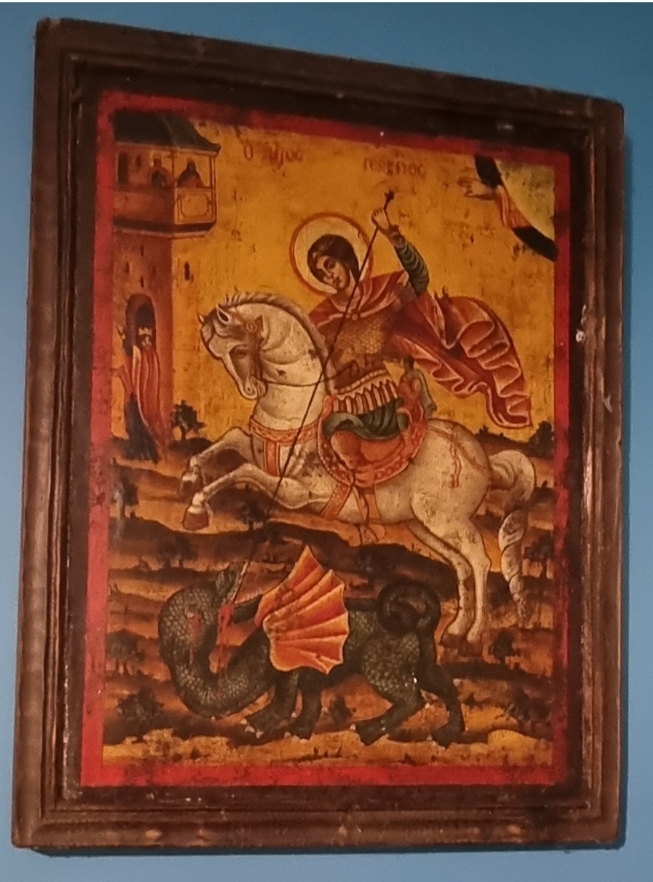
The door creaked open a bit, letting in the scent of incense down the hallway. Shadows danced on the bedroom walls, leaving the corners in darkness. The flickers came from the kandili beside the family’s icons in the corner of my mother’s room. I made sure not to think that my mother worshiped those images. She once said, “These holy pictures are like windows for us, a peek into the eternal worlds while we’re stuck in this one.” It was tough for a kid like me to wrap my head around that. But every time I kissed an icon, I reminded myself I wasn’t worshiping it.

I nudged the door open a bit more, trying to slip into the room without being noticed. Stepping onto the woolen rug, I tiptoed to the edge of the bed. There, I saw my mother on her knees, arms outstretched toward the iconastasi. Her back faced me. Slowly, she stood up, crossing herself. In the reflection off the icon of St. George and the Dragon, I saw my mother’s face. Her image overlapped with the saint’s, dividing her nose in half with the saint’s spear. One eye covered the saint’s chest, while the other floated above the horse’s bridle. The tip of her eyebrow touched the captured princess’s crown, her mouth a cushion for the Dragon’s back.

Mother’s greying hair framed a perfect silhouette within the silver frame.


Turning Inwards

January 30, 2021

This is a transcript of a talk I gave in Darlinghurst, Sydney quite a few years ago. It is my understanding of the need for Self Observation and Self Remembering which can only truly begin when we turn inwards.  Everything written below is based on my understanding of the Gurdjieff Work. I gave the talk as part of the Sydney Group.

Stavros

====================================================================

We always imagine ourselves to be much higher than we actually are. We take it for granted that we are individuals, that we have consciousness and that we can ‘DO’. But there are moments in our life when events and situations might shock us into recognition that we do not know where we are going and that our own efforts to control and direct our lives have been in vain. In these moments we feel an emptiness, a void which cannot be filled by social position, friends or wealth.

It is in moments like these that we are given an opportunity to re-evaluate our so called individuality, consciousness and will, in other words, to re-evaluate the image we have of ourselves. If we are sincere in these moments we recognise that the image we have of ourselves is not us at all but rather a mask which we very rarely see through. Life through our sincerity has brought us to the question of ourselves. If we are not individuals with the power to be conscious of our actions and thus direct our lives, then who and what are we? Who am I? What is my place in the scheme of existence? In the face of such questions, we realise that we have a need to know ourselves for ourselves and through ourselves.

If I wish to know myself and through this knowledge to know the real world, how do I begin? How do I make the right effort to turn inwards to myself and what is the right effort? It is at this point of our own search that we recognise the necessity to study the methods of self-study, which lead to understanding and eventually knowledge of ourselves. Whether alone or with others we have found ourselves in unfamiliar territory. In this region of the unknown we may hope that the forces active on this level will send us the help we need.

To have any chance of reaching our goal of self-knowledge without losing ourselves we need a guide. Here, as elsewhere, we must learn from those who know and accept to be guided by those who have already trodden the same path.

The guide cannot walk our journey for us, the guide cannot turn my attention inwards to myself. All that the guide may do is to point out the pitfalls and obstacles which lie along our path and whether we understand the methods of self-study. On this path understanding is our only currency and our only means by which we may pay for the help we need. The understanding spoken of here is completely different to the intellectual knowledge which our modern science has accustomed us to. It is for this reason that real self-knowledge requires a school. It cannot be found in books, which can give only theoretical data, mere information, leaving the whole of the real work still to be done – to turn inwards towards our own inner experience and transform information into understanding through consciously living what we are.

If the turning we are speaking of is not only of the mind, but the whole of us, and if we realise that we are not the image we have of ourselves then what can the words ‘the whole of us’ mean? Here we come across our own doubts, confusion and resistance. The words come easy but the turning required is not as easy as hearing and saying the words. We listen, we speak, but over and over again we are taken by the disorder of outer activity and find ourselves falling prey to doubts, fantasies and sterile words. This is the beginning. It is this awareness which will provide the experience of a real wish to resolve this inner confusion.

When we try to observe ourselves we see that we have to remain attentive both to ourselves and to a particular aspect of ourselves. We realise that this turning is not given to us spontaneously and that the attempt to turn with the whole of ourselves is dependent up the participation of three factors or forces. These are ‘I’ who observe face to face with what ‘I’ observe within myself and the third factor which connects the two – our attention.

Taking these three factors into consideration we will speak firstly about attention. Our usual state of attention is one in which we lose our identity in some activity – be it reading a book, talking to a friend, listening to music, hammering a nail, or just simply daydreaming. This is known as identification. Identification has different ways of manifesting within ourselves depending upon the activity. One of these ways is when we drift from object to object, from sight to sound to thought to a sensation with no apparent aim, no apparent direction: it is automatic. Or, our attention is attracted by something which exercises a strong hold – an argument, a beautiful face, a memory of some place or person. In this way we are drawn by our interest and the situation takes over ourselves. Another way in which our attention is spent is when we direct it by a simple effort for a certain time intentionally – making something, studying, playing a musical instrument, cooking, sewing. The common element we find in each of these ways of paying attention is that we are aware only of one thing at a time. This is our ordinary state. We can be aware either of the person we are talking to, or of our own words, of a pain in my body, of a scene, or of my thoughts about the scene. But, except on very rare occasions, we are not aware simultaneously of our own words and the person we are addressing, of my own pain and someone else’s, of a scene and my thoughts about it, of my situation and my feelings of it. The attention which is needed to turn inwards so that a self study may begin is such a divided attention.

Divided attention is from another level within ourselves. It is the attention which at the same time of observation takes into account everything we are. This two way attention requires an attitude very different from our usual one. When we first make the effort to turn inwards our attention goes one way, then another, sometimes towards what I observe in myself, alternating at a faster or slower speed. This happens as easily in one direction as another. Though this attention is not given to us naturally, the attempt to observe oneself generates the energy for divided attention artificially. This very attempt is an exercise which develops the needed attention and makes it possible so that it can grow to the point where self-study may begin. In the beginning there is no stable support on which our attention can be based. Real self-observation appears to us to depend as much on this support as on the attention itself. From this we understand that the three forces that must be present are closely interdependent.

The second factor is “who” observes. We said earlier that self-observation requires “the whole of ourselves” and not just our analytical mind and we realise that with our usual attention and attitude we become identified with the situation at hand. When we are identified we are not present to the situation. We become totally attached and there is no space for the sense of myself. With our normal attention there is no ‘I’ which is the stable support to observe particular aspects of my life. For real self-observation to be possible ‘I’ must be present while the observation is going on. The sense of ‘all of me’ is the ‘I’ which is able to take into account in the field of attention directed toward myself a greater number of elements. The ‘I’ who observes has a field of vision analogous to that seen through a fish eye lens which has a more global perspective when compared to the normal natural view.

When ‘I’ is not present (which is our normal state) we forget ourselves almost uninterruptedly. In us things do themselves – speaking, laughing, feeling, acting – but they do it automatically and we ourselves are not there to witness. One part of ourselves laughs, another speaks, another acts.

There is no feeling that: I speak, I laugh, I act, I observe. Nothing that is done in this way can be integrated into a whole. Life lives itself through us and we are not there to partake of it. From this we understand that what we truly seek is more abundant life.

If our usual state is one of forgetting ourselves then the need to have a stable presence of ‘I’ may be fulfilled by trying to remember ourselves.

This stable presence is not given to us by merely knowing about it. It can be acquired after long work on ourselves but even now we can have a relative degree of presence, a certain coherence of all that we can collect in ourselves.

Self-remembering is the attempt to have global awareness of oneself. It is the state where I am conscious that I am here in these surroundings and feel a connection with the surroundings around me in the overall presence of something higher. This sense of something higher is connected with the valuation of our own essential question. It may be our own aim in the light of our search, it may be the Sun from which all life on this planet has its on-gen, it may be our own meaning of God, or our own teacher. What is important in this effort to remember oneself is that it must be attempted by the sense of “the whole of ourselves and not just thought about. It is only when we try to make this effort that real self-observation can begin. When we try it we discover that without it we are constantly changing, constantly taken by events both within and without. We discover that all that we have gathered within ourselves is dispersed at the slightest distraction. We also find that in practice nothing is more difficult for us than to be there with enough stability for an observation.

The third factor which is needed to turn inwards is the object of our ob¬servation – the elements of ourselves, what we are. These elements constantly change and escape us altogether.Though the elements are in constant change the field in which these elements move is always there. When we notice other people we see their external behaviour which we all perform as a response to the demands of life. This external behaviour is directed by the functional structures comprising the field towards which our attention is directed. These functional structures are the same in all circumstances and are the result of what we are and what life has made of them. We see through our eyes and hear through our ears, we don’t see through our ears or hear through our eyes. The seeing and hearing are the functional structures of our eyes and ears respectively. Likewise, within ourselves certain behaviours, such as thinking, emotionalising and moving, are possible due to the functional structures which allow them to happen. However, the way things take place in us, the interaction of our functions and the manner in which they associate to produce our personalities and responses, all this goes on in the dark with out our knowing it. So, to observe the elements of ourselves we must do something special to make them visible.

When we strike a match against the chemically treated part of a matchbox the friction between the two creates a spark which becomes a flame, and we have light. For us to see the elements of ourselves we must likewise have friction between the ‘I’ who observes and the field which contains the elements.This inner friction is the struggle against the automatic aspects of ourselves: those moment by moment personages which are always there. The struggle is against the habits which give us the false image of ourselves.

This struggle arouses the light of double attention which we need and forces us to confront those habits which keep us asleep, automated and engulfed in constant self-forgetfulness.

Self-forgetfulness, sleep, is our lot without struggle with our automatic selves. Mechanicalness and dreams replace our true birthright of freedom and reality. What am I saying?

I will illustrate with an example. I find myself waiting for a bus to take me to the bank. After buying the bus ticket my hands begin fidgeting. Soon my fingers begin to fold the ticket over, and over again, until it is a tiny cube like they have done hundreds of times before in the same manner. My head and left arm, in perfect synchronisation, move to the exact spot where my eyes can see the time on my watch. There is no real need to know the time since a moment earlier this same action was performed. My head is full of associations which whirl by in a random manner – a half-eaten memory of words exchanged over the breakfast table, an image of a television commercial, a song picked up from, I don’t know where, provides the background muzak. The bus arrives. Find my self at the middle of the bus bumping a man who grunts at me. Anger rises – there is no rebuke in words but my posture and face express it all the same. Sitting down, the realisation dawns that the bus ticket is no longer in my hand. My hands search my pockets, my eyes search the floor directly beneath my feet, my body is in all sorts of positions looking for the bus ticket. Simultaneously, the thoughts and emotions race through to the tune of “What will I say if the ticket inspector boards this bus?” No ticket. Soon memories float by and that time on the beach in North Queensland returns. While daydreaming I miss my stop because I find myself two blocks further than the bank which was my original destination. The button is pressed and the bus stops.

The above is what is meant by mechanicalness and sleep. This is how we are living most of our lives, and this state of consciousness which we call ‘normal’, is what we have sold our birthright for. Where is the man here? Where is the ‘I’ which if present and active would make my life real? Below is a description of what struggle with oneself may be.

I find myself on the street. I begin walking back towards the bank, I remember what happened on the bus. From somewhere within me the feeling ari¬ses that there is something wrong with myself. I, who can create grandiose plans for my future life, even to the place beyond the grave, can’t even re¬member to get off the bus in time. The words of Gurdjieff cut through my as¬sociations, ‘Life is Real Only Then When I Am.’ It is remembered with my mind that it is possible to turn inwards so that I may live and be present to my life. I see that I am not present but I know that I can be present. What I am can be remembered by who I am. The matchbox can be struck by the match. Oh! But it is so pleasant, so easy, to remain within my automatic nature, fully asleep to myself and the world. The effort required to struggle with myself is something more than the effort to earn my physical livelihood. Besides, it is an effort not required for my physical survival so why should I bother. Let me sleep on. And yet, if there is no effort, no struggle, to be . I am dead and only an automaton of flesh, bones and memory exists. I wish to live. I – the all of me – wish to be. The emptiness of what I am is passive – it is easily comforted with illusions and imagination that already I am and that I can do.

I long for life but where this longing stems from I don’t know and what this ‘life’ is which is longed for, I don’t know. This longing, this yearning for something which is unknown draws a part of my attention away from the surface associations and for a moment the heat of the sun is sensed on my face and hands. I have a body which is real, concrete and here and now. My body is the anchor of my longing. It is possible to turn inwards. The walking continues back to the bank. The longing for life is now expressed by a wish to see through my own eyes, to sense with my own skin, to hear through my own ears, to feel the ground beneath my own feet. I wish to move with my own whole body.

It is remembered that the easiest functional structure to attempt to study is the moving part of myself. I wish to be, I wish to struggle with myself, I wish to slow down my walking pace so that the walking part of myself can be seen. My hand reaches for my coat pocket searching for a cigarette. That part of myself which longs for life gives the strength to say no to my hand but I promise a cigarette later if it allows presence to fill it. My mind is once again occupied with associations which pass through it automatically. I struggle to place in my mind a conscious image of myself being fully present at the entrance of the bank. My walking becomes faster. To be present at the entrance of the bank my walking pace must slow down again. Intimations of the shoe around my foot, sensation of heel touching ground, then the front part of shoe, slight pressure of my trousers around my knee as it bends, the sensation of my collar around my neck comes and goes, a breeze returns my face to myself via sensation. My pace is slower. Emotion arises – it is connected with what happened on the bus – anger with myself. My mind reminds me a little later that the only way to struggle with emotions at first is not to express negative ones. Associations arise with this thought, my mind continues in its deviation from the conscious image of myself being present at the bank’s entrance but the awareness of my walking and the growing sensation of my body keeps some attention on the elements of what I am.

My body reminds me of the Sun for its heat is once again sensed on my hands and face. The longing, the wish to be, now evokes a decision to try with the whole of myself, with the awareness of my walking, with the denial of the cigarette, with the struggle against self-pity and anger, with the effort to control my thoughts, I now try with the whole of myself to place and feel myself and the immediate surroundings of the street under the Sun. For a split second time slows down and something which connects me and the external world opens and within the traffic noise, within the milk bar sandwich sign, within the garbage bin beside me, within the shop windows displaying goods and the people around me, within my footsteps and the body that senses the clothes on it, within the associations running through the mind, within it all the sense of another realm, a realm which seems to give Life to life enters and the question “Who am I?” echoes back to myself. This sense leaves me with the memory of an otherness and I find myself at the entrance of the bank understanding that I know nothing when it comes to the Real World.

With this effort of struggling with our habitual nature we must remember that the original aim for making the effort is so that the elements of what we are become visible. This is of fundamental importance because at this point lies one of the biggest obstacles on the path of return to ourselves. For something to become visible means that it becomes seen and nothing more. So with turning inwards all that is required at the beginning is that we see ourselves and simply record what we see and nothing more. Within the more lies the obstacle and this more is manifested within us when we try to analyse what we see. This analysis is the deviation of our attention from the whole of ourselves towards the relatively small part of ourselves we call the mind. Once we begin to analyse what we see we cease to observe and begin to imagine that we are observing.

We must also be careful that in hearing about the process of turning inwards and the methods of self-study that we do not fall into the trap of the rational, logical mind and reduce the real meaning of the words self-study, self-observation and self-remembering to mere psychologising. These words are signs on the path back to ourselves and since we do not know who we are, have meaning which goes beyond what contemporary psychology may imbue them with. It is for this reason that Vaysse in his Towards Awakening calls self-observation the secret ally. In a similar vein Don Juan tells Carlos Castaneda that the warrior who follows the path of the heart has an ally which is a power a man could bring into his life to help him and give him the strength necessary to perform certain actions. This ally, Don Juan says will make a man see and understand things about which no human being could possibly enlighten him.

At the beginning of this talk we saw that life through certain circumstances brought about a shock which forced us into recognising the futility of living from a false image of ourselves. We have seen that by making certain efforts we may turn inwards consciously. This turning inwards is dependent upon our own essential need and longing for our true home. Sincerity is the key which unlocks the door to ourselves and this door becomes visible through turning inwards. By turning inwards we see what we are and through this seeing we are given the help with which the search for who we are may begin anew with renewed strength and real hope.

I finish this talk with the words of Rene Daumal which, I believe trace the journey from the false image of ourselves towards the values of our real self:

I am dead because I lack desire

I lack desire because I think I possess

I think I possess because I do not try to give

In trying to give, you see that you have nothing

Seeing you have nothing, you try to give of yourself

Trying to give of yourself, you see you are nothing

Seeing you are nothing, you desire to become

In desiring to become, you begin to live.

stavros

PS Check out the 3 pointed attention idea in my post on Kites and Attention

https://dodona777.wordpress.com/?s=kites+attention


A Special Locket/Talisman – an excerpt from a story I’m writing…

October 11, 2020

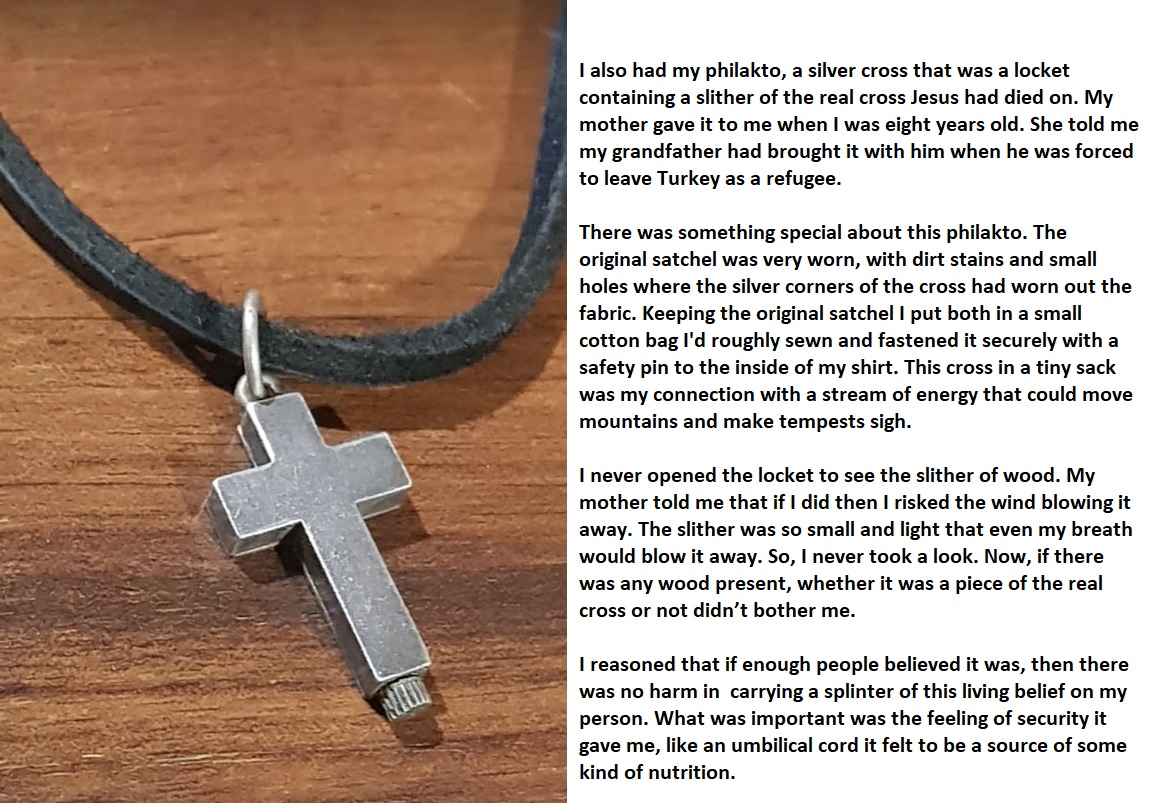
My name Stavros means Cross in Greek. So, this Philakto (Φυλαχτο) which means “talisman” carries another layer of meaning for me. This talisman has appeared and disappeared in my life a number of times. Maybe it was an unconscious forgetfulness as to where I placed it but whatever reason I may not see it for some years. When it appears it’s always at a time when I need some connection with something more than the rational world can provide me. Well, this talisman came into my hands just the other day and now I’m wearing it around my neck .

The excerpt below comes from a story that’s “faction” ie based on my travels through Australia when I was younger and intensely searching for Truth. I believed that the Road & the synchronicity of events that happen travelling around with hardly any money would reveal to me the deeper pattern behind the chaos of my life. Did it? Well, read my book when I finish it 🙂