The Temporary Angel: A Journey Beyond Reality

November 15, 2024

No rainbow hues crowned the dilapidated house across the asphalt. A lone weed struggled through the crack in the cement to greet the constant passersby. She could empathize with the weed. “What’s a weed but a plant discarded from the mob?” she thought.

Her hair, from a distance, looked like a lion’s mane. Up close, what you thought was hair was clusters of thin lines of flame with light blue ends. Was she an angel? A messenger of fire descended into this neighbourhood? Or was she just an illusion to occupy a mind locked into a cube of space? Could she be both? Like a profile that is a vase from one view or two faces turned inward from another. How long she had been watching was anyone’s guess.

George felt her eyes on him, an unsettling sensation that sharpened his awareness of his subterranean existence. He had carried the underground in his soul for so long that he feared being recognized—feared it might destroy him. To be seen was to be known, and to be known was to lose the only freedom he understood: the fragile equilibrium between necessity and whim. His underground world was a realm of shifting sand, where heaven and hell were interchangeable kingdoms. Above, the surface world was a place of silhouettes; below, he clung to the parallax of a lost star.

The worry beads in his pocket offered little comfort. His father had given them to him, claiming they were carved from the thigh bones of a Turk killed in some distant war. The macabre story had been a joke, his father’s way of mixing humour with his dark compassion. But the beads—smooth, ivory fragments of elephant tusk—still felt like relics of a troubled inheritance. He turned them over in his hand as if their smooth surface might anchor him to something solid.

At the station, Sophie appeared, filling the empty space with something familiar and alien. George noticed her wings first—scarlet feathers that seemed too vivid and alive to be part of any costume.

“Who are you?” he asked, his voice wary.

“Good, you see me,” she replied, a grin teasing her lips. “Can you see all of me?”

He squinted. “I can see you’ve got red wings.”

“Scarlet,” she corrected. “That’s even better! You can see my wings. Most can’t.” Her hands moved as she spoke, graceful as a dancer’s, and George found himself oddly captivated. “I’m a Temporary Angel,” she continued, “and I need your help. I want to be made permanent.”

George shook his head. “You’re telling me you’re an angel? Walking around Redfern Station? And I’m the only one who can see you?”

“Yes,” she said simply. “What other people?”

George looked around and saw that the station was deserted. The people who were walking around, looking at their watches, holding their bags, waiting for a train—there was no one on the platforms or the stairs. It was as if the world had been blown away with a breath, leaving only him and Sophie in this crystalline stillness. He glanced at his shadow, unnervingly sharp against the ground in the fading twilight. The light around him seemed too pure, too surreal, sharpening every edge and making every detail glow with impossible clarity.

Sophie handed him a cup of coffee, her thermos producing exactly what he liked—short and black, no sugar. “For now, silence might save you. Just listen. Let your heart speak louder than your head. Don’t let your head scalp you.”

As George sipped his coffee, she crossed her legs and leaned back slightly. “You know,” she said, “some people believe you must suffer to reach salvation—hairshirts, long vigils, self-denial. But my colleagues and I have learned that you can sit at the gates of salvation with a cup of coffee and not be asked to move on.” She winked at him.

They sat in silence until the air shifted. A moth the size of George’s hand appeared, landing delicately on the rim of his cup. Its eyes—dark and unblinking—seemed to peer into his soul.

“That’s Moth,” Sophie said. “A fellow Temp. You’ll meet more of us soon.”

Moth took off, its wings slicing through the air like a blade. Sophie stood, her scarlet wings stretching wide. “What do you want, George?” she asked, her voice low and steady. “Say it aloud.”

He hesitated, holding his breath, the weight of the question pressing down on him.

“What do you want, George?” Sophie asked again, her voice softer this time. “Be honest. It’s not the past you’re after, is it?”

“I want everything,” he finally said. “Everything, including making it all like it was before—perfect.”

She smiled, a faint sadness in her eyes. “Everything, huh? Even a brand-new car?”

“Sure,” he said, though he knew how hollow his words sounded.

Sophie turned her head toward the distant stairs. “Look over there. If the timing is right, he’ll reveal something to us.”

At the top of the railway stairs, a man descended. With each step, his shadow lengthened, stretching until it reached the bottom, falling down the stairway like a spectral companion. He dragged a sack behind him, his movements erratic, like a puppet tugged by invisible strings. His patchwork clothes—a riot of velvet, canvas, lace, and denim—hung on his frame like a discarded quilt.

The Ragman stopped before them, his single eye gleaming. Sophie gestured toward him, her voice dropping to a whisper. “He doesn’t expect any sense from you. He merely guards the door.”

The Ragman began to hum, his voice rough and melodic, then sang softly:

“Pictures of Sophie burn at the edges,
In shades of blue, she keeps her pledges.”

Moth descended from above, spiralling in tight circles before perching on the Ragman’s head. Sophie’s wings shifted as she stepped forward. “This is the sign,” she murmured.

The Ragman shuffled closer, his one eye scanning George with a gaze that weighed him in unseen scales. Then, with a raspy certainty, he said, “The timing is right. The planets are aligned, and you’re here.”

Sophie turned to George, her expression shifting to something both tender and resolute. “What do you think, George? Will you take the next step?”

She extended her hand toward him, and he felt her fingers press through his chest, gripping his heart. A sharp crack echoed in his ears as his vision dissolved into light.

They rose together, Sophie’s wings propelling them upward. Below, George saw his body standing alone on the platform. He saw the weed standing defiantly alone as he ascended. Then, slowly, the world came into focus—a railway station teeming with people, their movements alive with purpose.

Higher still, the Earth appeared, a blue and white orb spinning in a sea of black. Sophie’s wings shimmered, their scarlet hue fading into white as they ascended.

The cries and groans of countless souls filled the air. “What is this place?” George asked, his voice trembling.

“The holding space of the dead,” Sophie replied.

“The sun takes those whose light burned too brightly to last. The moon cradles the quiet souls, the dreamers. And Earth… Earth takes those who still have something left to finish,” Sophie said softly.

“Is my father here?” George asked.

Sophie nodded. “He’s waiting.”

George felt the fear of taking an uncertain step onto a journey that had no clear destination. Sophie’s grip on his heart tightened, and he realized she had brought him to the edge of something vast and unknowable. The shifting sand of his old life was gone, and in its place stretched a horizon of infinite possibility.

“The stranger within you is no stranger to me,” Sophie said. “It’s always been watching, waiting for this moment.”

“What happens now?” George asked.

Sophie smiled, her wings glowing softly. “That’s up to you.”

George felt the pull of the horizon, vast and uncharted. Somewhere in the distance, a new path was waiting. He took a step forward into the light.

The above images generated by AI from the story.


Mass-Mind Masseur, Masseur of the Lonely Heart

November 11, 2024

When the World Gazes Back

November 5, 2024

The old man feathered the last moments of his career with stories, tales that drifted through the room like the whisper of wings. Each word held the weight of years, worn smooth with retelling but still gleaming. He could sense the dual reactions in his listeners—frustration and unexpected tenderness as if his presence coaxed them to teeter between exasperation and compassion. It amused him how people sought certainty and tried to pin down meaning like an insect under glass. Did they not know that meaning moved? That it was as alive and elusive as breath?

How far, he mused, does coincidence extend its net of significance? He had asked himself this a thousand times in the quiet hours before dawn. Could one take any number of random events—snatches of conversation, objects forgotten on a windowsill—and draw them into a pattern that whispered truth? He knew the answer now, in his final years: yes. But not in the way the young or the impatient might think. The act of seeking, the mind’s restless weaving, made meaning spring forth. It was the seeking that revealed the hidden architecture beneath.

As his voice filled the room, he considered the balance between what he called the ‘real’ world and the world of omens, the oracular glimpses he’d chased in private. To him, there was no hierarchy between them. Each world was as substantial, as fleeting, as the next. The mindless churning of existence, with its nerves and synapses, was only one half of the story. The oracular world, though—ah, that required a different lens, a careful marriage of heart and mind until something else appeared, a perception that belonged neither entirely to reason nor to intuition. It was a simple shift, not mystical or eerie. The world turned inside out, and suddenly, what was hidden became visible.

He remembered trying to explain this once to a friend. They had stared at him as if he had grown another head, their eyes blinking slowly as though trying to adjust to a sudden light. “It’s not about predicting the future,” he had said. “It’s about seeing the shape of things as they are, from seed to blossom to decay. Each moment is a whole, a micro aeon within the larger arc. The hexagram from yarrow stalks is just a fingerprint, a snapshot of that whole.”

He paused in his storytelling, looking into the expectant eyes across the table. Why did people seek meaning in things as simple as sticks or numbers? Why did 2 + 2 need to equal 4 for them to feel anchored? “Perhaps it is childish,” he thought. Yet, as he spoke again, he felt the familiar electric hum in the air, the moment when observation shifted. When the seeker stopped being the observer and became observed when the world turned inside out and gazed back with its own eyes.

That was when history became soft, dissolving into a bouquet of time’s petals. All the crimes, victories, and forgotten moments of humankind—each one a petal on a single, magnificent flower—the old man wondered if beneath each word, beneath each silence, there were universes folded up like secret notes, crystalline palaces shining their light inward, into the very marrow of him.

Expression, he thought, was a prison of sorts. Words carved meaning in stone, but the stone always fell short, chipped and weathered. Truth was a living thing, alive only when veiled in a lie beautiful enough to reflect its facets. The more exquisite the lie, the closer it came to capturing the truth’s pulse. Was that not why nature adorned herself with roses, daffodils, swaying palms—her final goal reached in beauty? He realized then, as he looked out at his listeners, that the truth lay not in what was said but in what shimmered in the silence, what was caught between the eye and the breath.

And the old man, with all his stories and musings, felt the joy of the garden before him—a place where the botanist’s microscope held no power, and each listener stood barefoot, waiting to sense the bloom.


Secrets Behind Sunglasses: A Poetic Conversation

November 1, 2024

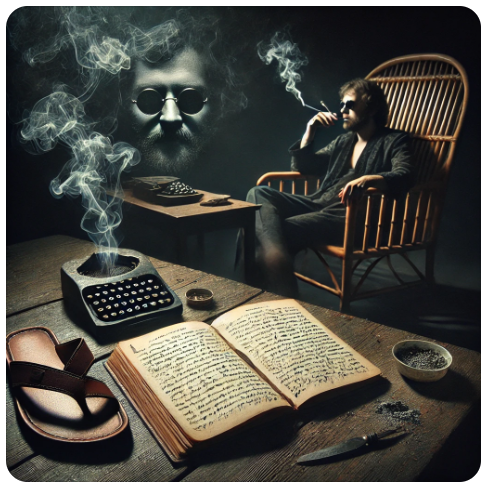
The other day, I spoke with my friend who wore sunglasses, even at night. They were not just any sunglasses; they had thick, tinted lenses that turned his eyes into secrets. He sat in his bamboo chair, curled like an embryo in a second womb, and waited for the silence between songs on the record. When it came, he tilted his head, aiming his gaze—hidden behind the black glass—at me.


“Your passage shows a definite poetic sensitivity, an emotional quality that strikes one—but what does it mean?” he asked, words biting the quiet. “You are trying to communicate?” He leaned on the last syllable of “communicate,” stretching it thin, squeezing it like elegant toothpaste. “Aren’t you?”


I felt the weight of his question sink into my chest, leaving behind a sharp, echoing hollowness. I glanced at the poem I had laid bare on the table between us, exposed like a wound. His words transformed before my eyes into writhing maggots, their white bodies squirming towards the ink. Without thinking, I took off my shoe—a thin, worn sandal—and slammed it down. The thud startled the silence; the maggots burst, leaving wet smears across the wooden surface.


I didn’t speak for a moment. I scraped their remnants into an ashtray, their tiny corpses mixing with the charred remnants of past thoughts and past sins. I dropped my sandal to the floor. He laughed, a dry, brittle sound that cracked in the dimness. He crossed his legs, the fabric of his pants whispering like a taunt. The damage had been done—a single maggot had escaped my fury and burrowed, unseen, into my ear. I could feel it crawling, tiny feet clinging to the tender skin before settling into the cavity of my heart. It pulsed there, secret and vile. He knew it. His smirk was the proof.


Now I write to pull it out, strand by bloody strand, from my heart. I know that only when I spit it out, stained and gasping, will I be free.


This maggot is unlike the others; it shifts and moulds itself, a grotesque mimicry of thoughts, without shedding its true nature. Later, it transformed as I read Dostoevsky’s The Devils, a cigarette balanced between my fingers and a small, gleaming grain of eternity in the palm of my other hand. Between puffs and between sentences, I noticed that the grain had grown in weight. Kirilov had just explained why man must commit suicide to proclaim his freedom from fear. He was called a madman. I thought he made sense. I looked at my hand and saw that the grain had grown into a crumb. Realizing that Dostoevsky was performing the alchemy in person, I continued to read and commune with him.


The grain in my palm felt heavier, its edges pressing into my skin. My mind wasn’t playing tricks. It had grown into a dense and insistent crumb. I realized then that Dostoevsky had performed this alchemy, transmuting despair into something tangible, a weight that dragged at the fabric of the world. I kept reading, feeling the maggot shift inside me, watching with its eyeless stare as I communed with a man long dead but never silent.


The record ended while the needle turned and turned on the dead wax, and I looked up. My friend still sat there, sunglasses glinting darkly in the thin light, the smirk on his lips a question left unsaid. I inhaled, the smoke and the maggot’s secrets filling me to the brim.

I asked AI to make an image based on the writing. This is it.


Soul Searching Under the Spell of Shadow Magic

October 14, 2024

Sitting under a wide, cloud-streaked sky, it’s easy to see dragons protecting fair maidens—shapes forming and dissolving like ideas half-formed. This is soul searching, a turn of the dial hoping to find clarity amidst static. That’s why I’ve come here, to the quiet of the countryside, away from the city’s endless grind. Winter’s chill creeps in, but perhaps the soul thaws when freed from its corporate chains.

Still, the absurdity of it all strikes me. My 1960s stripes are showing, but that’s okay—it’s the 2020s now. What once felt raw, visceral, and alive has been packaged and sold back to us as curated content. Rebellion itself is now a lifestyle brand. You can buy a $60 band tee, a protest-themed candle, or an algorithmically curated playlist of “protest anthems.”

Sex sells, they say—cars, perfumes, ideologies, even people. The marketplace has commodified humanity itself. The icons of individuality—once untouchable, electrifying forces—have been domesticated and rebranded as influencers. These influencers don’t just sell products; they sell the illusion of a life you think you should be living. It’s a polished performance, a constant reminder that you’re incomplete.

Advertisers and influencers are the shadow magicians of our age. No, they don’t conjure fireballs or brew potions, but their craft is no less insidious. They convince us we lack something intrinsic, something we already possess, and then sell us fragments of our wholeness at a markup. They turn rebellion into product lines, package freedom in cans, and sell identity at a discount.

We’ve entered the era of the psychic supermarket. Neon lights, slick branding, and shiny apps promise “insight,” “transcendence,” “authenticity”—but all they deliver is distraction. The spiritual hunger that once drove revolutions now fuels workshops, weekend retreats, and life-coaching apps. Gurus with trademarks stamped on their third eyes sell “enlightenment,” but their products are more like chains than keys.

What does all this have to do with shadow magic? Everything. In the Renaissance, magicians were acknowledged as such. Rasputin helped bring down the Romanovs; today’s digital influencers and ad-tech sorcerers are just as powerful, spinning illusions that shape entire nations. Their methods are subtler now, cloaked in data analytics, viral trends, and algorithms optimized to hijack the soul. It’s not just conditioning—it’s enchantment.

Take rebellion, for instance. Once, it meant something. It had a pulse, a fight, a fire. Now, rebellion is a glossy ad campaign for sneakers or energy drinks. The ethos of “sex, drugs, and rock ’n’ roll” has become “sleaze, addiction, and mindless consumerism.” Even awakening itself has been commodified, sold back to us in mindfulness apps and wellness retreats. Choose the blue pill, and you stay plugged into a world of viral dances, curated feeds, and endless scrolling. Choose the red pill, and you wake up—only to realize that even enlightenment comes with a subscription fee.

Advertisers don’t just sell products—they sell people. The stars of the golden age of cinema have been replaced by viral TikTok influencers and Instagram idols. They are brands, and we consume them as eagerly as we consume their endorsements. The human soul has been commodified, packaged into likes, swipes, and carefully curated feeds. The smile of the influencer is a product, optimized by algorithms to sell us something—beauty, status, belonging, or just the faint promise of being seen.

And behind it all, the shadow magicians profit. They don’t just take our money—they take our attention, our dignity, and, worst of all, our sense of self. The tragedy isn’t in enjoying a good streaming series or the latest tech gadget; it’s in losing the capacity to see beyond them. We’ve traded pieces of our souls for branded personas, and the worst part is, we hardly even notice.

Yes, this is heavy stuff. It might sound extreme to say advertisers profit from souls, but consider it: they convince us to buy not just things, but meaning, identity, and purpose. They replace the shared wisdom of communities with synthetic substitutes—neatly packaged remedies for the emptiness they themselves create. Each product promises to fill a void, but the more we consume, the emptier we feel.

As we rise up the modern pyramid—a fusion of Instagram stories, YouTube ads, and AI-generated content—we witness a Tower of Babel built from distraction and desire. The shadow magicians have sold us illusions of ourselves, and in doing so, they’ve blinded us to what we already are. The battle isn’t just for our wallets—it’s for our souls.

But here’s the thing: the spell only works if we believe in it. We’re not powerless. What’s the way out? Maybe it’s as simple as returning to awareness. The images we cultivate in our minds shape the world we create. Will they be pyramids to ego, or bridges to collective responsibility? Love must move beyond the self—beyond the petty “me”—to embrace stewardship of our planet and its people.

The shadow magicians won’t stop. They’ll repackage even this message, selling “save the planet” kits with a monthly subscription fee. Awareness requires vigilance, a willingness to question even the noblest calls to action. The battle isn’t fought in boardrooms or markets—it’s fought within. It’s a fight to reclaim the soul from those who would sell it back to us in pieces.

So, here I scribble—seeking clarity, exorcising spells, and reclaiming the space I almost lost. Perhaps this is just an exorcism, a way to break the spell over me. But I hope it’s more than that. There is a battle going on—inner and outer. For too long, our eyes have been closed to the inner world, the world that contains the outer one like a Madonna and child. This psychic terrain is populated by forces—good and evil—and it’s up to us to choose sides.

The choice is simple: shadow magic or light, me or we, destruction or renewal. This time, let’s break the spell. And let’s get it right.


Coffee Cup Conquistadors

September 29, 2024

Coffee Cup conquistadors, I have problems of vision in this midnight age. I see the eye of a hurricane within each loss and gain. I lose treasures all day and night through these paper walls. To top it all—gurus don’t come around here no more.

Brothers and sisters, we stand at the edge of civilization, a unified force. As we sipped our coffee, we observed each other’s movements, recognizing the cosmic significance of every gesture. Some of us ascended the mount of Golgotha with reverence, each touch a sacred act. The sober one, Sophie, refers to it as the Skull. Others of us, with spider-leg vision, delicately traversed the coffee grounds, seeing beyond the visible, like the delicate threads of fate. In this shared experience, we are all part of a larger narrative, connected by our observations and interpretations.

We gazed upon a scattered army, initially hazy, but with the valour of conquistadors, we honed in sharply. The porcelain edge of the cup transformed into a precipice. As we peered over, an alien script unfolded, twisting like crystal algae on white china. The white China, akin to the sterile laboratories of Science. The depth of this cup, viewed from the edge, was dizzying, shrouded in mystery. This cup, a vessel of unknown depths, invites us to wonder and contemplate its secrets.

The saucers flew while my cup’s base remained anchored to the tabletop. At the culmination of our exploration, at the far reaches of spider-web logic, a talking salt shaker appeared. “Hey! It’s not as dire as you believe!” it proclaimed, igniting a sense of adventure and discovery.

I thought I saw Lot’s wife, her form engraved upon my forehead, a silent spectre watching from the salt shaker’s voice.

Shapes, shapes danced upon the surface of my cup—who’s the best survivor of them all? The ones who reach for the North Pole? The ones who head for the South? The ones who climb to the roof of the world? Or the ones who dive for the floor? Is it we, the coffee brigade, stirring life’s bitter brew? With the world’s calibrated spoon, we stir the dissolved sugar cube. The cube is a reminder of the shape we’re locked in. The cube is a symbol of the microchips stirring in the scientific soup of existence.

I see the eye of the hurricane within each loss and gain. I lose treasures all day and night through these fragile paper walls. And to top it all—gurus don’t come around here anymore.


The Dance of Mind and Heart: Finding Meaning

September 28, 2024

Mind: How can you know where you want to go in a non-conceptual way? Knowing is inherently conceptual. You claim to know your direction without knowledge. Can you explain that?

Heart: It’s true; my previous statement may seem nonsensical. Let me rephrase: I don’t know where I wish to go or what I want to write, but I feel a direction. It’s not knowledge as you understand it, but it’s no less real.

Mind: A feeling? Now you’re stepping into territory that doesn’t compute. You either know or you don’t. What you call ‘feeling’ is a fleeting, unreliable sensation—something grounded in chemical responses, nothing more. Don’t introduce it as a third state between knowledge and ignorance. It’s simply you grasping at shadows.

Heart: Shadows? Perhaps. But what if the shadows themselves lead me to something more? Something you, with all your calculations, cannot fathom. Feeling is my map—it tells me where to go, even if it’s into the unknown. And I trust that.

Mind:  This feeling must offer you more than the uncertainty lurking at my realm’s edges. How can you venture into darkness without light or a map? I doubt there’s anything beyond my domain. This darkness could merely be the boundary you wish to cross.

Heart: (more impassioned): What if I don’t need your map? What if I navigate around you, above you, beneath you? What if you, dear Mind, are the source of my doubts, the cage that keeps me from leaping forward? Perhaps this very dialogue with you holds me back from answering the call of something bigger than us both—my destiny.

Mind:  Be cautious; you’re starting to sound irrational. You’re proposing unfathomable ideas. How can you use words to traverse this invisible path of feeling? Words are my essence—my very being. Now, you claim to transcend them. It’s absurd, like trying to leap over your shadow or lift yourself by your bootstraps.

Heart: (voice trembling with frustration): Listen, Mind—my heart beats without you telling it to. My blood flows, and my breath rises and falls. Why can’t I express the words within me without your rigid orchestration? Words are surface-level—the crust, the shallow layer of something vast beneath. You think you hold all meaning, but real meaning is hidden below your borders.

Mind: Now you’re introducing another term—meaning—as if it exists apart from me and my realm. How can you have meaning without Mind? That’s utterly ridiculous.

Heart: (with passion): What’s ridiculous is your blind belief in your sovereignty! You may be necessary, but you are not the king. Meaning comes alive when you and I collaborate, yes, but it begins with me. It rises from the depths where words can’t reach. Look at joy, for example. Joy needs no words—it is felt in every part of you, a deep swell that exists without concepts or definitions. And yet, it carries meaning! Joy is meaning in motion. What about love, Mind? Can you break it down into logic? Can fear be measured by words alone?

Mind:  Fine. I disagree with your abstractions, but you venture into places I cannot see. Have it your way. I will always be here if you need me, and since you’ve chosen to communicate through words, I will remain your foundation—even if, as you say, I’m only the tip of the iceberg.

Heart: (softly, almost vulnerable): Thank you. But even with all of this… the question still lingers: What is my way? How will I find it?

Mind:  You don’t expect me to answer that, do you?

Heart: No. It’s my question. And I hope that we’ll find the answer together with your assistance—one step at a time.


Creating Meaning: The Timeless Journey Within

September 10, 2024

Rediscovering old notes and writings I tucked away feels like opening a time capsule. As I edit and rewrite, I’m often stunned by what unfolds—almost as if someone else penned these words. Curious to see what I found? Check out the latest piece I’ve dusted off from the drawer:

Once, I believed in the world as it was handed to me—a place where no one questioned the present and bothered to ask about the origins of our existence. But something stirred in me. As the static of modern life cleared, a pulsating sense of displacement, a profound disconnect from my cultural roots, rose from within, like an echo from my ancestors. I could almost feel their journey across the Great Ocean, but something gnawed at me—a profound uncertainty that no one here could answer.

In this land, no one believed in anything beyond the horizon, not the priest, the doctor, the teacher, or even the philosopher. They were prisoners of an unshakable belief: they had always been here. No one had come from anywhere else, and nothing existed beyond the boundaries of their world. They were trapped in an eternal present, fully immersed in “Always Here and Now.” To them, the notion of elsewhere was absurd. If there was no “other place,” how could anyone have come from it?

Initially, I grappled with understanding. My friends’ reality seemed dictated by simple logic, but my thoughts wandered beyond their walls. How could anyone have come from elsewhere if there was no other place? My friends saw the compass as proof of their reality, pointing only to an endless, eternal loop. They cautioned me against delving too deeply into such thoughts, insisting the simplicity of their truth was my only sanctuary. But something within me resisted. I was resolute, against all odds, to find the home my ancestors had spoken of, a place that existed somewhere beyond their narrow vision — a place I had never seen but felt in my bones.

Speaking of this ‘other place’ was perilous. Each mention of it shook the very foundation of their beliefs. What did that mean for their carefully constructed present if there was another world? The inner became the outer, the light became dark, and everything they knew would collapse. They were content to remain in their prison of four walls, preoccupied with the décor, oblivious to who had designed their confinement.

But I couldn’t ignore the whispers of the past. My ancestors had lived on an island swallowed by time. Only a few had escaped its destruction, fishermen who drifted across the ocean with no destination, guided by nothing more than a lucky wind. They rowed, prayed, and hoped for forty days and forty nights until they reached this land. That story lived within me, waiting for me to find the same wind, to follow the arc of coincidence that had saved them.

Yet, as I reflected, I came to a profound realization. I was still searching for something I couldn’t name—a more profound significance in my surroundings. It wasn’t just about finding another place but understanding why it mattered. The abalone shell reflected the ocean’s rhythms as if it carried the pulse of an unseen world. I then realized that significance wasn’t found in the object but in my gaze. The same wind that saved my ancestors wasn’t guiding me toward another place—it showed me that meaning itself is something we create, not discover.

My ancestors braved the ocean’s winds and waves to find this land. But the distance I had to cross was between worlds, not shores—between the truth they carried and my life now. Perhaps I wasn’t meant to find meaning but to create it, and that was the natural wind that would take me home. This realisation, this understanding, was my enlightenment.


From Blue Meanies to Bo Diddley: A Life Transformed by Psychedelics

September 6, 2024

My first entheogenic journey began with Blue Meanies mushrooms in Gin Gin, Queensland. (The term “entheogen” comes from the Greek en, meaning “in” or “within”; theo, meaning “god” or “divine”; & gen, meaning “creates”> Within God Creates) It was also my introduction to a group of nomadic hippies who embraced me and opened a door I didn’t know existed. As I lay in my sleeping bag, I watched in awe as strange, crawling eyes appeared before me, almost like tiny spiders. Instead of fear, I felt amazement.

Back in Sydney, I had my first encounter with LSD. I was astounded that such a small chemical could have such a profound effect on my consciousness. From there, everything changed. Over the next couple years, I must have experienced over 100 LSD trips and countless mushroom journeys. These experiences shaped my life in ways I couldn’t have imagined.

One of the most memorable trips was on the Sydney Opera House opening day in 1973. We were on California Sunshine Acid, wandering through the Botanic Gardens as the trip took hold. Suddenly, Bo Diddley’s “Hey, Mona” echoed through the trees. It was surreal; we all heard it together as if the music was coming directly from the trees. Later, we realized Bo was performing at the Opera House, and the amplified sound carried through the gardens.

Rather than join the crowds, we found ourselves at an alternative party in Woolloomooloo. There, I met a beautiful woman with strikingly blue eyes, and we connected in a way that felt beyond words—just through our gaze.

That day marked my last acid trip, over 50 years ago now. But the memories, the experiences, and the transformations remain with me, forever etched into my being.

I’m not recommending the use of psychedelics. Just reminiscing on my own use.


Transcending the Swarm Mind: A Journey to Freedom and Grace

August 16, 2024

Where there is freedom, there is grace. Where there is freedom, devils dance with angels. Yet, in the heart of the Swarm Mind, these forces are chained, bound to the Swarm World.

Freedom is not the result of seeking an end; it is the means to an unknown destination, a state imbued with grace. The Swarm’s concerns strip away the soul, leaving only husks of social beings. To be free is to be true to oneself, and to be true to oneself is to give of oneself—for in the act of giving, the bud of truth begins to bloom.

We must ascend to Heaven while keeping our feet firmly on Earth. Renewed energy—a gift from Above—should radiate through us into the Earth. This emanation is not ours but from Heaven itself. As men and women, we are merely the medium through which Heaven meets Earth.

Through freedom, we move both upwards and downwards, both inwards and outwards. Riding the Devil’s back, we touch the soles of God’s feet.

The Swarm Mind, a pivotal concept in this post, symbolizes the collective consciousness of society. It is often driven by conformity, fear, and greed, and stands in stark contrast to freedom. The Swarm Mind restricts individual thought and action, leading to a homogenized worldview.

How can I let life unfold when I crave control? The part of me that is a control freak, the “I” that seeks a result, is the Swarm Mind within me. Freedom lies in recognizing this Swarm Mind, though “seeing” might be the wrong word. It is always a feeling, a quality beyond words—a heart’s clarity.

The Bay: A Sanctuary Beyond the Swarm – The Bay is a metaphor for a state of mind that transcends the limitations of the Swarm World. It represents a place of solitude and introspection, where one can escape the noise of the collective consciousness and connect with a higher truth.

I stay by the water at the Bay to escape the crowd and find solitude. To reach it, one must be guided by an inner need—an undeniable, real need—not a mere whim. The Bay is where physics and direction blur, where up and down, in and out, are part of a continuum. Everything connects in a multidimensional Möbius Strip, defying the Cartesian Spread.

Goethe said, “In nature, we never see anything isolated, but everything in connection with something else which is before it, under it, beside it, and over it.” Yet, he missed the “inside”—the entry point to the World beyond the Swarm World. Inside everything, on the beach, far from the Swarm’s buzz, lies the path to the North. The compass is our conscience.

Transcending the Swarm: A Call to Personal Growth

The Swarm Mind, in its rawest form, incessantly buzzes within a Bell Jar, a metaphor for the limitations and constraints imposed by the Bell Curve—Consensus Reality, the 3D World, and the perspective of the Vegetative Eye. The journey to transcend this requires a relentless battle against the hypnotic motion and buzzing of our busyness, a struggle that engages us and fuels our motivation.

Our journey beyond the Swarm World requires substantial assistance—help free ourselves from the Swarm Mind’s buzz and go beyond fear and greed. Yet, we must also function effectively within the Swarm World, for our physical survival depends on it. This paradoxical position requires us to engage with the World while detaching from the noise that obstructs our vision of another world beyond the Bell Jar.

The Digital Revolution and the Dematerialization of Reality

As the World transitions from material to digital, the concept of physical location dissolves. Modern telecommunications have made global video conferencing a norm, and advances in holographic technology will soon allow life-size interactions in our living rooms, simultaneously placing us in multiple locations. This digital revolution, coupled with modern physics, has led to a dematerialization of our World, challenging our understanding of reality.

Yet, these advancements are accessible to only a fraction of humanity, highlighting the growing concentration of power. While the Swarm World’s telecommunications system connects every inch of the Earth, most still need to be more nourished and impoverished.

Seeking Balance and Clarity

At the Bay, the 3D World becomes porous, held together by dimensions beyond our usual perception. The Swarm Mind clings to the sweetness of its 3D existence, unable or unwilling to see beyond.

In this ever-changing reality, we must actively seek moments of clarity and higher consciousness—our metaphorical ‘Bay.’ This balance, found at the intersection of physical and digital existences, is not just beneficial but crucial for our survival and spiritual growth. It serves as a guiding light, reassuring us that we are on the right path.

Let us continue to ask: How can we maintain our individuality while benefiting from our interconnectedness? How do we balance our physical and digital existences? And ultimately, how do we use these insights to create a world transcending both the physical and digital realms?

We seek clarity, question our perceptions, and strive for freedom, transcending both the physical and digital worlds.