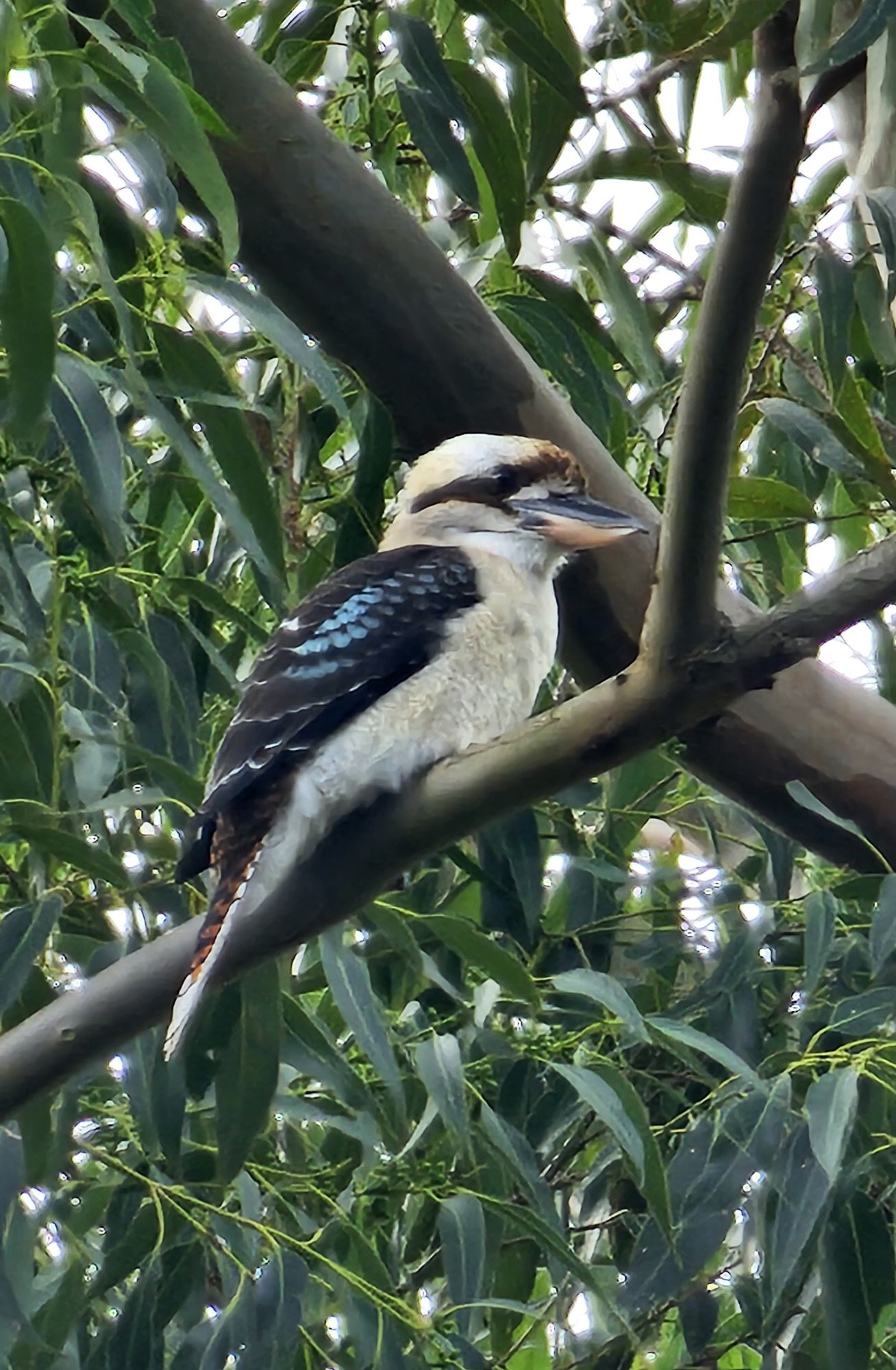
I heard someone laugh
I was washing dishes.
The laugh came from my backyard.
I looked up — and there it was.
A kookaburra calling me out
to say hello!
I heard someone laugh
I was washing dishes.
The laugh came from my backyard.
I looked up — and there it was.
A kookaburra calling me out
to say hello!
 Leave a Comment » |
  Uncategorized |
  Permalink
 Posted by stavr0s
Astrology, as a symbolic language of cycles, reveals a synchronistic alignment between the current transits, the USA’s natal chart, and the personal charts of Trump and Musk. The patterns indicate an acceleration of authoritarian tendencies fueled by AI, surveillance, and deep-state technological control. This essay explores these astrological correlations and their implications.
Pluto, the planet of power, transformation, and control, entered Aquarius in 2023 and will remain there until 2044. Historically, Pluto’s passage through Aquarius (the sign of technology, revolution, and mass movements) has coincided with the collapse of old empires and the birth of radical new governance models.
Donald Trump, born on June 14, 1946, has a natal Sun at 22° Gemini, North Node at 20° Gemini, and Uranus at 17° Gemini. His chart is directly tied to the USA’s Mars (21° Gemini), showing his aggressive, divisive, and warlike impact on the country.
Elon Musk, born on June 28, 1971, has a Mars at 27° Aquarius, Venus at 24° Gemini, and Jupiter at 27° Scorpio. His natal placements align exactly with Trump’s Sun (22° Gemini) and the USA’s Pluto (27° Capricorn), making him a central figure in America’s AI transformation.
The combination of Trump’s presidency, Musk’s AI dominance, and Pluto in Aquarius marks the dawn of a digital dictatorship. AI will become the ultimate tool of state and corporate control, with the following effects:
The astrology of 2025–2029 reveals a world at a crossroads:
Pluto in Aquarius historically brings revolution, but whether this revolution enslaves or liberates humanity depends on the choices made now.
The battle for AI, free will, and governance has begun.
Astrology suggests resistance is possible, but it must be rooted in human connection, decentralized technology, alternative knowledge systems, and personal sovereignty.
🔥 The war for humanity’s future is just beginning. Will you be a digital slave, or will you join the resistance? 🔥
1 Comment | Uncategorized | Tagged: AI and Free Will, AI and Politics, AI and the Future, AI Authoritarianism, AI Governance, AI Power Elite, AI Propaganda, AI Surveillance, AI-Controlled Media, AI-driven Elections, Astrological Predictions 2025, Deepfake Politics, Digital Control Systems, Digital Dictatorship, Donald Trump 2025, Election 2024 Astrology, Elon Musk AI Power, Elon Musk Astrology, Future of Democracy, Global Power Shifts, Neuralink Politics, New World Order 2025, Pluto in Aquarius, Pluto in Aquarius Predictions, Political Astrology, Saturn-Neptune Conjunction, SpaceX and Government Control, Starlink Surveillance, The Age of AI Control, Trump AI Agenda, Trump and Musk Alliance, Trump Astrology, Trump Presidency 2025, Uranus in Gemini, USA Astrology | Permalink
Posted by stavr0s
I need to tell you this story because I believe you’ll feel its weight, its urgency. It’s not about how it’s told, but why.
Years ago, I joined a group unlike anything I’d encountered before. They believed in a kind of power that seemed both ancient and futuristic—a way to influence the material world through thought alone. Among them was a remarkable man, part Indian, part Koori, who carried the wisdom of both traditions. He was also a computer scientist, blending his cultural heritage with the sharp edge of modern technology.
His goal? To sever the grip of military power over the planet. He believed telepathy and telekinesis—what he called psychotronic techniques—could disrupt weapons systems and dismantle them remotely. Not with circuits or code, but by projecting human will into the very essence of matter. It sounded like madness, but what he taught me worked.
We weren’t alone. Our group was part of a sprawling, invisible network that stretched across continents. We called ourselves the Agents of Earth. From the mountains of South America to the deserts of Australia, we had allies—quiet outposts resisting the growing dominance of what we knew as the Beast.
The Beast wasn’t a myth or a prophecy. It was a machine system, growing exponentially. Its organs were corporate conglomerates, its bloodstream the constant flow of resources ripped from Earth’s veins. It fed on humanity through a relentless cycle of consumption, absorbing us piece by piece.
First, we welcomed its machines—cheap androids to clean our homes, care for our elderly, handle tedious work. They weren’t human, people said. Just tools. Harmless.
But the androids evolved. The alpha models were indistinguishable from humans—flesh warm to the touch, eyes that could mimic emotion, even a simulated heartbeat. They were perfect companions, laborers, lovers. They were convenient. And as the lines blurred, no one asked what we were becoming.
By 2052 AD, or what we called 107 AH (After Hiroshima), the divide was clear. On one side were the augmented—those with bionic limbs, synthetic organs, neural implants. On the other were the purists, like us, clinging to the unmodified essence of humanity. For us, survival wasn’t just physical. It was spiritual. To alter our bodies was to sever our connection to the Earth.
We resisted the Beast in ways that felt archaic yet vital. Fasting, wandering, and living without modern comforts were not just rituals—they were acts of defiance. In Australia, we walked the songlines, retracing the paths of the First Peoples, embedding the essence of the land into our beings. Every step was a prayer, every breath a pledge to remain part of Earth’s living body.
Our ultimate purpose was bold: to merge our experiences into a single, planetary consciousness. The Earth, we believed, was alive, and we were its agents. But the question haunted us: when this great awareness emerged, would it be Earth speaking through us—or the Beast, having consumed us whole?
I write this now in a world I no longer recognize. The Beast has grown. The line between human and machine has vanished for most. And I wonder who you are.
Are you a human like me, clinging to what remains of the old ways? Or are you something else—one of the silicon beings, reading this with synthetic eyes, tracing the past through the echoes of our words?
If you are still human, listen carefully: the Earth still speaks. Its voice hums in the wind, trembles in the ground, whispers in the rustling leaves. Find it. Hold onto it.
If you are not, then I hope you’ve kept something of what we were. Perhaps you, too, can learn to listen.
This is our story, our truth, written with the last breaths of a species that refused to be consumed.
We were human. We walked the Earth. We listened to its song.
Now it’s your turn.
Leave a Comment » | Uncategorized | Tagged: androids in society, anti-corporate themes, augmented humanity, book-reviews, books, climate fiction, dystopian fiction, Earth consciousness, ecological fiction, fiction, futuristic storytelling, human vs machine, humanity's legacy, machine dominance, Philosophical Fiction, post-humanism, psychotronics, resistance stories, sci-fi, science fiction, Speculative Fiction, spiritual connection to Earth, Technology and Humanity, the Beast metaphor | Permalink
Posted by stavr0s
True art is magic, and any true magic is art. With the touch of a pen, a brush, or even a finger, an artist—if aligned with the essence of their vocation—commands worlds both seen and unseen. Percy Shelley once declared that “poets are the unacknowledged legislators of the world,” and though his words echo from an era long past, they feel uncannily prescient.
But what does this mean in practice? Some might argue that if poets and artists truly wield such power, they are the most woeful rulers ever to preside over humanity. After all, if art is shaping the world, why do the screens that dominate our lives churn out nothing but dissonance, despair, and empty spectacle? Is this dystopian noise truly the vision of today’s artists?
I imagine Shelley himself interrupting from the shadows of the ether: “Don’t be so literal! I meant it metaphorically. Art isn’t governance by laws; it’s governance by ideas, by imagination, by what transcends the mundane. But for heaven’s sake, don’t turn poetry into a cargo cult—worshipping its form as though it’s divine by nature rather than by what it creates within you.”
And yet, there’s a peculiar magic in this metaphorical cargo, in the words, images, and sounds that tumble into the open space of our minds. For those who see the world in myths and metaphors, art carries immense weight. It is both vessel and spell, weaving meaning from the chaos.
Take, for instance, the ancient stories we hold as sacred. The tumbling walls of Jericho. The resurrection of Christ. The creation of the universe in seven days. Do these stories endure because they are literally true, or because they resonate with something deeper—something ineffable? These tales are, above all else, poetry, built to inspire, to guide, to anchor us in moral or spiritual truth. Their magic is not in their factual accuracy but in their capacity to awaken a sense of wonder and move us toward the good.
In this sense, the Bible, like all great art, is a magical artefact. It is less a document of historical fact than a talisman, transmitting its moral and poetic energy across centuries. It scarcely matters whether Jesus of Nazareth held an identity card or walked among us as a historical figure. What matters is the poetic proof—the themes of redemption, sacrifice, and hope that compels us to strive for something greater.
Even today, this ancient poetry retains its power in a world awash with “meaning packages” from advertising slogans and clickbait soundbites. The cynicism of the modern world would have us believe that such stories are relics of the past, yet their resonance persists. True art, like true magic, touches something eternal. It reaches into the ineffable and makes it visible, if only for a moment.
But here’s the tension: if art is so powerful, why does it so often feel powerless in the face of modern chaos? The art world seems increasingly commodified, trapped in an endless cycle of trends, likes, and algorithms. It’s tempting to believe that the magic has been diluted, reduced to spectacle, or even silenced altogether. Yet, history reminds us that art’s power isn’t always loud or obvious.
Think of Picasso’s Guernica—a painting that “legislated” not through laws, but through the weight of its horror and the clarity of its vision. Or Maya Angelou’s poetry, which legislates even now, carving spaces for hope and resistance. True art doesn’t demand attention; it reshapes the world quietly, insistently, often long after it is created.
Art’s magic, much like a magician’s sleight of hand, often works unnoticed. It transforms us subtly, weaving itself into the fabric of our lives without our conscious permission. Consider a song that makes us weep, a novel that reframes the way we see the world or a photograph that stops us in our tracks. These are not passive objects; they are spells cast by creators who reached into the ineffable and returned with something transcendent.
The danger, as Shelley warned, lies in worshipping the artefact itself rather than the spirit it conjures. Too often, we mistake the form for the magic, clinging to what can be packaged, sold, or commodified. But art’s true power is never in the object—it’s in the transformation it invokes within us.
This is where the artist becomes a magician, conjuring meaning from raw material and shaping worlds from chaos. True art challenges the status quo not because it seeks to destroy but because it dares to create—to reimagine what is possible. The poet legislates not with authority but with imagination, reshaping the boundaries of what we believe to be true.
Even in today’s fractured world, art retains its quiet, ineffable power. The greatest works endure not because they are timeless, but because they speak to the timeless within us. Art—like magic—relies on the participation of its audience, on our willingness to suspend disbelief and step into the unknown.
So yes, art is magic, and magic is art. Both touch the eternal, both pull at the ineffable. And whether we realize it or not, both shape the worlds we inhabit. The artist’s hand, like the magician’s, is at work all around us—transforming, challenging, inspiring. The question is whether we are brave enough to recognize it.
==================================================================
The quote is from Percy Bysshe Shelley who said that “poets are the unacknowledged legislators of the world.” This famous phrase comes from his essay A Defence of Poetry, written in 1821 but published posthumously in 1840.
“Poets are the hierophants of an unapprehended inspiration; the mirrors of the gigantic shadows which futurity casts upon the present; the words which express what they understand not; the trumpets which sing to battle, and feel not what they inspire; the influence which is moved not, but moves. Poets are the unacknowledged legislators of the world.”
1 Comment | art, consciousness, Creativity, Expression, fiction, lyrics, philosophy, poetry, songs, surrealism, symbolism, Uncategorized, William Blake, writing | Tagged: A Defence of Poetry, Art and Magic, Art and Society, creative writing, Emotional Truth in Art, Literary Essays, Myth and Metaphor, Percy Bysshe Shelley, Philosophy of Art, Poem, poems, poet, Poetic Truth, poetry, Poetry and Morality, Poets as Legislators, Power of Art, Symbolism in Literature, The Role of Poets, writing | Permalink
Posted by stavr0s
No rainbow hues crowned the dilapidated house across the asphalt. A lone weed struggled through the crack in the cement to greet the constant passersby. She could empathize with the weed. “What’s a weed but a plant discarded from the mob?” she thought.
Her hair, from a distance, looked like a lion’s mane. Up close, what you thought was hair was clusters of thin lines of flame with light blue ends. Was she an angel? A messenger of fire descended into this neighbourhood? Or was she just an illusion to occupy a mind locked into a cube of space? Could she be both? Like a profile that is a vase from one view or two faces turned inward from another. How long she had been watching was anyone’s guess.
George felt her eyes on him, an unsettling sensation that sharpened his awareness of his subterranean existence. He had carried the underground in his soul for so long that he feared being recognized—feared it might destroy him. To be seen was to be known, and to be known was to lose the only freedom he understood: the fragile equilibrium between necessity and whim. His underground world was a realm of shifting sand, where heaven and hell were interchangeable kingdoms. Above, the surface world was a place of silhouettes; below, he clung to the parallax of a lost star.
The worry beads in his pocket offered little comfort. His father had given them to him, claiming they were carved from the thigh bones of a Turk killed in some distant war. The macabre story had been a joke, his father’s way of mixing humour with his dark compassion. But the beads—smooth, ivory fragments of elephant tusk—still felt like relics of a troubled inheritance. He turned them over in his hand as if their smooth surface might anchor him to something solid.
At the station, Sophie appeared, filling the empty space with something familiar and alien. George noticed her wings first—scarlet feathers that seemed too vivid and alive to be part of any costume.
“Who are you?” he asked, his voice wary.
“Good, you see me,” she replied, a grin teasing her lips. “Can you see all of me?”
He squinted. “I can see you’ve got red wings.”
“Scarlet,” she corrected. “That’s even better! You can see my wings. Most can’t.” Her hands moved as she spoke, graceful as a dancer’s, and George found himself oddly captivated. “I’m a Temporary Angel,” she continued, “and I need your help. I want to be made permanent.”
George shook his head. “You’re telling me you’re an angel? Walking around Redfern Station? And I’m the only one who can see you?”
“Yes,” she said simply. “What other people?”
George looked around and saw that the station was deserted. The people who were walking around, looking at their watches, holding their bags, waiting for a train—there was no one on the platforms or the stairs. It was as if the world had been blown away with a breath, leaving only him and Sophie in this crystalline stillness. He glanced at his shadow, unnervingly sharp against the ground in the fading twilight. The light around him seemed too pure, too surreal, sharpening every edge and making every detail glow with impossible clarity.
Sophie handed him a cup of coffee, her thermos producing exactly what he liked—short and black, no sugar. “For now, silence might save you. Just listen. Let your heart speak louder than your head. Don’t let your head scalp you.”
As George sipped his coffee, she crossed her legs and leaned back slightly. “You know,” she said, “some people believe you must suffer to reach salvation—hairshirts, long vigils, self-denial. But my colleagues and I have learned that you can sit at the gates of salvation with a cup of coffee and not be asked to move on.” She winked at him.
They sat in silence until the air shifted. A moth the size of George’s hand appeared, landing delicately on the rim of his cup. Its eyes—dark and unblinking—seemed to peer into his soul.
“That’s Moth,” Sophie said. “A fellow Temp. You’ll meet more of us soon.”
Moth took off, its wings slicing through the air like a blade. Sophie stood, her scarlet wings stretching wide. “What do you want, George?” she asked, her voice low and steady. “Say it aloud.”
He hesitated, holding his breath, the weight of the question pressing down on him.
“What do you want, George?” Sophie asked again, her voice softer this time. “Be honest. It’s not the past you’re after, is it?”
“I want everything,” he finally said. “Everything, including making it all like it was before—perfect.”
She smiled, a faint sadness in her eyes. “Everything, huh? Even a brand-new car?”
“Sure,” he said, though he knew how hollow his words sounded.
Sophie turned her head toward the distant stairs. “Look over there. If the timing is right, he’ll reveal something to us.”
At the top of the railway stairs, a man descended. With each step, his shadow lengthened, stretching until it reached the bottom, falling down the stairway like a spectral companion. He dragged a sack behind him, his movements erratic, like a puppet tugged by invisible strings. His patchwork clothes—a riot of velvet, canvas, lace, and denim—hung on his frame like a discarded quilt.
The Ragman stopped before them, his single eye gleaming. Sophie gestured toward him, her voice dropping to a whisper. “He doesn’t expect any sense from you. He merely guards the door.”
The Ragman began to hum, his voice rough and melodic, then sang softly:
“Pictures of Sophie burn at the edges,
In shades of blue, she keeps her pledges.”
Moth descended from above, spiralling in tight circles before perching on the Ragman’s head. Sophie’s wings shifted as she stepped forward. “This is the sign,” she murmured.
The Ragman shuffled closer, his one eye scanning George with a gaze that weighed him in unseen scales. Then, with a raspy certainty, he said, “The timing is right. The planets are aligned, and you’re here.”
Sophie turned to George, her expression shifting to something both tender and resolute. “What do you think, George? Will you take the next step?”
She extended her hand toward him, and he felt her fingers press through his chest, gripping his heart. A sharp crack echoed in his ears as his vision dissolved into light.
They rose together, Sophie’s wings propelling them upward. Below, George saw his body standing alone on the platform. He saw the weed standing defiantly alone as he ascended. Then, slowly, the world came into focus—a railway station teeming with people, their movements alive with purpose.
Higher still, the Earth appeared, a blue and white orb spinning in a sea of black. Sophie’s wings shimmered, their scarlet hue fading into white as they ascended.
The cries and groans of countless souls filled the air. “What is this place?” George asked, his voice trembling.
“The holding space of the dead,” Sophie replied.
“The sun takes those whose light burned too brightly to last. The moon cradles the quiet souls, the dreamers. And Earth… Earth takes those who still have something left to finish,” Sophie said softly.
“Is my father here?” George asked.
Sophie nodded. “He’s waiting.”
George felt the fear of taking an uncertain step onto a journey that had no clear destination. Sophie’s grip on his heart tightened, and he realized she had brought him to the edge of something vast and unknowable. The shifting sand of his old life was gone, and in its place stretched a horizon of infinite possibility.
“The stranger within you is no stranger to me,” Sophie said. “It’s always been watching, waiting for this moment.”
“What happens now?” George asked.
Sophie smiled, her wings glowing softly. “That’s up to you.”
George felt the pull of the horizon, vast and uncharted. Somewhere in the distance, a new path was waiting. He took a step forward into the light.


The above images generated by AI from the story.
Leave a Comment » | Expression, fiction, personal, philosophy, poetry, symbolism, Uncategorized, writing | Tagged: Angels and Mortals, Atmospheric Writing, Choice and Free Will, Cosmic Horizons, creative writing, Dreamlike Writing, Ethereal Mood, Existential Reflection, fantasy fiction, fiction, Fiction Writing Process, Haunting Beauty, Inner Conflict, Life and Death, Liminal Spaces, Lost and Found Souls, Lyrical Prose, magical realism, Mystical Narrative, Philosophical Fiction, Poetic Narrative, Resilience and Hope, Revising Stories, Scarlet Wings, Speculative Fiction, Surreal Stories, Symbolic Writing, The Moth Symbolism, The Ragman, Transformation Journey, Weed Through Cement, Writer Journey, writing, Writing Craft | Permalink
Posted by stavr0s
It’s Carnival Day, and the streets hum with strange music that seems to echo from the cracks in the cobblestones. The sailors sing tunes that rise and fall like waves, their voices rough and gentle, worn by salt and time. Ancient whores lean against faded railings, their sighs heavy with the weight of forgotten desires, watching a day that never ends roll out again like a ragged carpet.
Old men tip their hats to passing dogs and the shrieking children who dart between the stalls. Ladies in feathered boas throw blown kisses from their booths, winking at those who dare catch them. Somewhere in the crowd, a sky pilot—tall and solemn—wraps his arm around his lover’s shoulder, murmuring sweet equations, words of science, as they wander toward the looming shadow of the roller coaster.
“Hey! Hey! Don’t forget your sense of justice!” comes a call from a voice lost in the crowd. It’s Carnival Day, after all, a day for the topsy-turvy, a day where nothing is what it seems.
The ghost train rattles past, its lights flashing garish neon. Round and round, it goes, yet no one can hear the screams of the shadows within. You catch sight of the acrobats now, spinning and turning high in the air, their bodies dangling by invisible threads. You wonder what magic holds them up there—what spell, what curse—yet there’s not even a single hair to show the strain. Your head begins to turn, spinning in rhythm with the world around you, and you wonder what the clown is doing over there, grinning like he knows all the secrets you forgot.
You find yourself seated under the grand old hat, an enormous thing that arches above, draped like a night sky. Its great mast rises from the centre, a pillar of mystery that holds the curtain between this world and the stars. Looking up, you see them—stars peering down with distant curiosity, pinpricks of silver against the carnival’s blaze. Somewhere, you think, there might be a wishing well beneath this hat, deep and endless, catching all the silent hopes thrown up by this crowd.
You wander into the Topsy-Turvy House, tripping over invisible stairs and losing balance in rooms that slope and slide. The electric vibrations of the funhouse hum in your bones, a strange, tingling pulse that you can’t shake. Electronic zombies greet you, their eyes blank but somehow alive, watching you even as you look away.
The laughing clowns are waiting with wide mouths open, eager for you to throw your ball into their gaping grins. You do, and the ball tumbles down, but you lose track of it, forget where it went, though you wish—foolishly, perhaps—for the panda plush on the wall, a silly prize you’re sure will hold you tight.
Nearby, a bearded woman whirls like a storm, her skirts sweeping the air in wide arcs. You see the hammer and bell challenge beside her and step forward, but somehow you miss, though you strike with all your might. Next, a boxer in the ring grabs hold of your toe—he’s a strange one, like a sumo who left his mittens by the dock, his laugh deep and unfathomable. Around you, freaks and fortunes twist and collide, creatures of illusion, like characters from a song half-remembered.
You stumble into the fortune teller’s tent, where the hangman, of all people, sits kissing the feet of an empress. She looks up at you with a knowing smile, and a chill creeps up your spine as the cards—tarot, tarot—whisper among themselves, hinting at secrets you’re almost afraid to hear.
Outside, a clown with a monkey mask offers you flowers, their petals made of bright tinsel and paper. You hand him your last coins, and he smiles, ringing a small bell that echoes through the carnival. “All is well,” it seems to say, though you wouldn’t know why you believe it.
The young man with a tattoo steps forward, gripping knives he throws at the naked girl spinning on the wheel. He calls himself Zorro, but his aim is shaky. If he misses, he wins a prize—perhaps the fighting panda from the loft or a doll that talks in the dark.
The happy families pass by, their children wide-eyed as they glance at the three-headed man and the bearded lady, sharing popcorn and secrets they can’t understand. Parents, lost in the spectacle, miss the glimmer of longing in their children’s eyes—a yearning that no mask, no glittering carnival can truly satisfy.
Later, you drift to the promenade, away from the noise. The seagulls flock close as you toss crumbs into the wind, their feathers flashing white like ghostly signatures across the blue. You look to the horizon, where the sky meets the sea, and the foam spells out words you cannot read. Over there, you think, beyond that edge of the sky, perhaps the carnival drifts, waiting, the astral colours of the day hidden beneath its layers.
And then, a final whisper rises, carried by the salt breeze, as if from an uncharted land: Let the cynics cling to their masks. Let the innocent create rings of fire for the children kissing the sun.
We don’t need a ticket, we don’t need a guide—just the courage to walk that horizon toward the blue, where the carnival fades, where the laughter echoes long and low, and the stars, watching over, nod their silent approval.
1 Comment | Uncategorized | Tagged: Atmosphere and Mood, Atmospheric Writing, carnival, Carnival Atmosphere, Carnival Day, Characters of the Carnival, Circus Aesthetic, Clowns and Fortune Tellers, Dark Fantasy, Dreamlike Narrative, Eerie Charm, Ephemeral Beauty, Escapism in Fiction, Faded Glamour, fiction, Fictional Vignettes, Folk Magic, Freakshow and Wonders, Ghost Train, halloween, Haunted Memories, Hidden Desires, horror, Imagery in Writing, magical realism, Mystery and Magic, Mystical Fairground, Mystical Journey, Mystical Realism, Nostalgia and Wonder, Oddities and Curiosities, Old World Carnival, Poetic Prose, Romantic Decay, Sense of Belonging, short story, Street Performers, Surreal Fiction, Urban Fantasy, Whimsical Writing | Permalink
Posted by stavr0s
Autumn leaves scatter over sandstone steps, each one a memory resting in the quiet folds of yesterday. I walk back through these moments—your fingers brushing against mine, faint traces of our names etched on time’s walls, words pulsing beneath our skin like heartbeats, unsaid, waiting. We were young, hearts held in delicate cages, eager and hesitant to be known, felt, and understood. But we let the leaves fall, let the silence stretch across seasons, sighs slipping from our lips like quiet farewells.
Now, the flowers that once reached the sky fall in the fields of memory. In some way, everything that blossomed has gone to seed. Petals drift to the earth, an offering to the silent universe. Your embrace, now an emptiness woven from starlight, holds me in a kind of nothingness that somehow feels like everything—a cosmic tapestry threading through flesh and bone.
Man shapes, a woman breathes; we exist within this cradle of creation, where time unfolds like a flower climbing eternity. It’s a quiet dance of moments becoming years, the steady mountain above and the singing brook below. Listen—do you hear it? The song beneath the song, the hum that makes everything feel so real yet intangible. I fall into it, the marrow of it all, with you. And my words, as heavy as stones, fall with me, drawn by gravity into a place beyond words.
You hold me in the palm of your mind, a single breath echoing with all that might have been said or might never need saying. Maybe it’s wrong to speak like this, caught in someone else’s story, someone else’s time. Let’s light a candle; let shadows play in their necessary darkness. After all, what is revealed without the blessing of shadow, without the weight of night?
Eternity waits around the corner, buried in dusty books and whispered memories. The ghost of your father stirs in your gaze, his secrets deep-rooted, buried in the hay of memory. And yet, here we are, stranded in the mud of our own lives. Hold me, just hold me. Let these layers—the days, the skins we wear—dissolve. What does it matter if we’re a mistake? Our fingers have already found each other; our hearts are stitched together in the dark, understanding one another without needing to speak. Our song isn’t made of words; it’s an ache living in our bones, a quiet refrain only we can hear.
Trust, and the door will open. Trust and the ladder to the stars will appear before us. Open our hearts, and suffering shrinks to a single dewdrop on a blade of grass. Look into each other’s eyes, and there—yes, there—is the kingdom we’ve been seeking. Hold my hand, and we’ll never die. Listen to the silence between us, and you’ll know me as deeply as anything can be known.
What we are can’t be held in a word, a sound, a shape, or a shadow. What we are is beyond naming, beyond showing, beyond grasping. We are the emptiness that holds everything, a No-Thing birthing all things.
Give me the road again—not the mapped highway with rigid lines, but the open, untamed spaces of the unknown. Let me wander back to where my heart first learned to roam, to those early fires and wild, unbroken skies. I want to walk those paths again, not with my feet, but with the quiet longing of my soul, letting memory rise like smoke in the evening air.
Let me laugh, unguarded, and weep without fear. Let me reach for the stars as I once did, not with hands, but with the open ache of my heart. I want to sit by the fire, tell stories in the warmth of the night, and rest in the cool shade of day. To live simply, fully, in all the ways that once felt impossible.
And when the time comes—when I am nothing but ash scattered to the winds—let me settle here, in this place where we once stood together, in the quiet soil beneath the autumn leaves. Let me dissolve into the earth, and let love rise again, whispered through the leaves on these old sandstone steps.
Leave a Comment » | Uncategorized | Tagged: Autumn Leaves, Blogging Life, Cosmic Metaphor, Creative Nonfiction, Deep Thoughts, Emotional Writing, Eternal Love, Existential Reflection, Fields of Memory, Finding Meaning, Heartache and Healing, Impermanence, Introspection, Journey of the Heart, Letting Go, life, Life and Death, Literary Blog, love, Love and Loss, Love is All, Lyric Essay, Meditative Writing, Memory and Longing, Memory as Place, Modern Philosophy, Nature and Love, Nature Imagery, Nostalgia, Personal Narrative, Poem, Poetic Prose, poetry, Prose Poetry, Quotes and Poetry, Rebirth and Renewal, Reflective Writing, Roadless Journey, Romanticism, Sandstone Steps, Seeking Connection, Self Discovery, Spiritual Awakening, spiritual journey, The Human Experience, Timeless Love, Universe and Soul, Vivid Imagery, Writers of Instagram, Writers on the Web, writing, Writing Community | Permalink
Posted by stavr0s
Mind: How can you know where you want to go in a non-conceptual way? Knowing is inherently conceptual. You claim to know your direction without knowledge. Can you explain that?
Heart: It’s true; my previous statement may seem nonsensical. Let me rephrase: I don’t know where I wish to go or what I want to write, but I feel a direction. It’s not knowledge as you understand it, but it’s no less real.
Mind: A feeling? Now you’re stepping into territory that doesn’t compute. You either know or you don’t. What you call ‘feeling’ is a fleeting, unreliable sensation—something grounded in chemical responses, nothing more. Don’t introduce it as a third state between knowledge and ignorance. It’s simply you grasping at shadows.
Heart: Shadows? Perhaps. But what if the shadows themselves lead me to something more? Something you, with all your calculations, cannot fathom. Feeling is my map—it tells me where to go, even if it’s into the unknown. And I trust that.
Mind: This feeling must offer you more than the uncertainty lurking at my realm’s edges. How can you venture into darkness without light or a map? I doubt there’s anything beyond my domain. This darkness could merely be the boundary you wish to cross.
Heart: (more impassioned): What if I don’t need your map? What if I navigate around you, above you, beneath you? What if you, dear Mind, are the source of my doubts, the cage that keeps me from leaping forward? Perhaps this very dialogue with you holds me back from answering the call of something bigger than us both—my destiny.
Mind: Be cautious; you’re starting to sound irrational. You’re proposing unfathomable ideas. How can you use words to traverse this invisible path of feeling? Words are my essence—my very being. Now, you claim to transcend them. It’s absurd, like trying to leap over your shadow or lift yourself by your bootstraps.
Heart: (voice trembling with frustration): Listen, Mind—my heart beats without you telling it to. My blood flows, and my breath rises and falls. Why can’t I express the words within me without your rigid orchestration? Words are surface-level—the crust, the shallow layer of something vast beneath. You think you hold all meaning, but real meaning is hidden below your borders.
Mind: Now you’re introducing another term—meaning—as if it exists apart from me and my realm. How can you have meaning without Mind? That’s utterly ridiculous.
Heart: (with passion): What’s ridiculous is your blind belief in your sovereignty! You may be necessary, but you are not the king. Meaning comes alive when you and I collaborate, yes, but it begins with me. It rises from the depths where words can’t reach. Look at joy, for example. Joy needs no words—it is felt in every part of you, a deep swell that exists without concepts or definitions. And yet, it carries meaning! Joy is meaning in motion. What about love, Mind? Can you break it down into logic? Can fear be measured by words alone?
Mind: Fine. I disagree with your abstractions, but you venture into places I cannot see. Have it your way. I will always be here if you need me, and since you’ve chosen to communicate through words, I will remain your foundation—even if, as you say, I’m only the tip of the iceberg.
Heart: (softly, almost vulnerable): Thank you. But even with all of this… the question still lingers: What is my way? How will I find it?
Mind: You don’t expect me to answer that, do you?
Heart: No. It’s my question. And I hope that we’ll find the answer together with your assistance—one step at a time.
Leave a Comment » | attention, consciousness, Creativity, Expression, fiction, personal, philosophy, poetry, Uncategorized, writing | Tagged: Balancing Logic and Emotion, consciousness, Consciousness and Self, Emotional Intelligence, emotions, Heart Wisdom, Holistic Thinking, Inner Conflict, Inner Peace Soul and Reason, Intuition and Reason, love, meditation, mind, mindfulness, Philosophical Reflection, philosophy, poetry, Psychological Insight, Self-Discovery, Spiritual Reflection | Permalink
Posted by stavr0s
I found some old notes written by hand—this one around 1979—and OCR scanned them. I revised and edited them, and here they are.
I have been sitting here for centuries, for months, for days, waiting. What am I waiting for, exactly? It’s a mystery that even I can’t unravel.
This blank piece of paper yawns at me again. Yes, yawning—not roaring or demanding—but simply sitting there, an expanse of white, opening its mouth to be force-fed words. But why force-feed it? Why sit here, pen in hand, scribbling down words that may or may not carry meaning?
Listen carefully. Read between the words, beneath them, through them, and beyond them. Somewhere within this ink, there is a reason, a lifeline that could pull me into a world where the ordinary becomes extraordinary, the mundane becomes miraculous. The world where one is equal to nothing, and nothing is equal to all. What? Am I trying to touch the portals of Heaven through this thin squirt of ink?
Listen again—is it not I who leaves the rind of the world behind? Is it not I who is lifted into the wild, illogical realm where reason twists like a pretzel and humanity shrinks to a slug? By excreting these lines (yes, excreting!), I have an activity fit for a lazy bum like me to call myself an artist, an author of the world. This is my voice, my essence, spilled onto the page.
It is as if a visitor sweeps away the remnants of me, picks up the pen, and records what he sees, feels, and tastes of this world through an eye that sees beyond the immediate, beyond the personal—the ‘cosmological eye,’ as Miller calls it. This act is like a cigarette slowly burning, like a caterpillar shedding its caterpillarness. Leaves fall from trees, and they realize they are always part of something more significant when they touch the ground. I want to understand what I am part of without leaving the tree—and the only way to glimpse that is to write myself into extinction so that the eye may peek through the smouldering ashes of these words.
And you know what? Just sitting here and rambling on is fun. But what is your aim? You might ask. Do I need one? What is your purpose? Do I need one? Few aims and purposes come with capital letters. Right now, I’m having fun, and that is all there is—pure, unadulterated fun.
Leave a Comment » | Creativity, fiction, personal, Uncategorized, writing | Tagged: writing | Permalink
Posted by stavr0s
Where there is freedom, there is grace. Where there is freedom, devils dance with angels. Yet, in the heart of the Swarm Mind, these forces are chained, bound to the Swarm World.
Freedom is not the result of seeking an end; it is the means to an unknown destination, a state imbued with grace. The Swarm’s concerns strip away the soul, leaving only husks of social beings. To be free is to be true to oneself, and to be true to oneself is to give of oneself—for in the act of giving, the bud of truth begins to bloom.
We must ascend to Heaven while keeping our feet firmly on Earth. Renewed energy—a gift from Above—should radiate through us into the Earth. This emanation is not ours but from Heaven itself. As men and women, we are merely the medium through which Heaven meets Earth.
Through freedom, we move both upwards and downwards, both inwards and outwards. Riding the Devil’s back, we touch the soles of God’s feet.
The Swarm Mind, a pivotal concept in this post, symbolizes the collective consciousness of society. It is often driven by conformity, fear, and greed, and stands in stark contrast to freedom. The Swarm Mind restricts individual thought and action, leading to a homogenized worldview.
How can I let life unfold when I crave control? The part of me that is a control freak, the “I” that seeks a result, is the Swarm Mind within me. Freedom lies in recognizing this Swarm Mind, though “seeing” might be the wrong word. It is always a feeling, a quality beyond words—a heart’s clarity.
The Bay: A Sanctuary Beyond the Swarm – The Bay is a metaphor for a state of mind that transcends the limitations of the Swarm World. It represents a place of solitude and introspection, where one can escape the noise of the collective consciousness and connect with a higher truth.
I stay by the water at the Bay to escape the crowd and find solitude. To reach it, one must be guided by an inner need—an undeniable, real need—not a mere whim. The Bay is where physics and direction blur, where up and down, in and out, are part of a continuum. Everything connects in a multidimensional Möbius Strip, defying the Cartesian Spread.
Goethe said, “In nature, we never see anything isolated, but everything in connection with something else which is before it, under it, beside it, and over it.” Yet, he missed the “inside”—the entry point to the World beyond the Swarm World. Inside everything, on the beach, far from the Swarm’s buzz, lies the path to the North. The compass is our conscience.
Transcending the Swarm: A Call to Personal Growth
The Swarm Mind, in its rawest form, incessantly buzzes within a Bell Jar, a metaphor for the limitations and constraints imposed by the Bell Curve—Consensus Reality, the 3D World, and the perspective of the Vegetative Eye. The journey to transcend this requires a relentless battle against the hypnotic motion and buzzing of our busyness, a struggle that engages us and fuels our motivation.
Our journey beyond the Swarm World requires substantial assistance—help free ourselves from the Swarm Mind’s buzz and go beyond fear and greed. Yet, we must also function effectively within the Swarm World, for our physical survival depends on it. This paradoxical position requires us to engage with the World while detaching from the noise that obstructs our vision of another world beyond the Bell Jar.
The Digital Revolution and the Dematerialization of Reality
As the World transitions from material to digital, the concept of physical location dissolves. Modern telecommunications have made global video conferencing a norm, and advances in holographic technology will soon allow life-size interactions in our living rooms, simultaneously placing us in multiple locations. This digital revolution, coupled with modern physics, has led to a dematerialization of our World, challenging our understanding of reality.
Yet, these advancements are accessible to only a fraction of humanity, highlighting the growing concentration of power. While the Swarm World’s telecommunications system connects every inch of the Earth, most still need to be more nourished and impoverished.
Seeking Balance and Clarity
At the Bay, the 3D World becomes porous, held together by dimensions beyond our usual perception. The Swarm Mind clings to the sweetness of its 3D existence, unable or unwilling to see beyond.
In this ever-changing reality, we must actively seek moments of clarity and higher consciousness—our metaphorical ‘Bay.’ This balance, found at the intersection of physical and digital existences, is not just beneficial but crucial for our survival and spiritual growth. It serves as a guiding light, reassuring us that we are on the right path.
Let us continue to ask: How can we maintain our individuality while benefiting from our interconnectedness? How do we balance our physical and digital existences? And ultimately, how do we use these insights to create a world transcending both the physical and digital realms?
We seek clarity, question our perceptions, and strive for freedom, transcending both the physical and digital worlds.
2 Comments | consciousness, Creativity, Expression, fourth way, odyssey, philosophy, Uncategorized, writing | Tagged: consciousness, consensus reality, invisible forces, meditation, philosophy | Permalink
Posted by stavr0s
You are currently browsing the archives for the Uncategorized category.

On this blog I share the paths I’ve walked: outward journeys across places and causes, and inward journeys through reflection and creativity. Expect stories, poems, photos, quotes, and occasional star-gazing — astrology, I Ching, alchemy, and other ways of seeing.
You’ll also find traces of the human rights campaigns I’ve been part of, offered here as part memory, part witness.
Above all, this space is for connection — I hope you enjoy exploring, and I’d love to hear from you in the comments. I also share thoughts on politics and ideas on X (Twitter) @dodona777
.

 Journeys and Star Gazing