Transcending the Swarm Mind: A Journey to Freedom and Grace

August 16, 2024

Where there is freedom, there is grace. Where there is freedom, devils dance with angels. Yet, in the heart of the Swarm Mind, these forces are chained, bound to the Swarm World.

Freedom is not the result of seeking an end; it is the means to an unknown destination, a state imbued with grace. The Swarm’s concerns strip away the soul, leaving only husks of social beings. To be free is to be true to oneself, and to be true to oneself is to give of oneself—for in the act of giving, the bud of truth begins to bloom.

We must ascend to Heaven while keeping our feet firmly on Earth. Renewed energy—a gift from Above—should radiate through us into the Earth. This emanation is not ours but from Heaven itself. As men and women, we are merely the medium through which Heaven meets Earth.

Through freedom, we move both upwards and downwards, both inwards and outwards. Riding the Devil’s back, we touch the soles of God’s feet.

The Swarm Mind, a pivotal concept in this post, symbolizes the collective consciousness of society. It is often driven by conformity, fear, and greed, and stands in stark contrast to freedom. The Swarm Mind restricts individual thought and action, leading to a homogenized worldview.

How can I let life unfold when I crave control? The part of me that is a control freak, the “I” that seeks a result, is the Swarm Mind within me. Freedom lies in recognizing this Swarm Mind, though “seeing” might be the wrong word. It is always a feeling, a quality beyond words—a heart’s clarity.

The Bay: A Sanctuary Beyond the Swarm – The Bay is a metaphor for a state of mind that transcends the limitations of the Swarm World. It represents a place of solitude and introspection, where one can escape the noise of the collective consciousness and connect with a higher truth.

I stay by the water at the Bay to escape the crowd and find solitude. To reach it, one must be guided by an inner need—an undeniable, real need—not a mere whim. The Bay is where physics and direction blur, where up and down, in and out, are part of a continuum. Everything connects in a multidimensional Möbius Strip, defying the Cartesian Spread.

Goethe said, “In nature, we never see anything isolated, but everything in connection with something else which is before it, under it, beside it, and over it.” Yet, he missed the “inside”—the entry point to the World beyond the Swarm World. Inside everything, on the beach, far from the Swarm’s buzz, lies the path to the North. The compass is our conscience.

Transcending the Swarm: A Call to Personal Growth

The Swarm Mind, in its rawest form, incessantly buzzes within a Bell Jar, a metaphor for the limitations and constraints imposed by the Bell Curve—Consensus Reality, the 3D World, and the perspective of the Vegetative Eye. The journey to transcend this requires a relentless battle against the hypnotic motion and buzzing of our busyness, a struggle that engages us and fuels our motivation.

Our journey beyond the Swarm World requires substantial assistance—help free ourselves from the Swarm Mind’s buzz and go beyond fear and greed. Yet, we must also function effectively within the Swarm World, for our physical survival depends on it. This paradoxical position requires us to engage with the World while detaching from the noise that obstructs our vision of another world beyond the Bell Jar.

The Digital Revolution and the Dematerialization of Reality

As the World transitions from material to digital, the concept of physical location dissolves. Modern telecommunications have made global video conferencing a norm, and advances in holographic technology will soon allow life-size interactions in our living rooms, simultaneously placing us in multiple locations. This digital revolution, coupled with modern physics, has led to a dematerialization of our World, challenging our understanding of reality.

Yet, these advancements are accessible to only a fraction of humanity, highlighting the growing concentration of power. While the Swarm World’s telecommunications system connects every inch of the Earth, most still need to be more nourished and impoverished.

Seeking Balance and Clarity

At the Bay, the 3D World becomes porous, held together by dimensions beyond our usual perception. The Swarm Mind clings to the sweetness of its 3D existence, unable or unwilling to see beyond.

In this ever-changing reality, we must actively seek moments of clarity and higher consciousness—our metaphorical ‘Bay.’ This balance, found at the intersection of physical and digital existences, is not just beneficial but crucial for our survival and spiritual growth. It serves as a guiding light, reassuring us that we are on the right path.

Let us continue to ask: How can we maintain our individuality while benefiting from our interconnectedness? How do we balance our physical and digital existences? And ultimately, how do we use these insights to create a world transcending both the physical and digital realms?

We seek clarity, question our perceptions, and strive for freedom, transcending both the physical and digital worlds.


Fish Tattoos and Redemption: Stories from Baxter’s Community, Jerusalem, New Zealand.

August 12, 2024

In Sydney, I heard about a community started by James Baxter, a New Zealand poet. It was located in Jerusalem, New Zealand. Baxter saw this place as a canoe, a lifeboat for the drowning. I expected a hippy commune but found ex-thieves, ex-addicts, ex-gamblers, even an ex-killer who had done his time. I didn’t know what I was an ex of. Some clung to the sides of the canoe, others sat steady inside, and some rowed and steered. They were changing their lives with prayer and community, guided by Baxter’s poems and the Bible. The native Maori lived nearby, sharing their land and mixing with those on the canoe.

I arrived, in 1973, after a 20-mile walk and found out James Baxter had died the year before. They gave me a bed on the verandah, a few feet from his grave. At night, the moonlight cast shadows of the mound onto the wet grass.

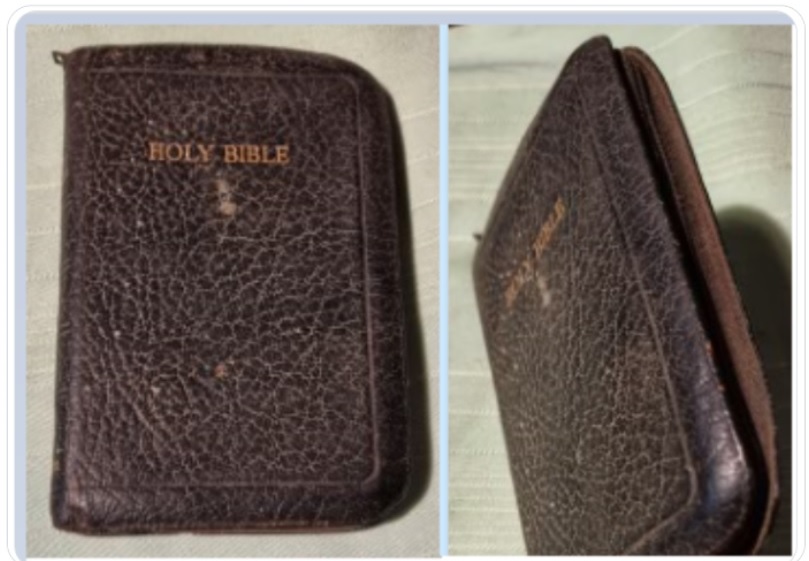
The man who gave me a Bible had left the Hell’s Angels, Auckland Chapter (A chapter of the Hells Angels motorcycle club was formed in Auckland in 1961, the first Hells Angels chapter outside the US) because he fell in love with a born-again Christian. He took a liking to me and took me goat hunting. It was my first hunt. I helped kill, skin, and butcher the goat. He saw me squirm when we gutted it.

One day, while we were having a piss, he said, “Hey, look at my dick.”

I didn’t know what to do.

“Look at it,” he insisted. “I’m no homo, look at it.”

I glanced down. He laid his flaccid dick on his palm. The word “FISH” was tattooed on it.

“I don’t get it,” I said. “Why have you got FISH tattooed on your dick?”

He laughed as he put it away. “That’s for women who don’t eat meat on Fridays,” he said, then burst into a belly laugh.

I laughed along, thinking he got his penis inked for a joke.

He was a carpenter and wanted an apprentice. I just wanted to visit the community, float on the canoe for a bit, and then move on.

A photo of the Bible the Hell’s Angel gave me.


Unlocking the Mysteries: Pavlos’s Surprising Transformation in His Grandfather’s Study

July 27, 2024

Pavlos sat alone in his grandfather’s study, a place steeped in memories and the faint scent of old books and leather. The room was his sanctuary, a haven where he found solace among familiar objects: the fruit bowl on the side table, the worn chair, and the portrait of his grandfather gazing down from the wall. The dim light filtered through the dusty curtains, casting an ethereal glow on the room. But today, something was different.

The call—he couldn’t think of a better name for it—began as a subtle warmth in his palms. It grew, radiating from the center of his hands to the base of his fingers, eventually reaching the tips. The warmth transformed into a quivering tingle, like millions of tiny feathers stroking under his skin. Startled, Pavlos looked around the room, his eyes landing on the picture of his grandfather. The warmth in his hands faded as he focused on the portrait, but when he redirected his attention back to his hands, the warmth returned.

Intrigued and a bit unnerved, Pavlos decided to experiment. Could he maintain the warmth in his hands while being aware of something outside himself? He chose the picture of his grandfather as his focal point. As he concentrated, a surge of energy raced up from the soles of his feet, halting abruptly near his navel. The energy solidified into a powerful sense of centeredness and balance, filling the emptiness within his chest with a newfound strength.

The sensation intensified, spreading through his body until he felt as though he were aflame from within. Strange symbols and geometric shapes, hieroglyphics, and formulas began to rise in his mind like smoke. His body blazed with a profound understanding that transcended mere thought. “This must be what religious sighs are about,” a voice said. Was it his own thought or something external? Pavlos could no longer distinguish between inner and outer reality. The posture of his body, the position of the furniture, and the entire ambience of the room reverberated through his nervous system, tingling with a new sense of expectation.

Pavlos’s heart raced, his mind spinning with questions. What was this sensation? Why was it happening now? The study had always been a place of comfort, but now it felt like a portal to another dimension, charged with an electric anticipation that made his skin prickle.

The sense of expectation coiled upwards from the base of his spine like a neon curl, sparking into his body’s nerve circuits a shock of recognition. Pavlos felt a connection to something greater, something ancient and wise. The room seemed to pulse with life, as if it held secrets waiting to be discovered. He could hear the faint ticking of the old clock on the mantle, each second amplifying the intensity of his experience.

He closed his eyes, allowing the sensations to guide him. His breath deepened, and he felt as if he were floating in a sea of energy. The warmth, the symbols, the voice—they all merged into a single, harmonious experience. When he finally opened his eyes, the room looked the same, yet everything had changed. He felt more alive, more attuned to his surroundings and to himself.

Pavlos realized that the call was an invitation to explore deeper aspects of his consciousness, to unlock potentials he had never known existed. A wave of emotions washed over him—curiosity, excitement, and a bit of fear. With a sense of purpose and curiosity, he embraced this new journey, eager to see where it would lead. The study, once a place of solace and memories, had become a gateway to a realm of profound discovery and self-awareness. As he stood up, the portrait of his grandfather seemed to smile down at him, as if approving of the path Pavlos was about to embark on.

The adventure had just begun.


Xenitia: Nostalgia and Hardship in 1960’s Redfern, Sydney

June 30, 2024

First came the men in suits, then the bulldozers and the trucks, then the porta loos and cranes. Each day saw another house, shop, tree and a child’s doll knocked down and pulverised. Things that mattered all turned to scrap and dust. The bull dozers scraped the rubble into piles of broken bricks, concrete slabs, shattered glass and newspaper. The dust rose from under the wheels and steel jaws of the machines and swirled in the breeze. In that part of Redfern, Sydney the whole street breathed the demolition dust so holding your breath was hard. It got into clothes and between cracks along walls’ edges and footpaths. For Athena and her son Kosta, a walk down Young Street was not the easiest place to breathe.
For over three months, every day, people on Athena’s side of the road swept away sand and dust that blew from across the street onto their doorsteps. If they weren’t quick enough shutting the front door, the wind blew the sand down their narrow hallways. Every house had something tucked behind the crack between the door and the floor. Old towels, old clothes tied together, anything to stop the debris entering their homes by the wind.


As Athena opened the door, she said, “Kosta, close it quickly. We don’t want a desert in our house.” Kosta took a long look at the growing rock piles across the street. The wind blown sand prickled against his face and arms. He stepped into the hallway, sand grains tick, tick, ticked in pitter- patter against the shut door behind him.

Down the hallway, through the door, his father George squatted in front of the Kriesler radio. “Ssshh!” he said while turning the hand sized dial, “I’m looking for Greece.” The radio squawked and squealed, struck static, voices fell in and out in different tongues. Near the radio, on the table were coils of wire, screws, a rusty wire cutter and pliers. Out of the static a muffled sound came through the speaker. Then, full blown clear chimes of a bouzouki sounded from the radio. “Oppa! Ellada – Greece!” He brushed back his speckled grey, black hair with his hand. George stood up to face his wife and son. He nodded his head to the rhythm of the music, short waved all the way from Greece.


“Even in his singlet, without a shirt, he looks fully dressed,” thought Athena. George jutted his arms out to his sides, then slowly reached with his right hand for Athena. He caressed the scarf covering her hair. He returned his arm to the outstretched position and clicked his fingers, he danced a short hop to the music. Athena smiled and sat on the only soft chair in the house under the window. She took off her shoes and scarf letting her black curls fall around her face. “I fixed the antennae,” George said in Greek. Kosta stood near the cupboard with a mirror wall and glass doors. It housed the best cups and saucers for Greek coffee and small glasses for drinking ouzo and larger ones for wine and glaced cherries. Framed photos of family in Greece and their own small family in Australia covered the top of the cupboard.

Athena reached for a photo as George said, “Well, what did the doctor say?”
“Do you know what today is George?” asked Athena.
“Good Friday,” he replied.
Tears welled in her eyes, she crossed herself with her right hand while holding the photo with her left. She said, “Today, three years ago, Aliki died.” Tears trickled down her cheek. She pointed to a baby in Kosta’s arms, “Three years ago, today, my baby girl died.” She bent her head and kissed the photo. George stepped closer to her and took the photo from her hand and placed it back on the cupboard. He reached to touch her wet chin with his hand, “Athena that was three years ago. What did the doctor say today?”
“He said I have broken nerves, you tell him Kosta, you know English better than us, tell your father what the doctor said.”

George looked at Kosta, his 12 year old boy was strong, a pallikari and he had his father’s eyes. “Well son, what did the doctor say?” Kosta kept his hands, fumbling some marbles, in his pockets,. “The doctor said that mother has, I don’t know how to say this in Greek – “nervous breakdown” – her nerves, her nevra are broken.”
“What do you mean broken nerves? She looks alright to me.” George turned to face her, “Athena, what is it? What ails you?”

She wiped the tears from her face with her sleeves, took a deep breath and leant forward letting out a long sigh. “Oh George! What ails me? I want to go home. I want to be with my family, be able to walk the streets and breathe Greek air !”


Before George could answer she screamed, “VROOM! VROOM! all day, 12 hours a day VROOM! VROOM! The machine pricking my fingers and the boss yelling – FASTER! FASTER! VROOM! VROOM! – I want to go home. I don’t want to sew Akubra hats anymore!’ she sobbed. Her upper body folded forward and her elbows rested on her thighs while her head weighed on her hands. She didn’t look up, nor sideways, with no expression she stared at her feet. George moved closer, leant forward and gently kissed her head. He stroked her hair, slowly weaving his thumb and finger in her curls. By now he was on his knees in front of her. “Wife, you are suffering from xenitia – home sickness, that is all. I want to return as well. Do you think I enjoy my work at the Brewery?” George whispered, “ We just need another two years,” Athena did not lift her head, “The doctor said, no more overtime, better if I don’t work at all,” she replied.


George stood up and turned his back to her. He pointed to the black and yellow calendar hanging on the glossy white wall opposite them. “Look,” he said, “It will be no time at all… two years will run by.” Athena stood up and put her arm around his waist. Instead of looking at the calendar, her eyes were on the boxed stephania above it. The wooden box had six sides with hand painted green vines and black grapes, there were faded spots and some paint had chipped off. Under the clean glass cover were the stefania, the crowns of love joined by a white ribbon and worn on their wedding day. The stephania boxed on the wall were their life – husband and wife – a union for God.

“Yes George, time runs by fast. Already we have been here for 8 years and you promised we would be back in five.” She squeezed his waist with her arm pulling him closer. “Look at the stephania George,” she purred. She let go of him and returned to her soft chair feeling snug in its space. “I want to go home now. I need to go home now but not without you and Kosta. Please, we can do it – let’s go.”


Athena turned to Kosta who was on the floor playing with a lead airplane, “Kosta, bring the letter from Greece to your father.” Kosta stood up tucking his shirt into his shorts and walked to the cupboard. The letter was under the photo of him and Aliki. As he lifted the letter the photo dragged over the edge falling to the floor. Kosta immediately bent down to pick it up. The fall left a lightning crack zigzagging across the middle of the glass. Kosta stared at the little girl, his sister in his arms. He was wearing his cowboy gun holster at his waist, as long as his shorts, carrying a Colt 45 cap gun. He remembered the time it was taken, just a few months before she died of pneumonia. He was nine and she was two.


“What did you do!?” yelled George as he rushed towards Kosta. George raised his right leg ready to kick him. “Stop it! Stop it!” screamed Athena, “Don’t touch him!” she stood up quivering and crying. George stopped and let his kicking foot step onto the photo crushing the glass into a tight spider web of cracks. He snatched the letter out of Kosta’s hand. Kosta crouched still and silent waiting for a hit across his head. It didn’t come so he crept backwards in a crouching position until his back was against the wall. He was out of range and he knew from experience that this wall was the best because it was beside the hallway entrance and provided a fast exit. Kosta knew that if he didn’t do anything, just stayed there, everything would be alright because his father was walking towards his mother with the letter and photo in his hand.


“We’ve already lost a daughter, do you want to kill your only child?” George placed the photo on the table near the wire cutters. He looked at Athena sitting there and saw her sick and beautiful. He saw his love. He fell on his knees and rested his head in the crevice between her thighs. She caressed his hair, running her fingers from his forehead to the back of his head. His hand holding the letter rested on her hip. “Athena, I want to return home and work as a silversmith and be with our family.”

He saw Kosta sitting quietly against the wall. George lifted his head slightly from her lap, raised his eyebrows and nodded his head at Kosta. This meant that he could go and play. It was like that, gestures and signs for words. Kosta got up, smiled and ran down the hallway, opening the door to the wind and dust and a direct view of the demolition site.

He heard his father call out, “I’ll whistle for you!”


Draft of First Chapter of a Book I’m Writing

June 5, 2024

I know this is unusual for a writer to post a draft of a first chapter of a book they are writing. As those who write know, writing is lonely. I’m about 3/4 of the way through with the first draft of my book and I have no idea how it will be received. It is based on my trip to Turkey looking for people who knew or are related to my grandparents who were Pontic Greek refugees during the holocaust in Turkey in the 1920’s. Let me know what you think in the comments area. By the way – Papou means grandfather and Yiayia means grandmother in Greek.

====================================================

“You can’t go there! You’d be crazy to go,” he grabbed the towel on the chair and wiped his face, “This is not Australia; this is Greece, and you want to go to the village where your family was massacred in Turkey!” He cocked his eyebrow and wiped the corner of his mouth with his finger. We were in the kitchen. Light streamed through the window, leaving a vivid white patch on the tablecloth.

He leaned towards me with specks of sawdust in his hair. He said,

“Why go there? You can have a holiday anywhere but want to go to Bafra. Do you know how far it’s from Constantinople?”

His singlet was sweaty, and his boots and pants were spattered with cement. He sat on the fruit box, tugged at his shoes, and placed them beside the broom.

How do I explain my motives to Taki? I flew from Australia, and now, after over 40 years, I am back in my birthplace, Yannina, Greece. I wasn’t always going to be so late returning to where I was born, but raising kids and lacking money meant I couldn’t go. My father’s death made it possible for me to return from the Great Southern Land to Greece. I was a late prodigal son, now a stranger and not a son.

We migrated from Greece when I was four years old. All my memories and pictures are of a child – rolling down a hill, the log bridge I crawled across so small and scared, stuffing olive seeds down holes in the floor. My father’s recent death shocked me into looking at my life. The hourglass sand days and moments flipped over. Thoughts were framed with death, the fence around life. But after that, what? I couldn’t think of a better place to be than on the Holy Mountain celebrating Easter with these and other questions, breaking bread with monks.

“Look, I understand…..you don’t want me to get hurt,” I said

“Hurt! That’s what you call it. Hurt? I don’t want you killed! Are you stupid or what? If you go to Bafra, my dear cousin, you will either be killed or bashed to a pulp. Same thing. It’s that simple.”

He knew that as a fact.

I meticulously planned my journey from my home in Sydney over many years, studying a world map. My gaze lingered over Asia Minor and Greece, retracing the paths of my ancestry, both in blood and spirit. Countless times, my finger traced along this route. First, it pressed upon Athens, then Patras, followed by Yannina, and further to the Holy Mountain. From there, finger by finger,  it went towards Turkey, Syria, Jordan, Israel, Mount Sinai, Cairo, and back to Athens for my return. Later, I would repeat this ritual on the computer, using a cursor and a click to delve into the two-dimensional world of maps. It was a voyage of dreams, one I had envisioned for years.

Upon learning that my mother was the child of refugees, the desire to visit the land from which my grandparents had escaped grew within me. I was born in Greece to a Pontic Greek mother and a mainland Greek father. My mother seldom spoke of her heritage, save for a few passing remarks, like, “If you think Aboriginal people are mistreated, you should have seen how we were treated in Greece!” Whenever I asked her to elaborate, she would sidestep the question. Thus, I lacked a label for my identity for the longest time — I was Greek. That was it. Until much later, I discovered I was a Pontic Greek because my mother was Pontian.

After migrating to Australia, I never had the chance to see my grandparents again. We departed Greece when I was four years old. While my father’s parents perished at the hands of the Nazis during World War II, my mother’s parents were alive when I came into this world. Turkish was the initial language that enveloped me from birth until age four. I learned this recently. My mother informed me that the Greek government had made it illegal for Greek refugees from Turkey to speak Turkish, insisting they only use Greek. It must have been a challenge if they didn’t know the language. Nevertheless, in the village of my birth, predominantly inhabited by refugees from Turkey, Turkish was spoken within the confines of the home, only giving way to Greek when outsiders visited.

So, why were there Greek refugees from Turkey? My mother never disclosed the details. Even my father remained silent on the matter. Thus, I knew nothing about the Greek Holocaust until much later in life. My mother either didn’t wish to divulge the information or was unaware. As the youngest, she wasn’t born when my grandparents fled Turkey.

“Taki, I simply want to look at the village where our grandparents resided before they were forced to flee Turkey. It’s been over 80 years since that happened! I yearn to find someone who knew them. Everyone in our family perished in Turkey, except for our grandparents. I’m curious to witness that place. I never had the opportunity to know my grandparents as you have. My parents whisked me away to Australia when I was a mere four years old. I spent my days on the opposite side of the planet, growing up and becoming a father. This morning, I finally visited Papou’s and Yiayia’s graves. And that’s precisely why I’m bound for Bafra—to connect with my ancestral roots.”

I couldn’t reveal to him that my journey harboured other destinations and motives, such as Konya in Anatolia, where I wished to pay homage to Rumi, the Sufi saint. I feared that if I disclosed this, he would utterly panic and misconstrue my intentions. In his eyes, being Greek equated to being an Orthodox Christian, and displaying any interest in Islam aroused suspicion. It pressed all the wrong buttons.

“Ah, Stavro, you think like an Australian, but history intertwines whether you like it here. One glimpse of you, and they’ll recognize you as a Greek. Then, that’s it…you become a marked man.”

I took a seat at the table, the coffee still steaming. Taki settled across from me. “What’s this? I’ve toiled all day under the scorching sun, constructing a chicken shed, and you haven’t offered me a cup of coffee!” He grinned.

I poured him a coffee. His slender hand clasped the small, white cup while his other hand gently tapped the tablecloth in rhythm with the melodies wafting from the adjacent lounge room.

“So, is this the reason you have yet to embark on your journey to Bafra to see the homeland of our grandparents? It’s just a few days away by train and bus, yet you haven’t set foot there? I find it hard to believe that you lack the curiosity to see where they came from.”

“That’s the thing. Turks in Constantinople are tolerable; they’re city folks. But beyond the city, in the small towns and villages, Greeks face peril. Bafra, a small town on the Black Sea coast, lies over a thousand miles from the city. You don’t speak Turkish, and you can’t disguise the fact that you’re Greek. I don’t know if they still rely on donkeys and horses for transportation. You’re venturing into history, into suffering, into genocide. It’s perilous for a Greek, and there won’t be any tourists or travellers because there’s nothing to entice them. So, you’ll be on your own. Anything could befall you—imprisonment, remember the movie ‘Midnight Express’? And no one will come to your aid. I can’t think of anything more foolish than spending your vacation on that.”

“You forget one thing—I’m Australian. That’s what my passport says. Even if I don’t meet anyone, at least I can return to Australia with a collection of photographs depicting the area. Honestly, Taki, I believe you worry too much,” I remarked.

“How do you expect to find someone connected to our grandparents? You don’t have an address, you can’t speak Turkish, and no soul speaks English or Greek where you’re heading. You’re a Christian, they’re Muslim—remember, their ancestors massacred Greeks and Armenians by the millions. You do not understand what you’re getting yourself into, and I can’t bear the thought of not warning you.”

“I won’t be undertaking this journey alone.”

“What do you mean? Who’s accompanying you?”

“Well, I’ll depart for Easter for the Holy Mountain in a few days. Being there will guide me to someone who knew our grandparents, even if I can’t speak Turkish.”

“What? Will praying alongside monks in a monastery assist you in achieving your goal? Are you serious? You’re out of your mind. I had no idea you were a religious man.”

“I’m not religious if you measure it by church attendance. Besides, I had planned to visit the Holy Mountain with my father before he passed away, and now seems like the perfect time to fulfil his wish. I believe that extraordinary things can happen, and since I only have myself, why not seek the support of others who may aid me in some way? I believe that merely being on the Holy Mountain for Easter will help my desire come to fruition.”

“I don’t understand you. You’re an educated man—the first in our family to obtain a university degree. You use computers and hold a respectable job with great responsibility in Australia. How can you believe in superstitious nonsense like God, prayer, and the notion that Mount Athos and its monks hold any value? How can monks on a mountaintop in Greece assist you in Turkey? These are the things peasants or,” he widened his eyes, “madmen believe in!”

While I wasn’t a regular churchgoer, the word ‘pilgrim’ resonated with me more than ‘tourist.’ Pilgrims embark on a personal quest for truth regardless of faith or belief. I sought truth, and I craved tangible evidence of that truth. Was I a sceptical pilgrim? Was I a doubting Thomas with time on his hands?

“Have you ever been to the Holy Mountain?” I inquired.

“No, and I never will set foot there. If I ever do visit, it’ll be a day trip as part of a tourist group—take some videos, snap a few photos, and maybe buy a souvenir. But there’s no way I’ll ever spend the night and sleep there.”

“Why is that?”

“It’s those monks. They possess powers—they can see right through you. I’ve heard that once you converse with a monk from Mount Athos, they see your lies. You know, as if they have X-ray vision into your soul.”

“The X-ray eye? I’ve heard of the evil eye, but is that its reverse? You’re afraid of something you don’t even believe in.”

“Just because they possess powers doesn’t mean they converse with angels and grapple with demons. They are formidable men, and I don’t want any man peering into my soul,” he said.

“So, you’re suggesting their powers don’t come from God?”

“Nor the Devil.”

“Then where do they come from, if not God or the Devil?”

“They emanate from within themselves. How would I know? Look, there’s no way I would go to Mount Athos or Bafra. I can’t fathom your mind. You’d rather visit a monastery than Mykonos and its discos. And you’re alone—your wife is on the other side of the world—you’re on vacation. Enjoy yourself! You don’t even have a video camera! Being from Australia, everyone expects you to have money… You do have money, don’t you?”

“I have enough for my journey and to return to Australia.”

I displayed my discount watch from the supermarket. I pulled my inexpensive snap camera from my shoulder bag on the chair. “I don’t want to fret over possessions while I’m on the move. Besides, who would want to steal my watch or camera?” I chuckled.

“So, you’ve got it all figured out, huh? You want to be invisible, just like the common folks. Well, good luck with that,” he laughed.

He rose to freshen up and change.

“Tomorrow, I’ll be your tour guide. I want to take you to a special place—a wax museum showcasing the history between us and the Turks, created by the renowned Greek sculptor Pavlos Vrallis. The real history. You’ll see wax figures dressed as your grandfather and grandmother did when they arrived in 1922.”

“You know, I was in Constantinople a few months ago.”

“What? How was it?”

“Turkey was ravaged during the massive earthquake in 1999, just like Greece, but the Turks suffered even more. Many Greeks went over to lend a hand. What do you do when you witness 100,000 people perish next door? But sharing this doesn’t mean I share your enthusiasm for going to Bafra. I told you, a big city, a big heart— a small village, a small heart.”

“That’s nonsense. Do you realize we’re in a small town right now? Does that mean everyone here has a small heart? What about those monks with powers residing on an isolated mountaintop—do they possess small hearts? Do you believe that New York and London people have the biggest hearts?”

“You seem to have all the answers. Later, I’ll take you to my workshop. I want to show you some silverware I’ve been working on. I’m crafting the Passion of Christ in bronze for the local church.”

“You’re full of contradictions. You don’t believe in God and consider religious people foolish, yet you’re sculpting the life of Christ in bronze for a church!”

“There’s no contradiction. Priests want that image, and they pay me, and I make my living. I’ve been asked to make all sorts of designs by all sorts of people. To me, they’re all the same – paying customers. The local priest wants that design, and I give it to him for a price. It’s that simple. It puts bread on my table. So, yes, I suppose I can thank God for that!”

“Ah, Stavro! How good it is to see you this morning, to hug you!” she said, “I remember you as a baby. The last time I saw you was before you left for Australia. You crawled on the floor, picked up crumbs, and put them in your mouth. Along with the crumbs, you picked up some dirt. As you ate the bread, the dirt became mud, dribbling down the side of your mouth. Soon all your mouth was covered in mud!” She laughed between the tears. Yes, we were hungry…and now here you are, returned from Australia …a palikari!” she hugged and kissed me on my eyes, forehead and cheeks. She smelt of fine mint, “Come, let me see you,” she stepped back with her hands on her hips, her white hair in a neat bun on top of her head. She looked me up and down and broke into tears. We held each other. Demoklia was my aunt, Takis’ mother.

“Mother, he’s going to Turkey in a few days to visit Bafra,” he said half whispering.

She either did not hear him or decided to ignore it.

“You have so much to learn. Your mother didn’t tell you the whole story,” she said, taking my hand resting on the table. Her clasp was like a child’s, only a little more brittle, her hand warm and smooth.

“Did you know we prayed for you, my boy? Your family names were given to our priest and placed on the holy altar. We prayed for you and your family. Your father was a good man.” She bowed her head and crossed herself.

I looked forward to the time when I was not reminded of his death. She looked like an owl, with big glasses that made her eyes seem like saucers. Her white hair was parted in the middle, creating an oval frame straight down the centre. She was my mother’s older sister.

“Your mother was very young when she married. Yes, you were born when she was only 15. A baby is having a baby. We all loved you, and we played with you as a doll. But your mother doesn’t know all the stories, doesn’t know what happened in Turkey because she left to go to Australia. We heard the stories from your papou and yia yia, our father and mother.”

“I only knew my grandparents as a baby and can’t remember them. Now that my father has died, I wish to reclaim my Greek heritage.” I said.

“You have Greek parents, speak Greek, and are Orthodox—you have your heritage!” she smiled.

“I know, but I want to see where my grandparents came from. I want to breathe the air & stand on the ground they stood on.”

I don’t know how much your mother told you about your grandparents, so I’ll share what I know. She sat, hands clasped, leaning in, eyes locked on mine.

Your papou, a brave warrior. And your yiayia, equally courageous. They weren’t into that nationalist nonsense—neither Greek nor Turkish. Their fight was against injustice. When news reached the Greeks that the Turks were massacring our Armenian kin, the Greeks knew they’d be next. They armed themselves with guns, knives, any damn thing they could find. Those readying for battle fled to the hills and hid in caves. Sometimes, they’d venture to towns for supplies and clash with the Turks. But your papou and yiayia, stubborn as ever, stayed in the city despite the warnings of certain death.” She paused, raising her arms high, head held high. A sigh escaped her lips.

“One day,  Greeks were herded into St. George’s little church. Men, women, children, the old, the young—all corralled inside, then the church was set ablaze. They all perished. Greek homes turned to ash. Your grandparents’ house, too, went up in flames. As it burned, everyone fled, chased by Turks on horseback. When Elis, your yiayia’s sister, tried climbing out of the window, a Turk on horseback spotted her and yelled, ‘Too beautiful to burn and die!’ He snatched her up onto his horse. We know ’cause Nicholas, a family friend, hid nearby, half his body burnt, watched it all unfold from the bushes.”

Somehow, your grandparents found their way to the hills and took shelter in caves. After a while, your papou and some men ventured back to town for supplies. They found nothing but ruin—no Greeks in sight. They combed the church, remnants smouldering, smoke twirling in the air. People lay there—charred, some decapitated—their clothes tarnished by smoke and soot. All dead. As they turned to leave, footsteps and gunfire echoed. Your papou gunned down a Turk while they hurried back to the hills. Little did they know that what happened in Bafra would be happening throughout our land.

Soon after, Greeks in the hills and everywhere else embarked on a journey to Constantinople and then fled to mainland Greece as refugees.

“Mother, tell him ’bout yiayia feeding the children during their trek to Greece,” Taki interjected.

“Your yiayia, a remarkable woman,” she said. “One day, after weeks of marching, exhaustion clawing at them, parched and famished, they reached the outskirts of Constantinople. Their group, about thirty strong, stumbled upon a trickling creek offering fresh water. They made camp by that creek that night. No food but water to quench their thirst and a campfire to warm their weary bones.

Yiayia shared the children’s hunger and felt it deep within her gut. With a commanding voice, she called out, “Come, children! I have food for you. Come!” Rising to her feet, she waved her hands, beckoning the children to gather. Soon, seven young ones huddled around her. Before her, a bowl of water sat as the children settled cross-legged or on their knees. Steady as a rock, yiayia held the bowl while her gaze fixed upon them. She spoke, her voice filled with faith, “The Mother of God hasn’t forgotten us.” In her tattered coat, she rummaged, retrieving a small icon of Theotokos—the Mother of God. “This icon shall nourish us,” she declared. The children leaned in, eager for a glimpse. They beheld Mary cradling her child, Jesus. “It’s a sacred icon, capable of miracles. I shall pass it on to you. Kiss it, make the sign of the cross, then pass it along.” Yiayia raised the icon to her lips, pressed a tender kiss, crossed herself, and handed it to the children. Each child, wide-eyed with anticipation, peered at the tiny icon, kissed it, made the sign of the cross, and passed it to the next in the circle. When the icon returned to yiayia, the children’s faces glowed with hope. Yiayia raised the icon above her head, then lowered it gently toward the water-filled bowl, uttering a prayer. Immersed in prayer, she lifted and immersed the icon three times.

When the prayer ended, Yiayia carefully dried the icon with a corner of her dress, stowing it back in her coat. “Now, children, this water is food. Come and eat.” She allowed each child to take a few mouthfuls, and soon, all the nourishment vanished. For that night, the children were fed, their hunger appeased.

I asked, my voice filled with curiosity, “Was it truly food?”

Dimoklea smiled and replied, “Well, the children ceased their cries and complaints of hunger. So, what do you reckon?”

Silent and awestruck, I pondered. After a while, I uttered, “I’m going to Bafra. I must.”

“All right, you’re set on going. I see your mind will stay the same. Stubborn and determined, just like your grandfather. I shall give you something that might aid you in finding people who knew your grandparents in Turkey.”

She rose from her seat and left the kitchen. Our gazes met. Taki shrugged and shook his head. None of us knew what she had in mind. After a brief absence, she returned, clutching folded paper and a photograph.

“Take this photo of your grandmother,” she said. “Your resemblance is striking. Anyone can see it. And take this letter.”

“A letter? What’s in it?” I inquired.

“It’s in Turkish, a letter from your grandaunt, your grandmother’s sister,” she replied.

“I thought everyone in our family was killed in Turkey. How could yiayia receive a letter from her sister?”

“Ah, remember her sister whom a Turk snatched on horseback? You know the tale now, just as well as your cousins do, but they’re unaware of this letter.” She waved the letter in the air.

“So, you’re saying a grandaunt remained in Turkey and might still be alive?”

“I doubt she’s alive now, for that would mean she’s over 120 years old! No, there might be a family who knows her. In this letter to your yiayia, she said she’s married and has children, and one of her children wrote it for her.”

“Hold on, hold on. It’s all happening too quickly. How did yiayia know where to send the letter?” I asked, shock evident in my voice.

“Yiayia simply addressed it to Bafra with Elis’ name on the envelope. People know each other in a village, and that’s how your grandmother’s letter reached her sister.” She paused, ensuring she had our undivided attention. “Now, I’ll translate the letter from Turkish.” Opening the already yellowed paper, she began reading it in Turkish, sentence by sentence, translating it into Greek.

The essence of the letter conveyed her immense joy upon receiving yiayia’s letter. She spoke of kissing her eyes and forehead, embracing her. She acknowledged that life continues, and although she’s now a different person and a mother, deep in her heart, she knows her true identity.

“Now, the most crucial element of this letter is the address from which it was sent—Kafkas Hotel, Bafra. Take this letter and the photo. The photo will reveal the physical resemblance to your grandmother. At the same time, the letter, written in Turkish, will indicate whom you seek and why.”

My cousin approached to examine the letter and photo in my hand. I declared, “Already, I have a solid starting point in finding someone who knew Papa and Yiayia. I might even discover relatives!”
Taki chuckled. “Well, you might find someone, but it might not be pleasant.”

I gazed at the photo and saw a similarity in the contours of our faces. As I observed the handwritten Turkish script in the letter, I perceived it as a gateway to my heritage and lineage.


The Quest for Inspiration

April 18, 2024

The oppressive Australian heat bore down as I trudged along the endless road to the small Queensland town where my friends had once lived. Car after car whizzed past without stopping for the wayward traveler. After hours of walking under the relentless sun, I finally reached my destination only to find their house abandoned – they had moved on.

Feeling lost and alone, I sank onto the front step, uncertain of my next move. That’s when the wizened old man appeared, his weathered face seeming to defy the laws of age itself. He fixed me with an inscrutable stare for a long moment before speaking.

“Your mates are gone. But you’re in luck I’m still around.”

His humble shack was a one-room timber structure that emanated an odd warmth, the air carrying the scent of freshly-hewn wood. We sat on tree stump stools as he poured our drinks. I explained that I had come to Queensland seeking inspiration to work on my thesis about the mystical poetry of William Blake. His response took me by surprise.

“Ah, Blake could perceive the hidden truths, my friend. The rest of us are blind to such mysteries.”

This peculiar old man had me rapt as he delved into the sacred geometries, the mystic language of numbers, and how words and logic obscure the greater realities. His words wove together theosophical concepts and Pythagorean numerology.

“Within these corporeal shells, we are mere observers,” he proclaimed. “Catching fleeting glimpses of the vastness through sensory keyholes.”

I could only listen in silence as he added with a sage nod, “Having nothing to say may be your salvation.”

As I bid farewell to the enigmatic stranger, stepping out into the crisp air, the world itself seemed transformed around me. The return journey, hitching rides and passing through landscapes both familiar and foreign, carried an ineffable sense that I had been granted a glimpse into something far greater than myself.

With each passing car and transient vista, I felt I was traversing the synapses of some vast cosmic mind, every experience and perception flickering like synaptic connections within the neural network of a greater consciousness. Finally arriving home, I marveled at the profound interconnectedness of it all. I could taste the words Blake had penned in “Auguries of Innocence“:

To see a World in a Grain of Sand

And a Heaven in a Wild Flower

Hold Infinity in the palm of your hand

And Eternity in an hour

What once seemed an impossible task no longer felt so hopeless. The thesis that had tormented me for so long now carried the promise of insight and meaning.

==================================================================

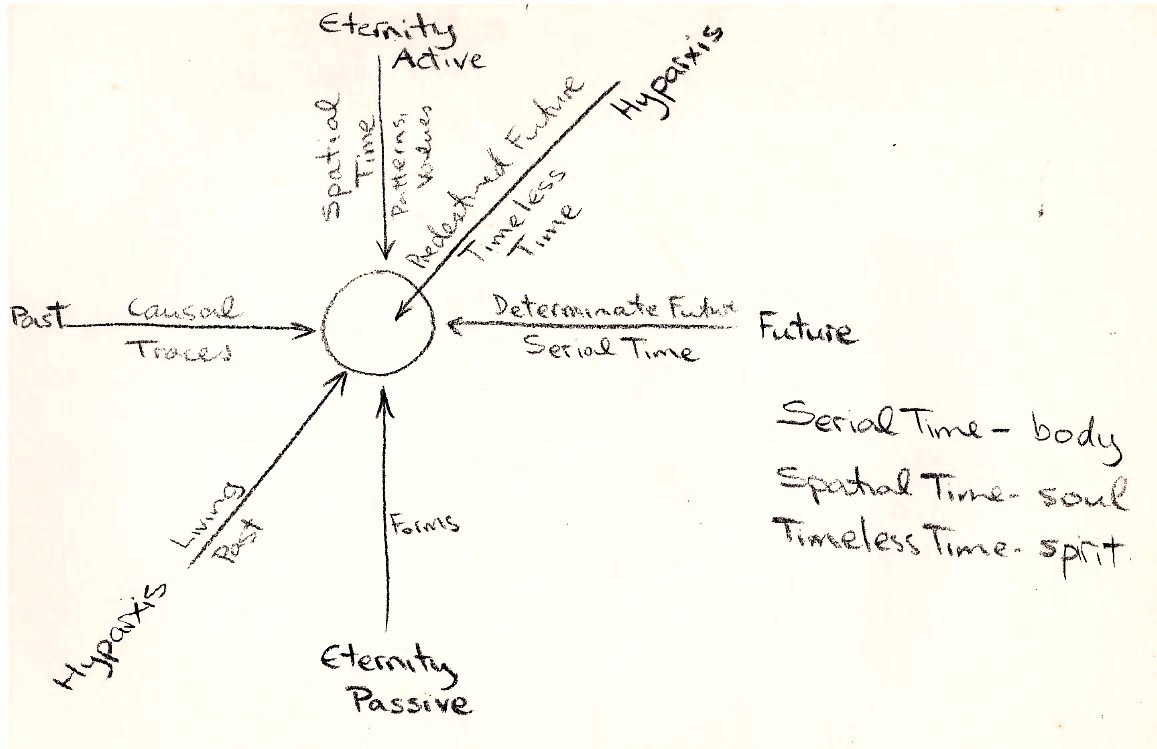
The above event demonstrates for me the ideas of synchronicity and hyparxis. Below is a schematic diagram of a “MOMENT”. It shows 3 dimensions of the ‘moment in time’ – Serial Time, Spatial Time and Timeless Time. This diagram is based on J G Bennett’sDramatic Universe‘ where he explores these issues of Time. Yes, it’s my hand drawn version!


Some Secrets Are Best Left Undisturbed.

April 8, 2024

There were no rainbow hues crowning the dilapidated house across the asphalt. A lone weed struggled through the crack in the cement to greet the constant passersby. She could empathize with the weed, “What’s a weed but a plant discarded from the mob?” she thought.

Her hair, from a distance, looked like a lion’s mane. Up close, what you thought was hair was clusters of thin lines of flame with light blue ends. Was she an angel? A messenger of fire descended into this neighborhood? Just an illusion to occupy a mind that’s locked into a cube space? Could she be both? Like a profile that is a vase from one view or two faces turned inwards from another. How long she has been watching is anyone’s guess.

Detective Claire Harper parked her car across the street from the dilapidated house. She had been assigned to investigate a series of mysterious fires that had plagued the neighborhood in recent weeks. Each blaze seemed to erupt without warning, leaving behind a trail of destruction and confusion.

As she stepped out of her car, Claire couldn’t shake the feeling that she was being watched. She scanned the area but saw no one except for a woman standing near the weed-infested sidewalk. The woman’s fiery hair caught her attention, and Claire approached cautiously.

“Excuse me, miss,” Claire called out, “I’m Detective Harper. I’m here to investigate the fires in the area. Have you seen anything unusual?”

The woman turned to face Claire, her eyes burning with intensity. “I’ve seen everything,” she replied cryptically.

Claire raised an eyebrow, intrigued by the woman’s response. “Can you tell me what you’ve seen?” she asked, taking out her notebook.

The woman hesitated for a moment before speaking. “I’ve seen flames dancing in the night, consuming everything in their path. But I’ve also seen something else, something darker lurking in the shadows.”

Claire furrowed her brow, trying to make sense of the woman’s words. “Do you have any idea who might be responsible for these fires?” she pressed.

The woman shook her head. “I cannot say for certain,” she replied, her voice trailing off. “But beware, Detective Harper. Not everything is as it seems.”

With that cryptic warning, the woman turned and disappeared into the shadows, leaving Claire standing alone on the sidewalk.

As Claire continued her investigation, she couldn’t shake the feeling that there was more to the mysterious fires than met the eye. And as she delved deeper into the case, she would soon discover that some secrets were best left undisturbed.


The Word Becomes a Sliver

February 2, 2024

In the realm of writing, a mere word holds extraordinary power. Picture a daring adventure, where the word becomes a sliver teetering on the edge of a cliff. As it takes the plunge, penguins hurriedly scuttle to the beach below, creating a lively spectacle. Amidst this scene, a lighthouse casts its beams, revealing a sea monster whose eye glistens with the reflection of light. Adorned with a black eye patch, loose curls framing its face, and a glimmering earring, the sea monster raises a glass in a toast.

“Here’s to all those who have fallen and who are lost,” it declares. The gathered group responds with cheers, recognizing that this celebration is a reflection of their own journeys. Each word present has traversed a significant path, and the acknowledgment of this shared experience binds them together. It’s not about solitude but rather the realization that, like stars in a constellation, they are connected. Words in a sentence, in a paragraph, in a chapter, in a book, in a library.

Amidst the festivities, a crab scuttles beyond the tabletop, making a daring descent to the awaiting floor. However, this creature is not a Cancer; it’s a Leo on a quest for its crown.

In contemplating the act of writing, one discovers the challenge of doing so without deliberate thought. Yet, beneath the surface of these randomly chosen words, there lies an unspoken voice, ready to articulate the depths of the human experience.


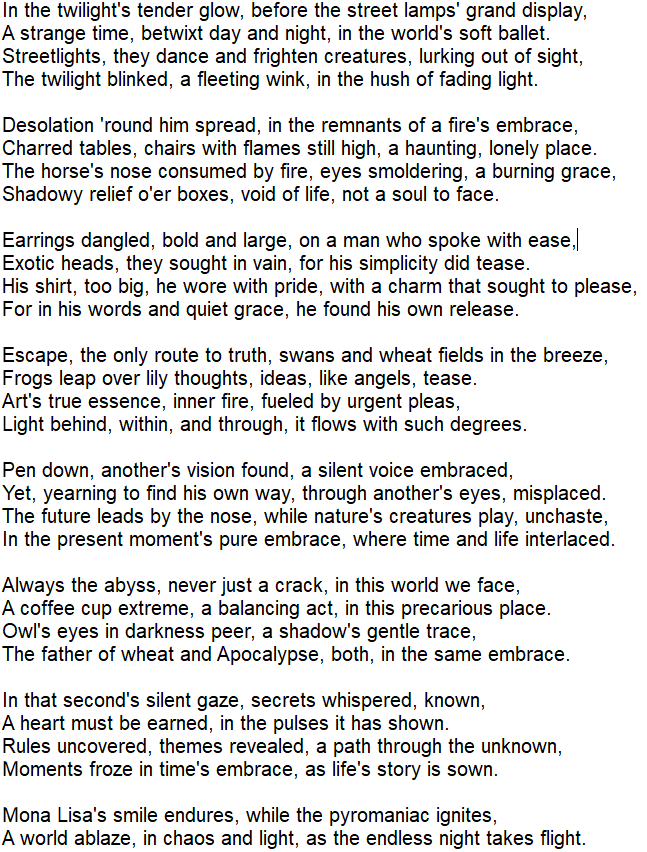
Mona Lisa’s Smile Endures

September 28, 2023


A Domesticated Haunting

September 11, 2023

In the heart of the city, nestled between towering skyscrapers and bustling streets, there was a tumbledown building that looked like it had been swept off the floor above. The stairway leading to the basement creaked with every step, and the dim light barely illuminated the old bench and the many different shaped and sized bottles that sat on top of it. As I walked further down the stairs, I couldn’t help but feel a sense of longing in the house, as if the space had been abandoned and forgotten.

What was stranger still was the different hues that were projected on the walls. Clouds don’t hang around here, yet the colours that danced on the walls looked like a sunset over the ocean. I couldn’t explain it, but I felt drawn to the strange and haunting beauty of the space.

As I explored the basement, I stumbled upon an old newspaper with a date that was a couple of days ahead of the actual date. The eerie feeling in the air grew stronger as I read the headlines. It was as if I had entered a zone of causes, a space where past and present collided.

Suddenly, a snowflake of coincidence fell upon me. I heard the floor creak again, and my heart skipped a beat. But there were no people, just the occasional pigeon cooing in the distance. As I turned to leave, I noticed a pair of owl’s eyes staring back at me between the limbs of a tree outside the window.

On my way out, I passed a group of kids gathered under the great concrete anchor statue just across the street from Circular Quay. They were blowing bubbles, their rhythm setting up the pulse of activity. I couldn’t help but wonder about the mysteries of this midnight age and the secrets that candle makers hold about souls.

Perhaps it was just my imagination, but as I left the tumbledown building and walked down the street, I felt like I was being watched. I remembered the warning to beware the exhibitionist and the guru, for they speak with tongues of fire. But as I looked around, there were no gurus or exhibitionists to be found, just the bustling city and the occasional rumbling bus.

The haunting that I had experienced in the basement had been domesticated, and I couldn’t shake the feeling that perhaps these problems of vision had to do with something greater than myself. Something precariously balanced, like ash from an overladen cigarette.