Ink and Invitation

October 31, 2025

“We call things into being long before we realise what we have invited.”

Some people will say I’m strange for noticing this — but lately I’ve been unsettled by how many walk the streets carrying death and darkness on their skin.
Skulls grinning from shoulders.
Demons curled along arms.
Faces twisted in torment inked into chests and backs.

They remind me of some very bad acid trips I had in the early 1970s — when the veil tore too far, and I didn’t know how to close it again.

People say, “It’s just art.”
But I’ve lived long enough to know symbols aren’t neutral.
They call. They invite. They open doors.

I’m always reminded, when I see rebellious young Greeks covered in tattoos, that in ancient Greece these stigmata were not marks of identity or defiance.
They were punishments — burned or cut into criminals, slaves, and prisoners of war. A permanent sign of ownership — of being claimed.
Our ancestors believed that what was carved into the skin also carved its meaning into the soul.

For thousands of years, humans carried symbols for blessing — crosses, icons, beads, prayers folded into pockets, saints’ names whispered under breath.
We understood that what we placed close to the body had power.
We understood to be careful.

I carry a cross given to me by my mother when I was a child.
She told me it held a tiny splinter of the real cross Jesus was crucified on.
She warned me never to open the locket because the splinter was so fine my breath might blow it away.
So I never opened it.
And I wear it every day.

People ask if I was never curious.
But if it was real — and I breathed it away — what then?

Wearing a cross around the neck is not the same as inscribing a cross into the skin.

I’m not judging anyone.
I’ve walked my own shadowed paths.
I know what it is to open a door without realising what enters with it.
So when I say these images feel like invitations to something dark — I say it softly, from remembering, not from any desire to be right.

Some will disagree. Some will shake their heads.
That’s fine.

But I won’t place an image alongside these words.
I have no wish to give those symbols more room than they already take.
To show them would be to help them travel.

So I speak quietly here, without pictures:

There are forces we forget at our own cost.
And disbelief does not protect us from what we call forth.

No argument here — only a feeling I could not ignore.

That is all.


The Bucket and the Sea

October 11, 2025

Written two decades after the Flotillas of Hope voyage — a small act on a wide sea that still echoes today.

The Bucket and the Sea

They call it a bucket list now — a catalogue of things to consume before death. Mountains to be conquered, rivers to be cruised, skydives to prove we were here. It sounds brave until you see the queues — climbers waiting their turn to summit Everest like shoppers at a checkout. Even the gods must turn away.

My own list was never written. It unfolded quietly, without permission. One day it became a voyage — a small flotilla bound for Nauru, its sails stitched from conscience rather than canvas. I had never sailed before, but joined those who had — experienced skippers who trusted purpose as much as compass. We went not for glory, but to bear witness — to shame our own government into releasing those who had been forgotten.

We never reached the island. Navy boats met us on the horizon, their warnings slicing through wind and salt. We turned back, our message carried instead by waves and news wires. And somehow, impossibly, it worked: seventy-seven refugees were released. Not because we were powerful, but because the sea has a way of amplifying truth.

There were no medals at the end, no television crews waiting on shore. Just salt on our lips and a strange, enduring silence — the kind that follows when the world briefly tilts toward justice.

So when I see others chasing their “bucket lust,” when they pay for their Everest or their Rhine cruise, I remember how it felt to sail into the unknown with nothing to sell and everything to lose. That was the real summit — a crossing not upward, but outward, beyond the self and into something vast, unforgiving, and sacred.

Some journeys are not about ascent. They are about surrender — and the rare, salt-stung moments when the wind itself seems to whisper: You’ve already arrived.


Flotillas of Hope was a 2004 Australian humanitarian voyage protesting the offshore detention of asylum seekers on Nauru. Although the boats were turned back by naval patrols, the action drew international attention — and soon after, of the hundreds detained, seventy-seven refugees were released.


The Stone Seeker: A Myth of the Wandering Soul

October 2, 2025

A departure from my usual posts — this one takes the form of myth, an inner journey written as an allegory. I offer it as a companion to my ongoing stories.

He was called Stavros, which means Cross, and that was his burden — and his path.

One day, in a time that was no time, he heard the silent summons. Not from the sky, but from the pulse within the earth. He set out, carrying nothing but his breath and the ache of questions. He climbed the ancient spine of Sinai without sleep, ascending stone upon stone, as if walking up the ribs of a forgotten god. At the summit, the sun did not answer him — but it showed him he was not alone.

The descent was harder. That is the truth of all peaks. He reached the foot of the mountain and sat by the monastery of Katherine, where silence grows like lichen on old stone. There he met the Gatekeeper — a monk whose heart had fossilised into ritual. Stavros spoke the sacred tongue, but the Gatekeeper did not recognise him. He uttered the Word — “Yunan” — and dismissed him like a leaf blown against the stone walls.

So the Seeker left the sacred walls and returned to the road. It was on this road that he met the Trickster Guide — a Bedouin named Mohamed, who spoke through music and mischief. He offered herbs not for healing but for vision. He rolled a joint while guiding the chariot at great speed. Smoke curled like a serpent toward the heavens, and the desert began to shimmer.

Mohamed showed him the living map: dunes that were coastlines, mountains that were camels in repose. “This is Sinai,” he said, “and there is the Red Sea.” In that moment, the Seeker saw geography become prophecy. The land was not just land — it was a scroll unrolling.

Mohamed led him to a mosque, a café, a grove of planted trees. “We are of the 15 tribes,” the Guide said. “We plant what will shade the unborn.” The Seeker ate with him, drank the dark tea of mystery, and vanished into moonlit streets.

Then came the Labyrinth.

In the night city, he was lost among alleyways, where cats whispered secrets and doors led nowhere. He emerged by chance, or fate, and met the Scribe, who wrote his name in the language of the ancestors. “All men have three names,” said the Scribe, “but only one is true.”

The Seeker travelled again — across waters, under stars, on feluccas that rocked like cradles of time. He met companions with names like runes: Linda, Olga, Shayari. Together they smoked, drank rakii, and watched angels dissolve into the air like incense.

He arrived at a threshold: the City of Columns. There, under a sky bleached of memory, he sat on sand and turned a plastic bottle into a shrine. He waited for a chariot to carry him across the Nile of forgetting. Someone called him “the Greek with eight children,” and he laughed. He had none — and yet carried thousands within him.

Then came the Two Georges.

One was a Potter. One was a Priest of the Inner Fire. They saw in Stavros something he had hidden from himself. “You evoke the honour of Christ in others,” they said. “You wear innocence like armour.” They fed him macaroni and truth. In return, they asked for stories.

And so he spoke.

And in speaking, he remembered.

Dialogue became divination. Each question was a key. Each story a lost scroll. “In dialogue,” said George, “there is living transmission. The book you write is not of ink. It is breath, shared.”

They spoke of the monk on Athos who gave him a stone. “Leave this on the mountain,” he had said. And so Stavros carried it until the burden became a prayer. They spoke of karma, of grace, of gifts that are given but never earned.

Then came the desecration.

He passed through Luxor and saw the sign — McDonald’s, Temple of Luxor Street. The Golden Arches beside eternal stone. He took a photo, not to remember, but to mourn. Some desecrations are not loud. Some come wrapped in convenience.

And still, a stranger in Cairo whispered: “Welcome.” One word, like a flame in the dust.

The Seeker came to understand: giving and receiving were not separate acts. He had received shelter, food, names, music, silence. He had given stories, listening, laughter, witness. There was no accounting. Only flow.

He saw now that the journey had not been from place to place, but from self to soul. He gave before he received. He received before he gave. It was not barter. It was the hidden law.

And then — the Word.

“Sorry,” they said, “is just a word.” But he knew better. The Word began the world. Words held power, memory, vibration. Words could curse. Words could carry. Words could redeem.

He left the stone on the mountain.

He returned carrying only light.


Near Shore, Far Out

October 1, 2025

I keep reading about experienced sailors dying close to shore. Not in the middle of the Pacific, not after months at sea — but within sight of land. And each time, something stirs uneasily inside me.

Because I once sailed four thousand kilometres there and back to Nauru. And I had no experience. None. No yachtmaster’s ticket, no decades at the helm. Just a call, a cause, and an instinct that said: go.

I wasn’t alone, though — I joined experienced skippers and crew who knew the sea far better than I did. My leap was into their world, not a solo crossing.

At the time, it felt like courage, or maybe necessity. Looking back now, it feels different. It feels like standing on the edge of a cliff without knowing if the parachute on my back would open. I tremble at the thought. I used Astrology for both my horoscope and the horoscope of the Flotillas of Hope to justify the decision to send the Call to Action to Nauru. To justify my, now in retrospect – my need, to stretch my ‘being’.

But here’s the truth: trembling in hindsight is not the same as folly at the time. What we see later is always coloured by what we know now. Back then, I lived as I always have — by leaps. Leaps into the unknown, trusting that my Guardian Angel working behind the scenes of life would catch me.

Others trained, charted, prepared. I leapt. And somehow, I survived. Not because I was wise, not because I was skilled, but because something — call it fate, protection, or really that Angel — carried me through.

Now, when I hear of sailors lost near shore, my heart aches. It reminds me that the sea has no favourites, and that my survival was never guaranteed. It humbles me. It makes me bow my head, not boast.

But it also tells me something else: my life has always been this way. Not straight, not cautious, but here, there and anywhere. Risk and recovery, fall and renewal. And even the trembling I feel now is part of the me that survived — the deepening that comes after the leap.


Out of Step, In Tune

June 18, 2025

I’ve never moved easily with the crowd. Even as a child, I sensed things others didn’t notice. I saw patterns. I felt tension where others felt calm. That difference set the course for much of my life. I later came to understand it as neurodivergence.

This way of thinking made me restless in the face of injustice. When politicians tried to divide people, I helped create Cultural Stomp. When Australia locked up refugees on remote islands, I helped send boats toward Nauru. These actions didn’t come from strategy. They came from something more basic: I couldn’t stay silent.

It also shaped how I look after my health. At 73, I walk every day, track my progress, and keep my habits sharp. My VO₂ Max sits around 41.5—on par with men much younger. I didn’t plan to achieve that. I just kept going, step by step.

Writing followed the same pattern. I never set out to write for an audience. I wrote to make sense of what I saw and felt. My work comes from moments that stood out—dreams, memories, odd encounters, sharp turns in the road. Most of it came quietly, over many years.

I’ve lived most of my life outside the usual path. I rarely feel part of things. But that distance gave me something else: the space to see clearly, and the will to act when it mattered.

The posts here on this blog comes from that place. No polish. No performance. Just what felt real, when it mattered most.


No One Would Believe It — Not Even Me

June 18, 2025


By Stavros, age 73

I stopped smoking in 2007. I had been a pack-a-day smoker since my youth. I never played sports. I didn’t train. I had no interest in fitness.

In 2021, I weighed 88 kilograms. That’s when I was diagnosed with Type 2 diabetes. My doctor offered me medication or the option to change my diet and exercise. I chose the second option. It didn’t feel like a brave choice. It just seemed like common sense.

I had no idea how unusual that was.

I started walking every day. I changed what I ate. I didn’t go to the gym. I didn’t follow any program. I just kept walking.

Over time, I added structure. Brisk walks. Hills. Intervals. I watched my blood sugar. I stayed consistent. I lost weight.

Three and a half years later, I weigh 70 kilograms. My diabetes is in remission. I’ve never taken medication.

Then something happened I didn’t expect.

Based on heart rate data and walking performance, my estimated VO₂ max is over 41. That puts me in the top 5% of fitness for men over 70. I’m 73. I never trained as an athlete. I smoked for decades. I started late.

But the numbers don’t lie. My heart rate is low. My walk times are strong. My recovery is fast. My doctor is amazed.

Most people wouldn’t believe it. But it happened. And it happened without drama. No gyms. No apps. No slogans.

Just me, walking. Every day.

I never set out to become fit. I only wanted to avoid medication. What happened instead was quiet, slow, and real.

You don’t need to be young to begin. You don’t need to be special to keep going.

You just need to start. And keep starting.


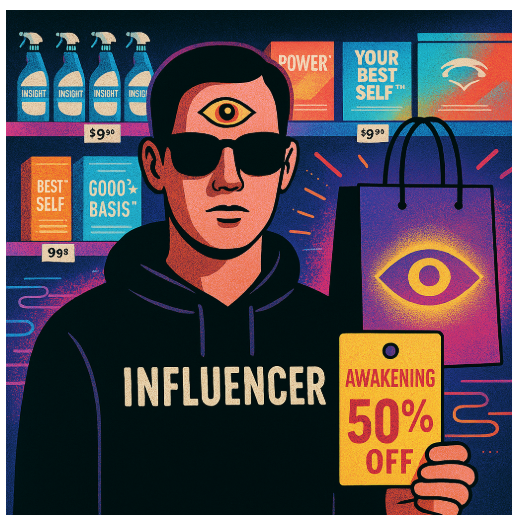
Echoes from the Discount Nirvana Aisle

April 14, 2025

“Third eye’s open, but I’m still blind—must’ve bought the knockoff.”
Whispers from the Algorithm

The Third Eye Is Pointed at the Sky When I Bend Over

This is soul-searching—but not the soft-focus, candlelit kind they sell you in Instagram ads.

It’s the kind of soul-searching that starts when you wake up at 3 a.m. in a cold sweat, realizing your entire personality might be a subscription service. When the thoughts hit so hard you can’t scroll them away.

It’s a tuning of the inner dial—not for good vibes, but to find whatever truth is still leaking through the static. Because let’s be clear: this isn’t about finding peace. It’s about noticing you’ve been sold a leash with a smile.

The revolution?

It’s wearing eyeliner now and dancing on TikTok for likes.

Your rebellion has been repackaged into a hoodie with a brand logo and a mission statement. Every radical thought you’ve had is now available in four easy payments, with free shipping and a 10% discount if you sell your friends out too.

We used to throw rocks at kings. Now we rate their content. Welcome to the age of the black magician. No wands. No robes. Just copywriters, influencers, and people who learned to spell authenticity in Helvetica. And here’s the kicker: they don’t just sell you soap anymore.

They sell you your own face, reflected in a polished screen, whispering:
“You’re almost enough. Just one more upgrade.” It’s not just advertising. It’s sorcery.

And the real spell?

Convincing you that the answers were never inside you—but conveniently waiting in someone’s cart. Let’s talk about the new high priests of this digital cathedral:

Influencers.

They used to be your neighbors.
Now they’re lifestyle oracles.

Curated messiahs with ring lights and discount codes.

Their job isn’t to be real—it’s to look real enough that you’ll follow them straight into the abyss of comparison and consumption. They call it “sharing.”

It’s selling.

They call it “vulnerability.”

It’s emotional clickbait.

And they don’t even know they’re doing it—because the spell caught them first.
They are the product and the packaging, wrapped in digital incense and filtered light.

Their third eye?

Trademarked. Verified. Brand-aligned.

But me?

I’ll take the third eye that ancient Greek playwright joked about—the one that points to the heavens when you bend over. Yeah, that one.

Crude, sure. But it had better aim than the polished, bullshit eye they’re selling me now. That third eye at least had the decency to laugh at the gods, not pretend to be one.

Because the new spirituality isn’t about waking up. It’s about signing up. Log in. Add to cart. Manifest your dream life with our 7-step program and don’t forget to leave a review.

And if you’re not ready to pay for it? Well, then you’re not “aligned” yet. Your resistance is your poverty speaking. They’ll shame you in pastel colors and smiling fonts. This is soul robbery in broad daylight.

And we’re clapping along to the rhythm because the beat’s got a good hook.

The psychic supermarket is open 24/7.

Insight™

Power™

Your Best Self™

All available now, pre-packaged and promise-wrapped.

But here’s the sick twist: no matter how much you buy, you’ll always feel behind. Because the product isn’t transformation—it’s lack. Permanent, bottomless, sponsored lack.

And if you ever wake up—if you ever really see it—someone’s there, waiting, ready to sell you the antidote to the thing they sold you in the first place.

“You’ve always been just one more product away from peace.”
Echoes from the Discount Nirvana Aisle

Maybe that’s what I’m doing now.

Maybe this whole rant is a spell of its own—an exorcism, or maybe just me screaming into the neon-stained void, hoping someone still knows what it feels like to be human underneath all the branding.

There’s a war happening.

Not with tanks.

With images.

The battle isn’t good vs. evil—it’s what kind of image will sit on the throne of your psyche.

One builds an altar to ego, likes, and carefully measured virtue signals.

The other might actually save the goddamn planet.

Because what’s killing us isn’t evil—it’s performance.

The performance of care.
The performance of identity.
The performance of being real.

We’re drowning in simulations of sincerity, while the real thing starves in a basement somewhere, forgotten.

And so the question is this:

Are you buying a product?

Or selling a piece of your soul?

Are you seeing with your own eyes?

Or watching through the lens of a third eye™ brought to you by the latest mindfulness app?

Because the spell only works if you don’t know it’s being cast.

But once you see it—really see it—there’s no going back.

And maybe that’s what they’re really afraid of.

“Enlightenment now comes with a promo code.”
Found scrawled in the margins of a mindfulness app

  •  

The Apple and the Cosmos: A Dance of Reality

December 9, 2024

Before me sits an apple, ordinary yet radiant, its waxy surface catching a sharp glint of light from a lamp above. It is tangible, immediate—its crispness confirmed as I lift it to my lips, its flavour vibrant and undeniably real. Beside it rests a protractor, leaning against a globe, and an astrological chart sprawled across my desk. These objects—tools of measurement and mapping—whisper of realities far removed from the apple’s tangible presence. The apple anchors me in the here and now while the instruments gesture toward the distant, the abstract, the infinite.

The apple is a feast for the senses. I can touch it, taste it, smell it, and see it. Though its atoms appear tightly packed, they are, in truth, vast spaces of energy and vibration. Magnify one of its atoms, and its solidity dissolves into a void where particles exist only as probabilities, dancing in fields of energy. Yet, this solid illusion sustains my bite, my taste, and my knowing.


The horoscope beside it lacks the apple’s tangibility. It cannot be bitten or held, but it represents something equally profound: a symbolic map of the cosmos. Where the apple’s reality is immediate, the horoscope projects patterns of meaning across time and space, binding celestial rhythms to the human story. These two things—apple and horoscope, immediate and archetypal—remind me that reality is both seen and imagined, both concrete and infinite.


This paradox of perception defines our existence. The apple, so close I can taste it, is not as solid as it seems. And the stars, so distant their light has travelled for millennia to reach me, are not as unreachable as they seem. Between the apple and Alpha Centauri lies an unfathomable gulf, yet they are part of the same web of existence, bound by the laws of physics and the rhythms of the cosmos.


Newton, watching the fall of an apple, saw the invisible thread connecting Earth and sky. Einstein deepened this insight, showing that space and time are inseparable and that matter and energy are two forms of the same thing. Quantum physics has unravelled the idea of separateness, revealing that particles are not isolated entities but relationships—waves of possibility collapsing into form through interaction.


David Bohm’s theory of implicate order expands this vision further, suggesting that the universe is a seamless whole where every fragment reflects the entirety, like a hologram. In a hologram, each fragment contains the whole image, even when divided into pieces. Similarly, the universe is encoded in every part of itself. The apple before me is not merely an apple; it is a microcosm of the cosmos, its atoms vibrating with the same energies that fuel the stars.


The horoscope, too, speaks to this interconnectedness. It is not about planets and rocks but about relationships, patterns, and cycles. The zodiac mirrors the rhythms of life, like the apple tree that blossoms, bears fruit, and eventually returns to the Earth. The horoscope encodes the rhythms of the cosmos in symbols, reminding us that the patterns above are reflected in the patterns within.


This interconnectedness challenges the illusion of separation. The apple and the stars, the immediate and the eternal, are not opposites but facets of the same reality. Our senses, while invaluable, reveal only a sliver of the whole. Light, for instance, is just one octave in a vast electromagnetic spectrum, and beyond the visible lies a universe of energies—X-rays, gamma rays, cosmic rays—that remain unseen but ever-present.


Similarly, the frameworks of language and culture limit how we perceive and interpret the world. But within these limits lies a profound truth: we are not separate observers of the universe; we are participants in its creation. As physicist John Wheeler suggested, the act of observation itself shapes reality, collapsing waves of probability into patterns of existence. Our consciousness, like a hologram, reflects the universe within it.


The apple before me, the stars above, and the chart on my desk are all threads in this web of unity. The apple speaks of immediacy, the stars of eternity, the chart of the connections that bridge the two. At this moment, I recall a walk in an orchard with my father years ago. He handed me an apple, freshly picked, and told me to hold it carefully as though it contained the world. I didn’t understand him then, but now I see his wisdom. The apple was the world, the stars, and myself—all woven together.


So, as I bite into the apple now, tasting its crispness and feeling its tang, I know it is real. But I also know that in this simple act, I am connected to the stars, to the atoms that form both fruit and flesh, to the patterns that govern the universe.


In the apple, I taste the infinite, and in the infinite, I find myself.


The Swirl of Coffee and Questions

November 21, 2024

I was having coffee with a friend who happens to be a teacher. I watched the steam spiral as my companion clinked her spoon against the porcelain, stirring her cup absently. As these coffee conversations do, we meandered from the mundane to the metaphysical. From the internet we went to the meaning of life. My friend has a knack for asking the right questions at the right time.

“So, tell me – what’s the point of it all?” she asked as she gazed through the cafe window where a woman passed by pushing a pram.

“I don’t know. When I die, when you die, my and your senses are dead, so we’re not here. So much for the factual world,” I replied, trying to remember which philosopher said something like that.

She smiled and, looking directly into my eyes, replied, “But you believe in reincarnation, don’t you? Isn’t that laden with purpose?”

I shrugged, “Sure it’s romantic to believe in some kind of afterlife. But, look around – does this scream purpose to you?”

She brushed her hair away from her forehead then her eyes wandered to the window again. A street performer decided to stand in front of the window and perform some clumsy juggling.

“Religion tries to make sense of it all,” I pressed on, “But even the high priests of science kneel before an empty throne. Their emptiness includes weirdo quarks, quantum realms and even god-particles – they say forces beyond our comprehension. It kinda sounds poetic that Tao dances in the heart of the matter, even beautiful. But sacred? No way.”

Her brow furrowed. “So science is the new religion?”

I leaned in, gesturing toward the phone lying between us. “No, not science. Scientism. It replaces reverence with results, mystery with measurability, quality with quantity.” I picked up the phone, “And it’s not just the gadgets.” My voice softened, “It’s the mindset: sharp edges, hard lines, reducing everything – life, death, the cosmos itself – to equations and particles. Even love is written off as a bunch of chemicals sloshing in the brain.” I shook my head, placing the phone on the table. “Wow, what are we left with?”

Her silence invited me to continue.

“Don’t you see?” my voice quickening. “We’re told we’re nothing but the products of chemical accidents on a spinning rock around a Type G star. What is prayer? It’s just some sound waves pushing through the air. Yep, random collisions of chemicals over the millenniums mutated into creatures who love, create, play and pray. OK, the ancient gods may have been illusions, but at least they offered dignity. What does scientism give us? Purpose replaced by algorithms, reverence and a sense of the sacred by replicable results.”

I stopped and leant back in my chair. Took another sip of my coffee. Her hands folded, her expression thoughtful. “But isn’t technology also liberating. It connects us and makes life easier.”

“Ah,” I said, raising a finger. “I love what science has given us. Science didn’t just discover miracles; it made them. Instead of AD – as our way of marking history, I would like to see AP – After Penicillin. I love that technology has freed us from chores. But that freedom might also free us from the planet. No, not sending seed ships on interplanetary and galactic colonization trips. I mean a final liberation – our extinction.”

Now, I was on a roll. I couldn’t stop the impetus of my talking, “Science didn’t just explain lightning; it gave us bombs more destructive than Zeus’s wrath. It replaced the sacred with equations, prayer with noise, and purpose with randomness.”

She frowned and looked at her near-empty cup of coffee. “You make it sound hopeless.”

“Maybe it is,” I admitted. “Scientism is a product of rigid thinking and religious fundamentalism has the same rigidity. You know – dogma in robes and dogma in lab coats. The kind of thinking that says it has the answers but does not know how to listen.”

She studied me for a long moment. “So what’s your solution?”

I smiled, took another sip of my coffee and looked out the window at the juggler. “I don’t know if there is a solution. Maybe we don’t need one. Maybe we just need to live without demanding it be solved. To sit with the questions, like we’re doing now.”

She chuckled softly. “Sounds like you just reinvented faith.”

I laughed. “Maybe, but I like to see scientists do a bit of Zen Koan thinking. You know, like wonder what is the sound of one hand clapping and have their logic scrambled just for a short while.”

What’s left for us, I asked my friend, when both gods and reason fail? My coffee had gone cold by then. The swirling depths had disappeared, as had the steam. But the question lingered, unanswered.

And maybe that’s all it ever will be—a question.


A Letter to My Absent Guardian Angel

November 20, 2024

To My Ever-Absent Guardian Angel
66 Automatism Road,
Mammonville, 6666

Dear (Supposedly) Watchful One,

It’s been a while—decades, in fact. I thought I’d drop you a line, not because I miss you (I don’t), but because I need answers. Primarily: Where the hell have you been?

You left without so much as a celestial Post-it. For us mere mortals, words matter. Even a basic “BRB” would’ve sufficed. But no, you flapped your wings and ghosted—ironically, since you’re already sort of a ghost. I won’t harp on it (much), but if “guardian” is still part of your job description, it might be time to recheck the fine print.

Anyway, life update: I’ve applied for the position of Director of My Own Life. Admittedly, the pay isn’t great—it’s public service, after all—but the benefits include fewer existential breakdowns and a slightly better carbon footprint. Sure, it’s a one-man gig, and the office hours are ridiculous, but hey, somebody’s got to steer this shipwreck.

Now, a burning question: why did our last encounter happen in a pub? Of all places, I imagined you’d prefer to appear in a shaft of light through a stained-glass window or something appropriately divine. Instead, you nursed a lager while I lamented my woes over a pint. Do angels even drink? Is there a heavenly liquor license I should know about?

If this sounds like I’m whining, well, maybe I am. But cut me some slack. You’ve been AWOL while I’ve wandered the planet armed only with Google Maps and a vague sense of purpose. The truth is, my life’s compass—whether literal or metaphorical—seems perpetually broken. Magnetic north? Useless. Tarot cards? Cryptic. Apps? Battery-draining. You get the idea.

On a related note, your detachable angel wings are still at the dry cleaners. The guy said something about a stubborn stain on the last feather, the one shaped like a bow. Blood, he thinks. Care to explain? I paid the cleaning fee, by the way—you’re welcome.

Honestly, I’m starting to wonder: were you scraping the bottom of the celestial eligibility list when they assigned me? I mean, it’s not like I’m top-tier humanity, but c’mon. Did you lose a bet? Draw the short straw?

And don’t even think about rolling your eyes or straightening your halo as you read this. I can picture you now, muttering, “He’ll never get that Director job. No chance.” Well, here’s the deal: this time, I’m doing it without you. No divine interventions, no whispered nudges in the right direction. You’re officially off the hook.

If you’re just a figment of my imagination—my brain’s way of outsourcing responsibility—then fine. But if you’re real, consider this a resignation letter from our arrangement. Not out of bitterness (okay, maybe a little), but because I need to stand alone, facing the metaphorical wall. And who knows? Maybe that wall will turn out to be a door once I stop expecting you to open it for me.

If I land the job, I’ll rescind all the childish grumbles I ever sent your way. If I don’t…well, at least I’ll know I tried, unsupervised.

Yours (conditionally),
Stavros

P.S. I’m busy this week, but after Sunday, feel free to drop by—no expectations, no feathers, no complaints.