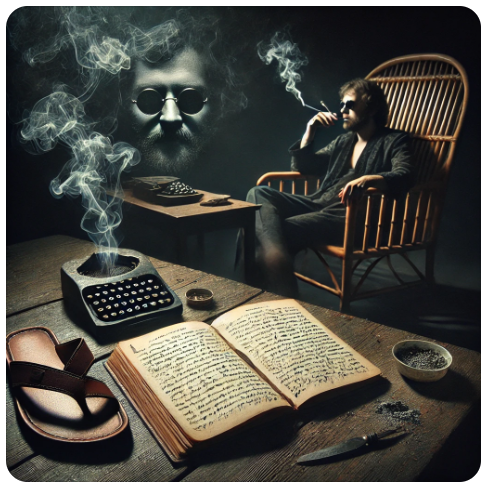
The Playground of Shadows

November 16, 2024

Boredom sat heavily on him, like dust on an old, untouched shelf. He stretched out his limbs, a shell adrift with no anchor, skimming across some dull, endless sea. Nirvana, the world whispered, was an empty thing if this was it. Peace? It felt like the slow pulse of something unfeeling, a lifeless melody humming in the background.

But there was a whisper, too, some echo of Buddha, prophets, and wanderers who saw meaning where he could find none. “The world is your playground,” they seemed to say, and yet, the toys scattered around him were chipped and faded, the games already won and lost. The thrill was gone.

He looked down at his hands, at his shoe, at the cigarette butt lying desolate on the cracked pavement. He saw only a cigarette butt, but when he reached for it, his fingers were wrapped in some spectral glove, ancient and unknowable, numbing his touch. A silky chant rose from the earth, and in the flickering haze, he caught a glimpse of her—the forgotten Madonna on the run, the ghost of a purpose that had long since slipped through his fingers.

And so, he took to the highway in the wind, that endless road North, where the sands met the sky and eternity seemed to lie just around the bend. The prophet in his mind handed him a book and an angel with curls handed him his soul. Here, he thought, is something close to freedom. Here, he felt the weight of all things lightened by the wind as he climbed mountains, lit fires, and let his words drift into the stars—alone yet somehow complete.

But the nights were haunted by shadow games. By candlelight, he felt the passing of unspoken truths caught in the heavy air, thick with incense and echoes. Sitting across from him, his companion cast her glance, a holy arc, over him. No mirrors were needed, only the quiet acceptance of their hearts pulsing in time. Together, they watched the fall of all things—leaves, bottles, lives—and knew that letting go was the only way to hold anything.

He felt the years burn away like the slow ember of his cigarette, holes punched through the fabric of his past. In the distance, a gladiator carried worlds on his shoulders, a Da Vinci gaze locked on some distant horizon. Yes, he thought, pull the plug on life’s bath. Let it all drain away. And as the waves of what was and what would be crashed against his pedestals, he let them crumble, the sand running through his fingers in memory of time slipping by.

The smell of white night, nostalgic and sweet, settled over him like a soft rain. He closed his eyes, feeling the weight and lightness of it all. His life, his love, and his losses had collided like the gentle kiss of billiard balls, a game played without cues, a moment that had once perched on the tree they’d planted in the garden of then.

As he let it all fall, he saw that his life was neither storm nor fury but dew on a flower, a brief glisten in the morning light that would, by noon, disappear. Smiling to himself, he walked into the wind, his footsteps soft on the path toward meaning or maybe just toward peace.


Secrets Behind Sunglasses: A Poetic Conversation

November 1, 2024

The other day, I spoke with my friend who wore sunglasses, even at night. They were not just any sunglasses; they had thick, tinted lenses that turned his eyes into secrets. He sat in his bamboo chair, curled like an embryo in a second womb, and waited for the silence between songs on the record. When it came, he tilted his head, aiming his gaze—hidden behind the black glass—at me.


“Your passage shows a definite poetic sensitivity, an emotional quality that strikes one—but what does it mean?” he asked, words biting the quiet. “You are trying to communicate?” He leaned on the last syllable of “communicate,” stretching it thin, squeezing it like elegant toothpaste. “Aren’t you?”


I felt the weight of his question sink into my chest, leaving behind a sharp, echoing hollowness. I glanced at the poem I had laid bare on the table between us, exposed like a wound. His words transformed before my eyes into writhing maggots, their white bodies squirming towards the ink. Without thinking, I took off my shoe—a thin, worn sandal—and slammed it down. The thud startled the silence; the maggots burst, leaving wet smears across the wooden surface.


I didn’t speak for a moment. I scraped their remnants into an ashtray, their tiny corpses mixing with the charred remnants of past thoughts and past sins. I dropped my sandal to the floor. He laughed, a dry, brittle sound that cracked in the dimness. He crossed his legs, the fabric of his pants whispering like a taunt. The damage had been done—a single maggot had escaped my fury and burrowed, unseen, into my ear. I could feel it crawling, tiny feet clinging to the tender skin before settling into the cavity of my heart. It pulsed there, secret and vile. He knew it. His smirk was the proof.


Now I write to pull it out, strand by bloody strand, from my heart. I know that only when I spit it out, stained and gasping, will I be free.


This maggot is unlike the others; it shifts and moulds itself, a grotesque mimicry of thoughts, without shedding its true nature. Later, it transformed as I read Dostoevsky’s The Devils, a cigarette balanced between my fingers and a small, gleaming grain of eternity in the palm of my other hand. Between puffs and between sentences, I noticed that the grain had grown in weight. Kirilov had just explained why man must commit suicide to proclaim his freedom from fear. He was called a madman. I thought he made sense. I looked at my hand and saw that the grain had grown into a crumb. Realizing that Dostoevsky was performing the alchemy in person, I continued to read and commune with him.


The grain in my palm felt heavier, its edges pressing into my skin. My mind wasn’t playing tricks. It had grown into a dense and insistent crumb. I realized then that Dostoevsky had performed this alchemy, transmuting despair into something tangible, a weight that dragged at the fabric of the world. I kept reading, feeling the maggot shift inside me, watching with its eyeless stare as I communed with a man long dead but never silent.


The record ended while the needle turned and turned on the dead wax, and I looked up. My friend still sat there, sunglasses glinting darkly in the thin light, the smirk on his lips a question left unsaid. I inhaled, the smoke and the maggot’s secrets filling me to the brim.

I asked AI to make an image based on the writing. This is it.