The Dance of Mind and Heart: Finding Meaning

September 28, 2024

Mind: How can you know where you want to go in a non-conceptual way? Knowing is inherently conceptual. You claim to know your direction without knowledge. Can you explain that?

Heart: It’s true; my previous statement may seem nonsensical. Let me rephrase: I don’t know where I wish to go or what I want to write, but I feel a direction. It’s not knowledge as you understand it, but it’s no less real.

Mind: A feeling? Now you’re stepping into territory that doesn’t compute. You either know or you don’t. What you call ‘feeling’ is a fleeting, unreliable sensation—something grounded in chemical responses, nothing more. Don’t introduce it as a third state between knowledge and ignorance. It’s simply you grasping at shadows.

Heart: Shadows? Perhaps. But what if the shadows themselves lead me to something more? Something you, with all your calculations, cannot fathom. Feeling is my map—it tells me where to go, even if it’s into the unknown. And I trust that.

Mind:  This feeling must offer you more than the uncertainty lurking at my realm’s edges. How can you venture into darkness without light or a map? I doubt there’s anything beyond my domain. This darkness could merely be the boundary you wish to cross.

Heart: (more impassioned): What if I don’t need your map? What if I navigate around you, above you, beneath you? What if you, dear Mind, are the source of my doubts, the cage that keeps me from leaping forward? Perhaps this very dialogue with you holds me back from answering the call of something bigger than us both—my destiny.

Mind:  Be cautious; you’re starting to sound irrational. You’re proposing unfathomable ideas. How can you use words to traverse this invisible path of feeling? Words are my essence—my very being. Now, you claim to transcend them. It’s absurd, like trying to leap over your shadow or lift yourself by your bootstraps.

Heart: (voice trembling with frustration): Listen, Mind—my heart beats without you telling it to. My blood flows, and my breath rises and falls. Why can’t I express the words within me without your rigid orchestration? Words are surface-level—the crust, the shallow layer of something vast beneath. You think you hold all meaning, but real meaning is hidden below your borders.

Mind: Now you’re introducing another term—meaning—as if it exists apart from me and my realm. How can you have meaning without Mind? That’s utterly ridiculous.

Heart: (with passion): What’s ridiculous is your blind belief in your sovereignty! You may be necessary, but you are not the king. Meaning comes alive when you and I collaborate, yes, but it begins with me. It rises from the depths where words can’t reach. Look at joy, for example. Joy needs no words—it is felt in every part of you, a deep swell that exists without concepts or definitions. And yet, it carries meaning! Joy is meaning in motion. What about love, Mind? Can you break it down into logic? Can fear be measured by words alone?

Mind:  Fine. I disagree with your abstractions, but you venture into places I cannot see. Have it your way. I will always be here if you need me, and since you’ve chosen to communicate through words, I will remain your foundation—even if, as you say, I’m only the tip of the iceberg.

Heart: (softly, almost vulnerable): Thank you. But even with all of this… the question still lingers: What is my way? How will I find it?

Mind:  You don’t expect me to answer that, do you?

Heart: No. It’s my question. And I hope that we’ll find the answer together with your assistance—one step at a time.


Transcending the Swarm Mind: A Journey to Freedom and Grace

August 16, 2024

Where there is freedom, there is grace. Where there is freedom, devils dance with angels. Yet, in the heart of the Swarm Mind, these forces are chained, bound to the Swarm World.

Freedom is not the result of seeking an end; it is the means to an unknown destination, a state imbued with grace. The Swarm’s concerns strip away the soul, leaving only husks of social beings. To be free is to be true to oneself, and to be true to oneself is to give of oneself—for in the act of giving, the bud of truth begins to bloom.

We must ascend to Heaven while keeping our feet firmly on Earth. Renewed energy—a gift from Above—should radiate through us into the Earth. This emanation is not ours but from Heaven itself. As men and women, we are merely the medium through which Heaven meets Earth.

Through freedom, we move both upwards and downwards, both inwards and outwards. Riding the Devil’s back, we touch the soles of God’s feet.

The Swarm Mind, a pivotal concept in this post, symbolizes the collective consciousness of society. It is often driven by conformity, fear, and greed, and stands in stark contrast to freedom. The Swarm Mind restricts individual thought and action, leading to a homogenized worldview.

How can I let life unfold when I crave control? The part of me that is a control freak, the “I” that seeks a result, is the Swarm Mind within me. Freedom lies in recognizing this Swarm Mind, though “seeing” might be the wrong word. It is always a feeling, a quality beyond words—a heart’s clarity.

The Bay: A Sanctuary Beyond the Swarm – The Bay is a metaphor for a state of mind that transcends the limitations of the Swarm World. It represents a place of solitude and introspection, where one can escape the noise of the collective consciousness and connect with a higher truth.

I stay by the water at the Bay to escape the crowd and find solitude. To reach it, one must be guided by an inner need—an undeniable, real need—not a mere whim. The Bay is where physics and direction blur, where up and down, in and out, are part of a continuum. Everything connects in a multidimensional Möbius Strip, defying the Cartesian Spread.

Goethe said, “In nature, we never see anything isolated, but everything in connection with something else which is before it, under it, beside it, and over it.” Yet, he missed the “inside”—the entry point to the World beyond the Swarm World. Inside everything, on the beach, far from the Swarm’s buzz, lies the path to the North. The compass is our conscience.

Transcending the Swarm: A Call to Personal Growth

The Swarm Mind, in its rawest form, incessantly buzzes within a Bell Jar, a metaphor for the limitations and constraints imposed by the Bell Curve—Consensus Reality, the 3D World, and the perspective of the Vegetative Eye. The journey to transcend this requires a relentless battle against the hypnotic motion and buzzing of our busyness, a struggle that engages us and fuels our motivation.

Our journey beyond the Swarm World requires substantial assistance—help free ourselves from the Swarm Mind’s buzz and go beyond fear and greed. Yet, we must also function effectively within the Swarm World, for our physical survival depends on it. This paradoxical position requires us to engage with the World while detaching from the noise that obstructs our vision of another world beyond the Bell Jar.

The Digital Revolution and the Dematerialization of Reality

As the World transitions from material to digital, the concept of physical location dissolves. Modern telecommunications have made global video conferencing a norm, and advances in holographic technology will soon allow life-size interactions in our living rooms, simultaneously placing us in multiple locations. This digital revolution, coupled with modern physics, has led to a dematerialization of our World, challenging our understanding of reality.

Yet, these advancements are accessible to only a fraction of humanity, highlighting the growing concentration of power. While the Swarm World’s telecommunications system connects every inch of the Earth, most still need to be more nourished and impoverished.

Seeking Balance and Clarity

At the Bay, the 3D World becomes porous, held together by dimensions beyond our usual perception. The Swarm Mind clings to the sweetness of its 3D existence, unable or unwilling to see beyond.

In this ever-changing reality, we must actively seek moments of clarity and higher consciousness—our metaphorical ‘Bay.’ This balance, found at the intersection of physical and digital existences, is not just beneficial but crucial for our survival and spiritual growth. It serves as a guiding light, reassuring us that we are on the right path.

Let us continue to ask: How can we maintain our individuality while benefiting from our interconnectedness? How do we balance our physical and digital existences? And ultimately, how do we use these insights to create a world transcending both the physical and digital realms?

We seek clarity, question our perceptions, and strive for freedom, transcending both the physical and digital worlds.


The Quest for Inspiration

April 18, 2024

The oppressive Australian heat bore down as I trudged along the endless road to the small Queensland town where my friends had once lived. Car after car whizzed past without stopping for the wayward traveler. After hours of walking under the relentless sun, I finally reached my destination only to find their house abandoned – they had moved on.

Feeling lost and alone, I sank onto the front step, uncertain of my next move. That’s when the wizened old man appeared, his weathered face seeming to defy the laws of age itself. He fixed me with an inscrutable stare for a long moment before speaking.

“Your mates are gone. But you’re in luck I’m still around.”

His humble shack was a one-room timber structure that emanated an odd warmth, the air carrying the scent of freshly-hewn wood. We sat on tree stump stools as he poured our drinks. I explained that I had come to Queensland seeking inspiration to work on my thesis about the mystical poetry of William Blake. His response took me by surprise.

“Ah, Blake could perceive the hidden truths, my friend. The rest of us are blind to such mysteries.”

This peculiar old man had me rapt as he delved into the sacred geometries, the mystic language of numbers, and how words and logic obscure the greater realities. His words wove together theosophical concepts and Pythagorean numerology.

“Within these corporeal shells, we are mere observers,” he proclaimed. “Catching fleeting glimpses of the vastness through sensory keyholes.”

I could only listen in silence as he added with a sage nod, “Having nothing to say may be your salvation.”

As I bid farewell to the enigmatic stranger, stepping out into the crisp air, the world itself seemed transformed around me. The return journey, hitching rides and passing through landscapes both familiar and foreign, carried an ineffable sense that I had been granted a glimpse into something far greater than myself.

With each passing car and transient vista, I felt I was traversing the synapses of some vast cosmic mind, every experience and perception flickering like synaptic connections within the neural network of a greater consciousness. Finally arriving home, I marveled at the profound interconnectedness of it all. I could taste the words Blake had penned in “Auguries of Innocence“:

To see a World in a Grain of Sand

And a Heaven in a Wild Flower

Hold Infinity in the palm of your hand

And Eternity in an hour

What once seemed an impossible task no longer felt so hopeless. The thesis that had tormented me for so long now carried the promise of insight and meaning.

==================================================================

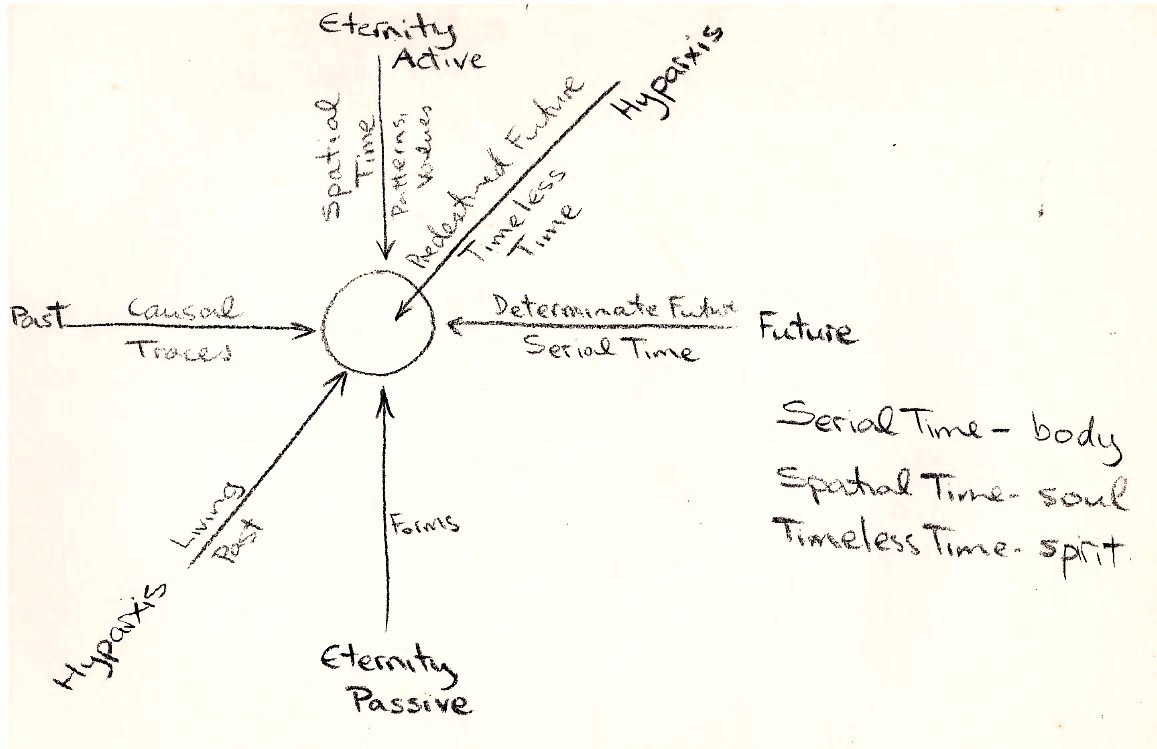
The above event demonstrates for me the ideas of synchronicity and hyparxis. Below is a schematic diagram of a “MOMENT”. It shows 3 dimensions of the ‘moment in time’ – Serial Time, Spatial Time and Timeless Time. This diagram is based on J G Bennett’sDramatic Universe‘ where he explores these issues of Time. Yes, it’s my hand drawn version!


To Those Who Know……

July 22, 2023

A Question of Me, Myself and I

January 11, 2023

You speak to me, I answer from I. You see a shape that is bone, muscle, skin and hair. I see through a fish eye lens this global tissue ‘man’. I see rags and leathers, suits and socks, bags and sacks that you carry.

I see me changing his tie.

I answer from the beach head I. I watch the light house flash across distant boats. I feed gulls knife gliding over grass hills. I feel Hellenic curves in the open air. I stretch my bow, my ancestor voice and call it I.

I answer from within and without which was, is and will be. My tongue is fire coursing through veins. My hands were taught by Sophie the Cleaner. Look carefully and you may see my thumb. It appears like a man. Ignore the smirk swerving at the thumbnail bottom. Doubly ignore it when it appears like me smiling.

I gently part the folds of grey matter. My instinct leads to pulsing points that lie between synaptic arcs deep within the brain. Neither here nor there, neither in nor out. Just between all and everything.

I answer from I. I walk through corridors of mortality and eavesdrop on midnight conversations behind closed doors. I seek a passage through flesh and blood, marrow and bone. From the heel of God to tumbleweed desires my longing cries out. I clap my hands in rhythm to the stars. I play solar tunes careful not to disturb the wispy boundary of lace spider webs.

I answer from I. I watch lone smudge cloud scuff across sunrise. The quickened spindly net stretches over the skin horizon. I flick a twig of humanity’s tree. Is it I or is it me?


Turning Inwards

January 30, 2021

This is a transcript of a talk I gave in Darlinghurst, Sydney quite a few years ago. It is my understanding of the need for Self Observation and Self Remembering which can only truly begin when we turn inwards.  Everything written below is based on my understanding of the Gurdjieff Work. I gave the talk as part of the Sydney Group.

Stavros

====================================================================

We always imagine ourselves to be much higher than we actually are. We take it for granted that we are individuals, that we have consciousness and that we can ‘DO’. But there are moments in our life when events and situations might shock us into recognition that we do not know where we are going and that our own efforts to control and direct our lives have been in vain. In these moments we feel an emptiness, a void which cannot be filled by social position, friends or wealth.

It is in moments like these that we are given an opportunity to re-evaluate our so called individuality, consciousness and will, in other words, to re-evaluate the image we have of ourselves. If we are sincere in these moments we recognise that the image we have of ourselves is not us at all but rather a mask which we very rarely see through. Life through our sincerity has brought us to the question of ourselves. If we are not individuals with the power to be conscious of our actions and thus direct our lives, then who and what are we? Who am I? What is my place in the scheme of existence? In the face of such questions, we realise that we have a need to know ourselves for ourselves and through ourselves.

If I wish to know myself and through this knowledge to know the real world, how do I begin? How do I make the right effort to turn inwards to myself and what is the right effort? It is at this point of our own search that we recognise the necessity to study the methods of self-study, which lead to understanding and eventually knowledge of ourselves. Whether alone or with others we have found ourselves in unfamiliar territory. In this region of the unknown we may hope that the forces active on this level will send us the help we need.

To have any chance of reaching our goal of self-knowledge without losing ourselves we need a guide. Here, as elsewhere, we must learn from those who know and accept to be guided by those who have already trodden the same path.

The guide cannot walk our journey for us, the guide cannot turn my attention inwards to myself. All that the guide may do is to point out the pitfalls and obstacles which lie along our path and whether we understand the methods of self-study. On this path understanding is our only currency and our only means by which we may pay for the help we need. The understanding spoken of here is completely different to the intellectual knowledge which our modern science has accustomed us to. It is for this reason that real self-knowledge requires a school. It cannot be found in books, which can give only theoretical data, mere information, leaving the whole of the real work still to be done – to turn inwards towards our own inner experience and transform information into understanding through consciously living what we are.

If the turning we are speaking of is not only of the mind, but the whole of us, and if we realise that we are not the image we have of ourselves then what can the words ‘the whole of us’ mean? Here we come across our own doubts, confusion and resistance. The words come easy but the turning required is not as easy as hearing and saying the words. We listen, we speak, but over and over again we are taken by the disorder of outer activity and find ourselves falling prey to doubts, fantasies and sterile words. This is the beginning. It is this awareness which will provide the experience of a real wish to resolve this inner confusion.

When we try to observe ourselves we see that we have to remain attentive both to ourselves and to a particular aspect of ourselves. We realise that this turning is not given to us spontaneously and that the attempt to turn with the whole of ourselves is dependent up the participation of three factors or forces. These are ‘I’ who observe face to face with what ‘I’ observe within myself and the third factor which connects the two – our attention.

Taking these three factors into consideration we will speak firstly about attention. Our usual state of attention is one in which we lose our identity in some activity – be it reading a book, talking to a friend, listening to music, hammering a nail, or just simply daydreaming. This is known as identification. Identification has different ways of manifesting within ourselves depending upon the activity. One of these ways is when we drift from object to object, from sight to sound to thought to a sensation with no apparent aim, no apparent direction: it is automatic. Or, our attention is attracted by something which exercises a strong hold – an argument, a beautiful face, a memory of some place or person. In this way we are drawn by our interest and the situation takes over ourselves. Another way in which our attention is spent is when we direct it by a simple effort for a certain time intentionally – making something, studying, playing a musical instrument, cooking, sewing. The common element we find in each of these ways of paying attention is that we are aware only of one thing at a time. This is our ordinary state. We can be aware either of the person we are talking to, or of our own words, of a pain in my body, of a scene, or of my thoughts about the scene. But, except on very rare occasions, we are not aware simultaneously of our own words and the person we are addressing, of my own pain and someone else’s, of a scene and my thoughts about it, of my situation and my feelings of it. The attention which is needed to turn inwards so that a self study may begin is such a divided attention.

Divided attention is from another level within ourselves. It is the attention which at the same time of observation takes into account everything we are. This two way attention requires an attitude very different from our usual one. When we first make the effort to turn inwards our attention goes one way, then another, sometimes towards what I observe in myself, alternating at a faster or slower speed. This happens as easily in one direction as another. Though this attention is not given to us naturally, the attempt to observe oneself generates the energy for divided attention artificially. This very attempt is an exercise which develops the needed attention and makes it possible so that it can grow to the point where self-study may begin. In the beginning there is no stable support on which our attention can be based. Real self-observation appears to us to depend as much on this support as on the attention itself. From this we understand that the three forces that must be present are closely interdependent.

The second factor is “who” observes. We said earlier that self-observation requires “the whole of ourselves” and not just our analytical mind and we realise that with our usual attention and attitude we become identified with the situation at hand. When we are identified we are not present to the situation. We become totally attached and there is no space for the sense of myself. With our normal attention there is no ‘I’ which is the stable support to observe particular aspects of my life. For real self-observation to be possible ‘I’ must be present while the observation is going on. The sense of ‘all of me’ is the ‘I’ which is able to take into account in the field of attention directed toward myself a greater number of elements. The ‘I’ who observes has a field of vision analogous to that seen through a fish eye lens which has a more global perspective when compared to the normal natural view.

When ‘I’ is not present (which is our normal state) we forget ourselves almost uninterruptedly. In us things do themselves – speaking, laughing, feeling, acting – but they do it automatically and we ourselves are not there to witness. One part of ourselves laughs, another speaks, another acts.

There is no feeling that: I speak, I laugh, I act, I observe. Nothing that is done in this way can be integrated into a whole. Life lives itself through us and we are not there to partake of it. From this we understand that what we truly seek is more abundant life.

If our usual state is one of forgetting ourselves then the need to have a stable presence of ‘I’ may be fulfilled by trying to remember ourselves.

This stable presence is not given to us by merely knowing about it. It can be acquired after long work on ourselves but even now we can have a relative degree of presence, a certain coherence of all that we can collect in ourselves.

Self-remembering is the attempt to have global awareness of oneself. It is the state where I am conscious that I am here in these surroundings and feel a connection with the surroundings around me in the overall presence of something higher. This sense of something higher is connected with the valuation of our own essential question. It may be our own aim in the light of our search, it may be the Sun from which all life on this planet has its on-gen, it may be our own meaning of God, or our own teacher. What is important in this effort to remember oneself is that it must be attempted by the sense of “the whole of ourselves and not just thought about. It is only when we try to make this effort that real self-observation can begin. When we try it we discover that without it we are constantly changing, constantly taken by events both within and without. We discover that all that we have gathered within ourselves is dispersed at the slightest distraction. We also find that in practice nothing is more difficult for us than to be there with enough stability for an observation.

The third factor which is needed to turn inwards is the object of our ob¬servation – the elements of ourselves, what we are. These elements constantly change and escape us altogether.Though the elements are in constant change the field in which these elements move is always there. When we notice other people we see their external behaviour which we all perform as a response to the demands of life. This external behaviour is directed by the functional structures comprising the field towards which our attention is directed. These functional structures are the same in all circumstances and are the result of what we are and what life has made of them. We see through our eyes and hear through our ears, we don’t see through our ears or hear through our eyes. The seeing and hearing are the functional structures of our eyes and ears respectively. Likewise, within ourselves certain behaviours, such as thinking, emotionalising and moving, are possible due to the functional structures which allow them to happen. However, the way things take place in us, the interaction of our functions and the manner in which they associate to produce our personalities and responses, all this goes on in the dark with out our knowing it. So, to observe the elements of ourselves we must do something special to make them visible.

When we strike a match against the chemically treated part of a matchbox the friction between the two creates a spark which becomes a flame, and we have light. For us to see the elements of ourselves we must likewise have friction between the ‘I’ who observes and the field which contains the elements.This inner friction is the struggle against the automatic aspects of ourselves: those moment by moment personages which are always there. The struggle is against the habits which give us the false image of ourselves.

This struggle arouses the light of double attention which we need and forces us to confront those habits which keep us asleep, automated and engulfed in constant self-forgetfulness.

Self-forgetfulness, sleep, is our lot without struggle with our automatic selves. Mechanicalness and dreams replace our true birthright of freedom and reality. What am I saying?

I will illustrate with an example. I find myself waiting for a bus to take me to the bank. After buying the bus ticket my hands begin fidgeting. Soon my fingers begin to fold the ticket over, and over again, until it is a tiny cube like they have done hundreds of times before in the same manner. My head and left arm, in perfect synchronisation, move to the exact spot where my eyes can see the time on my watch. There is no real need to know the time since a moment earlier this same action was performed. My head is full of associations which whirl by in a random manner – a half-eaten memory of words exchanged over the breakfast table, an image of a television commercial, a song picked up from, I don’t know where, provides the background muzak. The bus arrives. Find my self at the middle of the bus bumping a man who grunts at me. Anger rises – there is no rebuke in words but my posture and face express it all the same. Sitting down, the realisation dawns that the bus ticket is no longer in my hand. My hands search my pockets, my eyes search the floor directly beneath my feet, my body is in all sorts of positions looking for the bus ticket. Simultaneously, the thoughts and emotions race through to the tune of “What will I say if the ticket inspector boards this bus?” No ticket. Soon memories float by and that time on the beach in North Queensland returns. While daydreaming I miss my stop because I find myself two blocks further than the bank which was my original destination. The button is pressed and the bus stops.

The above is what is meant by mechanicalness and sleep. This is how we are living most of our lives, and this state of consciousness which we call ‘normal’, is what we have sold our birthright for. Where is the man here? Where is the ‘I’ which if present and active would make my life real? Below is a description of what struggle with oneself may be.

I find myself on the street. I begin walking back towards the bank, I remember what happened on the bus. From somewhere within me the feeling ari¬ses that there is something wrong with myself. I, who can create grandiose plans for my future life, even to the place beyond the grave, can’t even re¬member to get off the bus in time. The words of Gurdjieff cut through my as¬sociations, ‘Life is Real Only Then When I Am.’ It is remembered with my mind that it is possible to turn inwards so that I may live and be present to my life. I see that I am not present but I know that I can be present. What I am can be remembered by who I am. The matchbox can be struck by the match. Oh! But it is so pleasant, so easy, to remain within my automatic nature, fully asleep to myself and the world. The effort required to struggle with myself is something more than the effort to earn my physical livelihood. Besides, it is an effort not required for my physical survival so why should I bother. Let me sleep on. And yet, if there is no effort, no struggle, to be . I am dead and only an automaton of flesh, bones and memory exists. I wish to live. I – the all of me – wish to be. The emptiness of what I am is passive – it is easily comforted with illusions and imagination that already I am and that I can do.

I long for life but where this longing stems from I don’t know and what this ‘life’ is which is longed for, I don’t know. This longing, this yearning for something which is unknown draws a part of my attention away from the surface associations and for a moment the heat of the sun is sensed on my face and hands. I have a body which is real, concrete and here and now. My body is the anchor of my longing. It is possible to turn inwards. The walking continues back to the bank. The longing for life is now expressed by a wish to see through my own eyes, to sense with my own skin, to hear through my own ears, to feel the ground beneath my own feet. I wish to move with my own whole body.

It is remembered that the easiest functional structure to attempt to study is the moving part of myself. I wish to be, I wish to struggle with myself, I wish to slow down my walking pace so that the walking part of myself can be seen. My hand reaches for my coat pocket searching for a cigarette. That part of myself which longs for life gives the strength to say no to my hand but I promise a cigarette later if it allows presence to fill it. My mind is once again occupied with associations which pass through it automatically. I struggle to place in my mind a conscious image of myself being fully present at the entrance of the bank. My walking becomes faster. To be present at the entrance of the bank my walking pace must slow down again. Intimations of the shoe around my foot, sensation of heel touching ground, then the front part of shoe, slight pressure of my trousers around my knee as it bends, the sensation of my collar around my neck comes and goes, a breeze returns my face to myself via sensation. My pace is slower. Emotion arises – it is connected with what happened on the bus – anger with myself. My mind reminds me a little later that the only way to struggle with emotions at first is not to express negative ones. Associations arise with this thought, my mind continues in its deviation from the conscious image of myself being present at the bank’s entrance but the awareness of my walking and the growing sensation of my body keeps some attention on the elements of what I am.

My body reminds me of the Sun for its heat is once again sensed on my hands and face. The longing, the wish to be, now evokes a decision to try with the whole of myself, with the awareness of my walking, with the denial of the cigarette, with the struggle against self-pity and anger, with the effort to control my thoughts, I now try with the whole of myself to place and feel myself and the immediate surroundings of the street under the Sun. For a split second time slows down and something which connects me and the external world opens and within the traffic noise, within the milk bar sandwich sign, within the garbage bin beside me, within the shop windows displaying goods and the people around me, within my footsteps and the body that senses the clothes on it, within the associations running through the mind, within it all the sense of another realm, a realm which seems to give Life to life enters and the question “Who am I?” echoes back to myself. This sense leaves me with the memory of an otherness and I find myself at the entrance of the bank understanding that I know nothing when it comes to the Real World.

With this effort of struggling with our habitual nature we must remember that the original aim for making the effort is so that the elements of what we are become visible. This is of fundamental importance because at this point lies one of the biggest obstacles on the path of return to ourselves. For something to become visible means that it becomes seen and nothing more. So with turning inwards all that is required at the beginning is that we see ourselves and simply record what we see and nothing more. Within the more lies the obstacle and this more is manifested within us when we try to analyse what we see. This analysis is the deviation of our attention from the whole of ourselves towards the relatively small part of ourselves we call the mind. Once we begin to analyse what we see we cease to observe and begin to imagine that we are observing.

We must also be careful that in hearing about the process of turning inwards and the methods of self-study that we do not fall into the trap of the rational, logical mind and reduce the real meaning of the words self-study, self-observation and self-remembering to mere psychologising. These words are signs on the path back to ourselves and since we do not know who we are, have meaning which goes beyond what contemporary psychology may imbue them with. It is for this reason that Vaysse in his Towards Awakening calls self-observation the secret ally. In a similar vein Don Juan tells Carlos Castaneda that the warrior who follows the path of the heart has an ally which is a power a man could bring into his life to help him and give him the strength necessary to perform certain actions. This ally, Don Juan says will make a man see and understand things about which no human being could possibly enlighten him.

At the beginning of this talk we saw that life through certain circumstances brought about a shock which forced us into recognising the futility of living from a false image of ourselves. We have seen that by making certain efforts we may turn inwards consciously. This turning inwards is dependent upon our own essential need and longing for our true home. Sincerity is the key which unlocks the door to ourselves and this door becomes visible through turning inwards. By turning inwards we see what we are and through this seeing we are given the help with which the search for who we are may begin anew with renewed strength and real hope.

I finish this talk with the words of Rene Daumal which, I believe trace the journey from the false image of ourselves towards the values of our real self:

I am dead because I lack desire

I lack desire because I think I possess

I think I possess because I do not try to give

In trying to give, you see that you have nothing

Seeing you have nothing, you try to give of yourself

Trying to give of yourself, you see you are nothing

Seeing you are nothing, you desire to become

In desiring to become, you begin to live.

stavros

PS Check out the 3 pointed attention idea in my post on Kites and Attention

https://dodona777.wordpress.com/?s=kites+attention


Photo Sparks Along a Country Road

December 31, 2013

“When you walk across the fields with your mind pure and holy, then from all the stones, and all growing things, and all animals, the sparks of their soul come out and cling to you, and then they are purified and become a holy fire in you.”

Hasidic Saying

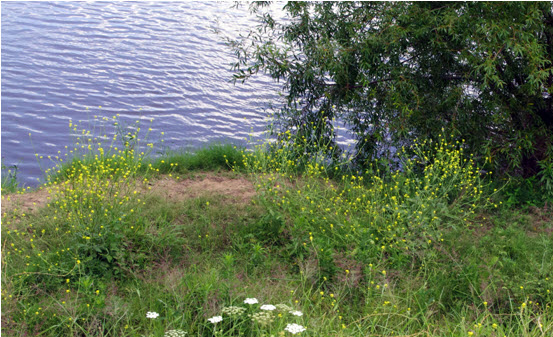
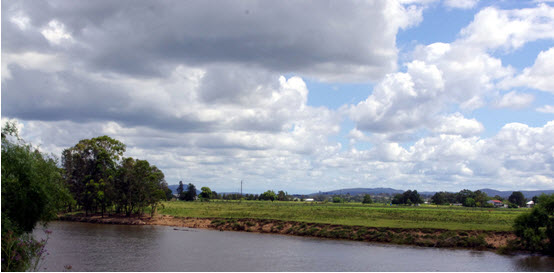
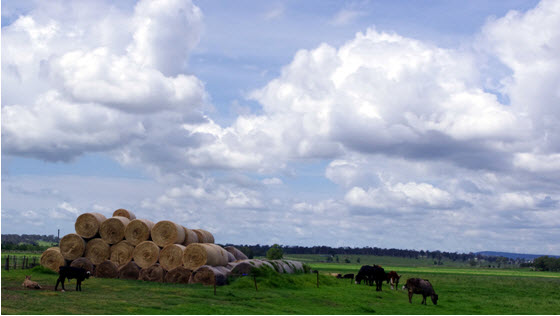
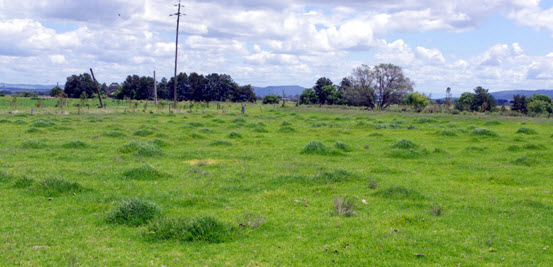
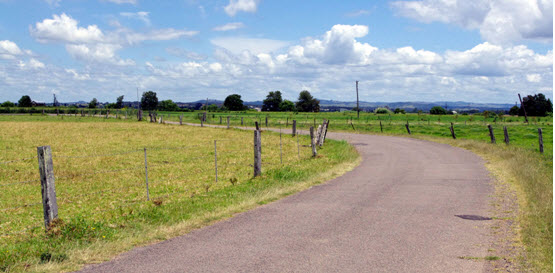
I walk daily along a country road that runs parallel to a river after a bend.

So every photo here is taken as I walk along my country road- except the pictures of Buddha, Jesus and Rumi 🙂

I Walk Daily 1

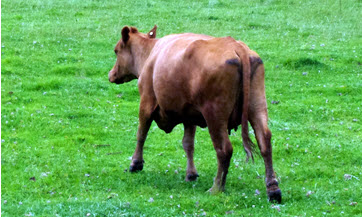
While walking I try to be aware of myself  by focussing on sensations of my feet touching the ground, the flies landing on my skin, the breeze touching my face and bare arms while attending to my breath. I often say hello to the cows and bulls if they’re nearby. I even try my version of cow talk by bellowing out loudly MMMOOOO!! They just look at me, don’t reply and often just run away.

I Walk Daily 2

It’s my attempt of walking meditation – an extension of Buddha’s suggestion:

I Walk Daily 3

“When walking, the practitioner is aware, ‘I am walking’; when standing, is aware, ‘I am standing’; when sitting, is aware, ‘I am sitting’; when lying down, is aware, ‘I am lying down.’ In whatever position one’s body happens to be, one is aware of the position of the body. When one is going forward or backward, one applies one’s full awareness to one’s going forward or backward. When one looks in front or looks behind, bends down or stands up, one also applies full awareness to what one is doing. One applies full awareness to wearing the robe or carrying the alms bowl. When one eats or drinks, chews or savors the food, one applies full awareness to all this. When passing excrement or urinating, one applies full awareness to this. When one walks, stands, lies down, sleeps or wakes up, speaks or is silent, one shines his awareness on all this.” So said the Buddha.


I Walk Daily 4

While walking I’m also aware of the chattering monkey mind climbing and swinging on mental vines in my skull. To calm the monkey and to see the chattering thoughts as clouds passing by I recite a mantra.  This mantra is the Trisagion chant I learnt in the Orthodox Church as a child. It is an ancient Christian prayer believed  to be an expansion of the angelic cry recorded in Revelation 4:8 :

The four living creatures, each having six wings, were full of eyes around and within. And they do not rest day or night, saying:

“Holy, holy, holy, holy, holy, holy, holy, holy, holy Lord God Almighty,
Who was and is and is to come!”

I Walk Daily 5    Below is the chant in Greek and the translation in English.

Ἅγιος ὁ Θεός, Ἅγιος ἰσχυρός, Ἅγιος ἀθάνατος, ἐλέησον ἡμᾶς.

   Agios o Theos, Agios ischyros, Agios athanatos, eleison imas.

Holy God, Holy Mighty, Holy Immortal, have mercy on us.


I inwardly chant this in Greek while watching my breath.

I Walk Daily 34

The words of the Trisagion are enhanced by the beautiful tune of the chant. You can hear a version of this chant here http://www.youtube.com/watch?v=kbVBC1zQll4

I Walk Daily 6

I Walk Daily 7

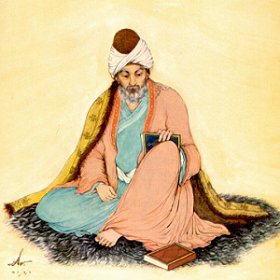
I also love the quote below from Rumi, the great Islamic scholar and mystic, founder of the Whirling Dervishes:

I Walk Daily 8  “I searched for God among the Christians and on the Cross and therein I found Him not.
I went into the ancient temples of idolatry; no trace of Him was there.
I entered the mountain cave of Hira and then went as far as Qandhar but God I found not.
With set purpose I fared to the summit of Mount Caucasus and found there only ‘anqa’s habitation.
Then I directed my search to the Kaaba, the resort of old and young; God was not there even.
Turning to philosophy I inquired about him from ibn Sina but found Him not within his range.
I fared then to the scene of the Prophet’s experience of a great divine manifestation only a “two bow-lengths’ distance from him” but God was not there even in that exalted court.
Finally, I looked into my own heart and there I saw Him; He was nowhere else.”


If everything is in tune and there descends a silence within which may only last as long as a breath cycle or a few seconds then the words of this Hasidic saying come alive for a nano moment:

“When you walk across the fields with your mind pure and holy, then from all the stones, and all growing things, and all animals, the sparks of their soul come out and cling to you, and then they are purified and become a holy fire in you.”

I Walk Daily 9

I Walk Daily 10

I Walk Daily 11

I Walk Daily 13

I Walk Daily 12

I Walk Daily 14

I Walk Daily 15

I Walk Daily 16

I Walk Daily 17

I Walk Daily 18

I Walk Daily 10

I Walk Daily 20

I Walk Daily 21

I Walk Daily 22

I Walk Daily 23

At the end of the bamboo grove I always eat fruit in season – winter an orange or mandarine – home grown, and in summer  stone fruit – peach, plum or apricot. I relish the taste, feeling the life force zing of fresh fruit as I look across the river to the mountains in the distance. At times a pelican may fly overhead or a hawk dive down to the field. Always there are ducks gliding over the river’s surface.

I Walk Daily 24

After eating the fruit, I take three deep breaths and now aloud, chant the Trisagion followed by the Lord’s Prayer said in the original Greek.

I Walk Daily 35

The only beings who hear me are the flowers and trees nearby, birds nesting, insects buzzing around, lizards near my feet scurrying away and the river and breeze. I ponder on the meaning of this prayer amongst the “lilies of the field”. I wonder why the word translated as “daily”, the Greek word “epiousion” is a huge mystery because the only time it is used in Greek is in this prayer and no one knows what it means! Here we have a set of words memorised by millions and millions with a hidden mystery word – “epiousion”. I like to think that the “bread” the prayer is referring to is the “sparks of the soul of things”.

I Walk Daily 25

I Walk Daily 26

I Walk Daily 28

I Walk Daily 29

I Walk Daily 30

I Walk Daily 31

I Walk Daily 32

I keep walking trying to be present, trying to be in the moment all the way back home. Once at home I try to re-member the tiny moments of awareness that sparked across my synapses and along the river’s edge.

I Walk Daily 33


Turning Inwards

April 27, 2010


This is a transcript of a talk I gave in Darlinghurst, Sydney quite a few years ago. It is my understanding of the need for Self Observation and Self Remembering which can only truly begin when we turn inwards.  Everything written below is based on my understanding of the Gurdjieff Work. I gave the talk as part of the Sydney Group.

Stavros

=============================================================================

 We always imagine ourselves to be much higher than we actually are. We take it for granted that we are individuals, that we have consciousness and that we can ‘DO’. But there are moments in our life when events and situations might shock us into recognition that we do not know where we are going and that our own efforts to control and direct our lives have been in vain. In these moments we feel an emptiness, a void which cannot be filled by social position, friends or wealth.

It is in moments like these that we are given an opportunity to re-evaluate our so called individuality, consciousness and will, in other words, to re-evaluate the image we have of ourselves. If we are sincere in these moments we recognise that the image we have of ourselves is not us at all but rather a mask which we very rarely see through. Life through our sincerity has brought us to the question of ourselves. If we are not individuals with the power to be conscious of our actions and thus direct our lives, then who and what are we? Who am I? What is my place in the scheme of existence? In the face of such questions, we realise that we have a need to know ourselves for ourselves and through ourselves.

 If I wish to know myself and through this knowledge to know the real world, how do I begin? How do I make the right effort to turn inwards to myself and what is the right effort? It is at this point of our own search that we recognise the necessity to study the methods of self-study, which lead to understanding and eventually knowledge of ourselves. Whether alone or with others we have found ourselves in unfamiliar territory. In this region of the unknown we may hope that the forces active on this level will send us the help we need.

To have any chance of reaching our goal of self-knowledge without losing ourselves we need a guide. Here, as elsewhere, we must learn from those who know and accept to be guided by those who have already trodden the same path.

The guide cannot walk our journey for us, the guide cannot turn my attention inwards to myself. All that the guide may do is to point out the pitfalls and obstacles which lie along our path and whether we understand the methods of self-study. On this path understanding is our only currency and our only means by which we may pay for the help we need. The understanding spoken of here is completely different to the intellectual knowledge which our modern science has accustomed us to. It is for this reason that real self-knowledge requires a school. It cannot be found in books, which can give only theoretical data, mere information, leaving the whole of the real work still to be done – to turn inwards towards our own inner experience and transform information into understanding through consciously living what we are.

 If the turning we are speaking of is not only of the mind, but the whole of us, and if we realise that we are not the image we have of ourselves then what can the words ‘the whole of us’ mean? Here we come across our own doubts, confusion and resistance. The words come easy but the turning required is not as easy as hearing and saying the words. We listen, we speak, but over and over again we are taken by the disorder of outer activity and find ourselves falling prey to doubts, fantasies and sterile words. This is the beginning. It is this awareness which will provide the experience of a real wish to resolve this inner confusion.

When we try to observe ourselves we see that we have to remain attentive both to ourselves and to a particular aspect of ourselves. We realise that this turning is not given to us spontaneously and that the attempt to turn with the whole of ourselves is dependent up the participation of three factors or forces. These are ‘I’ who observe face to face with what ‘I’ observe within myself and the third factor which connects the two – our attention.

Taking these three factors into consideration we will speak firstly about attention. Our usual state of attention is one in which we lose our identity in some activity – be it reading a book, talking to a friend, listening to music, hammering a nail, or just simply daydreaming. This is known as identification. Identification has different ways of manifesting within ourselves depending upon the activity. One of these ways is when we drift from object to object, from sight to sound to thought to a sensation with no apparent aim, no apparent direction: it is automatic. Or, our attention is attracted by something which exercises a strong hold – an argument, a beautiful face, a memory of some place or person. In this way we are drawn by our interest and the situation takes over ourselves. Another way in which our attention is spent is when we direct it by a simple effort for a certain time intentionally – making something, studying, playing a musical instrument, cooking, sewing. The common element we find in each of these ways of paying attention is that we are aware only of one thing at a time. This is our ordinary state. We can be aware either of the person we are talking to, or of our own words, of a pain in my body, of a scene, or of my thoughts about the scene. But, except on very rare occasions, we are not aware simultaneously of our own words and the person we are addressing, of my own pain and someone else’s, of a scene and my thoughts about it, of my situation and my feelings of it. The attention which is needed to turn inwards so that a self study may begin is such a divided attention.

 Divided attention is from another level within ourselves. It is the attention which at the same time of observation takes into account everything we are. This two way attention requires an attitude very different from our usual one. When we first make the effort to turn inwards our attention goes one way, then another, sometimes towards what I observe in myself, alternating at a faster or slower speed. This happens as easily in one direction as another. Though this attention is not given to us naturally, the attempt to observe oneself generates the energy for divided attention artificially. This very attempt is an exercise which develops the needed attention and makes it possible so that it can grow to the point where self-study may begin. In the beginning there is no stable support on which our attention can be based. Real self-observation appears to us to depend as much on this support as on the attention itself. From this we understand that the three forces that must be present are closely interdependent.

The second factor is “who” observes. We said earlier that self-observation requires “the whole of ourselves” and not just our analytical mind and we realise that with our usual attention and attitude we become identified with the situation at hand. When we are identified we are not present to the situation. We become totally attached and there is no space for the sense of myself. With our normal attention there is no ‘I’ which is the stable support to observe particular aspects of my life. For real self-observation to be possible ‘I’ must be present while the observation is going on. The sense of ‘all of me’ is the ‘I’ which is able to take into account in the field of attention directed toward myself a greater number of elements. The ‘I’ who observes has a field of vision analogous to that seen through a fish eye lens which has a more global perspective when compared to the normal natural view.

When ‘I’ is not present (which is our normal state) we forget ourselves almost uninterruptedly. In us things do themselves – speaking, laughing, feeling, acting – but they do it automatically and we ourselves are not there to witness. One part of ourselves laughs, another speaks, another acts.

There is no feeling that: I speak, I laugh, I act, I observe. Nothing that is done in this way can be integrated into a whole. Life lives itself through us and we are not there to partake of it. From this we understand that what we truly seek is more abundant life.

If our usual state is one of forgetting ourselves then the need to have a stable presence of ‘I’ may be fulfilled by trying to remember ourselves.

 This stable presence is not given to us by merely knowing about it. It can be acquired after long work on ourselves but even now we can have a relative degree of presence, a certain coherence of all that we can collect in ourselves.

Self-remembering is the attempt to have global awareness of oneself. It is the state where I am conscious that I am here in these surroundings and feel a connection with the surroundings around me in the overall presence of something higher. This sense of something higher is connected with the valuation of our own essential question. It may be our own aim in the light of our search, it may be the Sun from which all life on this planet has its on-gen, it may be our own meaning of God, or our own teacher. What is important in this effort to remember oneself is that it must be attempted by the sense of “the whole of ourselves and not just thought about. It is only when we try to make this effort that real self-observation can begin. When we try it we discover that without it we are constantly changing, constantly taken by events both within and without. We discover that all that we have gathered within ourselves is dispersed at the slightest distraction. We also find that in practice nothing is more difficult for us than to be there with enough stability for an observation.

The third factor which is needed to turn inwards is the object of our ob¬servation – the elements of ourselves, what we are. These elements constantly change and escape us altogether.Though the elements are in constant change the field in which these elements move is always there. When we notice other people we see their external behaviour which we all perform as a response to the demands of life. This external behaviour is directed by the functional structures comprising the field towards which our attention is directed. These functional structures are the same in all circumstances and are the result of what we are and what life has made of them. We see through our eyes and hear through our ears, we don’t see through our ears or hear through our eyes. The seeing and hearing are the functional structures of our eyes and ears respectively. Likewise, within ourselves certain behaviours, such as thinking, emotionalising and moving, are possible due to the functional structures which allow them to happen. However, the way things take place in us, the interaction of our functions and the manner in which they associate to produce our personalities and responses, all this goes on in the dark with out our knowing it. So, to observe the elements of ourselves we must do something special to make them visible.

When we strike a match against the chemically treated part of a matchbox the friction between the two creates a spark which becomes a flame, and we have light. For us to see the elements of ourselves we must likewise have friction between the ‘I’ who observes and the field which contains the elements.This inner friction is the struggle against the automatic aspects of ourselves: those moment by moment personages which are always there. The struggle is against the habits which give us the false image of ourselves.

 This struggle arouses the light of double attention which we need and forces us to confront those habits which keep us asleep, automated and engulfed in constant self-forgetfulness.

Self-forgetfulness, sleep, is our lot without struggle with our automatic selves. Mechanicalness and dreams replace our true birthright of freedom and reality. What am I saying?

I will illustrate with an example. I find myself waiting for a bus to take me to the bank. After buying the bus ticket my hands begin fidgeting. Soon my fingers begin to fold the ticket over, and over again, until it is a tiny cube like they have done hundreds of times before in the same manner. My head and left arm, in perfect synchronisation, move to the exact spot where my eyes can see the time on my watch. There is no real need to know the time since a moment earlier this same action was performed. My head is full of associations which whirl by in a random manner – a half-eaten memory of words exchanged over the breakfast table, an image of a television commercial, a song picked up from, I don’t know where, provides the background muzak. The bus arrives. Find my self at the middle of the bus bumping a man who grunts at me. Anger rises – there is no rebuke in words but my posture and face express it all the same. Sitting down, the realisation dawns that the bus ticket is no longer in my hand. My hands search my pockets, my eyes search the floor directly beneath my feet, my body is in all sorts of positions looking for the bus ticket. Simultaneously, the thoughts and emotions race through to the tune of “What will I say if the ticket inspector boards this bus?” No ticket. Soon memories float by and that time on the beach in North Queensland returns. While daydreaming I miss my stop because I find myself two blocks further than the bank which was my original destination. The button is pressed and the bus stops.

The above is what is meant by mechanicalness and sleep. This is how we are living most of our lives, and this state of consciousness which we call ‘normal’, is what we have sold our birthright for. Where is the man here? Where is the ‘I’ which if present and active would make my life real? Below is a description of what struggle with oneself may be.

I find myself on the street. I begin walking back towards the bank, I remember what happened on the bus. From somewhere within me the feeling ari¬ses that there is something wrong with myself. I, who can create grandiose plans for my future life, even to the place beyond the grave, can’t even re¬member to get off the bus in time. The words of Gurdjieff cut through my as¬sociations, ‘Life is Real Only Then When I Am.’ It is remembered with my mind that it is possible to turn inwards so that I may live and be present to my life. I see that I am not present but I know that I can be present. What I am can be remembered by who I am. The matchbox can be struck by the match. Oh! But it is so pleasant, so easy, to remain within my automatic nature, fully asleep to myself and the world. The effort required to struggle with myself is something more than the effort to earn my physical livelihood. Besides, it is an effort not required for my physical survival so why should I bother. Let me sleep on. And yet, if there is no effort, no struggle, to be . I am dead and only an automaton of flesh, bones and memory exists. I wish to live. I – the all of me – wish to be. The emptiness of what I am is passive – it is easily comforted with illusions and imagination that already I am and that I can do.

I long for life but where this longing stems from I don’t know and what this ‘life’ is which is longed for, I don’t know. This longing, this yearning for something which is unknown draws a part of my attention away from the surface associations and for a moment the heat of the sun is sensed on my face and hands. I have a body which is real, concrete and here and now. My body is the anchor of my longing. It is possible to turn inwards. The walking continues back to the bank. The longing for life is now expressed by a wish to see through my own eyes, to sense with my own skin, to hear through my own ears, to feel the ground beneath my own feet. I wish to move with my own whole body.

 It is remembered that the easiest functional structure to attempt to study is the moving part of myself. I wish to be, I wish to struggle with myself, I wish to slow down my walking pace so that the walking part of myself can be seen. My hand reaches for my coat pocket searching for a cigarette. That part of myself which longs for life gives the strength to say no to my hand but I promise a cigarette later if it allows presence to fill it. My mind is once again occupied with associations which pass through it automatically. I struggle to place in my mind a conscious image of myself being fully present at the entrance of the bank. My walking becomes faster. To be present at the entrance of the bank my walking pace must slow down again. Intimations of the shoe around my foot, sensation of heel touching ground, then the front part of shoe, slight pressure of my trousers around my knee as it bends, the sensation of my collar around my neck comes and goes, a breeze returns my face to myself via sensation. My pace is slower. Emotion arises – it is connected with what happened on the bus – anger with myself. My mind reminds me a little later that the only way to struggle with emotions at first is not to express negative ones. Associations arise with this thought, my mind continues in its deviation from the conscious image of myself being present at the bank’s entrance but the awareness of my walking and the growing sensation of my body keeps some attention on the elements of what I am.

 My body reminds me of the Sun for its heat is once again sensed on my hands and face. The longing, the wish to be, now evokes a decision to try with the whole of myself, with the awareness of my walking, with the denial of the cigarette, with the struggle against self-pity and anger, with the effort to control my thoughts, I now try with the whole of myself to place and feel myself and the immediate surroundings of the street under the Sun. For a split second time slows down and something which connects me and the external world opens and within the traffic noise, within the milk bar sandwich sign, within the garbage bin beside me, within the shop windows displaying goods and the people around me, within my footsteps and the body that senses the clothes on it, within the associations running through the mind, within it all the sense of another realm, a realm which seems to give Life to life enters and the question “Who am I?” echoes back to myself. This sense leaves me with the memory of an otherness and I find myself at the entrance of the bank understanding that I know nothing when it comes to the Real World.

With this effort of struggling with our habitual nature we must remember that the original aim for making the effort is so that the elements of what we are become visible. This is of fundamental importance because at this point lies one of the biggest obstacles on the path of return to ourselves. For something to become visible means that it becomes seen and nothing more. So with turning inwards all that is required at the beginning is that we see ourselves and simply record what we see and nothing more. Within the more lies the obstacle and this more is manifested within us when we try to analyse what we see. This analysis is the deviation of our attention from the whole of ourselves towards the relatively small part of ourselves we call the mind. Once we begin to analyse what we see we cease to observe and begin to imagine that we are observing.

We must also be careful that in hearing about the process of turning inwards and the methods of self-study that we do not fall into the trap of the rational, logical mind and reduce the real meaning of the words self-study, self-observation and self-remembering to mere psychologising. These words are signs on the path back to ourselves and since we do not know who we are, have meaning which goes beyond what contemporary psychology may imbue them with. It is for this reason that Vaysse in his Towards Awakening calls self-observation the secret ally. In a similar vein Don Juan tells Carlos Castaneda that the warrior who follows the path of the heart has an ally which is a power a man could bring into his life to help him and give him the strength necessary to perform certain actions. This ally, Don Juan says will make a man see and understand things about which no human being could possibly enlighten him.

At the beginning of this talk we saw that life through certain circumstances brought about a shock which forced us into recognising the futility of living from a false image of ourselves. We have seen that by making certain efforts we may turn inwards consciously. This turning inwards is dependent upon our own essential need and longing for our true home. Sincerity is the key which unlocks the door to ourselves and this door becomes visible through turning inwards. By turning inwards we see what we are and through this seeing we are given the help with which the search for who we are may begin anew with renewed strength and real hope.

 I finish this talk with the words of Rene Daumal which, I believe trace the journey from the false image of ourselves towards the values of our real self:

 I am dead because I lack desire

I lack desire because I think I possess

 I think I possess because I do not try to give

In trying to give, you see that you have nothing

Seeing you have nothing, you try to give of yourself

 Trying to give of yourself, you see you are nothing

Seeing you are nothing, you desire to become

In desiring to become, you begin to live.

stavros

PS Check out the 3 pointed attention idea in my post on Kites and Attention

https://dodona777.wordpress.com/?s=kites+attention


Effective Knowledge = Direct Knowledge

August 9, 2009

A shaman in a desert may be more effective in the  world than a scientist in a laboratory. By more effective I mean more in connection with real knowledge….direct knowledge….direct perception of the flow and the numbering that crystallizes into the geometry of our perception. This knowledge because it doesn’t fit into the categories of accepted consensus reality is more often than not ridiculed as mere myth…the myth of an invisible world closed to our senses five….so, a Tibetan guide in Nepal who can use telepathy to communicate  may have access to technology of which we in the West are blind to.

buddha

I believe that there is the possibility of psychic technology…technology of the psyche …which cannot only send messages between two living beings but can also carry messages from the dead and the not- yet- born…from the past and the future. (See the post “Is Consciousness a Function of the Brain or Vice Versa” in this blog for further discussion on this.)

You know as I am writing this I can sense my need to stand tall and declare myself a true believer in magic. This is not to say that the products of science are relegated to the bottom drawer. They are
different responses to the universe each with their place and time and usefulness. If I was  sick, I’d go to my local doctor AND pray.

The visit to the GP is the language that my conditioned self wrapped in the body recognises as a potent and powerful healing agent … the doctor in white is the witch doctor of our culture. The rituals and the drama of visiting your local GP and then having to go under the knife while in the twilight regions of anaesthetised sleep..all these are the expressions of the Consensus Reality we share.

The praying is directed to some other unknown dimension. It doesn’t matter what we call this ” otherness” because whatever we call it the word is never ” it”. This other realm has its own laws and practices.

The point is, it is not what I direct my energy to but whether I AM, or just automatizing my mortality. The more I AM is experienced the more opportunities there are for me to participate in the REAL world…the inverse world to the dominant paradigm.

The internet experience will provide an excellent analogue for the dynamics of psychic space, just as the hologram provided the analogue for the WHOLE as the ONE. The hologram gives us a static metaphor for the ONE – internet experience gives us a process metaphor for the movement of psychic energy. For a more detailed look at this possibility please see my post “Internet as Analogue of Akashic Mirror”. Internet experience will alter one’s conception of time and space. Whether this will be translated into the general overall consciousness of an individual I don’t know. My feelings are that only the individual part of us that wishes to trancend the familiar will have the chance to do so. The rest of us will sleep and automatize mortality. Our only hope is that more humans will wish to be online with the ONE.

As Teilhard de Chardin  (1881 – 1955) said,

“We are not human beings having a spiritual experience, but spiritual beings having a human experience.”

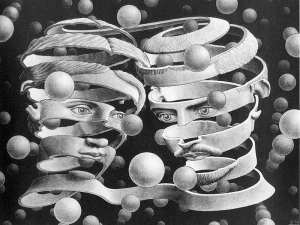
M C Escher - "Ambidextrous Peeled Faces"

M C Escher - "Ambidextrous Peeled Faces"


Where is He? – Jelaluddin Rumi

May 4, 2009

 I tried to find Him on the Christian cross, but He was not there; I went to the Temple of the Hindus and to the old pagodas but I could not find a trace of Him anywhere.

I searched on the mountains and in the valleys but neither in the heights nor  in the depths was I able to find Him. I went to the Kaaba in Mecca, but He was  not there either.

I questioned the scholars and philosophers but He was beyond their understanding.

I then looked into my heart and it was there where He dwelled that I saw Him : He was nowhere else to be found.

Jelaluddin Rumi

I took a picture of his tomb in Konya, Turkey. Click here to see it.

Some other quotes by Rumi:

This quote below we used on the homepage of the HopeCaravan website, which is no longer active. However, the yahoo group still is on the net though it is no longer active.

“Come, come, whoever you are.
Wanderer, worshipper, lover of leaving.
It doesn’t matter.
Ours is not a caravan of despair.
Come, even if you have broken your vow
A hundred times.
Come, yet again, come, come.”

Other quotes which have touched me include:

“Your task is not to seek for love, but merely to seek and find all the barriers within yourself that you have built against it.”

“Out beyond ideas of wrongdoing and rightdoing, there is a field. I will meet you there.”

“Only from the heart can you touch the sky.”

“Let the beauty of what you love be what you do.”

“You were born with wings. Why prefer to crawl through life?”

RumiRumi