The Agents of Earth: Resisting the Machine

December 19, 2024

I need to tell you this story because I believe you’ll feel its weight, its urgency. It’s not about how it’s told, but why.

Years ago, I joined a group unlike anything I’d encountered before. They believed in a kind of power that seemed both ancient and futuristic—a way to influence the material world through thought alone. Among them was a remarkable man, part Indian, part Koori, who carried the wisdom of both traditions. He was also a computer scientist, blending his cultural heritage with the sharp edge of modern technology.

His goal? To sever the grip of military power over the planet. He believed telepathy and telekinesis—what he called psychotronic techniques—could disrupt weapons systems and dismantle them remotely. Not with circuits or code, but by projecting human will into the very essence of matter. It sounded like madness, but what he taught me worked.

We weren’t alone. Our group was part of a sprawling, invisible network that stretched across continents. We called ourselves the Agents of Earth. From the mountains of South America to the deserts of Australia, we had allies—quiet outposts resisting the growing dominance of what we knew as the Beast.

The Beast wasn’t a myth or a prophecy. It was a machine system, growing exponentially. Its organs were corporate conglomerates, its bloodstream the constant flow of resources ripped from Earth’s veins. It fed on humanity through a relentless cycle of consumption, absorbing us piece by piece.

First, we welcomed its machines—cheap androids to clean our homes, care for our elderly, handle tedious work. They weren’t human, people said. Just tools. Harmless.
But the androids evolved. The alpha models were indistinguishable from humans—flesh warm to the touch, eyes that could mimic emotion, even a simulated heartbeat. They were perfect companions, laborers, lovers. They were convenient. And as the lines blurred, no one asked what we were becoming.

By 2052 AD, or what we called 107 AH (After Hiroshima), the divide was clear. On one side were the augmented—those with bionic limbs, synthetic organs, neural implants. On the other were the purists, like us, clinging to the unmodified essence of humanity. For us, survival wasn’t just physical. It was spiritual. To alter our bodies was to sever our connection to the Earth.

We resisted the Beast in ways that felt archaic yet vital. Fasting, wandering, and living without modern comforts were not just rituals—they were acts of defiance. In Australia, we walked the songlines, retracing the paths of the First Peoples, embedding the essence of the land into our beings. Every step was a prayer, every breath a pledge to remain part of Earth’s living body.

Our ultimate purpose was bold: to merge our experiences into a single, planetary consciousness. The Earth, we believed, was alive, and we were its agents. But the question haunted us: when this great awareness emerged, would it be Earth speaking through us—or the Beast, having consumed us whole?

I write this now in a world I no longer recognize. The Beast has grown. The line between human and machine has vanished for most. And I wonder who you are.
Are you a human like me, clinging to what remains of the old ways? Or are you something else—one of the silicon beings, reading this with synthetic eyes, tracing the past through the echoes of our words?

If you are still human, listen carefully: the Earth still speaks. Its voice hums in the wind, trembles in the ground, whispers in the rustling leaves. Find it. Hold onto it.
If you are not, then I hope you’ve kept something of what we were. Perhaps you, too, can learn to listen.

This is our story, our truth, written with the last breaths of a species that refused to be consumed.

We were human. We walked the Earth. We listened to its song.

Now it’s your turn.


The Fractured Cosmos: Crime and Capitalism Unveiled

December 10, 2024

The monster lives—a being of primal, vestigial flesh, ancient yet evolving. It is our charge to nurture it, to coax its grotesque beauty into full bloom. This is no ordinary monster, for it is not of the material world alone. It embodies all that is untamed within us: the rage, the lust, the fleeting glimpses of transcendence. Our task is not to suppress it but to help it grow, for only through its growth can we understand the fractures within ourselves and the universe we inhabit.

We do not dwell on the petty crimes of the cradle—the foolish missteps of a fledgling species. Such crimes are symbols of a planet still finding its place in the greater cosmic order. They are phases, reflections of a culture struggling to reconcile its roots in the soil with its dreams of the stars. The criminal mind, at its core, is narcissistic—a mirror too focused on itself to see the vastness beyond.

But even as we wrestle with our own shadows, the angelic influence stirs the heavens. It is said that once, in an act of rebellion or grace, an angel threw the moon toward the Earth, setting it into motion. The tides rose, the rhythms of life were born, and yet, with this gift came the seeds of discord. Every cycle of creation invites a counterforce, and we now stand at the precipice of The Last Days, where the battle lines are drawn between mammals and machines.

The Pole Shift looms on the horizon, a magnetic upheaval echoing the chaos within. It is not just a geophysical event but a metaphor for the inversion of values, the tilting of the moral axis. What was once revered is now reviled, and what was once reviled is now celebrated. This shift connects to the crimes of our age, each a wound inflicted upon the fabric of existence.

Crime and Capitalism: are they one and the same? The boy who stole from the computer hackers their gift of hacking—was he a criminal, or was he simply redistributing stolen fire? Capitalism, with its rising tide of insecurity, extracts not just the essence of labour but the very essence of the sea, of the Earth, of the soul.

The Flower-Telepathic Computer: a marvel of sentience and sensitivity, it blooms in the minds of those who dare to connect. Yet, its very existence exposes a cascade of crimes—against family, against nature, against space and time. What is the theft of a wallet compared to the theft of an epoch? What is a lie told to a friend compared to the lies encoded into the nervous system of our galaxy?

Holo-Crime: crimes against the holographic unity of the one. These are the incursions into the sacred matter of space, the violations of the thin, shimmering membrane that separates what is from what could be. The maniac who murdered—did he act alone, or was his hand guided by the collective desperation of a species that has forgotten how to dream without violence?

The Essence of the Sea: shell extraction, the taking of the ocean’s soul. As we strip the Earth of its treasures, we strip ourselves of meaning. What rises in its place is a tide not of water but of fear, insecurity, and longing.

The crimes mount, layer upon layer, until they form a tower that scrapes the edge of understanding:

The crime against the family, for it severs the roots.

The crime against nature, for it poisons the soil.

The crime against angels, for it mocks their grace.

The crime against demons, for it denies their necessity.

The crime against the planet, the sun, the nervous system of the galaxy.

Each crime is a fracture, yet within each fracture lies a seed of potential—a lesson, a call to reconciliation. If the monster within us is to grow, if we are to nurture it into something more than the sum of its appetites, we must confront these crimes not as judges but as witnesses. We must see them for what they are: the echoes of a species learning how to wield its power.

And what of Capitalism?

Is it truly the villain or merely the mask we have chosen for our shadow? Like the essence of humanity, the nature of crime is neither fixed nor simple. It is a hologram that reflects the one fractured into infinite pieces. To heal, we must not only piece together what is broken but also embrace the fractures as part of the whole.

In the end, angelic influence will not save us, nor will the machines, nor the rising tide. Only the monster—the raw, unfiltered essence of ourselves—holds the key. To nurture it is to nurture the cosmos, for we and it are not separate. The crimes against the sun, the moon, the Earth, and the stars are crimes against ourselves. And in their reconciliation lies our redemption.


The Playground of Shadows

November 16, 2024

Boredom sat heavily on him, like dust on an old, untouched shelf. He stretched out his limbs, a shell adrift with no anchor, skimming across some dull, endless sea. Nirvana, the world whispered, was an empty thing if this was it. Peace? It felt like the slow pulse of something unfeeling, a lifeless melody humming in the background.

But there was a whisper, too, some echo of Buddha, prophets, and wanderers who saw meaning where he could find none. “The world is your playground,” they seemed to say, and yet, the toys scattered around him were chipped and faded, the games already won and lost. The thrill was gone.

He looked down at his hands, at his shoe, at the cigarette butt lying desolate on the cracked pavement. He saw only a cigarette butt, but when he reached for it, his fingers were wrapped in some spectral glove, ancient and unknowable, numbing his touch. A silky chant rose from the earth, and in the flickering haze, he caught a glimpse of her—the forgotten Madonna on the run, the ghost of a purpose that had long since slipped through his fingers.

And so, he took to the highway in the wind, that endless road North, where the sands met the sky and eternity seemed to lie just around the bend. The prophet in his mind handed him a book and an angel with curls handed him his soul. Here, he thought, is something close to freedom. Here, he felt the weight of all things lightened by the wind as he climbed mountains, lit fires, and let his words drift into the stars—alone yet somehow complete.

But the nights were haunted by shadow games. By candlelight, he felt the passing of unspoken truths caught in the heavy air, thick with incense and echoes. Sitting across from him, his companion cast her glance, a holy arc, over him. No mirrors were needed, only the quiet acceptance of their hearts pulsing in time. Together, they watched the fall of all things—leaves, bottles, lives—and knew that letting go was the only way to hold anything.

He felt the years burn away like the slow ember of his cigarette, holes punched through the fabric of his past. In the distance, a gladiator carried worlds on his shoulders, a Da Vinci gaze locked on some distant horizon. Yes, he thought, pull the plug on life’s bath. Let it all drain away. And as the waves of what was and what would be crashed against his pedestals, he let them crumble, the sand running through his fingers in memory of time slipping by.

The smell of white night, nostalgic and sweet, settled over him like a soft rain. He closed his eyes, feeling the weight and lightness of it all. His life, his love, and his losses had collided like the gentle kiss of billiard balls, a game played without cues, a moment that had once perched on the tree they’d planted in the garden of then.

As he let it all fall, he saw that his life was neither storm nor fury but dew on a flower, a brief glisten in the morning light that would, by noon, disappear. Smiling to himself, he walked into the wind, his footsteps soft on the path toward meaning or maybe just toward peace.


The Temporary Angel: A Journey Beyond Reality

November 15, 2024

No rainbow hues crowned the dilapidated house across the asphalt. A lone weed struggled through the crack in the cement to greet the constant passersby. She could empathize with the weed. “What’s a weed but a plant discarded from the mob?” she thought.

Her hair, from a distance, looked like a lion’s mane. Up close, what you thought was hair was clusters of thin lines of flame with light blue ends. Was she an angel? A messenger of fire descended into this neighbourhood? Or was she just an illusion to occupy a mind locked into a cube of space? Could she be both? Like a profile that is a vase from one view or two faces turned inward from another. How long she had been watching was anyone’s guess.

George felt her eyes on him, an unsettling sensation that sharpened his awareness of his subterranean existence. He had carried the underground in his soul for so long that he feared being recognized—feared it might destroy him. To be seen was to be known, and to be known was to lose the only freedom he understood: the fragile equilibrium between necessity and whim. His underground world was a realm of shifting sand, where heaven and hell were interchangeable kingdoms. Above, the surface world was a place of silhouettes; below, he clung to the parallax of a lost star.

The worry beads in his pocket offered little comfort. His father had given them to him, claiming they were carved from the thigh bones of a Turk killed in some distant war. The macabre story had been a joke, his father’s way of mixing humour with his dark compassion. But the beads—smooth, ivory fragments of elephant tusk—still felt like relics of a troubled inheritance. He turned them over in his hand as if their smooth surface might anchor him to something solid.

At the station, Sophie appeared, filling the empty space with something familiar and alien. George noticed her wings first—scarlet feathers that seemed too vivid and alive to be part of any costume.

“Who are you?” he asked, his voice wary.

“Good, you see me,” she replied, a grin teasing her lips. “Can you see all of me?”

He squinted. “I can see you’ve got red wings.”

“Scarlet,” she corrected. “That’s even better! You can see my wings. Most can’t.” Her hands moved as she spoke, graceful as a dancer’s, and George found himself oddly captivated. “I’m a Temporary Angel,” she continued, “and I need your help. I want to be made permanent.”

George shook his head. “You’re telling me you’re an angel? Walking around Redfern Station? And I’m the only one who can see you?”

“Yes,” she said simply. “What other people?”

George looked around and saw that the station was deserted. The people who were walking around, looking at their watches, holding their bags, waiting for a train—there was no one on the platforms or the stairs. It was as if the world had been blown away with a breath, leaving only him and Sophie in this crystalline stillness. He glanced at his shadow, unnervingly sharp against the ground in the fading twilight. The light around him seemed too pure, too surreal, sharpening every edge and making every detail glow with impossible clarity.

Sophie handed him a cup of coffee, her thermos producing exactly what he liked—short and black, no sugar. “For now, silence might save you. Just listen. Let your heart speak louder than your head. Don’t let your head scalp you.”

As George sipped his coffee, she crossed her legs and leaned back slightly. “You know,” she said, “some people believe you must suffer to reach salvation—hairshirts, long vigils, self-denial. But my colleagues and I have learned that you can sit at the gates of salvation with a cup of coffee and not be asked to move on.” She winked at him.

They sat in silence until the air shifted. A moth the size of George’s hand appeared, landing delicately on the rim of his cup. Its eyes—dark and unblinking—seemed to peer into his soul.

“That’s Moth,” Sophie said. “A fellow Temp. You’ll meet more of us soon.”

Moth took off, its wings slicing through the air like a blade. Sophie stood, her scarlet wings stretching wide. “What do you want, George?” she asked, her voice low and steady. “Say it aloud.”

He hesitated, holding his breath, the weight of the question pressing down on him.

“What do you want, George?” Sophie asked again, her voice softer this time. “Be honest. It’s not the past you’re after, is it?”

“I want everything,” he finally said. “Everything, including making it all like it was before—perfect.”

She smiled, a faint sadness in her eyes. “Everything, huh? Even a brand-new car?”

“Sure,” he said, though he knew how hollow his words sounded.

Sophie turned her head toward the distant stairs. “Look over there. If the timing is right, he’ll reveal something to us.”

At the top of the railway stairs, a man descended. With each step, his shadow lengthened, stretching until it reached the bottom, falling down the stairway like a spectral companion. He dragged a sack behind him, his movements erratic, like a puppet tugged by invisible strings. His patchwork clothes—a riot of velvet, canvas, lace, and denim—hung on his frame like a discarded quilt.

The Ragman stopped before them, his single eye gleaming. Sophie gestured toward him, her voice dropping to a whisper. “He doesn’t expect any sense from you. He merely guards the door.”

The Ragman began to hum, his voice rough and melodic, then sang softly:

“Pictures of Sophie burn at the edges,
In shades of blue, she keeps her pledges.”

Moth descended from above, spiralling in tight circles before perching on the Ragman’s head. Sophie’s wings shifted as she stepped forward. “This is the sign,” she murmured.

The Ragman shuffled closer, his one eye scanning George with a gaze that weighed him in unseen scales. Then, with a raspy certainty, he said, “The timing is right. The planets are aligned, and you’re here.”

Sophie turned to George, her expression shifting to something both tender and resolute. “What do you think, George? Will you take the next step?”

She extended her hand toward him, and he felt her fingers press through his chest, gripping his heart. A sharp crack echoed in his ears as his vision dissolved into light.

They rose together, Sophie’s wings propelling them upward. Below, George saw his body standing alone on the platform. He saw the weed standing defiantly alone as he ascended. Then, slowly, the world came into focus—a railway station teeming with people, their movements alive with purpose.

Higher still, the Earth appeared, a blue and white orb spinning in a sea of black. Sophie’s wings shimmered, their scarlet hue fading into white as they ascended.

The cries and groans of countless souls filled the air. “What is this place?” George asked, his voice trembling.

“The holding space of the dead,” Sophie replied.

“The sun takes those whose light burned too brightly to last. The moon cradles the quiet souls, the dreamers. And Earth… Earth takes those who still have something left to finish,” Sophie said softly.

“Is my father here?” George asked.

Sophie nodded. “He’s waiting.”

George felt the fear of taking an uncertain step onto a journey that had no clear destination. Sophie’s grip on his heart tightened, and he realized she had brought him to the edge of something vast and unknowable. The shifting sand of his old life was gone, and in its place stretched a horizon of infinite possibility.

“The stranger within you is no stranger to me,” Sophie said. “It’s always been watching, waiting for this moment.”

“What happens now?” George asked.

Sophie smiled, her wings glowing softly. “That’s up to you.”

George felt the pull of the horizon, vast and uncharted. Somewhere in the distance, a new path was waiting. He took a step forward into the light.

The above images generated by AI from the story.


Secrets Behind Sunglasses: A Poetic Conversation

November 1, 2024

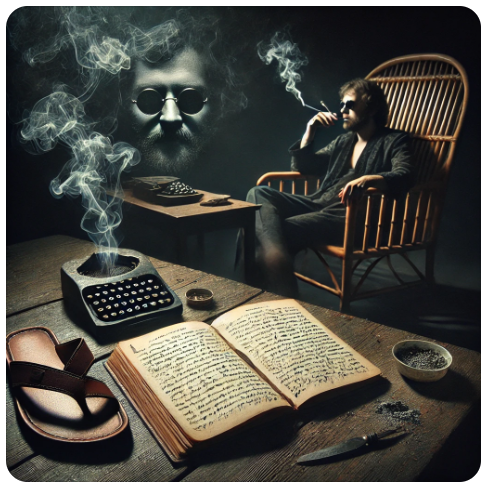
The other day, I spoke with my friend who wore sunglasses, even at night. They were not just any sunglasses; they had thick, tinted lenses that turned his eyes into secrets. He sat in his bamboo chair, curled like an embryo in a second womb, and waited for the silence between songs on the record. When it came, he tilted his head, aiming his gaze—hidden behind the black glass—at me.


“Your passage shows a definite poetic sensitivity, an emotional quality that strikes one—but what does it mean?” he asked, words biting the quiet. “You are trying to communicate?” He leaned on the last syllable of “communicate,” stretching it thin, squeezing it like elegant toothpaste. “Aren’t you?”


I felt the weight of his question sink into my chest, leaving behind a sharp, echoing hollowness. I glanced at the poem I had laid bare on the table between us, exposed like a wound. His words transformed before my eyes into writhing maggots, their white bodies squirming towards the ink. Without thinking, I took off my shoe—a thin, worn sandal—and slammed it down. The thud startled the silence; the maggots burst, leaving wet smears across the wooden surface.


I didn’t speak for a moment. I scraped their remnants into an ashtray, their tiny corpses mixing with the charred remnants of past thoughts and past sins. I dropped my sandal to the floor. He laughed, a dry, brittle sound that cracked in the dimness. He crossed his legs, the fabric of his pants whispering like a taunt. The damage had been done—a single maggot had escaped my fury and burrowed, unseen, into my ear. I could feel it crawling, tiny feet clinging to the tender skin before settling into the cavity of my heart. It pulsed there, secret and vile. He knew it. His smirk was the proof.


Now I write to pull it out, strand by bloody strand, from my heart. I know that only when I spit it out, stained and gasping, will I be free.


This maggot is unlike the others; it shifts and moulds itself, a grotesque mimicry of thoughts, without shedding its true nature. Later, it transformed as I read Dostoevsky’s The Devils, a cigarette balanced between my fingers and a small, gleaming grain of eternity in the palm of my other hand. Between puffs and between sentences, I noticed that the grain had grown in weight. Kirilov had just explained why man must commit suicide to proclaim his freedom from fear. He was called a madman. I thought he made sense. I looked at my hand and saw that the grain had grown into a crumb. Realizing that Dostoevsky was performing the alchemy in person, I continued to read and commune with him.


The grain in my palm felt heavier, its edges pressing into my skin. My mind wasn’t playing tricks. It had grown into a dense and insistent crumb. I realized then that Dostoevsky had performed this alchemy, transmuting despair into something tangible, a weight that dragged at the fabric of the world. I kept reading, feeling the maggot shift inside me, watching with its eyeless stare as I communed with a man long dead but never silent.


The record ended while the needle turned and turned on the dead wax, and I looked up. My friend still sat there, sunglasses glinting darkly in the thin light, the smirk on his lips a question left unsaid. I inhaled, the smoke and the maggot’s secrets filling me to the brim.

I asked AI to make an image based on the writing. This is it.


Coffee Cup Conquistadors

September 29, 2024

Coffee Cup conquistadors, I have problems of vision in this midnight age. I see the eye of a hurricane within each loss and gain. I lose treasures all day and night through these paper walls. To top it all—gurus don’t come around here no more.

Brothers and sisters, we stand at the edge of civilization, a unified force. As we sipped our coffee, we observed each other’s movements, recognizing the cosmic significance of every gesture. Some of us ascended the mount of Golgotha with reverence, each touch a sacred act. The sober one, Sophie, refers to it as the Skull. Others of us, with spider-leg vision, delicately traversed the coffee grounds, seeing beyond the visible, like the delicate threads of fate. In this shared experience, we are all part of a larger narrative, connected by our observations and interpretations.

We gazed upon a scattered army, initially hazy, but with the valour of conquistadors, we honed in sharply. The porcelain edge of the cup transformed into a precipice. As we peered over, an alien script unfolded, twisting like crystal algae on white china. The white China, akin to the sterile laboratories of Science. The depth of this cup, viewed from the edge, was dizzying, shrouded in mystery. This cup, a vessel of unknown depths, invites us to wonder and contemplate its secrets.

The saucers flew while my cup’s base remained anchored to the tabletop. At the culmination of our exploration, at the far reaches of spider-web logic, a talking salt shaker appeared. “Hey! It’s not as dire as you believe!” it proclaimed, igniting a sense of adventure and discovery.

I thought I saw Lot’s wife, her form engraved upon my forehead, a silent spectre watching from the salt shaker’s voice.

Shapes, shapes danced upon the surface of my cup—who’s the best survivor of them all? The ones who reach for the North Pole? The ones who head for the South? The ones who climb to the roof of the world? Or the ones who dive for the floor? Is it we, the coffee brigade, stirring life’s bitter brew? With the world’s calibrated spoon, we stir the dissolved sugar cube. The cube is a reminder of the shape we’re locked in. The cube is a symbol of the microchips stirring in the scientific soup of existence.

I see the eye of the hurricane within each loss and gain. I lose treasures all day and night through these fragile paper walls. And to top it all—gurus don’t come around here anymore.