The Fractured Cosmos: Crime and Capitalism Unveiled

December 10, 2024

The monster lives—a being of primal, vestigial flesh, ancient yet evolving. It is our charge to nurture it, to coax its grotesque beauty into full bloom. This is no ordinary monster, for it is not of the material world alone. It embodies all that is untamed within us: the rage, the lust, the fleeting glimpses of transcendence. Our task is not to suppress it but to help it grow, for only through its growth can we understand the fractures within ourselves and the universe we inhabit.

We do not dwell on the petty crimes of the cradle—the foolish missteps of a fledgling species. Such crimes are symbols of a planet still finding its place in the greater cosmic order. They are phases, reflections of a culture struggling to reconcile its roots in the soil with its dreams of the stars. The criminal mind, at its core, is narcissistic—a mirror too focused on itself to see the vastness beyond.

But even as we wrestle with our own shadows, the angelic influence stirs the heavens. It is said that once, in an act of rebellion or grace, an angel threw the moon toward the Earth, setting it into motion. The tides rose, the rhythms of life were born, and yet, with this gift came the seeds of discord. Every cycle of creation invites a counterforce, and we now stand at the precipice of The Last Days, where the battle lines are drawn between mammals and machines.

The Pole Shift looms on the horizon, a magnetic upheaval echoing the chaos within. It is not just a geophysical event but a metaphor for the inversion of values, the tilting of the moral axis. What was once revered is now reviled, and what was once reviled is now celebrated. This shift connects to the crimes of our age, each a wound inflicted upon the fabric of existence.

Crime and Capitalism: are they one and the same? The boy who stole from the computer hackers their gift of hacking—was he a criminal, or was he simply redistributing stolen fire? Capitalism, with its rising tide of insecurity, extracts not just the essence of labour but the very essence of the sea, of the Earth, of the soul.

The Flower-Telepathic Computer: a marvel of sentience and sensitivity, it blooms in the minds of those who dare to connect. Yet, its very existence exposes a cascade of crimes—against family, against nature, against space and time. What is the theft of a wallet compared to the theft of an epoch? What is a lie told to a friend compared to the lies encoded into the nervous system of our galaxy?

Holo-Crime: crimes against the holographic unity of the one. These are the incursions into the sacred matter of space, the violations of the thin, shimmering membrane that separates what is from what could be. The maniac who murdered—did he act alone, or was his hand guided by the collective desperation of a species that has forgotten how to dream without violence?

The Essence of the Sea: shell extraction, the taking of the ocean’s soul. As we strip the Earth of its treasures, we strip ourselves of meaning. What rises in its place is a tide not of water but of fear, insecurity, and longing.

The crimes mount, layer upon layer, until they form a tower that scrapes the edge of understanding:

The crime against the family, for it severs the roots.

The crime against nature, for it poisons the soil.

The crime against angels, for it mocks their grace.

The crime against demons, for it denies their necessity.

The crime against the planet, the sun, the nervous system of the galaxy.

Each crime is a fracture, yet within each fracture lies a seed of potential—a lesson, a call to reconciliation. If the monster within us is to grow, if we are to nurture it into something more than the sum of its appetites, we must confront these crimes not as judges but as witnesses. We must see them for what they are: the echoes of a species learning how to wield its power.

And what of Capitalism?

Is it truly the villain or merely the mask we have chosen for our shadow? Like the essence of humanity, the nature of crime is neither fixed nor simple. It is a hologram that reflects the one fractured into infinite pieces. To heal, we must not only piece together what is broken but also embrace the fractures as part of the whole.

In the end, angelic influence will not save us, nor will the machines, nor the rising tide. Only the monster—the raw, unfiltered essence of ourselves—holds the key. To nurture it is to nurture the cosmos, for we and it are not separate. The crimes against the sun, the moon, the Earth, and the stars are crimes against ourselves. And in their reconciliation lies our redemption.


The Apple and the Cosmos: A Dance of Reality

December 9, 2024

Before me sits an apple, ordinary yet radiant, its waxy surface catching a sharp glint of light from a lamp above. It is tangible, immediate—its crispness confirmed as I lift it to my lips, its flavour vibrant and undeniably real. Beside it rests a protractor, leaning against a globe, and an astrological chart sprawled across my desk. These objects—tools of measurement and mapping—whisper of realities far removed from the apple’s tangible presence. The apple anchors me in the here and now while the instruments gesture toward the distant, the abstract, the infinite.

The apple is a feast for the senses. I can touch it, taste it, smell it, and see it. Though its atoms appear tightly packed, they are, in truth, vast spaces of energy and vibration. Magnify one of its atoms, and its solidity dissolves into a void where particles exist only as probabilities, dancing in fields of energy. Yet, this solid illusion sustains my bite, my taste, and my knowing.


The horoscope beside it lacks the apple’s tangibility. It cannot be bitten or held, but it represents something equally profound: a symbolic map of the cosmos. Where the apple’s reality is immediate, the horoscope projects patterns of meaning across time and space, binding celestial rhythms to the human story. These two things—apple and horoscope, immediate and archetypal—remind me that reality is both seen and imagined, both concrete and infinite.


This paradox of perception defines our existence. The apple, so close I can taste it, is not as solid as it seems. And the stars, so distant their light has travelled for millennia to reach me, are not as unreachable as they seem. Between the apple and Alpha Centauri lies an unfathomable gulf, yet they are part of the same web of existence, bound by the laws of physics and the rhythms of the cosmos.


Newton, watching the fall of an apple, saw the invisible thread connecting Earth and sky. Einstein deepened this insight, showing that space and time are inseparable and that matter and energy are two forms of the same thing. Quantum physics has unravelled the idea of separateness, revealing that particles are not isolated entities but relationships—waves of possibility collapsing into form through interaction.


David Bohm’s theory of implicate order expands this vision further, suggesting that the universe is a seamless whole where every fragment reflects the entirety, like a hologram. In a hologram, each fragment contains the whole image, even when divided into pieces. Similarly, the universe is encoded in every part of itself. The apple before me is not merely an apple; it is a microcosm of the cosmos, its atoms vibrating with the same energies that fuel the stars.


The horoscope, too, speaks to this interconnectedness. It is not about planets and rocks but about relationships, patterns, and cycles. The zodiac mirrors the rhythms of life, like the apple tree that blossoms, bears fruit, and eventually returns to the Earth. The horoscope encodes the rhythms of the cosmos in symbols, reminding us that the patterns above are reflected in the patterns within.


This interconnectedness challenges the illusion of separation. The apple and the stars, the immediate and the eternal, are not opposites but facets of the same reality. Our senses, while invaluable, reveal only a sliver of the whole. Light, for instance, is just one octave in a vast electromagnetic spectrum, and beyond the visible lies a universe of energies—X-rays, gamma rays, cosmic rays—that remain unseen but ever-present.


Similarly, the frameworks of language and culture limit how we perceive and interpret the world. But within these limits lies a profound truth: we are not separate observers of the universe; we are participants in its creation. As physicist John Wheeler suggested, the act of observation itself shapes reality, collapsing waves of probability into patterns of existence. Our consciousness, like a hologram, reflects the universe within it.


The apple before me, the stars above, and the chart on my desk are all threads in this web of unity. The apple speaks of immediacy, the stars of eternity, the chart of the connections that bridge the two. At this moment, I recall a walk in an orchard with my father years ago. He handed me an apple, freshly picked, and told me to hold it carefully as though it contained the world. I didn’t understand him then, but now I see his wisdom. The apple was the world, the stars, and myself—all woven together.


So, as I bite into the apple now, tasting its crispness and feeling its tang, I know it is real. But I also know that in this simple act, I am connected to the stars, to the atoms that form both fruit and flesh, to the patterns that govern the universe.


In the apple, I taste the infinite, and in the infinite, I find myself.


The Playground of Shadows

November 16, 2024

Boredom sat heavily on him, like dust on an old, untouched shelf. He stretched out his limbs, a shell adrift with no anchor, skimming across some dull, endless sea. Nirvana, the world whispered, was an empty thing if this was it. Peace? It felt like the slow pulse of something unfeeling, a lifeless melody humming in the background.

But there was a whisper, too, some echo of Buddha, prophets, and wanderers who saw meaning where he could find none. “The world is your playground,” they seemed to say, and yet, the toys scattered around him were chipped and faded, the games already won and lost. The thrill was gone.

He looked down at his hands, at his shoe, at the cigarette butt lying desolate on the cracked pavement. He saw only a cigarette butt, but when he reached for it, his fingers were wrapped in some spectral glove, ancient and unknowable, numbing his touch. A silky chant rose from the earth, and in the flickering haze, he caught a glimpse of her—the forgotten Madonna on the run, the ghost of a purpose that had long since slipped through his fingers.

And so, he took to the highway in the wind, that endless road North, where the sands met the sky and eternity seemed to lie just around the bend. The prophet in his mind handed him a book and an angel with curls handed him his soul. Here, he thought, is something close to freedom. Here, he felt the weight of all things lightened by the wind as he climbed mountains, lit fires, and let his words drift into the stars—alone yet somehow complete.

But the nights were haunted by shadow games. By candlelight, he felt the passing of unspoken truths caught in the heavy air, thick with incense and echoes. Sitting across from him, his companion cast her glance, a holy arc, over him. No mirrors were needed, only the quiet acceptance of their hearts pulsing in time. Together, they watched the fall of all things—leaves, bottles, lives—and knew that letting go was the only way to hold anything.

He felt the years burn away like the slow ember of his cigarette, holes punched through the fabric of his past. In the distance, a gladiator carried worlds on his shoulders, a Da Vinci gaze locked on some distant horizon. Yes, he thought, pull the plug on life’s bath. Let it all drain away. And as the waves of what was and what would be crashed against his pedestals, he let them crumble, the sand running through his fingers in memory of time slipping by.

The smell of white night, nostalgic and sweet, settled over him like a soft rain. He closed his eyes, feeling the weight and lightness of it all. His life, his love, and his losses had collided like the gentle kiss of billiard balls, a game played without cues, a moment that had once perched on the tree they’d planted in the garden of then.

As he let it all fall, he saw that his life was neither storm nor fury but dew on a flower, a brief glisten in the morning light that would, by noon, disappear. Smiling to himself, he walked into the wind, his footsteps soft on the path toward meaning or maybe just toward peace.


Carnival Day

November 14, 2024

It’s Carnival Day, and the streets hum with strange music that seems to echo from the cracks in the cobblestones. The sailors sing tunes that rise and fall like waves, their voices rough and gentle, worn by salt and time. Ancient whores lean against faded railings, their sighs heavy with the weight of forgotten desires, watching a day that never ends roll out again like a ragged carpet.

Old men tip their hats to passing dogs and the shrieking children who dart between the stalls. Ladies in feathered boas throw blown kisses from their booths, winking at those who dare catch them. Somewhere in the crowd, a sky pilot—tall and solemn—wraps his arm around his lover’s shoulder, murmuring sweet equations, words of science, as they wander toward the looming shadow of the roller coaster.

“Hey! Hey! Don’t forget your sense of justice!” comes a call from a voice lost in the crowd. It’s Carnival Day, after all, a day for the topsy-turvy, a day where nothing is what it seems.

The ghost train rattles past, its lights flashing garish neon. Round and round, it goes, yet no one can hear the screams of the shadows within. You catch sight of the acrobats now, spinning and turning high in the air, their bodies dangling by invisible threads. You wonder what magic holds them up there—what spell, what curse—yet there’s not even a single hair to show the strain. Your head begins to turn, spinning in rhythm with the world around you, and you wonder what the clown is doing over there, grinning like he knows all the secrets you forgot.

You find yourself seated under the grand old hat, an enormous thing that arches above, draped like a night sky. Its great mast rises from the centre, a pillar of mystery that holds the curtain between this world and the stars. Looking up, you see them—stars peering down with distant curiosity, pinpricks of silver against the carnival’s blaze. Somewhere, you think, there might be a wishing well beneath this hat, deep and endless, catching all the silent hopes thrown up by this crowd.

You wander into the Topsy-Turvy House, tripping over invisible stairs and losing balance in rooms that slope and slide. The electric vibrations of the funhouse hum in your bones, a strange, tingling pulse that you can’t shake. Electronic zombies greet you, their eyes blank but somehow alive, watching you even as you look away.

The laughing clowns are waiting with wide mouths open, eager for you to throw your ball into their gaping grins. You do, and the ball tumbles down, but you lose track of it, forget where it went, though you wish—foolishly, perhaps—for the panda plush on the wall, a silly prize you’re sure will hold you tight.

Nearby, a bearded woman whirls like a storm, her skirts sweeping the air in wide arcs. You see the hammer and bell challenge beside her and step forward, but somehow you miss, though you strike with all your might. Next, a boxer in the ring grabs hold of your toe—he’s a strange one, like a sumo who left his mittens by the dock, his laugh deep and unfathomable. Around you, freaks and fortunes twist and collide, creatures of illusion, like characters from a song half-remembered.

You stumble into the fortune teller’s tent, where the hangman, of all people, sits kissing the feet of an empress. She looks up at you with a knowing smile, and a chill creeps up your spine as the cards—tarot, tarot—whisper among themselves, hinting at secrets you’re almost afraid to hear.

Outside, a clown with a monkey mask offers you flowers, their petals made of bright tinsel and paper. You hand him your last coins, and he smiles, ringing a small bell that echoes through the carnival. “All is well,” it seems to say, though you wouldn’t know why you believe it.

The young man with a tattoo steps forward, gripping knives he throws at the naked girl spinning on the wheel. He calls himself Zorro, but his aim is shaky. If he misses, he wins a prize—perhaps the fighting panda from the loft or a doll that talks in the dark.

The happy families pass by, their children wide-eyed as they glance at the three-headed man and the bearded lady, sharing popcorn and secrets they can’t understand. Parents, lost in the spectacle, miss the glimmer of longing in their children’s eyes—a yearning that no mask, no glittering carnival can truly satisfy.

Later, you drift to the promenade, away from the noise. The seagulls flock close as you toss crumbs into the wind, their feathers flashing white like ghostly signatures across the blue. You look to the horizon, where the sky meets the sea, and the foam spells out words you cannot read. Over there, you think, beyond that edge of the sky, perhaps the carnival drifts, waiting, the astral colours of the day hidden beneath its layers.

And then, a final whisper rises, carried by the salt breeze, as if from an uncharted land: Let the cynics cling to their masks. Let the innocent create rings of fire for the children kissing the sun.

We don’t need a ticket, we don’t need a guide—just the courage to walk that horizon toward the blue, where the carnival fades, where the laughter echoes long and low, and the stars, watching over, nod their silent approval.


The Road of My Life

November 13, 2024

Autumn leaves scatter over sandstone steps, each one a memory resting in the quiet folds of yesterday. I walk back through these moments—your fingers brushing against mine, faint traces of our names etched on time’s walls, words pulsing beneath our skin like heartbeats, unsaid, waiting. We were young, hearts held in delicate cages, eager and hesitant to be known, felt, and understood. But we let the leaves fall, let the silence stretch across seasons, sighs slipping from our lips like quiet farewells.

Now, the flowers that once reached the sky fall in the fields of memory. In some way, everything that blossomed has gone to seed. Petals drift to the earth, an offering to the silent universe. Your embrace, now an emptiness woven from starlight, holds me in a kind of nothingness that somehow feels like everything—a cosmic tapestry threading through flesh and bone.

Man shapes, a woman breathes; we exist within this cradle of creation, where time unfolds like a flower climbing eternity. It’s a quiet dance of moments becoming years, the steady mountain above and the singing brook below. Listen—do you hear it? The song beneath the song, the hum that makes everything feel so real yet intangible. I fall into it, the marrow of it all, with you. And my words, as heavy as stones, fall with me, drawn by gravity into a place beyond words.

You hold me in the palm of your mind, a single breath echoing with all that might have been said or might never need saying. Maybe it’s wrong to speak like this, caught in someone else’s story, someone else’s time. Let’s light a candle; let shadows play in their necessary darkness. After all, what is revealed without the blessing of shadow, without the weight of night?

Eternity waits around the corner, buried in dusty books and whispered memories. The ghost of your father stirs in your gaze, his secrets deep-rooted, buried in the hay of memory. And yet, here we are, stranded in the mud of our own lives. Hold me, just hold me. Let these layers—the days, the skins we wear—dissolve. What does it matter if we’re a mistake? Our fingers have already found each other; our hearts are stitched together in the dark, understanding one another without needing to speak. Our song isn’t made of words; it’s an ache living in our bones, a quiet refrain only we can hear.

Trust, and the door will open. Trust and the ladder to the stars will appear before us. Open our hearts, and suffering shrinks to a single dewdrop on a blade of grass. Look into each other’s eyes, and there—yes, there—is the kingdom we’ve been seeking. Hold my hand, and we’ll never die. Listen to the silence between us, and you’ll know me as deeply as anything can be known.

What we are can’t be held in a word, a sound, a shape, or a shadow. What we are is beyond naming, beyond showing, beyond grasping. We are the emptiness that holds everything, a No-Thing birthing all things.

Give me the road again—not the mapped highway with rigid lines, but the open, untamed spaces of the unknown. Let me wander back to where my heart first learned to roam, to those early fires and wild, unbroken skies. I want to walk those paths again, not with my feet, but with the quiet longing of my soul, letting memory rise like smoke in the evening air.

Let me laugh, unguarded, and weep without fear. Let me reach for the stars as I once did, not with hands, but with the open ache of my heart. I want to sit by the fire, tell stories in the warmth of the night, and rest in the cool shade of day. To live simply, fully, in all the ways that once felt impossible.

And when the time comes—when I am nothing but ash scattered to the winds—let me settle here, in this place where we once stood together, in the quiet soil beneath the autumn leaves. Let me dissolve into the earth, and let love rise again, whispered through the leaves on these old sandstone steps.


My Lady of the Earth: A Tale of Renewal and Time

November 12, 2024

In the heart of a forgotten desert, a lone figure trudged down a cracked highway, each step scraping against the sun-scorched asphalt as if metal clanked against stone. His feet felt like tin cans, hollow and beaten, dragging his weary body forward as he clutched an old glass bowl—its only inhabitant a sliver of something ancient and alive, a glint of Time itself suspended in water. His arms ached, heavy and empty, as though they’d died long before, holding nothing but the fragile keepsake of ages past.

But just as his strength waned, there was a shift. She appeared as if conjured from the dust itself: My Lady of the Earth, the Sun’s seventh Queen. With a graceful lift of her arms, she raised him above the smoke, the Screen of all that clouded and concealed. Her touch was unlike anything he’d known, reaching through the rusting paths of his veins, setting them aglow with purpose. In her embrace, he felt something long lost—a feeling like Home, a warmth too timeless to describe.

He looked upon her as her veil began to dissolve. Beneath it, her face bore the quiet strength of mountains, still and unyielding, forever patient. From her eyes spilt silver brooks, flowing over her cheeks without urgency, slipping past with a gentleness that defied the chaotic world below. The brooks whispered of hidden peace, where Madonnas rested in perfect balance, and saints lay quiet in their coffins, untouched by mortal turmoil. Shadows of the powerful faded here, hollow ambitions dissipating like smoke. Even the rooster—herald of dawn and disturbance—lay silent in her presence as if Time paused.

She was both familiar and fierce, the Only Child of Passion and Earth’s eternal heartbeat. Winds swept through the dust, weaving through her form, rooting into her flesh, and carrying the age-old whispers of forgotten stars with them. Her body, raw and untamed, glistened in the light of the Sun, bound to it yet free, dancing in an endless circle of life and death, decay and rebirth.

With a flick of her golden feet, she nudged the Moon, sending it into an orbit known only to the wise and the wild, beckoning all with a silent proclamation. The man held his breath, feeling the weight of her gesture, her assurance—this was no end but the beginning, an age reborn. And as he stared into her eyes, he understood: he was no longer lost in the desert. He had been brought back to her, the soul of his journey entwined with the spirit of the Earth, who whispered to him that, like her, he too was eternal.


Secrets Behind Sunglasses: A Poetic Conversation

November 1, 2024

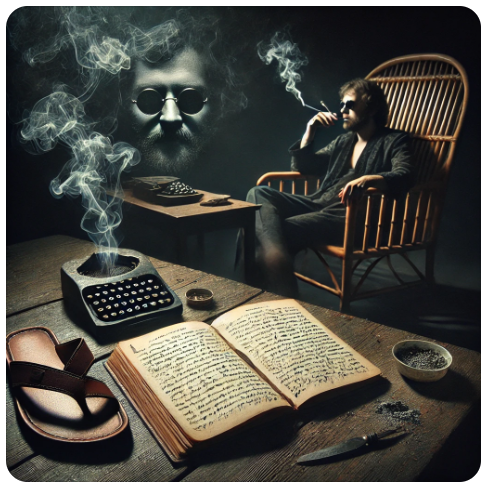
The other day, I spoke with my friend who wore sunglasses, even at night. They were not just any sunglasses; they had thick, tinted lenses that turned his eyes into secrets. He sat in his bamboo chair, curled like an embryo in a second womb, and waited for the silence between songs on the record. When it came, he tilted his head, aiming his gaze—hidden behind the black glass—at me.


“Your passage shows a definite poetic sensitivity, an emotional quality that strikes one—but what does it mean?” he asked, words biting the quiet. “You are trying to communicate?” He leaned on the last syllable of “communicate,” stretching it thin, squeezing it like elegant toothpaste. “Aren’t you?”


I felt the weight of his question sink into my chest, leaving behind a sharp, echoing hollowness. I glanced at the poem I had laid bare on the table between us, exposed like a wound. His words transformed before my eyes into writhing maggots, their white bodies squirming towards the ink. Without thinking, I took off my shoe—a thin, worn sandal—and slammed it down. The thud startled the silence; the maggots burst, leaving wet smears across the wooden surface.


I didn’t speak for a moment. I scraped their remnants into an ashtray, their tiny corpses mixing with the charred remnants of past thoughts and past sins. I dropped my sandal to the floor. He laughed, a dry, brittle sound that cracked in the dimness. He crossed his legs, the fabric of his pants whispering like a taunt. The damage had been done—a single maggot had escaped my fury and burrowed, unseen, into my ear. I could feel it crawling, tiny feet clinging to the tender skin before settling into the cavity of my heart. It pulsed there, secret and vile. He knew it. His smirk was the proof.


Now I write to pull it out, strand by bloody strand, from my heart. I know that only when I spit it out, stained and gasping, will I be free.


This maggot is unlike the others; it shifts and moulds itself, a grotesque mimicry of thoughts, without shedding its true nature. Later, it transformed as I read Dostoevsky’s The Devils, a cigarette balanced between my fingers and a small, gleaming grain of eternity in the palm of my other hand. Between puffs and between sentences, I noticed that the grain had grown in weight. Kirilov had just explained why man must commit suicide to proclaim his freedom from fear. He was called a madman. I thought he made sense. I looked at my hand and saw that the grain had grown into a crumb. Realizing that Dostoevsky was performing the alchemy in person, I continued to read and commune with him.


The grain in my palm felt heavier, its edges pressing into my skin. My mind wasn’t playing tricks. It had grown into a dense and insistent crumb. I realized then that Dostoevsky had performed this alchemy, transmuting despair into something tangible, a weight that dragged at the fabric of the world. I kept reading, feeling the maggot shift inside me, watching with its eyeless stare as I communed with a man long dead but never silent.


The record ended while the needle turned and turned on the dead wax, and I looked up. My friend still sat there, sunglasses glinting darkly in the thin light, the smirk on his lips a question left unsaid. I inhaled, the smoke and the maggot’s secrets filling me to the brim.

I asked AI to make an image based on the writing. This is it.