The Stone Seeker: A Myth of the Wandering Soul

October 2, 2025

A departure from my usual posts — this one takes the form of myth, an inner journey written as an allegory. I offer it as a companion to my ongoing stories.

He was called Stavros, which means Cross, and that was his burden — and his path.

One day, in a time that was no time, he heard the silent summons. Not from the sky, but from the pulse within the earth. He set out, carrying nothing but his breath and the ache of questions. He climbed the ancient spine of Sinai without sleep, ascending stone upon stone, as if walking up the ribs of a forgotten god. At the summit, the sun did not answer him — but it showed him he was not alone.

The descent was harder. That is the truth of all peaks. He reached the foot of the mountain and sat by the monastery of Katherine, where silence grows like lichen on old stone. There he met the Gatekeeper — a monk whose heart had fossilised into ritual. Stavros spoke the sacred tongue, but the Gatekeeper did not recognise him. He uttered the Word — “Yunan” — and dismissed him like a leaf blown against the stone walls.

So the Seeker left the sacred walls and returned to the road. It was on this road that he met the Trickster Guide — a Bedouin named Mohamed, who spoke through music and mischief. He offered herbs not for healing but for vision. He rolled a joint while guiding the chariot at great speed. Smoke curled like a serpent toward the heavens, and the desert began to shimmer.

Mohamed showed him the living map: dunes that were coastlines, mountains that were camels in repose. “This is Sinai,” he said, “and there is the Red Sea.” In that moment, the Seeker saw geography become prophecy. The land was not just land — it was a scroll unrolling.

Mohamed led him to a mosque, a café, a grove of planted trees. “We are of the 15 tribes,” the Guide said. “We plant what will shade the unborn.” The Seeker ate with him, drank the dark tea of mystery, and vanished into moonlit streets.

Then came the Labyrinth.

In the night city, he was lost among alleyways, where cats whispered secrets and doors led nowhere. He emerged by chance, or fate, and met the Scribe, who wrote his name in the language of the ancestors. “All men have three names,” said the Scribe, “but only one is true.”

The Seeker travelled again — across waters, under stars, on feluccas that rocked like cradles of time. He met companions with names like runes: Linda, Olga, Shayari. Together they smoked, drank rakii, and watched angels dissolve into the air like incense.

He arrived at a threshold: the City of Columns. There, under a sky bleached of memory, he sat on sand and turned a plastic bottle into a shrine. He waited for a chariot to carry him across the Nile of forgetting. Someone called him “the Greek with eight children,” and he laughed. He had none — and yet carried thousands within him.

Then came the Two Georges.

One was a Potter. One was a Priest of the Inner Fire. They saw in Stavros something he had hidden from himself. “You evoke the honour of Christ in others,” they said. “You wear innocence like armour.” They fed him macaroni and truth. In return, they asked for stories.

And so he spoke.

And in speaking, he remembered.

Dialogue became divination. Each question was a key. Each story a lost scroll. “In dialogue,” said George, “there is living transmission. The book you write is not of ink. It is breath, shared.”

They spoke of the monk on Athos who gave him a stone. “Leave this on the mountain,” he had said. And so Stavros carried it until the burden became a prayer. They spoke of karma, of grace, of gifts that are given but never earned.

Then came the desecration.

He passed through Luxor and saw the sign — McDonald’s, Temple of Luxor Street. The Golden Arches beside eternal stone. He took a photo, not to remember, but to mourn. Some desecrations are not loud. Some come wrapped in convenience.

And still, a stranger in Cairo whispered: “Welcome.” One word, like a flame in the dust.

The Seeker came to understand: giving and receiving were not separate acts. He had received shelter, food, names, music, silence. He had given stories, listening, laughter, witness. There was no accounting. Only flow.

He saw now that the journey had not been from place to place, but from self to soul. He gave before he received. He received before he gave. It was not barter. It was the hidden law.

And then — the Word.

“Sorry,” they said, “is just a word.” But he knew better. The Word began the world. Words held power, memory, vibration. Words could curse. Words could carry. Words could redeem.

He left the stone on the mountain.

He returned carrying only light.


Near Shore, Far Out

October 1, 2025

I keep reading about experienced sailors dying close to shore. Not in the middle of the Pacific, not after months at sea — but within sight of land. And each time, something stirs uneasily inside me.

Because I once sailed four thousand kilometres there and back to Nauru. And I had no experience. None. No yachtmaster’s ticket, no decades at the helm. Just a call, a cause, and an instinct that said: go.

I wasn’t alone, though — I joined experienced skippers and crew who knew the sea far better than I did. My leap was into their world, not a solo crossing.

At the time, it felt like courage, or maybe necessity. Looking back now, it feels different. It feels like standing on the edge of a cliff without knowing if the parachute on my back would open. I tremble at the thought. I used Astrology for both my horoscope and the horoscope of the Flotillas of Hope to justify the decision to send the Call to Action to Nauru. To justify my, now in retrospect – my need, to stretch my ‘being’.

But here’s the truth: trembling in hindsight is not the same as folly at the time. What we see later is always coloured by what we know now. Back then, I lived as I always have — by leaps. Leaps into the unknown, trusting that my Guardian Angel working behind the scenes of life would catch me.

Others trained, charted, prepared. I leapt. And somehow, I survived. Not because I was wise, not because I was skilled, but because something — call it fate, protection, or really that Angel — carried me through.

Now, when I hear of sailors lost near shore, my heart aches. It reminds me that the sea has no favourites, and that my survival was never guaranteed. It humbles me. It makes me bow my head, not boast.

But it also tells me something else: my life has always been this way. Not straight, not cautious, but here, there and anywhere. Risk and recovery, fall and renewal. And even the trembling I feel now is part of the me that survived — the deepening that comes after the leap.


The Shirt That Waited

May 10, 2025

A quiet moment in a thrift shop became a luminous sign—folded in cotton, stitched with meaning. A forgotten shirt reminded me that even in doubt, the path whispers back: keep going.

Today, a whisper found its way to me in cotton.

I took a turn I hadn’t planned. Missed another I thought I meant to take. My car drifted like a leaf on invisible currents, nudging me gently toward a thrift shop I’d never noticed before. I wasn’t looking for anything. Just drifting.

Inside, beneath the soft hum of fluorescent light and the faint scent of other people’s lives, I browsed without seeing—until I did.

A shirt.

Ordinary, almost.

Except for the words:

Found in a $10 bin. Delivered like a prophecy.

Never underestimate an old man who graduated from the Univeristy of Sydney.

I stood still.

The sentence blinked softly, like an old friend in disguise.

I’m an old man.

I’m a Sydney Uni graduate.

And lately… I’ve been adrift. Writing, yes—but shadowed by that quiet ache of doubt, that question: Who do you think you are?

The shirt didn’t answer. It just waited. As if it had been waiting a long time.

I’ve never seen such a message on any piece of clothing. Not in a shop. Not in a dream. Not in a life filled with signs and silences.

And where did I find it? Among a rack of forgotten clothes, a sale bin really—three garments for ten dollars. Almost thrown away, as if its worth were negligible. But value has its own strange gravity.

So I listened.

I bought the shirt, not to wear, but to honour the moment. Folded it like a relic. A thread in the quiet tapestry that tells me: Keep going. Your words matter. You are not to be underestimated—even by yourself.

Sometimes the universe speaks in lightning.

Sometimes, in shirts.

And no, this wasn’t random.

Not this precise. Not this poetic. Not on a day when I needed it most. There is a language beneath the visible, and sometimes it breaks the surface. This message wasn’t waiting in the shop. It was waiting for me. A quiet benediction disguised as cloth, gently reminding me that my path still holds light—and voice—and that even the doubting steps are part of the dance.

I didn’t expect to write this. I just followed a feeling, like I did that day in the shop. If it resonated with you, I’m glad. Sometimes the smallest signs are the ones we carry the longest.


The Fractured Cosmos: Crime and Capitalism Unveiled

December 10, 2024

The monster lives—a being of primal, vestigial flesh, ancient yet evolving. It is our charge to nurture it, to coax its grotesque beauty into full bloom. This is no ordinary monster, for it is not of the material world alone. It embodies all that is untamed within us: the rage, the lust, the fleeting glimpses of transcendence. Our task is not to suppress it but to help it grow, for only through its growth can we understand the fractures within ourselves and the universe we inhabit.

We do not dwell on the petty crimes of the cradle—the foolish missteps of a fledgling species. Such crimes are symbols of a planet still finding its place in the greater cosmic order. They are phases, reflections of a culture struggling to reconcile its roots in the soil with its dreams of the stars. The criminal mind, at its core, is narcissistic—a mirror too focused on itself to see the vastness beyond.

But even as we wrestle with our own shadows, the angelic influence stirs the heavens. It is said that once, in an act of rebellion or grace, an angel threw the moon toward the Earth, setting it into motion. The tides rose, the rhythms of life were born, and yet, with this gift came the seeds of discord. Every cycle of creation invites a counterforce, and we now stand at the precipice of The Last Days, where the battle lines are drawn between mammals and machines.

The Pole Shift looms on the horizon, a magnetic upheaval echoing the chaos within. It is not just a geophysical event but a metaphor for the inversion of values, the tilting of the moral axis. What was once revered is now reviled, and what was once reviled is now celebrated. This shift connects to the crimes of our age, each a wound inflicted upon the fabric of existence.

Crime and Capitalism: are they one and the same? The boy who stole from the computer hackers their gift of hacking—was he a criminal, or was he simply redistributing stolen fire? Capitalism, with its rising tide of insecurity, extracts not just the essence of labour but the very essence of the sea, of the Earth, of the soul.

The Flower-Telepathic Computer: a marvel of sentience and sensitivity, it blooms in the minds of those who dare to connect. Yet, its very existence exposes a cascade of crimes—against family, against nature, against space and time. What is the theft of a wallet compared to the theft of an epoch? What is a lie told to a friend compared to the lies encoded into the nervous system of our galaxy?

Holo-Crime: crimes against the holographic unity of the one. These are the incursions into the sacred matter of space, the violations of the thin, shimmering membrane that separates what is from what could be. The maniac who murdered—did he act alone, or was his hand guided by the collective desperation of a species that has forgotten how to dream without violence?

The Essence of the Sea: shell extraction, the taking of the ocean’s soul. As we strip the Earth of its treasures, we strip ourselves of meaning. What rises in its place is a tide not of water but of fear, insecurity, and longing.

The crimes mount, layer upon layer, until they form a tower that scrapes the edge of understanding:

The crime against the family, for it severs the roots.

The crime against nature, for it poisons the soil.

The crime against angels, for it mocks their grace.

The crime against demons, for it denies their necessity.

The crime against the planet, the sun, the nervous system of the galaxy.

Each crime is a fracture, yet within each fracture lies a seed of potential—a lesson, a call to reconciliation. If the monster within us is to grow, if we are to nurture it into something more than the sum of its appetites, we must confront these crimes not as judges but as witnesses. We must see them for what they are: the echoes of a species learning how to wield its power.

And what of Capitalism?

Is it truly the villain or merely the mask we have chosen for our shadow? Like the essence of humanity, the nature of crime is neither fixed nor simple. It is a hologram that reflects the one fractured into infinite pieces. To heal, we must not only piece together what is broken but also embrace the fractures as part of the whole.

In the end, angelic influence will not save us, nor will the machines, nor the rising tide. Only the monster—the raw, unfiltered essence of ourselves—holds the key. To nurture it is to nurture the cosmos, for we and it are not separate. The crimes against the sun, the moon, the Earth, and the stars are crimes against ourselves. And in their reconciliation lies our redemption.


The Art of Magic, the Magic of Art

December 1, 2024

True art is magic, and any true magic is art. With the touch of a pen, a brush, or even a finger, an artist—if aligned with the essence of their vocation—commands worlds both seen and unseen. Percy Shelley once declared that “poets are the unacknowledged legislators of the world,” and though his words echo from an era long past, they feel uncannily prescient.

But what does this mean in practice? Some might argue that if poets and artists truly wield such power, they are the most woeful rulers ever to preside over humanity. After all, if art is shaping the world, why do the screens that dominate our lives churn out nothing but dissonance, despair, and empty spectacle? Is this dystopian noise truly the vision of today’s artists?

I imagine Shelley himself interrupting from the shadows of the ether: “Don’t be so literal! I meant it metaphorically. Art isn’t governance by laws; it’s governance by ideas, by imagination, by what transcends the mundane. But for heaven’s sake, don’t turn poetry into a cargo cult—worshipping its form as though it’s divine by nature rather than by what it creates within you.”

And yet, there’s a peculiar magic in this metaphorical cargo, in the words, images, and sounds that tumble into the open space of our minds. For those who see the world in myths and metaphors, art carries immense weight. It is both vessel and spell, weaving meaning from the chaos.

Take, for instance, the ancient stories we hold as sacred. The tumbling walls of Jericho. The resurrection of Christ. The creation of the universe in seven days. Do these stories endure because they are literally true, or because they resonate with something deeper—something ineffable? These tales are, above all else, poetry, built to inspire, to guide, to anchor us in moral or spiritual truth. Their magic is not in their factual accuracy but in their capacity to awaken a sense of wonder and move us toward the good.

In this sense, the Bible, like all great art, is a magical artefact. It is less a document of historical fact than a talisman, transmitting its moral and poetic energy across centuries. It scarcely matters whether Jesus of Nazareth held an identity card or walked among us as a historical figure. What matters is the poetic proof—the themes of redemption, sacrifice, and hope that compels us to strive for something greater.

Even today, this ancient poetry retains its power in a world awash with “meaning packages” from advertising slogans and clickbait soundbites. The cynicism of the modern world would have us believe that such stories are relics of the past, yet their resonance persists. True art, like true magic, touches something eternal. It reaches into the ineffable and makes it visible, if only for a moment.

But here’s the tension: if art is so powerful, why does it so often feel powerless in the face of modern chaos? The art world seems increasingly commodified, trapped in an endless cycle of trends, likes, and algorithms. It’s tempting to believe that the magic has been diluted, reduced to spectacle, or even silenced altogether. Yet, history reminds us that art’s power isn’t always loud or obvious.

Think of Picasso’s Guernica—a painting that “legislated” not through laws, but through the weight of its horror and the clarity of its vision. Or Maya Angelou’s poetry, which legislates even now, carving spaces for hope and resistance. True art doesn’t demand attention; it reshapes the world quietly, insistently, often long after it is created.

Art’s magic, much like a magician’s sleight of hand, often works unnoticed. It transforms us subtly, weaving itself into the fabric of our lives without our conscious permission. Consider a song that makes us weep, a novel that reframes the way we see the world or a photograph that stops us in our tracks. These are not passive objects; they are spells cast by creators who reached into the ineffable and returned with something transcendent.

The danger, as Shelley warned, lies in worshipping the artefact itself rather than the spirit it conjures. Too often, we mistake the form for the magic, clinging to what can be packaged, sold, or commodified. But art’s true power is never in the object—it’s in the transformation it invokes within us.

This is where the artist becomes a magician, conjuring meaning from raw material and shaping worlds from chaos. True art challenges the status quo not because it seeks to destroy but because it dares to create—to reimagine what is possible. The poet legislates not with authority but with imagination, reshaping the boundaries of what we believe to be true.

Even in today’s fractured world, art retains its quiet, ineffable power. The greatest works endure not because they are timeless, but because they speak to the timeless within us. Art—like magic—relies on the participation of its audience, on our willingness to suspend disbelief and step into the unknown.

So yes, art is magic, and magic is art. Both touch the eternal, both pull at the ineffable. And whether we realize it or not, both shape the worlds we inhabit. The artist’s hand, like the magician’s, is at work all around us—transforming, challenging, inspiring. The question is whether we are brave enough to recognize it.

==================================================================

The quote is from Percy Bysshe Shelley who said that “poets are the unacknowledged legislators of the world.” This famous phrase comes from his essay A Defence of Poetry, written in 1821 but published posthumously in 1840.

“Poets are the hierophants of an unapprehended inspiration; the mirrors of the gigantic shadows which futurity casts upon the present; the words which express what they understand not; the trumpets which sing to battle, and feel not what they inspire; the influence which is moved not, but moves. Poets are the unacknowledged legislators of the world.”


The Road of My Life

November 13, 2024

Autumn leaves scatter over sandstone steps, each one a memory resting in the quiet folds of yesterday. I walk back through these moments—your fingers brushing against mine, faint traces of our names etched on time’s walls, words pulsing beneath our skin like heartbeats, unsaid, waiting. We were young, hearts held in delicate cages, eager and hesitant to be known, felt, and understood. But we let the leaves fall, let the silence stretch across seasons, sighs slipping from our lips like quiet farewells.

Now, the flowers that once reached the sky fall in the fields of memory. In some way, everything that blossomed has gone to seed. Petals drift to the earth, an offering to the silent universe. Your embrace, now an emptiness woven from starlight, holds me in a kind of nothingness that somehow feels like everything—a cosmic tapestry threading through flesh and bone.

Man shapes, a woman breathes; we exist within this cradle of creation, where time unfolds like a flower climbing eternity. It’s a quiet dance of moments becoming years, the steady mountain above and the singing brook below. Listen—do you hear it? The song beneath the song, the hum that makes everything feel so real yet intangible. I fall into it, the marrow of it all, with you. And my words, as heavy as stones, fall with me, drawn by gravity into a place beyond words.

You hold me in the palm of your mind, a single breath echoing with all that might have been said or might never need saying. Maybe it’s wrong to speak like this, caught in someone else’s story, someone else’s time. Let’s light a candle; let shadows play in their necessary darkness. After all, what is revealed without the blessing of shadow, without the weight of night?

Eternity waits around the corner, buried in dusty books and whispered memories. The ghost of your father stirs in your gaze, his secrets deep-rooted, buried in the hay of memory. And yet, here we are, stranded in the mud of our own lives. Hold me, just hold me. Let these layers—the days, the skins we wear—dissolve. What does it matter if we’re a mistake? Our fingers have already found each other; our hearts are stitched together in the dark, understanding one another without needing to speak. Our song isn’t made of words; it’s an ache living in our bones, a quiet refrain only we can hear.

Trust, and the door will open. Trust and the ladder to the stars will appear before us. Open our hearts, and suffering shrinks to a single dewdrop on a blade of grass. Look into each other’s eyes, and there—yes, there—is the kingdom we’ve been seeking. Hold my hand, and we’ll never die. Listen to the silence between us, and you’ll know me as deeply as anything can be known.

What we are can’t be held in a word, a sound, a shape, or a shadow. What we are is beyond naming, beyond showing, beyond grasping. We are the emptiness that holds everything, a No-Thing birthing all things.

Give me the road again—not the mapped highway with rigid lines, but the open, untamed spaces of the unknown. Let me wander back to where my heart first learned to roam, to those early fires and wild, unbroken skies. I want to walk those paths again, not with my feet, but with the quiet longing of my soul, letting memory rise like smoke in the evening air.

Let me laugh, unguarded, and weep without fear. Let me reach for the stars as I once did, not with hands, but with the open ache of my heart. I want to sit by the fire, tell stories in the warmth of the night, and rest in the cool shade of day. To live simply, fully, in all the ways that once felt impossible.

And when the time comes—when I am nothing but ash scattered to the winds—let me settle here, in this place where we once stood together, in the quiet soil beneath the autumn leaves. Let me dissolve into the earth, and let love rise again, whispered through the leaves on these old sandstone steps.


My Lady of the Earth: A Tale of Renewal and Time

November 12, 2024

In the heart of a forgotten desert, a lone figure trudged down a cracked highway, each step scraping against the sun-scorched asphalt as if metal clanked against stone. His feet felt like tin cans, hollow and beaten, dragging his weary body forward as he clutched an old glass bowl—its only inhabitant a sliver of something ancient and alive, a glint of Time itself suspended in water. His arms ached, heavy and empty, as though they’d died long before, holding nothing but the fragile keepsake of ages past.

But just as his strength waned, there was a shift. She appeared as if conjured from the dust itself: My Lady of the Earth, the Sun’s seventh Queen. With a graceful lift of her arms, she raised him above the smoke, the Screen of all that clouded and concealed. Her touch was unlike anything he’d known, reaching through the rusting paths of his veins, setting them aglow with purpose. In her embrace, he felt something long lost—a feeling like Home, a warmth too timeless to describe.

He looked upon her as her veil began to dissolve. Beneath it, her face bore the quiet strength of mountains, still and unyielding, forever patient. From her eyes spilt silver brooks, flowing over her cheeks without urgency, slipping past with a gentleness that defied the chaotic world below. The brooks whispered of hidden peace, where Madonnas rested in perfect balance, and saints lay quiet in their coffins, untouched by mortal turmoil. Shadows of the powerful faded here, hollow ambitions dissipating like smoke. Even the rooster—herald of dawn and disturbance—lay silent in her presence as if Time paused.

She was both familiar and fierce, the Only Child of Passion and Earth’s eternal heartbeat. Winds swept through the dust, weaving through her form, rooting into her flesh, and carrying the age-old whispers of forgotten stars with them. Her body, raw and untamed, glistened in the light of the Sun, bound to it yet free, dancing in an endless circle of life and death, decay and rebirth.

With a flick of her golden feet, she nudged the Moon, sending it into an orbit known only to the wise and the wild, beckoning all with a silent proclamation. The man held his breath, feeling the weight of her gesture, her assurance—this was no end but the beginning, an age reborn. And as he stared into her eyes, he understood: he was no longer lost in the desert. He had been brought back to her, the soul of his journey entwined with the spirit of the Earth, who whispered to him that, like her, he too was eternal.


Mass-Mind Masseur, Masseur of the Lonely Heart

November 11, 2024

The Folly of Creation

November 7, 2024

How do you record a moment of recognition? How do you capture moments of lost time and fill them with flowers? How do you grow a second self, one with ink for blood and paper for bones? By writing, of course.

Why attempt such folly as reshaping the world within your mind just to watch it transform again outside? It’s absurd, isn’t it? But if you’re not breaking down the world, how do you build anything new?

I’m making payments to the wind and sacrifices to the moon. Writing demands these offerings—it asks you to confront what threatens everything you hold dear.

If I understand you, then yes—now is the time. The time has come for flesh and blood to transmute into paper and ink. The only problem is, paper burns. But then again, man rots.

In that fleeting moment of recognition, we glimpse our own folly in this battle with mortality.


Secrets Behind Sunglasses: A Poetic Conversation

November 1, 2024

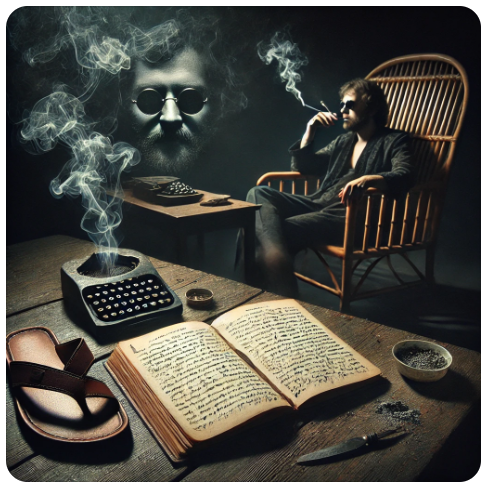
The other day, I spoke with my friend who wore sunglasses, even at night. They were not just any sunglasses; they had thick, tinted lenses that turned his eyes into secrets. He sat in his bamboo chair, curled like an embryo in a second womb, and waited for the silence between songs on the record. When it came, he tilted his head, aiming his gaze—hidden behind the black glass—at me.


“Your passage shows a definite poetic sensitivity, an emotional quality that strikes one—but what does it mean?” he asked, words biting the quiet. “You are trying to communicate?” He leaned on the last syllable of “communicate,” stretching it thin, squeezing it like elegant toothpaste. “Aren’t you?”


I felt the weight of his question sink into my chest, leaving behind a sharp, echoing hollowness. I glanced at the poem I had laid bare on the table between us, exposed like a wound. His words transformed before my eyes into writhing maggots, their white bodies squirming towards the ink. Without thinking, I took off my shoe—a thin, worn sandal—and slammed it down. The thud startled the silence; the maggots burst, leaving wet smears across the wooden surface.


I didn’t speak for a moment. I scraped their remnants into an ashtray, their tiny corpses mixing with the charred remnants of past thoughts and past sins. I dropped my sandal to the floor. He laughed, a dry, brittle sound that cracked in the dimness. He crossed his legs, the fabric of his pants whispering like a taunt. The damage had been done—a single maggot had escaped my fury and burrowed, unseen, into my ear. I could feel it crawling, tiny feet clinging to the tender skin before settling into the cavity of my heart. It pulsed there, secret and vile. He knew it. His smirk was the proof.


Now I write to pull it out, strand by bloody strand, from my heart. I know that only when I spit it out, stained and gasping, will I be free.


This maggot is unlike the others; it shifts and moulds itself, a grotesque mimicry of thoughts, without shedding its true nature. Later, it transformed as I read Dostoevsky’s The Devils, a cigarette balanced between my fingers and a small, gleaming grain of eternity in the palm of my other hand. Between puffs and between sentences, I noticed that the grain had grown in weight. Kirilov had just explained why man must commit suicide to proclaim his freedom from fear. He was called a madman. I thought he made sense. I looked at my hand and saw that the grain had grown into a crumb. Realizing that Dostoevsky was performing the alchemy in person, I continued to read and commune with him.


The grain in my palm felt heavier, its edges pressing into my skin. My mind wasn’t playing tricks. It had grown into a dense and insistent crumb. I realized then that Dostoevsky had performed this alchemy, transmuting despair into something tangible, a weight that dragged at the fabric of the world. I kept reading, feeling the maggot shift inside me, watching with its eyeless stare as I communed with a man long dead but never silent.


The record ended while the needle turned and turned on the dead wax, and I looked up. My friend still sat there, sunglasses glinting darkly in the thin light, the smirk on his lips a question left unsaid. I inhaled, the smoke and the maggot’s secrets filling me to the brim.

I asked AI to make an image based on the writing. This is it.