The Apple and the Cosmos: A Dance of Reality

December 9, 2024

Before me sits an apple, ordinary yet radiant, its waxy surface catching a sharp glint of light from a lamp above. It is tangible, immediate—its crispness confirmed as I lift it to my lips, its flavour vibrant and undeniably real. Beside it rests a protractor, leaning against a globe, and an astrological chart sprawled across my desk. These objects—tools of measurement and mapping—whisper of realities far removed from the apple’s tangible presence. The apple anchors me in the here and now while the instruments gesture toward the distant, the abstract, the infinite.

The apple is a feast for the senses. I can touch it, taste it, smell it, and see it. Though its atoms appear tightly packed, they are, in truth, vast spaces of energy and vibration. Magnify one of its atoms, and its solidity dissolves into a void where particles exist only as probabilities, dancing in fields of energy. Yet, this solid illusion sustains my bite, my taste, and my knowing.


The horoscope beside it lacks the apple’s tangibility. It cannot be bitten or held, but it represents something equally profound: a symbolic map of the cosmos. Where the apple’s reality is immediate, the horoscope projects patterns of meaning across time and space, binding celestial rhythms to the human story. These two things—apple and horoscope, immediate and archetypal—remind me that reality is both seen and imagined, both concrete and infinite.


This paradox of perception defines our existence. The apple, so close I can taste it, is not as solid as it seems. And the stars, so distant their light has travelled for millennia to reach me, are not as unreachable as they seem. Between the apple and Alpha Centauri lies an unfathomable gulf, yet they are part of the same web of existence, bound by the laws of physics and the rhythms of the cosmos.


Newton, watching the fall of an apple, saw the invisible thread connecting Earth and sky. Einstein deepened this insight, showing that space and time are inseparable and that matter and energy are two forms of the same thing. Quantum physics has unravelled the idea of separateness, revealing that particles are not isolated entities but relationships—waves of possibility collapsing into form through interaction.


David Bohm’s theory of implicate order expands this vision further, suggesting that the universe is a seamless whole where every fragment reflects the entirety, like a hologram. In a hologram, each fragment contains the whole image, even when divided into pieces. Similarly, the universe is encoded in every part of itself. The apple before me is not merely an apple; it is a microcosm of the cosmos, its atoms vibrating with the same energies that fuel the stars.


The horoscope, too, speaks to this interconnectedness. It is not about planets and rocks but about relationships, patterns, and cycles. The zodiac mirrors the rhythms of life, like the apple tree that blossoms, bears fruit, and eventually returns to the Earth. The horoscope encodes the rhythms of the cosmos in symbols, reminding us that the patterns above are reflected in the patterns within.


This interconnectedness challenges the illusion of separation. The apple and the stars, the immediate and the eternal, are not opposites but facets of the same reality. Our senses, while invaluable, reveal only a sliver of the whole. Light, for instance, is just one octave in a vast electromagnetic spectrum, and beyond the visible lies a universe of energies—X-rays, gamma rays, cosmic rays—that remain unseen but ever-present.


Similarly, the frameworks of language and culture limit how we perceive and interpret the world. But within these limits lies a profound truth: we are not separate observers of the universe; we are participants in its creation. As physicist John Wheeler suggested, the act of observation itself shapes reality, collapsing waves of probability into patterns of existence. Our consciousness, like a hologram, reflects the universe within it.


The apple before me, the stars above, and the chart on my desk are all threads in this web of unity. The apple speaks of immediacy, the stars of eternity, the chart of the connections that bridge the two. At this moment, I recall a walk in an orchard with my father years ago. He handed me an apple, freshly picked, and told me to hold it carefully as though it contained the world. I didn’t understand him then, but now I see his wisdom. The apple was the world, the stars, and myself—all woven together.


So, as I bite into the apple now, tasting its crispness and feeling its tang, I know it is real. But I also know that in this simple act, I am connected to the stars, to the atoms that form both fruit and flesh, to the patterns that govern the universe.


In the apple, I taste the infinite, and in the infinite, I find myself.


My Lady of the Earth: A Tale of Renewal and Time

November 12, 2024

In the heart of a forgotten desert, a lone figure trudged down a cracked highway, each step scraping against the sun-scorched asphalt as if metal clanked against stone. His feet felt like tin cans, hollow and beaten, dragging his weary body forward as he clutched an old glass bowl—its only inhabitant a sliver of something ancient and alive, a glint of Time itself suspended in water. His arms ached, heavy and empty, as though they’d died long before, holding nothing but the fragile keepsake of ages past.

But just as his strength waned, there was a shift. She appeared as if conjured from the dust itself: My Lady of the Earth, the Sun’s seventh Queen. With a graceful lift of her arms, she raised him above the smoke, the Screen of all that clouded and concealed. Her touch was unlike anything he’d known, reaching through the rusting paths of his veins, setting them aglow with purpose. In her embrace, he felt something long lost—a feeling like Home, a warmth too timeless to describe.

He looked upon her as her veil began to dissolve. Beneath it, her face bore the quiet strength of mountains, still and unyielding, forever patient. From her eyes spilt silver brooks, flowing over her cheeks without urgency, slipping past with a gentleness that defied the chaotic world below. The brooks whispered of hidden peace, where Madonnas rested in perfect balance, and saints lay quiet in their coffins, untouched by mortal turmoil. Shadows of the powerful faded here, hollow ambitions dissipating like smoke. Even the rooster—herald of dawn and disturbance—lay silent in her presence as if Time paused.

She was both familiar and fierce, the Only Child of Passion and Earth’s eternal heartbeat. Winds swept through the dust, weaving through her form, rooting into her flesh, and carrying the age-old whispers of forgotten stars with them. Her body, raw and untamed, glistened in the light of the Sun, bound to it yet free, dancing in an endless circle of life and death, decay and rebirth.

With a flick of her golden feet, she nudged the Moon, sending it into an orbit known only to the wise and the wild, beckoning all with a silent proclamation. The man held his breath, feeling the weight of her gesture, her assurance—this was no end but the beginning, an age reborn. And as he stared into her eyes, he understood: he was no longer lost in the desert. He had been brought back to her, the soul of his journey entwined with the spirit of the Earth, who whispered to him that, like her, he too was eternal.


Secrets Behind Sunglasses: A Poetic Conversation

November 1, 2024

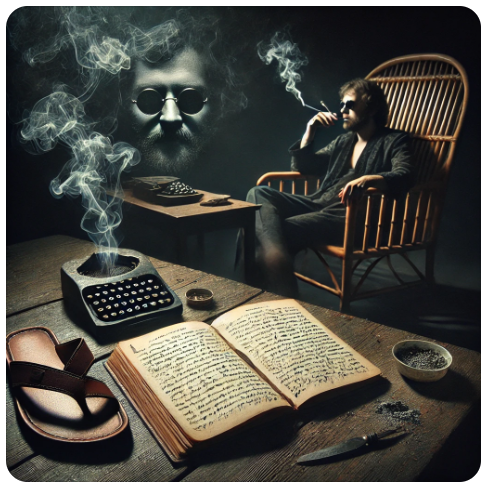
The other day, I spoke with my friend who wore sunglasses, even at night. They were not just any sunglasses; they had thick, tinted lenses that turned his eyes into secrets. He sat in his bamboo chair, curled like an embryo in a second womb, and waited for the silence between songs on the record. When it came, he tilted his head, aiming his gaze—hidden behind the black glass—at me.


“Your passage shows a definite poetic sensitivity, an emotional quality that strikes one—but what does it mean?” he asked, words biting the quiet. “You are trying to communicate?” He leaned on the last syllable of “communicate,” stretching it thin, squeezing it like elegant toothpaste. “Aren’t you?”


I felt the weight of his question sink into my chest, leaving behind a sharp, echoing hollowness. I glanced at the poem I had laid bare on the table between us, exposed like a wound. His words transformed before my eyes into writhing maggots, their white bodies squirming towards the ink. Without thinking, I took off my shoe—a thin, worn sandal—and slammed it down. The thud startled the silence; the maggots burst, leaving wet smears across the wooden surface.


I didn’t speak for a moment. I scraped their remnants into an ashtray, their tiny corpses mixing with the charred remnants of past thoughts and past sins. I dropped my sandal to the floor. He laughed, a dry, brittle sound that cracked in the dimness. He crossed his legs, the fabric of his pants whispering like a taunt. The damage had been done—a single maggot had escaped my fury and burrowed, unseen, into my ear. I could feel it crawling, tiny feet clinging to the tender skin before settling into the cavity of my heart. It pulsed there, secret and vile. He knew it. His smirk was the proof.


Now I write to pull it out, strand by bloody strand, from my heart. I know that only when I spit it out, stained and gasping, will I be free.


This maggot is unlike the others; it shifts and moulds itself, a grotesque mimicry of thoughts, without shedding its true nature. Later, it transformed as I read Dostoevsky’s The Devils, a cigarette balanced between my fingers and a small, gleaming grain of eternity in the palm of my other hand. Between puffs and between sentences, I noticed that the grain had grown in weight. Kirilov had just explained why man must commit suicide to proclaim his freedom from fear. He was called a madman. I thought he made sense. I looked at my hand and saw that the grain had grown into a crumb. Realizing that Dostoevsky was performing the alchemy in person, I continued to read and commune with him.


The grain in my palm felt heavier, its edges pressing into my skin. My mind wasn’t playing tricks. It had grown into a dense and insistent crumb. I realized then that Dostoevsky had performed this alchemy, transmuting despair into something tangible, a weight that dragged at the fabric of the world. I kept reading, feeling the maggot shift inside me, watching with its eyeless stare as I communed with a man long dead but never silent.


The record ended while the needle turned and turned on the dead wax, and I looked up. My friend still sat there, sunglasses glinting darkly in the thin light, the smirk on his lips a question left unsaid. I inhaled, the smoke and the maggot’s secrets filling me to the brim.

I asked AI to make an image based on the writing. This is it.


Coffee Cup Conquistadors

September 29, 2024

Coffee Cup conquistadors, I have problems of vision in this midnight age. I see the eye of a hurricane within each loss and gain. I lose treasures all day and night through these paper walls. To top it all—gurus don’t come around here no more.

Brothers and sisters, we stand at the edge of civilization, a unified force. As we sipped our coffee, we observed each other’s movements, recognizing the cosmic significance of every gesture. Some of us ascended the mount of Golgotha with reverence, each touch a sacred act. The sober one, Sophie, refers to it as the Skull. Others of us, with spider-leg vision, delicately traversed the coffee grounds, seeing beyond the visible, like the delicate threads of fate. In this shared experience, we are all part of a larger narrative, connected by our observations and interpretations.

We gazed upon a scattered army, initially hazy, but with the valour of conquistadors, we honed in sharply. The porcelain edge of the cup transformed into a precipice. As we peered over, an alien script unfolded, twisting like crystal algae on white china. The white China, akin to the sterile laboratories of Science. The depth of this cup, viewed from the edge, was dizzying, shrouded in mystery. This cup, a vessel of unknown depths, invites us to wonder and contemplate its secrets.

The saucers flew while my cup’s base remained anchored to the tabletop. At the culmination of our exploration, at the far reaches of spider-web logic, a talking salt shaker appeared. “Hey! It’s not as dire as you believe!” it proclaimed, igniting a sense of adventure and discovery.

I thought I saw Lot’s wife, her form engraved upon my forehead, a silent spectre watching from the salt shaker’s voice.

Shapes, shapes danced upon the surface of my cup—who’s the best survivor of them all? The ones who reach for the North Pole? The ones who head for the South? The ones who climb to the roof of the world? Or the ones who dive for the floor? Is it we, the coffee brigade, stirring life’s bitter brew? With the world’s calibrated spoon, we stir the dissolved sugar cube. The cube is a reminder of the shape we’re locked in. The cube is a symbol of the microchips stirring in the scientific soup of existence.

I see the eye of the hurricane within each loss and gain. I lose treasures all day and night through these fragile paper walls. And to top it all—gurus don’t come around here anymore.