The Stone Seeker: A Myth of the Wandering Soul

October 2, 2025

A departure from my usual posts — this one takes the form of myth, an inner journey written as an allegory. I offer it as a companion to my ongoing stories.

He was called Stavros, which means Cross, and that was his burden — and his path.

One day, in a time that was no time, he heard the silent summons. Not from the sky, but from the pulse within the earth. He set out, carrying nothing but his breath and the ache of questions. He climbed the ancient spine of Sinai without sleep, ascending stone upon stone, as if walking up the ribs of a forgotten god. At the summit, the sun did not answer him — but it showed him he was not alone.

The descent was harder. That is the truth of all peaks. He reached the foot of the mountain and sat by the monastery of Katherine, where silence grows like lichen on old stone. There he met the Gatekeeper — a monk whose heart had fossilised into ritual. Stavros spoke the sacred tongue, but the Gatekeeper did not recognise him. He uttered the Word — “Yunan” — and dismissed him like a leaf blown against the stone walls.

So the Seeker left the sacred walls and returned to the road. It was on this road that he met the Trickster Guide — a Bedouin named Mohamed, who spoke through music and mischief. He offered herbs not for healing but for vision. He rolled a joint while guiding the chariot at great speed. Smoke curled like a serpent toward the heavens, and the desert began to shimmer.

Mohamed showed him the living map: dunes that were coastlines, mountains that were camels in repose. “This is Sinai,” he said, “and there is the Red Sea.” In that moment, the Seeker saw geography become prophecy. The land was not just land — it was a scroll unrolling.

Mohamed led him to a mosque, a café, a grove of planted trees. “We are of the 15 tribes,” the Guide said. “We plant what will shade the unborn.” The Seeker ate with him, drank the dark tea of mystery, and vanished into moonlit streets.

Then came the Labyrinth.

In the night city, he was lost among alleyways, where cats whispered secrets and doors led nowhere. He emerged by chance, or fate, and met the Scribe, who wrote his name in the language of the ancestors. “All men have three names,” said the Scribe, “but only one is true.”

The Seeker travelled again — across waters, under stars, on feluccas that rocked like cradles of time. He met companions with names like runes: Linda, Olga, Shayari. Together they smoked, drank rakii, and watched angels dissolve into the air like incense.

He arrived at a threshold: the City of Columns. There, under a sky bleached of memory, he sat on sand and turned a plastic bottle into a shrine. He waited for a chariot to carry him across the Nile of forgetting. Someone called him “the Greek with eight children,” and he laughed. He had none — and yet carried thousands within him.

Then came the Two Georges.

One was a Potter. One was a Priest of the Inner Fire. They saw in Stavros something he had hidden from himself. “You evoke the honour of Christ in others,” they said. “You wear innocence like armour.” They fed him macaroni and truth. In return, they asked for stories.

And so he spoke.

And in speaking, he remembered.

Dialogue became divination. Each question was a key. Each story a lost scroll. “In dialogue,” said George, “there is living transmission. The book you write is not of ink. It is breath, shared.”

They spoke of the monk on Athos who gave him a stone. “Leave this on the mountain,” he had said. And so Stavros carried it until the burden became a prayer. They spoke of karma, of grace, of gifts that are given but never earned.

Then came the desecration.

He passed through Luxor and saw the sign — McDonald’s, Temple of Luxor Street. The Golden Arches beside eternal stone. He took a photo, not to remember, but to mourn. Some desecrations are not loud. Some come wrapped in convenience.

And still, a stranger in Cairo whispered: “Welcome.” One word, like a flame in the dust.

The Seeker came to understand: giving and receiving were not separate acts. He had received shelter, food, names, music, silence. He had given stories, listening, laughter, witness. There was no accounting. Only flow.

He saw now that the journey had not been from place to place, but from self to soul. He gave before he received. He received before he gave. It was not barter. It was the hidden law.

And then — the Word.

“Sorry,” they said, “is just a word.” But he knew better. The Word began the world. Words held power, memory, vibration. Words could curse. Words could carry. Words could redeem.

He left the stone on the mountain.

He returned carrying only light.


The Folly of Creation

November 7, 2024

How do you record a moment of recognition? How do you capture moments of lost time and fill them with flowers? How do you grow a second self, one with ink for blood and paper for bones? By writing, of course.

Why attempt such folly as reshaping the world within your mind just to watch it transform again outside? It’s absurd, isn’t it? But if you’re not breaking down the world, how do you build anything new?

I’m making payments to the wind and sacrifices to the moon. Writing demands these offerings—it asks you to confront what threatens everything you hold dear.

If I understand you, then yes—now is the time. The time has come for flesh and blood to transmute into paper and ink. The only problem is, paper burns. But then again, man rots.

In that fleeting moment of recognition, we glimpse our own folly in this battle with mortality.


Secrets Behind Sunglasses: A Poetic Conversation

November 1, 2024

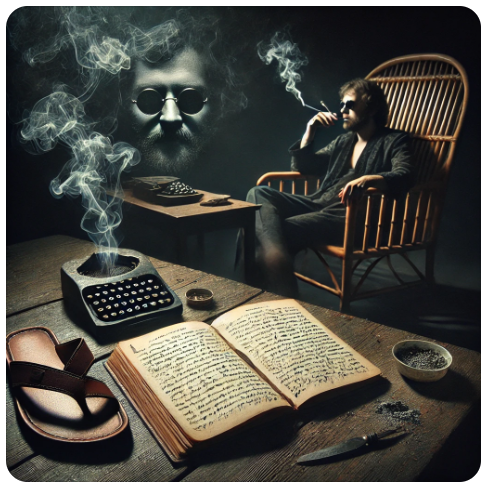
The other day, I spoke with my friend who wore sunglasses, even at night. They were not just any sunglasses; they had thick, tinted lenses that turned his eyes into secrets. He sat in his bamboo chair, curled like an embryo in a second womb, and waited for the silence between songs on the record. When it came, he tilted his head, aiming his gaze—hidden behind the black glass—at me.


“Your passage shows a definite poetic sensitivity, an emotional quality that strikes one—but what does it mean?” he asked, words biting the quiet. “You are trying to communicate?” He leaned on the last syllable of “communicate,” stretching it thin, squeezing it like elegant toothpaste. “Aren’t you?”


I felt the weight of his question sink into my chest, leaving behind a sharp, echoing hollowness. I glanced at the poem I had laid bare on the table between us, exposed like a wound. His words transformed before my eyes into writhing maggots, their white bodies squirming towards the ink. Without thinking, I took off my shoe—a thin, worn sandal—and slammed it down. The thud startled the silence; the maggots burst, leaving wet smears across the wooden surface.


I didn’t speak for a moment. I scraped their remnants into an ashtray, their tiny corpses mixing with the charred remnants of past thoughts and past sins. I dropped my sandal to the floor. He laughed, a dry, brittle sound that cracked in the dimness. He crossed his legs, the fabric of his pants whispering like a taunt. The damage had been done—a single maggot had escaped my fury and burrowed, unseen, into my ear. I could feel it crawling, tiny feet clinging to the tender skin before settling into the cavity of my heart. It pulsed there, secret and vile. He knew it. His smirk was the proof.


Now I write to pull it out, strand by bloody strand, from my heart. I know that only when I spit it out, stained and gasping, will I be free.


This maggot is unlike the others; it shifts and moulds itself, a grotesque mimicry of thoughts, without shedding its true nature. Later, it transformed as I read Dostoevsky’s The Devils, a cigarette balanced between my fingers and a small, gleaming grain of eternity in the palm of my other hand. Between puffs and between sentences, I noticed that the grain had grown in weight. Kirilov had just explained why man must commit suicide to proclaim his freedom from fear. He was called a madman. I thought he made sense. I looked at my hand and saw that the grain had grown into a crumb. Realizing that Dostoevsky was performing the alchemy in person, I continued to read and commune with him.


The grain in my palm felt heavier, its edges pressing into my skin. My mind wasn’t playing tricks. It had grown into a dense and insistent crumb. I realized then that Dostoevsky had performed this alchemy, transmuting despair into something tangible, a weight that dragged at the fabric of the world. I kept reading, feeling the maggot shift inside me, watching with its eyeless stare as I communed with a man long dead but never silent.


The record ended while the needle turned and turned on the dead wax, and I looked up. My friend still sat there, sunglasses glinting darkly in the thin light, the smirk on his lips a question left unsaid. I inhaled, the smoke and the maggot’s secrets filling me to the brim.

I asked AI to make an image based on the writing. This is it.


Creating Meaning: The Timeless Journey Within

September 10, 2024

Rediscovering old notes and writings I tucked away feels like opening a time capsule. As I edit and rewrite, I’m often stunned by what unfolds—almost as if someone else penned these words. Curious to see what I found? Check out the latest piece I’ve dusted off from the drawer:

Once, I believed in the world as it was handed to me—a place where no one questioned the present and bothered to ask about the origins of our existence. But something stirred in me. As the static of modern life cleared, a pulsating sense of displacement, a profound disconnect from my cultural roots, rose from within, like an echo from my ancestors. I could almost feel their journey across the Great Ocean, but something gnawed at me—a profound uncertainty that no one here could answer.

In this land, no one believed in anything beyond the horizon, not the priest, the doctor, the teacher, or even the philosopher. They were prisoners of an unshakable belief: they had always been here. No one had come from anywhere else, and nothing existed beyond the boundaries of their world. They were trapped in an eternal present, fully immersed in “Always Here and Now.” To them, the notion of elsewhere was absurd. If there was no “other place,” how could anyone have come from it?

Initially, I grappled with understanding. My friends’ reality seemed dictated by simple logic, but my thoughts wandered beyond their walls. How could anyone have come from elsewhere if there was no other place? My friends saw the compass as proof of their reality, pointing only to an endless, eternal loop. They cautioned me against delving too deeply into such thoughts, insisting the simplicity of their truth was my only sanctuary. But something within me resisted. I was resolute, against all odds, to find the home my ancestors had spoken of, a place that existed somewhere beyond their narrow vision — a place I had never seen but felt in my bones.

Speaking of this ‘other place’ was perilous. Each mention of it shook the very foundation of their beliefs. What did that mean for their carefully constructed present if there was another world? The inner became the outer, the light became dark, and everything they knew would collapse. They were content to remain in their prison of four walls, preoccupied with the décor, oblivious to who had designed their confinement.

But I couldn’t ignore the whispers of the past. My ancestors had lived on an island swallowed by time. Only a few had escaped its destruction, fishermen who drifted across the ocean with no destination, guided by nothing more than a lucky wind. They rowed, prayed, and hoped for forty days and forty nights until they reached this land. That story lived within me, waiting for me to find the same wind, to follow the arc of coincidence that had saved them.

Yet, as I reflected, I came to a profound realization. I was still searching for something I couldn’t name—a more profound significance in my surroundings. It wasn’t just about finding another place but understanding why it mattered. The abalone shell reflected the ocean’s rhythms as if it carried the pulse of an unseen world. I then realized that significance wasn’t found in the object but in my gaze. The same wind that saved my ancestors wasn’t guiding me toward another place—it showed me that meaning itself is something we create, not discover.

My ancestors braved the ocean’s winds and waves to find this land. But the distance I had to cross was between worlds, not shores—between the truth they carried and my life now. Perhaps I wasn’t meant to find meaning but to create it, and that was the natural wind that would take me home. This realisation, this understanding, was my enlightenment.


The Curve of My Heart’s Desire

January 22, 2020

My mother hassles me in her dotage to go to church, to confess my sins, take holy communion and to kiss the priest’s hand. I can’t tell her that I see the priesthood as a costume prop of divinity wrapped around men. It’s not just the presumption of priesthood that grates but also the arrogance radiating off the white dog collar.

priest dog collar

“Matthew 7:1-2 Judge not, that ye be not judged. For with what judgment ye judge, ye shall be judged: and with what measure ye mete, it shall be measured to you again.”

How far do I stray from this advice when I’m confronted by the Church? The whole edifice from its theology to its soteriology and its masonry is riddled with presumption and arrogance. Why must the source of Divine Power and Love be subject to franchise agreements? I cannot believe the ineffable manoeuvres like a lawyer. Is the priest a broker dealing in soul futures? With Wall St brokers, if you’re lucky, you may gain something. The Church provides words that haven’t been digested & transmuted into gold wisdom.

Is this to say that the Divine, the Miraculous, the Living Unknown do not exist? No. It only means that a systemic structure such as a Church cannot be the unpredictable, ineffable symbol of the Real. Now this engenders a whole host of issues of which the question “What is Real?” is at the centre. I don’t know the answer. I do know that the systemisers pretend to know.

What of confession? There’s something so essential, so oneself that hesitates to confess to another man one’s “sins”. The Greek word for “sin” is harmatia which means “missing the mark”. The assumption here is that both the priest and the confessor have agreed on what is sin. Even if they do agree as to what constitutes sin, it still sucks to confess these sins to another person. If it is true that God is not only transcendent but also imminent it follows that all failings and sins are already known to Him. The argument goes that when one confesses one is not confessing to the priest but rather through the priest to God. In other words the priest is an intermediary, a flesh & blood telephone. The priest also has the power to decide what, if any, penance is required. If you pay now you won’t have to worry about the interest rate in the after life. As a consequence, merely by humbling yourself to the intermediary, the priest, you will gain peace of mind and soul.

Really?

Do I need the responsibility of my life to rest on the decisions of a church man? What if the after life, the here after is THIS LIFE again? Yes, instead of a Ground Hog Day – a Ground Hog Life. Does it mean I will be forever doomed to pay lip service to a caricature of divinity just so I secure a respectable soul? Maybe there are souls that don’t fit the respectable mould. This does not mean they are not chosen by God. It only means that they may have another calling.

tree of knowledge

It goes deeper than this, it goes to the curve of one’s heart desire.

In me there resides the need to know, to understand. In me this desire to know who I am, what is my place in the universe and why I am here has directed the shape of my life. This desire has taken me to the edge of sanity where flying saucer landing pads in a commune’s backyard took the place of Hills Hoists. This desire has also turned my mind to the study of numbers, symbols, astrology, magic and divination – all of the mantic arts. The curve of my heart’s desire turns away from dogma & belief to the ever present mystery of simple life. This curvature reveals along its edge another calling that has nothing to do with any church or institution.

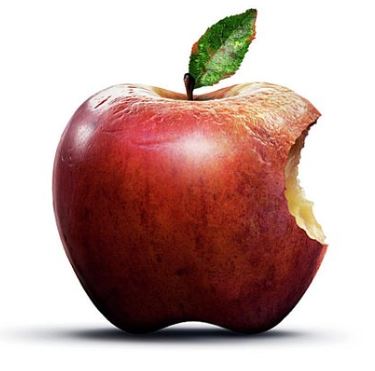
The desire to know was also probably Adam & Eve’s original sin. We all know what happened to them when they took a bite of the Apple.

Yes, I am inflicted because I seek knowledge of the Divine and I don’t want church men hovering around the curve of my heart’s desire.

apple

Photo Sparks Along a Country Road

December 31, 2013

“When you walk across the fields with your mind pure and holy, then from all the stones, and all growing things, and all animals, the sparks of their soul come out and cling to you, and then they are purified and become a holy fire in you.”

Hasidic Saying

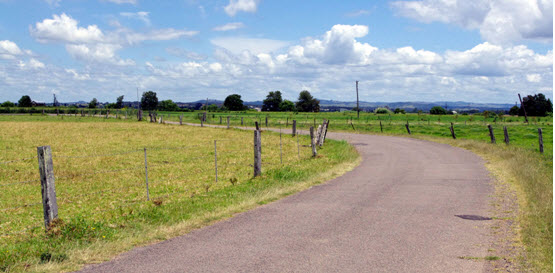
I walk daily along a country road that runs parallel to a river after a bend.

So every photo here is taken as I walk along my country road- except the pictures of Buddha, Jesus and Rumi 🙂

I Walk Daily 1

While walking I try to be aware of myself  by focussing on sensations of my feet touching the ground, the flies landing on my skin, the breeze touching my face and bare arms while attending to my breath. I often say hello to the cows and bulls if they’re nearby. I even try my version of cow talk by bellowing out loudly MMMOOOO!! They just look at me, don’t reply and often just run away.

I Walk Daily 2

It’s my attempt of walking meditation – an extension of Buddha’s suggestion:

I Walk Daily 3

“When walking, the practitioner is aware, ‘I am walking’; when standing, is aware, ‘I am standing’; when sitting, is aware, ‘I am sitting’; when lying down, is aware, ‘I am lying down.’ In whatever position one’s body happens to be, one is aware of the position of the body. When one is going forward or backward, one applies one’s full awareness to one’s going forward or backward. When one looks in front or looks behind, bends down or stands up, one also applies full awareness to what one is doing. One applies full awareness to wearing the robe or carrying the alms bowl. When one eats or drinks, chews or savors the food, one applies full awareness to all this. When passing excrement or urinating, one applies full awareness to this. When one walks, stands, lies down, sleeps or wakes up, speaks or is silent, one shines his awareness on all this.” So said the Buddha.


I Walk Daily 4

While walking I’m also aware of the chattering monkey mind climbing and swinging on mental vines in my skull. To calm the monkey and to see the chattering thoughts as clouds passing by I recite a mantra.  This mantra is the Trisagion chant I learnt in the Orthodox Church as a child. It is an ancient Christian prayer believed  to be an expansion of the angelic cry recorded in Revelation 4:8 :

The four living creatures, each having six wings, were full of eyes around and within. And they do not rest day or night, saying:

“Holy, holy, holy, holy, holy, holy, holy, holy, holy Lord God Almighty,
Who was and is and is to come!”

I Walk Daily 5    Below is the chant in Greek and the translation in English.

Ἅγιος ὁ Θεός, Ἅγιος ἰσχυρός, Ἅγιος ἀθάνατος, ἐλέησον ἡμᾶς.

   Agios o Theos, Agios ischyros, Agios athanatos, eleison imas.

Holy God, Holy Mighty, Holy Immortal, have mercy on us.


I inwardly chant this in Greek while watching my breath.

I Walk Daily 34

The words of the Trisagion are enhanced by the beautiful tune of the chant. You can hear a version of this chant here http://www.youtube.com/watch?v=kbVBC1zQll4

I Walk Daily 6

I Walk Daily 7

I also love the quote below from Rumi, the great Islamic scholar and mystic, founder of the Whirling Dervishes:

I Walk Daily 8  “I searched for God among the Christians and on the Cross and therein I found Him not.
I went into the ancient temples of idolatry; no trace of Him was there.
I entered the mountain cave of Hira and then went as far as Qandhar but God I found not.
With set purpose I fared to the summit of Mount Caucasus and found there only ‘anqa’s habitation.
Then I directed my search to the Kaaba, the resort of old and young; God was not there even.
Turning to philosophy I inquired about him from ibn Sina but found Him not within his range.
I fared then to the scene of the Prophet’s experience of a great divine manifestation only a “two bow-lengths’ distance from him” but God was not there even in that exalted court.
Finally, I looked into my own heart and there I saw Him; He was nowhere else.”


If everything is in tune and there descends a silence within which may only last as long as a breath cycle or a few seconds then the words of this Hasidic saying come alive for a nano moment:

“When you walk across the fields with your mind pure and holy, then from all the stones, and all growing things, and all animals, the sparks of their soul come out and cling to you, and then they are purified and become a holy fire in you.”

I Walk Daily 9

I Walk Daily 10

I Walk Daily 11

I Walk Daily 13

I Walk Daily 12

I Walk Daily 14

I Walk Daily 15

I Walk Daily 16

I Walk Daily 17

I Walk Daily 18

I Walk Daily 10

I Walk Daily 20

I Walk Daily 21

I Walk Daily 22

I Walk Daily 23

At the end of the bamboo grove I always eat fruit in season – winter an orange or mandarine – home grown, and in summer  stone fruit – peach, plum or apricot. I relish the taste, feeling the life force zing of fresh fruit as I look across the river to the mountains in the distance. At times a pelican may fly overhead or a hawk dive down to the field. Always there are ducks gliding over the river’s surface.

I Walk Daily 24

After eating the fruit, I take three deep breaths and now aloud, chant the Trisagion followed by the Lord’s Prayer said in the original Greek.

I Walk Daily 35

The only beings who hear me are the flowers and trees nearby, birds nesting, insects buzzing around, lizards near my feet scurrying away and the river and breeze. I ponder on the meaning of this prayer amongst the “lilies of the field”. I wonder why the word translated as “daily”, the Greek word “epiousion” is a huge mystery because the only time it is used in Greek is in this prayer and no one knows what it means! Here we have a set of words memorised by millions and millions with a hidden mystery word – “epiousion”. I like to think that the “bread” the prayer is referring to is the “sparks of the soul of things”.

I Walk Daily 25

I Walk Daily 26

I Walk Daily 28

I Walk Daily 29

I Walk Daily 30

I Walk Daily 31

I Walk Daily 32

I keep walking trying to be present, trying to be in the moment all the way back home. Once at home I try to re-member the tiny moments of awareness that sparked across my synapses and along the river’s edge.

I Walk Daily 33


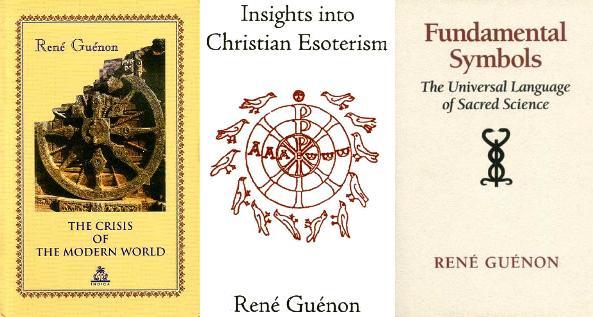
The veritable basis of symbolism – Rene Guenon

January 26, 2013

All that exists, in whatever mode this may be, necessarily participates in universal principles, and nothing exists except by participation in these principles, which are the eternal and immutable essences contained in the permanent actuality of the Divine Intellect. Consequently, it can be said that all things, however contingent they may be in themselves, express or represent these principles in their own way and according to their order of existence, for otherwise they would be purely and simply nothingness. Thus, from one order to another, all things are linked together and correspond, to come together in total and universal harmony, for harmony is nothing other than the reflection of principial unity in the manifested world; and it is this correspondence which is the veritable basis of symbolism.

Rene Guenon, Autorite spirituelle et pouvoir temporel ( from studies in symbolism compiled by Michel Valsan in the posthumous book “Fundamental Symbols – The Universal Language of Sacred Science.”)

guenon


Carlos Suarès – a Unique Qabalist

November 21, 2012

Carlos Suares

Carlos Suares (1892–1976) was a painter, writer and Qabalist. Qabala, also known as Kabbalah and Cabala is generally thought of as the esoteric side of Judaism. Carlos Suares spent over 40 years intensely studying the Qabala and he writes of the Qabala as a science of undifferentiated energy written in code embedded in the Bible, particularly Genesis and the Song of Solomon.

“I begin our study by saying that the Qabala is a science and that The Sepher Yetsira is a precise and accurate treatise on the structure of cosmic energy, written in a hidden code. This should not be a surprise: all the physical sciences are nowadays, written in cipher codes. If the code referring to the letters E, M, C was unknown, Einstein’s equation, E=MC2, could not be understood. The mystery of the Qabala is simply due to the fact that the cabalists are not aware of what its language is and to the ignorance both of the analogical mode of thought characterising this language, and of the necessity of connecting this text with modern scientific research, instead of with the archaic stages of a science. In this they are like people who call themselves great physicians because they spend their time studying Archimedes, or mathematicians because they know Euclid by heart. This kind of scholarship is no more than an intellectual diversion, contributing nothing to our strife-riven world, or to our present consciousness which has lost its past mythological illusions and is in the process of bridging religion and science…”

He makes the point that in reading the Autiot (the letters of the Hebrew language) and making the effort to connect with the “meaning” the reader partakes in a transformation of consciousness, even if the reader does not “understand” the apparent associations of the sacred letters – the Autiot.

I noticed when reading the Cipher of Genesis that a certain quality of energy became manifest in my mind. It is difficult to describe but it was more like ingesting a psychedelic substance in tiny doses with one’s eyes and the mind was a stomache digesting these letter – number doses. After making the effort to “understand – digest” the input of the letter – numbers a feeling of lightness and focus appeared. Like I say, it is difficult to describe and to even call it “reading” does not do the effort and material ingested justice.

By showing that the energising properties of the Autiot have a dual cosmic flow, the way to an essential stage of modern physics is cleared: the study of consciousness, in its material manifestations, as energy.
–Suares, Sepher Yetsira p.41 (Carlo Suarès)

In his book, “The Second Coming of Reb YHSHWH : The Rabbi Called Jesus Christ”  he presents his stance on what The Kingdom of Heaven is.

“The Eight Propositions”

“And when he was demanded of the Pharisees, when the kingdom of God should come, he answered them and said, The kingdom of God cometh not with observation: Neither shall they say, Lo here! or, lo there! for, behold, the kingdom of God is within you” (Luke 17:20-21). And this would be the keynote of the New Era. Here are the eight propositions:

1. Seek your total individuality. Don’t write it down anywhere. Don’t give it a name. Any definition of yourself is a deceptive hideout.

2. You will not find your total individuality. It is your total individuality that sees you, that witnesses your doings. It acts in our space-time continuum but is not restricted to it.

3. Your total individuality is your soul. It abides in the indeterminate plurality of universes. Because it is alive, it is evolving. Because it is outside of time, its evolution is only the time that you need to permit it to find you. Because it is multidimensional, it contributes to the composition of an Ecclesia. It is one and innumerable.

4. Your soul will not find you as long as your consciousness is made of the stuff of false evidences created by your mind: as long as you do not feel a sense of suffocation in those space-time false evidences.

5. The death of false evidences is a psychological death, announcer of resurrection. Each false evidence denounced opens a window in the inner space where the measurable dies.

6. This death of the measurable in the inner space is a personal experience. All that is said to you about it will prevent it from occurring. Do not listen to the professionals of any religions.

7. Beyond this death, our infinitely multiple individuality reveals to our present person that we are only one of its multifarious manifestations. We then meet the other manifestations of our soul spread out through history, still present and alive.

8. So this consciousness emanating from our soul integrates its earthly past and also its future. It knows itself continuous, without limits. It is all-consciousness, it penetrates every consciousness, it understands every consciousness, and that understanding is love.

The Sephiroth Cube

I suggest that you read his books so that you get a first hand account of the “energy” transmission mentioned above rather than have someone like me give you my filtered and flawed interpretations. Indeed, I would be lying if I said that I understand Carlos Suares’ Qabala. All I can say in truth is that I am in awe of what he brings and one day I hope to get an inkling, a taste of his understanding.


A Nano-Flash from reading “The Theory of Celestial Influence”

February 21, 2012

I wrote the stuff below after I read Rodney Collin’s book, “The Theory of Celestial Influence”. I was attempting to put in my own words a ” flash ” his book gave me. Rodney Collin began writing this book during P D Ouspensky’s last illness. He completed it soon after Ouspensky’s death. In fact, Collins believed that much of the book was transmitted to him by Ouspensky both before and after his death. Whether this is true or not doesn’t concern me.

The Theory of Celestial Influence” is one of those books which have thrilled me with the vision of worlds within worlds with onion skinned layers of Eternity and Time. He sets out to reconcile the considerable contradictions of the rational and imaginative minds and of the ways we see the external world versus our inner selves. It is subtitled MAN, THE UNIVERSE, AND COSMIC MYSTERY. You feel that it is an on the spot documentary report of the way the world is. It is staggering in its reach and depth.

For readers familiar with Gurdjieff’s cosmology you will here find further examinations of the systems outlined in by Ouspensky in In Search of the Miraculous. If you get a chance read it.

======================================================================

Let us attempt to visualize the metageometrical form of a four dimensional solid using as a model the planetary world.

From this view when looking into the sky we are actually observing cross sections of the sun and the moon. Planetary movement is no more than our perception of a succession of discrete points along the greater line of time. Yet in order for us to appreciate the magnitude of a four dimensional form we must take as our subject of investigation a sufficient number of points along the timeline of our solar system. But inasmuch as our own individual lives are quite trivial relative to the solar existence we cannot hope to formulate an interesting or even approximately accurate representation unless we view a much longer span of time than that occupied by the mere life of either a human or, for that matter, humanity.

Therefore, let us take as our “point in time” a one million year segment. In order to simplify our model let us first presume that the direction of the sun comprises a straight line. The four dimensional body or form of the sun over a million years would appear to an observer capable of perceiving such a thing as a large burning rod . Bound and tightly coiled about the rod spiral twelve much smaller concentric threads These are the planets. Upon closer examination we detect even smaller ridges spiraling the planetary threads. These are various moons and satellites. We could further complicate our model to include asteroids and comets as they traverse the sun, and as a matter of course we would have to significantly expand this now growing model if we were to place the sun in its proper place, because the sun itself spirals “through space” on its own predetermined path within the much larger galactic cosmos. Thus, instead of a straight rigid rod we would likely observe a curved, twisted, and spiraling rod. In fine, within this new model our time has become space. Imagining space thusly (i.e. in four dimensions) begs the question, “What of a man’s life?” Dissecting tightly wound threads from the central core and subsequently stripping away the outer threads (planets) we would eventually reach the third to the last thread, our earth. 

Living Solar System “Sperm” from book.

If we had a powerful enough viewing instrument we might discover various geologic ages. If our microscope were capable of finer resolution we might even be able to discern the age of man. As yet, an individual man, or even a single civilization would not be apparent. Perhaps certain age old relics would be observable such as the Sphinx or the Great Pyramids. And maybe the period between 1945 and 1965 would somehow be detected as the many above ground atomic explosions conducted by the U.S., U.S.S.R., and China were measured as strange bursts of nuclear energy.

Still, the life of any individual would not be missed. The wars, deaths, and all the suffering of humanity would be a minor thing indeed. And what we revere in our science, religion, and art would be nothing. In reality and if such a thing were possible it would be even less than nothing since we must remember that we are dealing with an almost instantaneous fragment of the life of the sun, i.e., a mere one million years.


Starry, starry questions?

February 21, 2012

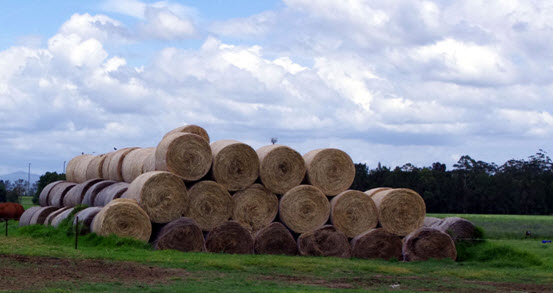
Does astrology really let me hear the echo of bells on Earth? Do stars really pull the heart strings of a doe and petals of a rose? Is my life only one long bale of circumstantial strings held by mind stuff that is on the same pallete as every other bale of humanity? Whose pallete, and, whose Farm do we belong? The bale of wheat that we are according to this image must be food for someone or something. Perhaps not food but material or ingredients. a part of a recipe Man eating gods? Why not? After all we have a major religion that practises on a regular basis god eating.