Kites and Consciousness

March 28, 2009


One the things that I love to do is fly kites. There is something so beautiful, peaceful and meditative when one is flying a kite against a blue sky. When the kite is high up in the sky and the kite string sings its low volumed but high pitched sound, you feel that you hold your quivering soul in your hands.

Sometimes, when the sky is clear and the wind constant, it feels like the reverse, that the soul holds my quivering body in its hands.

At rare moments, the string becomes an analogue of attention and instead of it being just one way, it is seen as being two way, the Kite holding me and “I” holding the Kite, simultaneously … double attention.

At even rarer moments, if I am centred and watching attentively, feeling the breeze on my face and arms, feeling the sensation of my body through the weight on my feet, a Third Attention arises. This Attention is the Attention of the Sky Above enveloping the double attention between Kite and “Me”. At moments like these, one feels the miniscule, tiny microscale of the Holy Trinity of Attention as expressed in one flying a kite under the sky.

One is reminded of a greater Holy Trinity of Attention which holds the World together – the Holy Trinity of Forces as expressed in many different traditions.

Check out the transcript of a talk I gave on “Turning Inwards” https://dodona777.wordpress.com/2010/04/27/turning-inwards/

If you click on the images below you will see a larger version of same.


On the Esoteric

March 23, 2009


To talk about the esoteric is in many ways a blasphemy – the very act of pretending knowledge of the divine is bad faith.

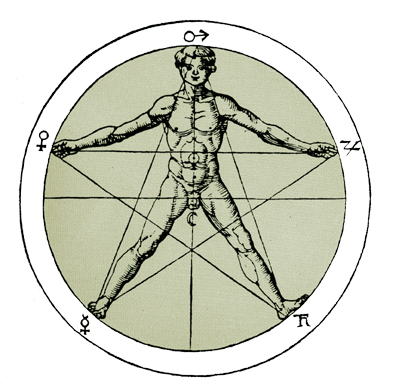
The intuitive finds its place in an inner hierarchy of will. I do feel sometimes that this kind of will should be capitalised – Will. When I think of the intuitive I think of the instinctive intelligence of a new born baby that turns its head and opens its mouth and begins to suckle on the mother’s breast. This is real intuitive intelligence – a balance between what is needed, what is possible, and what is beautiful. Today many in our Western “developed” world have lost the intuitive ability, to use one’s instinctive intelligence to create order in the world. The intuitive, I feel, is the circumference of the essential.

pentagram-astro-man1

Esoteric to me means HIDDEN – nothing more and nothing less. The esoteric partakes of an energy rather than static conceptualisation. The esoteric current flows through all and everything – yes, there is the esoteric side of a stone and the esoteric side of rationality and a smile. The only way to convey the esoteric from one human to another is through presence or the ingestion of energetic – wisdom – texts. These texts are living organic IDEAS that act like yeast in the mind. There are certain Ideas which are larger than mere conceptualisation and these Ideas, I feel, partake of a life, they are angelic life forms. The purpose of these living texts / Ideas is not to stuff one’s mind with extra information but rather to change its constitution so that it can become receptive to the esoteric. This is an aspect of alchemy.

Alchemical Medal

Alchemical Medal

The discernment of the intuitive / esoteric is a function of that same hidden energy. These sacred esoteric texts serve as long koans, and if approached in an appropriate manner may open a mind to the hidden forces. The idea of text must also be enlarged in regard to the esoteric. In this context the Temple of Luxor in Egypt is a text behaving in the above manner (see R A Schwaller de Lubicz ), as are the various revelations of the world’s religions, and various dances, rituals and art. Gurdjieff coined a word for these “texts” – legominisms.

To someone who is imbued with an esoteric vision, the whole of life is one big hieroglyph waiting to be read and understood. Astrology from this perspective, is a form of life “language” and algebra. Dane Rudhyar called Astrology, the algebra of life. I like this, but I also see Astrology as a language with its own syntax and grammar.

I believe that the ability to discern the esoteric from the exoteric has something to do with one’s will. This something cannot arise without assistance from the hidden parts of one’s nature.

I don’t seek the esoteric, the esoteric seeks me.


Recommendatons for Living – G I Gurdjieff

March 15, 2009


George I Gurdjieff  (1866? – 1949) was a Greek – Armenian who introduced the Fourth Way to the Western world. His Greek name is Georgiades which has been “Russified” to Gurdjieff by which he is more commonly known. Gurdjieff’s ideas have touched me to the core and I can say that of all the spiritual teachings available to us today, that his resonates in a very deep way with my own needs and search.
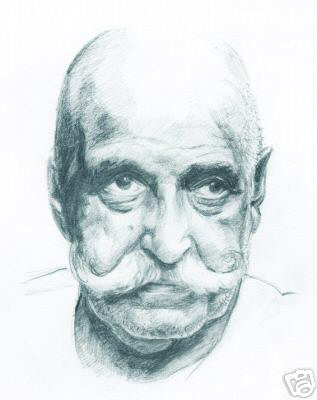
G I Gurdjieff

G I Gurdjieff

Below are some “Recommendations for Living”  from a Spanish site that states these are Gurdjieff’s. Don’t know if this the case but they feel right. Both the original in Spanish and an English translation are here, plus a link to the original source is provided at the end of the quote:

1. Fija tu atención en ti mismo, sé consciente en cada instante de lo que piensas, sientes, deseas y haces.
~ Fix your attention in yourself, be conscious at every instant of what you think, feel, want and do.

2. Termina siempre lo que comenzaste.
~ Always finish what you started.

3. Haz lo que estás haciendo lo mejor posible.
~ Do your best with whatever it is you are doing.

4. No te encadenes a nada que a la larga te destruya.
~ Do not chain yourself to anything that will destroy you on the long haul.

5. Desarrolla tu generosidad sin testigos.
~ Develop your generosity without witnesses.

6. Trata a cada persona como si fuera un pariente cercano.
~ Treat every person as if they were a close relative.

7. Ordena lo que has desordenado.
~ Order what you have messed up.

8. Aprende a recibir, agradece cada don.
~ Learn to receive, thank every gift.

9. Cesa de autodefinirte.
~ Cease to autodefine yourself.

10. No mientas ni robes, si lo haces te mientes y te robas a ti mismo.
~ Do not lie or steal, if you do, you lie to and steal from yourself.

11. Ayuda a tu prójimo sin hacerlo dependiente.
~ Help your neighbor without making him dependent.

12. No desees ser imitado.
~ Do not wish to be imitated.

13. Haz planes de trabajo y cúmplelos.
~ Make work plans and carry them out.

14. No ocupes demasiado espacio.
~ Do not take too much space.

15. No hagas ruidos ni gestos innecesarios.
~ Do not make unnecessary noises or gestures.

16. Si no la tienes, imita la fe.
~ If you don’t have it, imitate faith.

17. No te dejes impresionar por personalidades fuertes.
~ Do not let yourself be impressed by strong personalities.

18. No te apropies de nada ni de nadie.
~ Do not take possession of anything or anyone.

19. Reparte equitativamente.
~ Distribute equitably.

20. No seduzcas.
~ Do not seduce.

21. Come y duerme lo estrictamente necesario.
~ Eat and sleep what’s strictly necessary.

22. No hables de tus problemas personales.
~ Do not speak of your personal problems.

23. No emitas juicios ni críticas cuando desconozcas la mayor parte de los hechos.
~ Do not emit judgments or criticisms when you do not know most of the facts.

24. No establezcas amistades inútiles.
~ Do not establish useless friendships.

25. No sigas modas.
~ Do not follow fashions.

26. No te vendas.
~ Do not sell yourself.

27. Respeta los contratos que has firmado.
~ Respect the contracts you have signed.

28. Sé puntual.
~ Be on time.

29. No envidies los bienes o los éxitos del prójimo.
~ Do not envy the goods or successes of your neighbor.

30. Habla sólo lo necesario.
~ Say only what’s necessary.

31. No pienses en los beneficios que te va a procurar tu obra.
~ Do not think of the benefits that your actions will bring you.

32. Nunca amenaces.
~ Never threaten.

33. Realiza tus promesas.
~ Keep your promises.

34. En una discusión ponte en el lugar del otro.
~ In a discussion put yourself in the place of the other.

35. Admite que alguien te supere.
~ Admit that someone might supersede you.

36. No elimines, sino transforma.
~ Do not eliminate, transform.

37. Vence tus miedos, cada uno de ellos es un deseo que se camufla.
~ Conquer your fears, each one of them is a desire that camouflages itself.

38. Ayuda al otro a ayudarse a si­ mismo.
~ Help the other help himself.

39. Vence tus antipatí­as y acércate a las personas que deseas rechazar.
~ Conquer your antipathies and get close to the persons you wish to reject.

40. No actúes por reacción a lo que digan bueno o malo de ti.
~ Do not act out of a reaction to what good or bad they say about you.

41. Transforma tu orgullo en dignidad.
~ Transform your pride in dignity.

42. Transforma tu cólera en creatividad.
~ Transform your anger into creativity.

43. Transforma tu avaricia en respeto por la belleza.
~ Transform your greed into respect for beauty.

44. Transforma tu envidia en admiración por los valores del otro.
~ Transform your envy into admiration for the values of the other.

45. Transforma tu odio en caridad.
~ Transform your hate into charity.

46. No te alabes ni te insultes.
~ Do not praise nor insult yourself.

47. Trata lo que no te pertenece como si te perteneciera.
~ Treat what doesn’t belong to you as if it did.

48. No te quejes.
~ Do not complain.

49. Desarrolla tu imaginación.
~ Develop your imagination.

50. No des órdenes sólo por el placer de ser obedecido.
~ Do not give orders just for the pleasure of being obeyed.

51. Paga los servicios que te dan.
~ Pay for the services that you are given.

52. No hagas propaganda de tus obras o ideas.
~ Do not make propaganda of your doings or ideas.

53. No trates de despertar en los otros emociones hacia ti como piedad, admiración,
simpatí­a, complicidad.
~ Do not try to awaken in others emotions towards you like compassion, admiration, sympathy or complicity.

54. No trates de distinguirte por tu apariencia.
~ Do not try to distinguish yourself by your appearance.

55. Nunca contradigas, sólo calla.
~ Never contradict, just be silent.

56. No contraigas deudas, adquiere y paga en seguida.
~ Do not contract debts, acquire and pay right away.

57. Si ofendes a alguien, pídele perdón.
~ If you offend someone, ask for forgiveness.

58. Si lo has ofendido públicamente, excúsate en público.
~ If you have offended him publicly, apologize in public.

59. Si te das cuenta de que has dicho algo erróneo, no insistas por orgullo en ese error y
desiste de inmediato de tus propósitos.
~ If you realize you have said something wrong, do not insist out of pride on that mistake, and desist immediately of your intentions.

60. No defiendas tus ideas antiguas sólo por el hecho de que fuiste tú quien las enunció.
~ Do not defend your old ideas just because of the fact that it was you who uttered them.

61. No conserves objetos inútiles.
~ Do not keep useless objects.

62. No te adornes con ideas ajenas.
~ Do not adorn yourself with others’ ideas.

63. No te fotografíes junto a personajes famosos.
~ Do not take Pictures of you next to famous characters.

64. No rindas cuentas a nadie, sé tu propio juez.
~ Do not explain yourself to anyone, be your own Judge.

65. Nunca te definas por lo que posees.
~ Never define yourself by what you posses.

66. Nunca hables de ti sin concederte la posibilidad de cambiar.
~ Never speak of yourself without granting yourself the possibility of changing.

67. Acepta que nada es tuyo.
~ Accept that nothing is yours.

68. Cuando te pregunten tu opinión sobre algo o alguien, di sólo sus cualidades.
~ When asked your opinion about something or someone, only say their qualities.

69. Cuando te enfermes, en lugar de odiar ese mal considéralo tu maestro.
~ When you are sick, instead of hating that illness consider it your teacher.

70. No mires con disimulo, mira fijamente.
~ Do not look hintedly, look straight.

71. No olvides a tus muertos, pero dales un sitio limitado que les impida invadir toda tu vida.
~ Do not forget your dead, but give them a limited place that impedes them from invading all your life.

72. En el lugar en que habites consagra siempre un sitio a lo sagrado.
~ In the place you live consecrate always a place for the sacred.

73. Cuando realices un servicio no resaltes tus esfuerzos.
~ When you perform a service do not highlight your efforts.

74. Si decides trabajar para los otros, hazlo con placer.
~ If you decide to work for others, do it with pleasure.

75. Si dudas entre hacer y no hacer, arriésgate y haz.
~ If you doubt between doing and not doing, take a risk and do.

76.  No trates de ser todo para tu pareja; admite que busque en otros lo que tú no puedes darle.
~ Don’t try to be everything for your couple; admit he/she may search for in others what you cannot give him/her.

77.Cuando alguien tenga su público, no acudas para contradecirlo y robarle la audiencia.
~ When someone has their public, do not approach to contradict or steal the audience.

78. Vive de un dinero ganado por ti mismo.
~ Live off of money earned by yourself.

79. No te jactes de aventuras amorosas.
~ Do not boast about love affairs.

80. No te vanaglories de tus debilidades.
~ Do not vainglory yourself of your weaknesses.

81. Nunca visites a alguien sólo por llenar tu tiempo.
~ Never visit someone just to fill your time.

82. Obtén para repartir.
~ Obtain in order to share.

83. Si estás meditando y llega un diablo, pon ese diablo a meditar.
~ If you are meditating and a devil arrives, put that devil to meditate.

http://www.librosdeluz.net/2008/04/mandamientos-de-gurdjieff.html#

Here are some photos of Gurdjieff and some of the key people in the Work:

http://digitalseance.wordpress.com/galerie-dimage/la-galerie-de-gurdjieff/


A Ganma Odyssey

March 11, 2009


This is the title I used for an article published in  “Education Australia”  way back in 1998. I think it is still relevant in many ways, particularly now that Australia has had a change in goverment. Since it already is online I will just give you the link to it here  “A Ganma Odyssey” . If the link should ever become inactive I will upload it to this blog.
I chose this title to connect an Aboriginal word with my Greek heritage – the Odyssey. Ganma is an Aboriginal word from the Northern Territory which is the name for a waterhole that has fresh and salt water mixing together in a rock pool. One of the speakers at the conference (see below “The Ganma Metaphor”), suggested we use the word “ganma” to refer to a “multicultural space” as in a classroom. Anyway, read the article and you will see the full context. By using the word “odyssey” I alluded to my own Greek heritage and the fact that the journey to the Heart of Australia was also a journey to the centre of my own heart because I was retracing a journey I undertook about 25 years earlier as a young man on the road looking for truth . . . . my own naive version of a Dharma Bum.

The coloured text excerpts and photos, beneathe “The Ganma Metaphor” are scanned from the hard copy of “Education Australia” Issue 39, 1998. So, check the article out >> “A Ganma Odyssey”.

The Ganma Metaphor

“This metaphor I had learned during earlier visits to Yirrkala Community School in East Arnhem Land, on the coast of the northeast corner of the Northern Territory. Yirrkala has organised their curriculum and teaching around a metaphor of the contact zone where rivers meet the sea, named ganma in one of the local Aboriginal languages. Literally, ganma is where fresh and salt water meet. Metaphorically, ganma is where cultures meet: fresh water is indigenous Yolngu knowledge and practices; salt water is the white Balanda knowledge and practices; and one place where they meet is in school.

Flying in a small plane from Yirrkala west to Darwin after a visit in 1993, l could see clearly the swirls of different colors in the ganma waters: bluer from the sea, browner from the land. Manduwuy Yunupingu, who was principal of Yirrkala when I first visited in 1991, has also described the role of Yothu Yindi, his internationally known rock group, in the meeting place of popular culture in these same ganma terms (Shoemaker 1994).

At first thought, this ganma metaphor may seem to ignore the important power differential between dominant and nondominant cultures in institutions like schools. But if you think again about literal relationships between fresh water and salt, the potential threat of unequal power is there: salt water tides and typhoons can flood the land, while fresh water cannot seriously harm the ocean. But if the two can be kept in balance in the ganma space, then the rich nutrients that come together from the mix of different waters nourishes richly diverse forms of life-biologically in the literal situation, culturally and intellectually in the metaphorical.”

Courtney B. Cazden

Quote from ‘A Postscript from Alice Springs’, in Multiliteracies: Literacy learning and the design of social futures.

eductn-aust-ganma-odyssey-1

Here is an excerpt from the article :

It has been suggested that the human notion and definition of self has been through major shifts since the beginning of human consciousness (Julian Jaynes, “The Origin of Consciousness in the Breakdown of the Bicameral Mind”, Boston, Houghton Miffen, 1977 ). The closest to us historically, that may demonstrate this shift, is said to have occurred in Homer’s Greece.


According to this view, in Homer’s day, the people did not have the same sense of self as we may have. Their inner psychological organisation was different to what we take for granted. The voice of the mind was somehow perceived as a “god” speaking from outside themselves. It didn’t take too long before people started sussing out that there were a lot of “gods” running around in the temples and in the marketplaces saying contradictory things about how things were, that they saw the untruth of their “godhood”. Gradually this voice of the “gods” became established in the sense of self we call “ego”. What was there before the voice? Who and what was Ulysses’s “sense of self” on his Odyssey?

Have we in the dying years of the Industrial Age, come to a cultural cul-de-sac? Somehow, we have alienated ourselves from not only each other but also the common ground of experience – nature, the Earth. Is it time for another definition and sense of self, another way of knowing, one that acknowledges something other than the sovereign rights of the mechanistic, rational, technocratic and anti – spiritual mindset of the “Western” sense of self?

Edward de Bono in his “I Am Right, You Are Wrong”, thinks that this is the case. He suggests that a renaissance of thought and language patterns is needed so that humanity doesn’t self destruct. He proposes turning away from the “table top logic” of the traditional “Western” mindset in favour of developing a way of knowing that is based on perception. De Bono explains that recent developments in the understanding of self-organising systems and ideas from information theory, have given indications as to how the neural processes of the brain perform the activity of perception. Perception operates in nerve networks like a feature of a self-organising biological system, a living entity. Let’s call information that comes through our senses impressions. These impressions fall on the inner landscape of our mind like rain. The rain on the mind organises itself into tributaries, rivulets and streams of temporarily stable patterns. These patterns can subsequently flow into new sequences and patterns. According to de Bono, the perceptual mode of thinking encourages the mind to form multiple branching flow patterns; the sensory information is not boxed in by fixed linguistic concepts, generalities, and logic. Perceptual thought patterns follow the natural behaviour of neural networks; our present mode only plays back a recording of words and concepts provided by a preestablished cultural mindset.

Courtney Cazden during her paper on Ganma Space spoke of the necessity of getting rid of the margin and centre metaphor. This metaphor was based on the myth of terra nullius of students’ minds and being. Courtney told us that while she and Mary Kalantzis were flying to some school in the Northern Territory they noticed water holes that had fresh and salt water tributaries and other smaller rivulets all feeding the main space of the water hole. This, they found out was known as a ganma. The ganma looks like localised swirling spirals from the air. Courtney said that the mingling of brown, fresh and salt water in this space was analogous to the culturally diverse classroom. And in light of the process of perception is an apt image of the inner subjective world, our mind, our being.

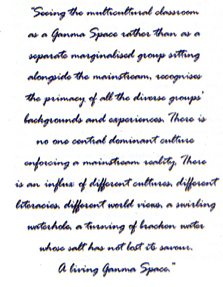
The multicultural classroom as a Ganma Space, this metaphor rather than create separate marginalised groups besides the mainstream, recognises the primacy of all the diverse groups’ backgrounds and experiences. There is no one central dominant culture enforcing a mainstream reality. There is an influx of different cultures, different literacies, different world views, a swirling waterhole, a turning of bracken water whose salt has not lost its savour.

A living Ganma Space.


Let’s go one step further and consider that in the industrially developed world there is the primacy of the head, (some localise it to the left hemisphere of the brain) and all the other ways of being and cognition – feelings, sensations and intuition have been marginalised. What do we have if we apply the ganma metaphor to our own inner world? In this ganma, head, heart, body and spirit all contribute equally, but differently, to our sense of the real. These parts of ourselves may all be cognitive in nature, they may be different tributaries of knowing, different source data. Ganma Space taken as psychological space, the internal world of our experience, would allow for the possibility to connect our known and unknown parts of ourselves. This opens the opportunity to connect with others by being able to include more of the “other” in one’s awareness.
Could the perceptual mode of thinking be a ganma way of knowing?

The taste I seek is a taste of being – not in the philosophical sense – a point of view to be debated, but rather an experience, an immersion through the background/underground of one’s chattering monkey mind – into the moment. We’ve seen that working from only a part of ourselves doesn’t work. The problems confronting all of us in this time of planetary transition are whole systems oriented. Now we see through Chaos theory, that a butterfly fluttering her wings in South Africa has global consequences. And when it comes to the ecological state of the Earth and the widening gap between the rich and poor across the planet, it is obvious that whole, global issues require an effort and a response that is from the whole of ourselves, the ganma of ourselves.

From “A Ganma Odyssey” published in Education Australia, 1998.

eductn-aust-ganma-odyssey-2eductn-aust-ganma-odyssey-3


eductn-aust-ganma-odyssey-4

eductn-aust-ganma-odyssey-5

eductn-aust-ganma-odyssey-6

eductn-aust-ganma-odyssey-8


eductn-aust-ganma-odyssey-7


eductn-aust-ganma-odyssey-9

eductn-aust-ganma-odyssey-10


Flotillas True Beginnings ……from the Holy Mountain

February 28, 2009

Mount Athos, Greece

Mount Athos is in north eastern Greece, east of Salonika and only accessible by boat from Ouranopolis  (ouranos means sky so Ouranopolis means Sky Town).

Mount Athos is in north eastern Greece, east of Salonika and only accessible by boat from Ouranopolis (ouranos means sky so Ouranopolis means Sky Town). The Holy Mountain is located on the red peninsular of Halchidi.

  When are true beginnings of events, births and resurrections? I ask this question because I’ve been asked when did the “Flotillas of Hope” begin? Common sense answers that it was the day and time the boats set off for Nauru. “Eureka” left Sydney on 15 May and “One Off” and “Eureka” left Brisbane for Nauru on 23 May, 2004. However, before the boats even existed, “Flotillas of Hope” was an email sent at a particular date and time from somewhere. Was this email “Call to Action” the real beginning of the project? A feeling anchored in my heart for a few months before the “Call to Action” email was sent over the internet.  Was this feeling the real beginning that only needed my fear of ridicule to disappear to express itself? Where did this feeling arise from?

I believe the real beginning happened four years before we set sail for Nauru. My father died in December, 1999 and being the eldest son of a Greek family it was my duty to go to Greece and check out some property stuff. I hadn’t been back to Greece since I left when I was four years old. I couldn’t afford to return to my birthplace, my roots, until I was 48. Over the years I dreamt about returning and all the special places I would visit. One was Dodona which is about 5 kilometres from Anatoli, the village where I was born. It is the oldest oracle in Greece, older than the Delphic Oracle. Legend has it that Jason, before he sailed off with the Argonauts searching for the Golden Fleece, visited the oracle of Dodona. The miraculous priam that spoke in prophecies from the front of the Argonauts’ boat, was carved from wood of Dodona’s  sacred grove.

Dodona, oldest oracle in Greece. I sat on one of the rocks and listened to Zeus speak through the rustling leaves before I left for the Holy Mountain.

Dodona, oldest oracle in Greece. I sat on one of the rocks and listened to Zeus speak through the rustling leaves before I left for the Holy Mountain.

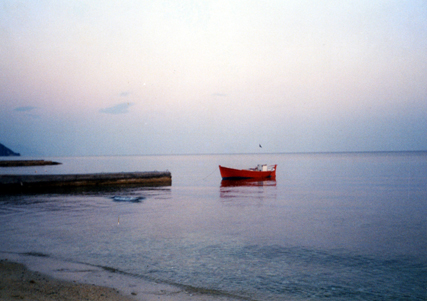
This is near the spot where Mary, Mother of God (Theotokos) shipwrecked on Holy Mountain's beach.

This is near the spot where Mary, Mother of God (Theotokos) shipwrecked on Holy Mountain’s beach.

One other place I dreamt of visiting was Mount Athos, the Holy Mountain as Greeks call it. The monks who live there consider themselves gardeners for the Mother of God’s Garden on Earth.  When Mary and Saint John set sail from Cyprus their tiny boat was blown by strong winds off course to the north east coast of Greece where it shipwrecked. When Mary saw the beauty of this place she asked her son Jesus if she could have it as her garden. Soon after, seekers of truth arrived, some remained to become gardeners and others left after some respite. This is why it is called the Holy Mountain.
 
 I was baptised as Greek Orthodox when I was a baby. In my late teens and early twenties I searched far and wide, behind book covers and the open roads of Australia and New Zealand looking for something. As part of that search I found that the Holy Mountain may have something of what I was looking for. I had sought answers in religions and philosophies alien to my heritage. Now was the chance to look into my own indigenous faith.
 
Ouranopolis - this is where you leave by boat to go to the Holy Mountain.

Ouranopolis – this is where you leave by boat to go to the Holy Mountain.

It was Easter, 2000, there I was sitting opposite Geronta Pavlo at the table with the wood oven heating some water behind me. I was inside a time bubble hugged by mud, stone and timber walls. Byzantium breathed in this small kitchen that has cooked meals and boiled water for over a millenium.

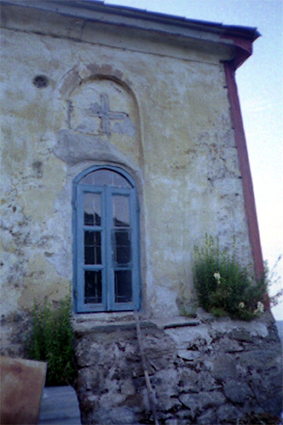
The tiny church next door to the room I stayed in at the old Byzantine house.

The tiny church next door to the room I stayed in at the old Byzantine house.

Of all the cats scampering for fish heads in the saucer near the door, two – the twins, Alpha and Omega ran towards Geronta, finding their way onto the table top. Geronta was quietly reading a newspaper. His hair, like small waterfalls of grey, fell over his shoulders and behind his back. Strands of his long white beard fell on the table. Gerontas, 90 years old, looked like a middle aged biker, with the full round belly of body armour and broad shoulders. Alpha and Omega tugged at his beard, he said, “Off with you,” and then smiled. I went to lift the boiling water off the stove and when I returned I saw Geronta folding a page of the newspaper. Over and over he folded. I wondered if this was some kind of Holy Mountain origami. When he finished folding he held it up.

He said, “Here Stavros, this is for you.”

I said, “What is it Gerontas?”

“It’s a boat. I don’t know why but my heart told my hands to make this for you.”

As I received the gift he said, shrugging his shoulders, “Who knows, it may mean that you return to the Holy Mountain sooner than you think. Or maybe something else. It is for you.”

The paper boat folded by Gerontas and given to Stavros.

The paper boat folded by Gerontas and given to Stavros.

What was interesting in retrospect is that he gave me the boat a day after we had a discussion about what is needed to alleviate suffering and injustice on Earth. I was thinking about the dispossessed, the homeless, the weak, the persecuted, the refugees of the world. I told Gerontas that the needs of the world are such that people who can do something should not hide on Holy Mountains but be in the world and try to change it for the better, Smiling, he said, “Our Christianity is esoteric, it is hidden. Here on the Holy Mountain you are no longer in the exoteric world. Our concerns are spiritual.”

“Gerontas, you appear not to care for the very ones Jesus tells us we should care for.”

“Stavros, from where you are it appears that way. You know, the Holy Mountain needs at least five monks to survive in caves and feed on light. Without these monks connecting Heaven and Earth through their sacrifice, the Mother of God’s Garden will wither and die. How do you know that this house, this monastery, this Holy Mountain does not play a similar role for the whole Earth? How much more pain and injustice would be on Earth now if the Holy Mountain did not exist? We, each of us has our calling, our vocation. My work is here while yours is in the exoteric.”

“Gerontas, do I need to become a monk to fulfil what is needed or is there another way?” I asked him.

Alpha or was it Omega, crawled softly towards his hand. He reached for the cat’s head and stroked it gently. He said, “This is what is needed from all…..the practice to bring the spiritual into the material, Heaven on Earth. You don’t need to be a monk or a nun to do this. All you need is pure intention. If your intent is pure, the way is open. Do what you have to do, follow your conscience and allow this particle of God,” he pointed to my heart,” your conscience, guide you.” He looked at me with soft eyes and added, “You must die before you die and then be reborn, this is what Easter is all about.”

A few days after I was on my way to Istanbul or Constantinople as Greeks call it with the paper boat and lots of material for thought. My journey over the next two months was along the ancient trade route from Istanbul to Cairo.  

I took the paper boat with me on Eureka. I now believe that the beginning of the journey to Nauru was the moment when Gerontas gave me the paper boat. He, as a gardener, planted a seed. 

St Paul at the base with Mount Athos in the background.

St Paul at the base with Mount Athos in the background.

Entrance path to the house I stayed in with the two monks.

Entrance path to the house I stayed in with the two monks.

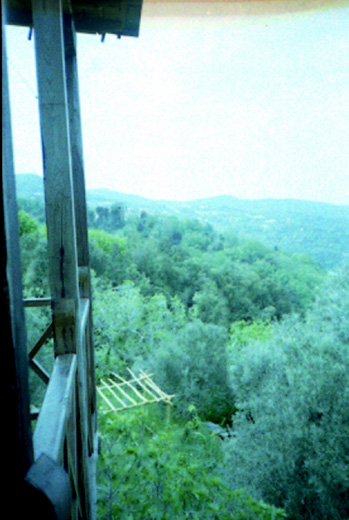
View from a balcony near my room.

View from a balcony near my room.


Symbols

February 24, 2009

geomterical-illusion

Here’s something I wrote a while back and have decided that it’s OK to just scan my hand written stuff as long as its legible.  Actually, I’m enjoying having this blog because it gives me the opportunity to sift through stuff I’ve written and then to “store” the “chosen” stuff in virtual space. If you’re reading this and you don’t like what I write, that’s OK too because you can move on and I still have my stuff stored in “space”.

Anyway, here’s something I wrote on I Ching symbolism ….. 

symbols-writing-sg


Is Consciousness a function of the brain or vice versa?

February 16, 2009
 

Nautilus pompilius
Nautilus pompilius

Ask yourself this question: Is consciousness a function of the brain or is the brain a function of consciousness?


 If you answer that consciousness is dependent on the brain then when the body dies, consciousness disappears too. First scenario: there is no consciousness around so there is no information processing; second scenario: the body and brain rots but consciousness is still around and probably processing information that only angels, demons and gods process as well. The glare of the body life blinds consciousness when riding a living brain. Brain drops dead, consciousness remains, out of the darkness light is present – spirit would be out of our world but touching it and relating to it.

 I belong to the group that believes the brain is a function of consciousness. From this very simple belief flow many effects. Perhaps there is a matrix of consciousness which has a “geometrical – mathematical” edge of subtle manifestation. I think this is what Pythagoras was on about when he said that a stone was a piece of “frozen music” and that everything has a number basis. This matrix of consciousness has a field which includes and extends into our own “individual” consciousness. This is where consciousness is NOT a function of the brain.

 From this side of the cranial fence I believe that an ancient text such as the I Ching – the Book of Changes can assist us in our exploration of the moment, the situation of the now. The Pythagorian emphasis on Number is expressed in an amazing mantic art that is based solely on number.


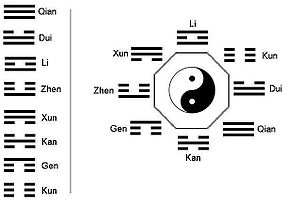
The eight trigrams of the bagua (King Wen "Later Heaven" order). Two of these trigrams makes a hexagram.

The eight trigrams of the bagua (King Wen "Later Heaven" order). Two of these trigrams makes a hexagram.

 The I Ching has as its basic structure 64 hexagrams (see also this blog for picture of the 64 hexagrams)which are generated by 8 trigrams which are in themselves generated by combination of two very simple bits of information a whole or a broken line. This is what excited Liebniz when he saw the exact parallel of his binary code with the ancient Chinese Oracle which at a minimum estimate has existed for over 5000 years and worked with binary bits thousands of years ago before Liebniz was born and dreamt of calculus.  

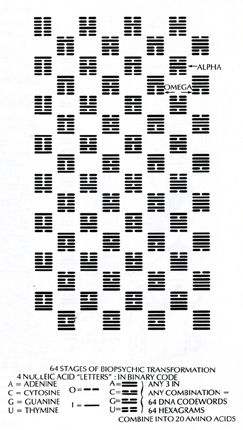
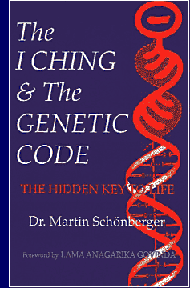
 This coincidence was surpassed by the discovery of DNA by Watson and Crick. The way the amino acids are formed and combined to create the helix spiral of our DNA also parallels the mathematical combinations required to create a six lined hexagram of the I Ching. Dr Martin Schonberger published “The I Ching and the Genetic Code – The Hidden Key to Life” in 1973. He discovered that there was a one – to – one equation of the 64 hexagrams of the I Ching and the 64 DNA codons of the genetic code. This discovery provided Carl Jung his topic of the funeral address in honour of the great German translator of I Ching, Richard Wilhelm. He said, “It can’t remain in the dark forever, that we are touching here on an Archimedean principle, with the help of which our occidental thinking could be unhinged.” Schonberger said, “that is precisely what happened by the manifestation of I Ching code in genetic code.”


I Ching as description of Genetic Code (diagram from "Earth Ascending" Jose Arguelles.

I Ching as description of Genetic Code (diagram from "Earth Ascending" Jose Arguelles).


schonberger_01

Here we find that an ancient Chinese text written over a course of thousands of years in its mathematical / numerological operation and in the exact binary equivalence with the genetic code shows that “consciousness” exists within the formation of the genetic code which gives every life form its unique characteristics and in the Book of Changes.

 Or is it just one big coincidence? 

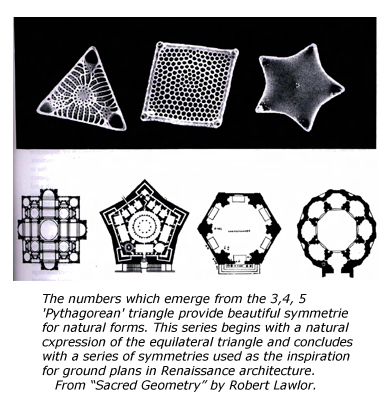
Some relevant statements about how archetypes and the number form of the same, the sacred geometry of the archetypal forms are made in Robert Lawlor’s book  “Sacred Geometry”.  He defines the “archetypal”  as “universal processes or dynamic patterns which can be considered independently of any structure or material form.”He states that, ” Modern thought has difficult access to the concept of the archetypal because European languages require that verbs or action words be associated with nouns. We therefore have no linguitic forms with which to image a process or activity that has no material carrier.”Ancient cultures symbolized these pure, eternal processes as gods, that is, powers or lines of actions through which SPIRIT is concretised into energy and matter.Lawlor uses DNA as an example of the above. Genetic coding as the vehicle of replication and continuity does not lie in the particular atoms (Carbon, Hydrogen, Oxygen or Nitrogen) of which the gene substance, DNA, is composed as these are subject to change. Thus, the carrier of continuity is not only the molecular composition of DNA but also its helix form.

 The helix, a special type from the group of regular spirals, results from sets of fixed geometric proportions. These proportions can be understood to exist a priori, without any material counterpart, as abstract, geometric relationships.Thus, one can say that the architecture of bodily existence is determined by an invisible, immaterial world of pure form and geometry.This invisible realm is part of  the consciousness of the universe. The brain is a function of this invisible innate geometry of life, this sacred geometry.

The structure of part of a DNA double helix.

The structure of part of a DNA double helix.

 pythagorean-geometry


These refraction photos are the closest visualization that science can give with respect to the nature of atomic substance, which appears to be patterns of geometrized light energy.

These refraction photos are the closest visualization that science can give with respect to the nature of atomic substance, which appears to be patterns of geometrized light energy.


fludd-circles


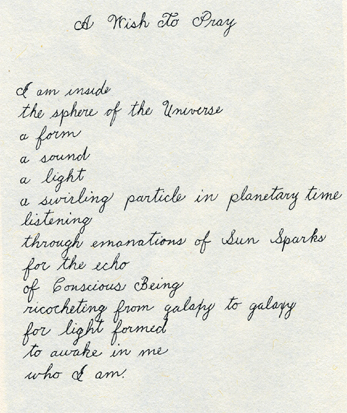
A Wish to Pray – Donald Petacchi

February 15, 2009

Below is a copy of a hand written poem by Donald Petacchi taken from his book,  “Work for Being in the Machine Age”.


A Wish to Pray, by Donald Petacchi

A Wish to Pray, by Donald Petacchi


Internet as analogue of Akashic Mirror

February 13, 2009


Sometimes a concrete object can be a perfect tool for an analogy. A classic example used by many is the hologram as an analogy of the One, the Holographic Universe, where one piece reflects the whole. It brings to mind the ancient teaching of Hermes Trismegistus “As above, so below”. The Holographic Universe is alive and intelligent and every child, be it stone, bird or snake, of the Uiverse is the universe in miniature. Now, remember, the Holographic Universe is NOT the real universe, it is a description supported by a technological invention. However, the description and the idea it points to can make sense of the micro scale domain of quantum physics. It allows a possible approach to the fact of nonlocality. This is where two events separated by distance influence each other in violation of locality. According to the Holographic Universe analogue, they do because they are part of the One. The Earth, from this perspective can be seen as a Holonomic Brain (see diagram below from Jose Arguelles at end of post).

Hermes Trismegastis on a Throne

Hermes Trismegistus on a Throne


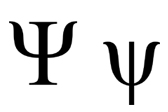
Now, let’s move to the internet, a more recent technology, what analogy can we draw from it? If the hologram gives us a static model which shows the connection between everything, the internet may give us a process, interactive, exchanging model of the that same holographic one. If Unity is the image evoked from the hologram, what can the internet image evoke? An info-living seamless web. String Theory? Don’t know, I’m not a scientist. But a living seamless web I can see and I can take it one step further – a living seamless webbing, a constant weaving of the matrix, of informational stuff. This informational stuff can be seen as “psi” stuff from the Greek 23rd letter psi which is used in parapsychological studies as the stuff of “mind”. 

23rd Greek letter - psi.

23rd Greek letter - psi.

Can the internet as technology be an analogy of what some have named the “astral” realm? This realm according to occult lore is that space between the physical body and the immortal spirit. It is also equated with the “soul” in the Christian tradition of Body, Soul and Spirit.

What can the internet analogy show us as a correspondence in the astral – soul realm? According to occult lore there is a record of everything that has ever happened on Earth. They are called the Akashic Records. The internet has this magical capacity with a Google ritual. Just type in a word and in a matter of microseconds you will have every answer recorded globally on the net relevant to the word. For a Paracelsus in the Middle Ages to witness this would indeed be magic. The Akashic Records of the Middle Ages have now in the 21 st Century been vindicated as an informational/knowledge possibility. Sure Googling  the internet is only a millionth part of the Akashic Records – but even this points analogically to what may be possible from an Astral realm.


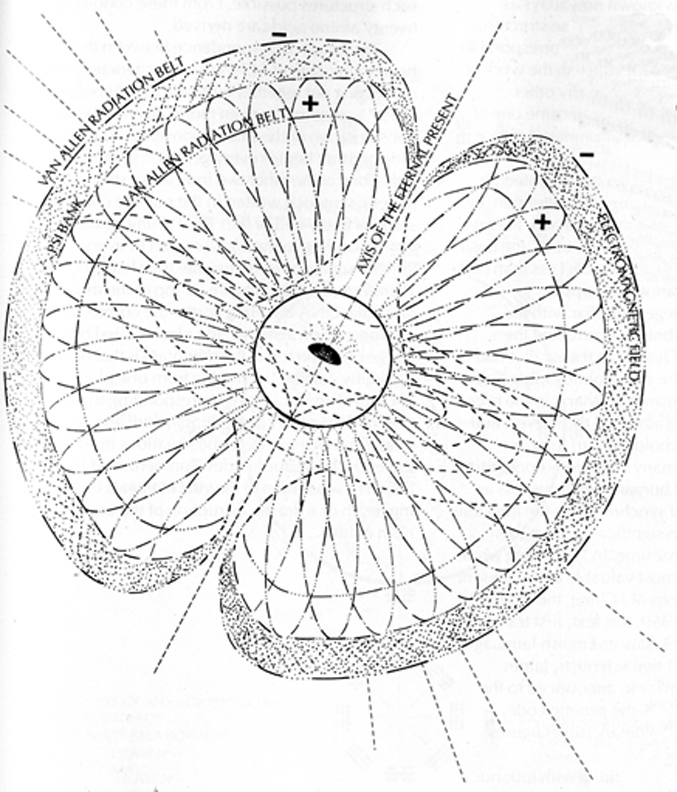
The unity of the hologram gives us frame, the web of the internet gives us movement. Why movement? The constant weaving of messages across the net gives us an image of an organic informational exchange, like neuronal activity. Yes, it gives as image the Noosphere weaving into webs manufactured out of crystal chips. This is what Jose Arguelles calls the “psi bank” as seen in the diagram below. Who knows, maybe we are witnessing the genesis of  a global mind. It has always been here, what has changed is humanity’s capacity to feel it. Funny that. On one hand we bemoan the loss of the hunter gatherer instinctual connection with Earth and on the other, the Silicon Valley microchip revolution with the internet has given us the possibility of a connection with Earth. The issue is more and more, as Moloch winks another sacrificial war, how to connect with the most archaic parts of our nature with the most contemporary. Archaic is in the Greek meaning of “arche” – the beginning, the first. What is the beginning of my nature? If we consider progress as an accretion over an instinctual – telepathic – holistic neolithic mind, then the genesis point of my nature is that which is not cerebral but more primeval. The danger is that we can allow the “inner reptile” take over and then we would be demonstrating the social realm of William Golding’s chilling “Lord of the Flies”.


We need both the “archaic” nature wedded to the rational nature for an attempt at being whole. How can we come to this? This is where discovering the unknown, uncharted inner country of our being is crucial. A great book which looks at the need to revitalise the “archaic” nature of our being is “Archaic Revival” by Terence McKenna.

terence-mckenna-quote


This is where the “how” of spirituality comes in.  


Is this what an Akashic Library looks like? “I have always imagined that Paradise will be a kind of library.” Jorge Luis Borges

Is this what an Akashic Library looks like? “I have always imagined that Paradise will be a kind of library.” Jorge Luis Borges

From Jose Arguelle "Earth Ascending" - Holonomic Brain & Demontration of Psi Circulation within Electromagnetic Field

From Jose Arguelles "Earth Ascending" - Holonomic Brain & Demonstration of Psi Circulation within Electromagnetic Field


On Sufism – author unknown…..

February 10, 2009

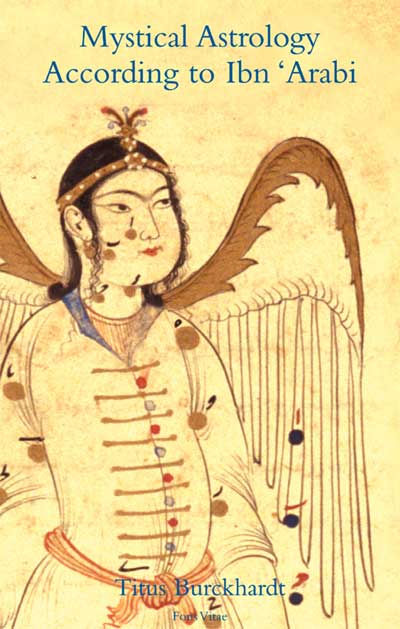
I don’t know where I got the short article from, maybe someone sent it to me with no author’s name on it. It doesn’t really matter, except I don’t want you to think that I wrote it. The Sufi poet the author quotes is, I consider, to be one of the wisest men who ever lived. When I was in Damascus, Syria, I met a local who took me to his tomb. I had to pretend that I was a Moslem to enter the holy place but that wasn’t difficult because of my “Middle Eastern” appearance. My guide just told me not to open my mouth and speak because my English or Greek would give me away. I crouched to enter the small entrance to Ibn Arabi’s tomb and when I came close I felt compelled to fall on my knees and bend my head in respect to him. The tomb, in 2000 was in a silver gilded cage (since then the tomb is within a glass cage) and I felt that this was so incongruous given the free spirit that made Ibn Arabi…well, Ibn Arabi (July 28, 1165 – November 10, 1240).

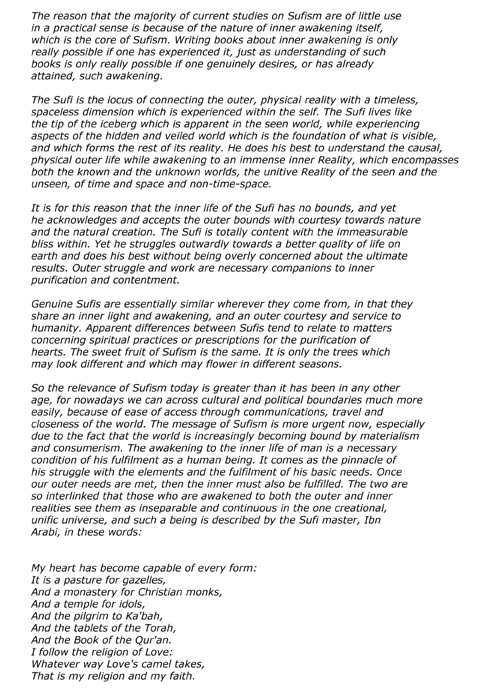
 Anyway, enjoy the following article as it outlines the Sufi experience for our times …… 

sufi-article-ibn-arabi1

book-cover-ibn-arabi-mystical-astro