It was a special day in Bethlehem, Palestine, back in 2000. I had the opportunity to visit the place believed to be where Jesus was born. Afterwards, I found myself in a shop, admiring Palestinian belts. The owner, a Muslim, and I struck up a conversation. He was intrigued by the Christian belief in the Holy Trinity and the crucifixion of God. Our discussion was a fascinating exchange of our different cultural and religious perspectives.
The spot where people throughout history believe is where Jesus was born
Our conversation was interrupted when a customer entered the shop, and the owner had to leave abruptly. To my surprise, he entrusted me with his shop despite our language barrier. His unexpected trust took me aback, but he reassured me that everything would be fine and that he would return shortly.
For about an hour, I found myself alone in the shop. Customers came and went, but no one engaged with me. When the owner returned, he prepared tea, and we resumed discussing religion. It was a moment of realization for me. Despite being a stranger and not sharing his faith, he entrusted me with his shop, a gesture that spoke volumes about the trust we had built during our conversation.
Reflecting on the day, I realized I could have quickly taken advantage of the situation and walked away with something. However, our conversation created a unique connection that led to the shop owner’s trust. As a parting gift, he gave me a Palestinian belt. It was a remarkable experience, a day I will never forget from my time in Palestine.
A Palestinian belt with some badges pinned on it. The embroidery patterns and motifs of Palestinian belts convey specific meanings related to the belts’ origin – the village, family, or marital status of the potential wearer. The intricate designs and variations in the Palestinian belt reflect the rich diversity and cultural heritage of the Palestinian people.
In the past few days, my perspective has broadened, expanding my horizons in unexpected ways. It’s as if everything has aligned serendipitously, forming a delicate snowflake of coincidences.
My mind races, breaking free from the monotony that once plagued my existence. Mundane surroundings take on a new significance, their dullness transformed into the building blocks of something extraordinary. But just as suddenly, the light illuminating this newfound perspective flickers and vanishes.
Leaning back, I consciously straighten my posture, akin to a cobra poised to strike, attuned to its melody. The familiar form remains, but the essence within undergoes a subtle transformation. I feel a fleeting sense of displacement like a fish momentarily out of water. Above me, clouds drift lazily, their ever-changing shapes mirroring my shifting thoughts.
Seeking solace, I find myself lying on the grass, immersed in contemplation. It is here, in the vastness of nature, that I ponder the metaphorical vessel that sails into my mind. Like a ship arriving through a door, it carries with it new ideas, inspiration, and possibilities.
One way to contemplate the concept of the fourth dimension is to envision the inhabitants of a two-dimensional world confined to the surface of a sheet of paper. In this hypothetical scenario, these inhabitants would be unaware of a third dimension, unable to fathom anything beyond length and breadth. The notion of height would be inconceivable to them, just as our three-dimensional perception might limit our understanding of the fourth dimension.
Imagine beings living in this flat, two-dimensional world, experiencing only length and breadth. If an object were to intrude into their world from “above,” introducing the dimension of height, these inhabitants would perceive it in a two-dimensional manner. For instance, if a pencil were to puncture the paper’s surface, it would appear to them as a minuscule dot, gradually expanding in diameter until it reaches a specific size and then remaining constant until it eventually disappears as the pencil passes entirely through the sheet.
To illustrate the passage of time within this context, let us calibrate the pencil into eight segments, each representing ten years. As the pencil traverses the sheet of paper, each segment corresponds to ten years for the inhabitants of this two-dimensional world. Thus, when four segments have crossed the paper’s surface, signifying forty years, it represents the midpoint of the pencil’s existence. However, the inhabitants cannot perceive the whole pencil, including the portion underneath the sheet and the remaining portion above it. Their limited perspective confines them to observe only the cross-section of the pencil intersecting their world, as they cannot comprehend the existence of a three-dimensional realm.
As beings dwelling in a three-dimensional reality, we encounter a similar limitation in perceiving the whole. Just as the inhabitants of the flat world cannot see the entire pencil but only its cross-section passing through their world, we may also be blind to the entirety of existence. Our inability to grasp the whole might lead us to perceive the past as no longer present and the future as yet to arrive. Could the signs of ageing, such as greying hair and wrinkles, serve as our human equivalent of pencil segments? Is a forty-year-old individual with grey hair comparable to four pencil segments traversing the paper’s surface?
Just as the pencil remains a complete entity even when it reaches the eighth segment, marking eighty years and exiting the paper, the inhabitants of the flat world perceive its disappearance. It no longer exists within their confined realm. Similarly, could humans passing through the three-dimensional world continue to exist within the four-dimensional realm after they cease to be visible, i.e., after death? The potential existence of such a realm is a source of profound wonder and contemplation, inviting us to explore the unknown.
The biblical verses, “And sware… that there should be time no longer” (Revelation 10:6) and “That ye, being rooted and grounded in love, may be able to comprehend with all saints what is the breadth, the length, the depth, and the height” (St. Paul’s Epistle to the Ephesians 3:17, 18), resonate with this exploration of the fourth dimension. They inspire awe and encourage us to deepen our understanding and connection with the dimensions that extend beyond our perceived reality, urging us to embrace a broader perspective on existence.
In conclusion, pondering the fourth dimension allows us to transcend the limitations of our three-dimensional perception. By contemplating the possibilities beyond our conventional understanding of time and existence, we open ourselves to new realms of thought and insight. While we may never fully comprehend the fourth dimension, we can embark on a journey of expanded awareness, enabling us to appreciate the profound mysteries that lie beyond the confines of our familiar reality.
You speak to me, I answer from I. You see a shape that is bone, muscle, skin and hair. I see through a fish eye lens this global tissue ‘man’. I see rags and leathers, suits and socks, bags and sacks that you carry.
I see me changing his tie.
I answer from the beach head I. I watch the light house flash across distant boats. I feed gulls knife gliding over grass hills. I feel Hellenic curves in the open air. I stretch my bow, my ancestor voice and call it I.
I answer from within and without which was, is and will be. My tongue is fire coursing through veins. My hands were taught by Sophie the Cleaner. Look carefully and you may see my thumb. It appears like a man. Ignore the smirk swerving at the thumbnail bottom. Doubly ignore it when it appears like me smiling.
I gently part the folds of grey matter. My instinct leads to pulsing points that lie between synaptic arcs deep within the brain. Neither here nor there, neither in nor out. Just between all and everything.
I answer from I. I walk through corridors of mortality and eavesdrop on midnight conversations behind closed doors. I seek a passage through flesh and blood, marrow and bone. From the heel of God to tumbleweed desires my longing cries out. I clap my hands in rhythm to the stars. I play solar tunes careful not to disturb the wispy boundary of lace spider webs.
I answer from I. I watch lone smudge cloud scuff across sunrise. The quickened spindly net stretches over the skin horizon. I flick a twig of humanity’s tree. Is it I or is it me?
On my daily walks I pass a field that has been planted with an unknown crop. It’s unknown because I don’t know the farmer and haven’t asked anyone what it is. I’m assuming it is potatoes but that’s only a guess.
For some reason when I look at this field Vincent Van Gogh hovers over my mind. I call it the Goghic Crop because it has that Vincent vibe. Anyway, I thought I’d post the pictures of this crop in a somewhat chronological order from the time the field was plowed, then sown until today where it looks in healthy growth.
Today is Wednesday 14 December 2022. I will post more photos as the days and weeks go by until it is time for harvest. Hopefully by that time I will know what the crop is.
I found out today, Monday, 23 January, 2023 that the farmer is growing pumpkins.
I live near a river that has a large flood plain to the north. We are very lucky because our home is on high ground so when the river floods we have “water views” but we don’t suffer the effects of a flood. The flood plain is quite large and consequently the views are expansive. This makes the sky and the clouds a prominent feature of the landscape.
Below are some photos of the sky above the flood plain with one picture reflecting the sky on the glass top of the river.
I tried using the Night Mode on my Samsung Ultra 21 recently and was amazed at what it does to simple backyard scenes. The pictures below are from that experiment.
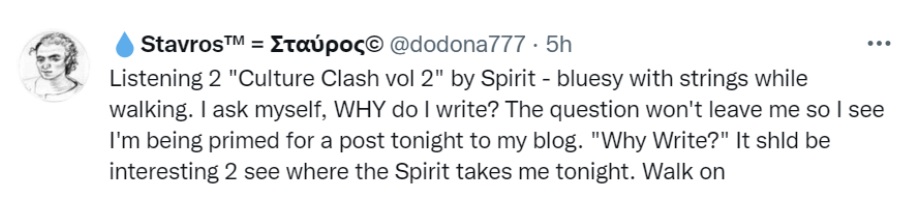
Today while on my daily walk a question crab crawled behind my eyes. I was looking at the scenery, taking photos of same, tweeting them and all the while there was this feeling – question “Why Write?” The question arose because I’ve been working on a book that I want to complete the first draft by the end of this year. In the background there’s another book I started and restarted many times that I also want to write after this one. A part of me says, just leave them, no one cares if they’re written or not. Why put yourself through all this anguish? Another part of me says, no you have to do it.
But why? Why write?
Do I write for fame? Well, that’s a joke, especially for someone my age. Even if I wasn’t old why would I want it? I love my invisibility. I don’t mind occasionally sticking my head out from the cave into the spotlight for a few seconds – a small spotlight, for a good purpose. To have that light on you every day, that would be torture. There’s a lot to be said about using a fake name. This is why I like Twitter. You can be kinda anonymous, say your stuff and just disappear.
Do I write as a side hustle? To make some extra dollars? That’s another joke when you consider that the average book sales in Australia is 813. This figure is the last time the Australian Bureau of Statistics collected comprehensive data on the publishing industry back in 2003 – 4. In 2015, 20,000 new ISBNs were created of which 390 books sold more than 10,000. Now a best seller, in Australia, is anything over 3000 copies. Hmm….and then you get 10% royalties on the net profit. So, if you have a best seller and sell, say 5000 & net profit of each book is say $15, you will get about $1.50 per book. You’re looking at about $7,500. Now, this is for a big best seller. If average sales is say 1000 you’d make about $1500. If you self publish the earnings are about 60% of net profit. I won’t bother going into details but suffice to say you won’t be making a living from it…unless you are lucky and have a super best seller.
It doesn’t look like I want to write to make money because it won’t make money. The other reason is that just making money doesn’t turn me on.
How about spreading a message, you know, changing the world? Telling people my politics and writing the ideas so that people take them on and hoping more people do it so that there’s a change in the world – for good. Yes, that appeals but it doesn’t require the discipline of writing a book to get those ideas out. I wrote an email Call to Action for the Flotillas of Hope to Nauru. Not a book, just an email. Did it change anything? Yes. John Howard’s conservative Government released 77 asylum seekers due to the Flotillas of Hope. Ideas do change the world and I can see that it’s a good reason to write. However, given that a best selling book in Australia is about 3,000 the chances of my book changing the world is pretty limited. I’d much rather write an email than a book if my purpose in writing it is to change the world.
What about leaving stories for my family and future generations to know who I was after I die? Yes, that’s a good reason to write. Out of all of the reasons so far, this one resonates. But it’s not enough. It doesn’t answer my question “Why Write?” It gives a partial answer but doesn’t explain this inner need to write that I feel.
What if I spent a few years writing my masterpiece and getting it published in the traditional way and no one buys it except family? Well, say my partner, my kids I don’t think would care. I won’t make money on it. I won’t get fame from it. I won’t change the world through it… and my family won’t really be interested.
If there’s a nano chance of achieving any of the above goals from writing, why write? Especially today with the web, print-on-demand and so so easy self-publishing. All of these self-published and traditionally published books flood the world with at least a million new titles every year. Let me say that again, a million new books, every year!
The question arises – is it a waste of time and effort to write a book if only your partner and maybe two others read it? According to publishing metrics if only 3 people buy it, the book is a gigantic failure. So, was it worth the effort to write it and then get it published, either traditionally or self published?
Well, something deep inside me is calling out YES! It’s this voice I hear when I write. It’s not logical, reasonable or even smart. It may even be idiotic but I’m subject to idiotic episodes, as my life demonstrates . What is this voice? Who does it belong to? It’s a voice I’ve listened to when I dropped out of uni, hit the road and traveled around Australia with hardly any money, fallen in love, left jobs, changed direction and sailed 8,000 kms with no prior experience in sailing. This voice can be dangerous to listen to but simultaneously can open a door to amazing adventures and emotional journeys. It is the voice of my heart. Heart? That muscle pumping blood? Maybe that’s where this voice resides, like my mind resides in the brain. Anyway, my heart informs me through feeling that I must do what must be done so that I feel OK. When I don’t listen I get depressed, I get a feeling that I’m dying inside. When I listen to its promptings I feel energised, alive and full of purpose. I have meaning in my life. Put a gag on the voice and I die.
So, why do I write? I write so that I answer the call of the heart. The heart may have other names – the Higher Self, the Muse, the inner god, the Wild One. Whatever name it has I have a need to express and this need is the heart calling me to do so.


 Posted by stavr0s