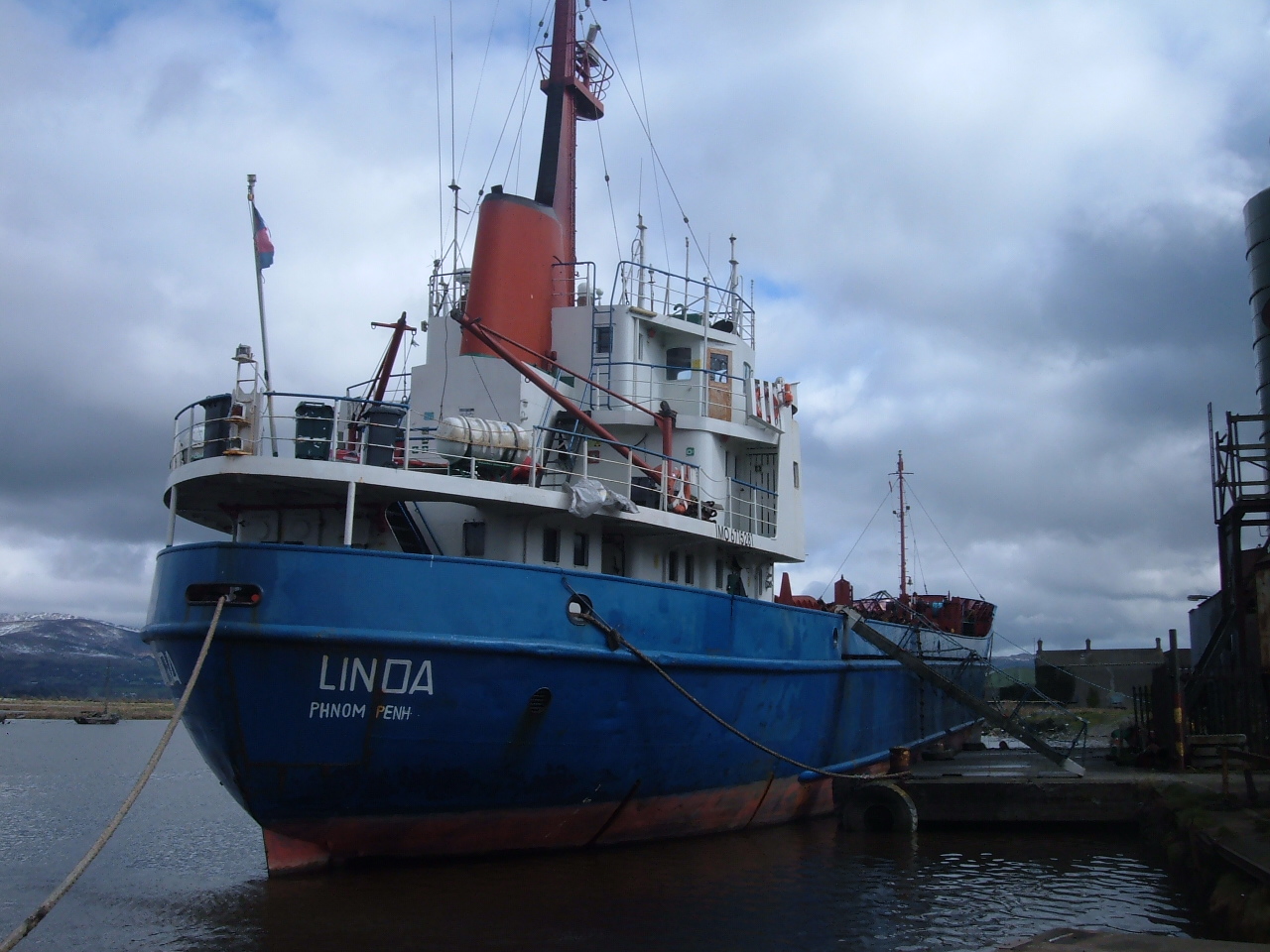
Lost in Damascus, Syria….

June 17, 2010

A month after leaving Mount Athos in Greece (May, 2000) I arrived in Damascus, Syria. I left my bag in the hotel and found my way to the Jordan Embassy. I needed a visa to get across the border to Jordan and I arrived five minutes late. The embassy officer was adamant I had to return the next day before 11.00AM. I was frustrated and irritated but I decided rather than give vent to my negativity I’d just walk in any direction to see what happened.

I walked streets with only Arabic signs and scripts.

My travel guide book gave the street names in English only. I walked by houses with concrete veneers and gardens on terraces, vines entwining telephone polls and wires across a lane making an arch of leaves, palm trees swaying in the dry breeze rooted in concrete pavements, lurid red and blue posters of the latest film shows on billboards and walls. I kept walking sensing the Syrian sun on my face and discovering I had no marker, no point of direction back to my hotel.

I was lost in the streets of Damascus.

There were flashes of deja vu, definite sensations and feelings I had been there before – a familiarity on the tip of the tongue. Maybe I was here in a previous life. I was lost in a place that felt like a long forgotten home. My stomach rumbled and I saw a restaurant with vats and tables outside on the street. I went in and found a seat at a table with four other men, one much older sat beside me. He began speaking to me in Arabic. When I replied, “Yunan, English” meaning Greek or English he spoke even louder so that others from tables nearby turned their heads towards us. I repeated, “La (no) Arabic – Yunan (Greek), English” pointing to my mouth. The old man had a short white beard that seemed to brighten when he shook his head. The others around our table stared at me.

I said, “I’m Australian – Australos – English or Greek – Yunan.”

A few tables away a man with a black moustache called out, “You from Australia?”

I said, “Yes”.

“Then why this?” He pointed to his face and drew a circle around it in the air and then pointed at me. Shrugging his shoulders he extended his arms in front of him.

He was saying in hand talk, “How come you look Syrian but claim to be Australian?”

I said, cradling an imaginary baby in my arms, “Baba, Yunanistan,” then I made my fingers walk in the air saying, “Australia.” I went to Australia as a baby from Greece. The others in the restaurant, even the owner were watching this exchange. They smiled and the man who asked the questions said, “Hey, I come and be with you.”

He was in his late thirties, slim with a certain earnestness about him as he walked towards my table. He squeezed between the two men sitting opposite me. By now his presence had made my table invisible again.

He said, “You from Australia? I know a little English.” I told him about my trip from Greece via Turkey, to Egypt and that I’d be leaving very soon for Jordan.

He asked,

“Where are you going now?”

“The old souq (market). I have lost my way and stopped to eat here.”

“Ah, good. I’m going to a library and the souq is on the way. I will show you where to go.”

There was a certain radiance about him, as if there was a tiny grain of the sun burning in his chest. He nodded, “I understand much better in English than I speak.” Something in the way he said “understand” touched me.

For no apparent reason I said, “One of my wishes while travelling through your land is to meet someone who is wise in the way of the Sufi,” I paused and in the silence I added, “I visited Rumi’s tomb in Konya, Turkey, how I dearly wish to visit Ibn Arabi’s tomb in Syria.”

“You know Ibn Arabi?” he asked surprised, “you know of our saints?”

“Yes, only a very little. I have read about Ibn Arabi in English. What little I know of him has touched my heart. I wish to pay him my respects.”

He said, “Come, let’s go. I want to take you to a special place, a surprise place for you.”

There was this instant trust between us. As we walked under a concrete bridge near a busy intersection he said, “You’re not a tourist just going click, click, click with a camera. You know something of my culture. Islam?”

The way he said “Islam” prompted me to reply, “I’m a Christian and I believe that all religions speak of one truth but in different tongues and styles. I’m searching for truth and anywhere I can find it I value it.”

“I will take you to Ibn Arabi’s tomb.”

“What here in Damascus?”

“Yes, just around the corner. You must not speak. Just copy everything I do. You look Syrian, only your tongue gives you away.”

I wondered why I had to pretend to be Syrian and not speak when we arrived at the saint’s tomb. I figured that it was a very small price to pay – to be silent. We passed some men sitting on wooden boxes playing backgammon on a small table. One of the players smiled at me revealing a toothless mouth. The streets of Damascus are mostly narrow and crooked. Saint Paul lived on Straight Street near where we were. We turned a corner going down a narrow lane and finally arrived at a small door in a stone wall of a mosque. As we entered we  climbed down some narrow stairs that lead to a silver cage enclosing a small tomb. It looked like a big beautiful bird cage on the floor.

Others already there were prostrating on their knees and lifting their torsos up while silently moving their lips to prayer. My friend indicated that I stay beside him and as he went down on his knees I copied his movements. I bowed and touched the floor near Ibn Arabi’s body. I was amazed that I was there in front of his tomb, a tomb that has been there for hundreds of years.

Muhyiddin Ibn Arabi (1165 – 1240) was at the centre of an extraordinary flourishing and cross fertilization of Jewish, Christian and Islamic thought in the Moorish culture of Andalusian Spain. He was a Spanish mystic who had a huge and subtle influence on both East and West. In his early childhood he was recognized and taught by two women saints, Yasmin of Marchena and Fatima of Cordoba. Dante’s “Divine Comedy” was influenced by Ibn Arabi’s work.

As I looked through the cage, the more I saw, the less I knew. Who am I? Why am I here? I smelt a delicate fragrance in the swirls of prayer around me. After about a quarter of an hour we arose and left. While climbing the stairs I took one final look at the small tomb of a great man. I felt my own smallness and my own limitations as a “man”. Somehow, even though his body had lay there for so long I felt something emanating from the space that contained Ibn Arabi’s remains. I wondered whether it was his own emanations that remained there or if the people who came to offer their respects and prayers left “soul stuff” that gradually accreted over the years so that one could feel a palpable presence in this small space. Maybe it was both and was it the same in other sacred places?

Mahmoud told me that it was Ibn Arabi’s special mission to scatter Sufi seeds onto diverse contemporary fields of learning accepted by the people so that they would come to recognise the One Love behind everything.

“Now, let us go to the special place I promised I will show you,” Mahmoud said with a grin.

“I thought Ibn Arabi’s tomb was the special place.”

“Yes, it is special and this other place is special in a different way. I won’t go to the library today, it can wait. I will spend time with you.”

I was curious as to what special place he had in mind. As we walked we mentioned various authors and books to each other and we were amazed that we recognised each other’s references. The theme was the search for truth and the miraculous. I was excited by the prospect of meeting a Damascus local who may have contact with people who understood the inner essence of Islam and who could sense or know the same essence in Christianity.

After a while he said, “You know that Christians, Moslems and Jews are cousins? Abraham was our common ancestor, our common source.”

We were at the large courtyard of the Omayyad Mosque. Mahmoud said,”It is interesting that this mosque was built on land that was sacred before Mohammed. It was used as a place of worship 3,000 years ago by the ancient Syrians. Then it was a pagan temple for Jupiter during the Roman era. Then it was… no, wait for the surprise.”

Omayyad Mosque, Damascus, Syria

We walked on beautiful geometric patterned tiles. These patterns were repeated on some of the façade and walls. The doors also had hand carved patterns that looked like they were lifted from crystal reflections. I felt as if I walked into a world of lattices, a net of lines, a web of relationships numerical in kind and geometric in shape. I took my shoes off and entered the main door. Inside was a cavernous space, Mahmoud pointed out a section of the wall with mosaic panels made of coloured and gilded glass. He told me that all the walls were decorated like this centuries ago. The prayer hall had a small domed shrine near where we stood.

Lost in Damascus Umayyad Mosque geometric

Omayyed Mosque

Approaching the shrine, Mahmoud said, “This is the surprise. The shrine contains St John the Baptist’s head and maybe his body!” Surrounding the shrine were Moslem people bowing and praying. I asked, ”Why the prayers for St John the Baptist? Why is his tomb here in a mosque?” Mahmoud delighted, said, ”Yes, I knew it would surprise you. This place of worship many centuries ago had divine services for both Christians and Moslems. The Christians worshipped in one half of the space and Moslems worshipped in the other half. Together Christians and Moslems worshipped under this same roof.”

I paid my respects to St John the Baptist, this time crossing myself the Greek Orthodox way. No one took exception to me for doing so and as we left I felt a real connection between our two faiths. Mahmoud explained to me that Jesus was a prophet and Mary his mother was revered in Islam. He told me that St John the Baptist was revered by Moslems as a saint. Mahmoud was right, this place was a special place and that it would surprise me. He invited me to his home which meant that we had to catch one of the many small service taxis (mini buses) that were everywhere on Damascus roads. Road rules didn’t seem to count here as our bus swerved in and out of lanes with no indication and turned corners without slowing down. While our bodies moved this way and that in concert with the bus I was curious as to how Mahmoud would take my experience at Rumi’s tomb in Konya, Turkey.

I said, “While I was visiting Rumi’s tomb I felt that I could only pay my respects as an Orthodox Christian but could only do this in a hidden way. I couldn’t externally pray like the Moslems around because I’m not Moslem and at the same time I couldn’t pray as a Christian outwardly because I did not want to offend those around me. So I held my hands together in front of me and inwardly I imagined my right hand making the shape of a cross. In my faith, the thumb stands for the Father, the index for the Son and the next finger, the Holy Spirit – the Holy Trinity. My ring finger curled into my palm signifies the divine nature of Christ and the little finger is the human nature.” I showed him the tripod of fingertips and my curling fingers. I continued, “So, in a manner of speaking my hand reflects the whole of my faith. I move my right hand with the thumb and my first two fingers joined together. Firstly to my forehead, then to my belly, then to the right of my heart and then to the left of my heart – three times. I did this inwardly while silently chanting a prayer. Outwardly I was standing with my head bowed and hands together but inwardly I was actively praying in the Christian way. Tell me Mahmoud, did I do the right thing for Rumi?”

We jolted forward as the bus swerved around another corner. Mahmoud said, “My friend it is obvious to me that your intentions were pure. You were in pure heart and so whatever you do in such a state is pure. You can do what you will and it would not be wrong because of your state of mind and heart. So, you did the right thing.” He stopped and looked at me eye ball to eye ball.

“By the way,” he said,”did you know that Sufis, the People of the Path are also called esoteric Christians?”

“No,” I said, “What of our cousins the Jews?”

“Rabbi Jesus is also revered by Jews in touch with the hidden stream.” He smiled and gently touched my hand, “You and I are seekers of truth and as such we are not caught in the literal meanings of scripture and sacred texts. It is these literal, fundamental meanings, dogmas that create misunderstanding between our religions and ways of being in the world.”

I couldn’t agree more but this didn’t mean that individual and unique differences that make up a particular set of beliefs were obliterated. No, it seems to me that seeking the essential truth behind the formal, literal truths was a way of freeing one self from narrow mindedness and the razor wire of fundamentalism. And I don’t just mean religious. To name a few – scientific, economic, political, psychological, philosophical, artistic ….in fact, name an activity and it can be done and thought of in a fundamentalist way.

Mahmoud lived in one of the many concrete and cement apartments in down town Damascus, right under the arc traced by missiles from Israel. He was very lucky he told me because he had a ground floor apartment with some earth for plants. A wooden door from the street set in a large wall was the entrance to his home.

He introduced me to his wife and two daughters, his father and mother and his brother as “Stavros from Australia”. His wife Jamil brought some tea in glass tumblers and sat next to me. She said, “Pleased to meet you and welcome. I want to show you a book. I am learning English.” I was touched by the effort she put in saying this to me in English.

We were sitting around a wooden table in the enclosed area behind the wall facing the street. Mahmoud pointed to a fountain and pool, the size of a bathtub on our right . He said,”I and my brother made this fountain.” It was made of cement with inlaid patterns of shells, coral and pebbles. The shape was more like a cumulus cloud than rigid lines of concrete blocks. The water spouted from a bowl in the centre while the spirals, circles, squares and triangles of the fountain’s container looked on with mosaic eyes. I walked over to it and admired the detail of their work.

Meanwhile Mahmoud’s father, mother and brother brought cucumbers, tomatoes, shallots, radishes, cheese, bread and boiled eggs to the table. Soon after, falafals, humous, fried eggplant, cinnamon beans and dips were added to the table. Everybody sat around the table with the young girls at one corner each. We each had a plate on which we placed what we wanted from the dishes before us. Everybody was interested in this stranger from the other side of the planet – Australia. In my shoulder bag I carried postcards of Australia to give to new friends. I pulled some out and passed them around – pictures of kangaroos, koalas, Sydney Opera House, Uluru and Sydney Harbour Bridge. Everybody recognised the kangaroos.

Jamil brought over a book on the English language. She was studying English on her own using this book and some tapes. Her husband Mahmoud helped when he could but he was not fluent in English either. She said,” Please, may I read and you tell me if sounds true? Please?” She read some dialogue between two people. One was asking for directions and the other answered. The only thing missing in her delivery was confidence.

As I sat there with this Syrian family I thought about philoxenia, “Friend of the Stranger” the Greek word for “hospitality” which in the original denotes something sacred and more open than “hospitality”. It is mentioned in Homer’s “The Odyssey” where Odysseus experienced philoxenia often in his travels. My new friends expressed philoxenia in such a way that it brought tears to my eyes. I was a stranger in their midst and they offered me friendship, food and comfort. A bond grew between us that had its strength in our common humanity and the fact that everyone is a stranger away from home. Mahmoud and his brother asked me what hotel I was staying at and then phoned for a taxi to take me there.

While waiting for the taxi Mahmoud said, “I want you to have this.” In his hand were some worry beads. I showed him the worry beads my uncle gave me in Greece. The Greek ones I had were more solid and heavier with round beads. Mahmoud’s were smaller and the beads were like long brown rice grains. We compared them.

He smiled, “Well you now have Syrian worries to keep your Greek ones company!”

Mahmoud and his brother rode with me to my hotel in the taxi. They would not allow me to pay for the fare. They just wanted to make sure that I was taken to the right place.

In Damascus, Syria, I found true philoxenia not xenophobia. Now I had a paper boat from the Holy Mountain and a set of worry beads from the Middle East to take with me back to Australia. When I returned to Australia I put these in a special bag where I kept other important things like hand made amulets, pellets of rose incense, a smooth stone from Dodona, crystals, a small wooden cross from Jerusalem, a tiny rock from Mt Sinai, a stone from an Aboriginal Elder in Australia and some holy oil from a small monastery of nuns near the birthplace of my father in Greece.

The bag, made of an old Turkish rug remnant was wrapped in a Palestinian keffiyeh from Bethlehem, along with the Chinese “Book of Changes” – the I Ching and Tarot cards. These four items were my psychic technology backup; just knowing they were there helped me on my journey to Nauru four years later. When we returned from Nauru the last item to be put into my special bag was the frayed remainder of the Southern Cross flag that flew on Eureka, the boat I sailed on. It was placed on top of the other things soon after we left South Bellona Reef on our way to Nauru.
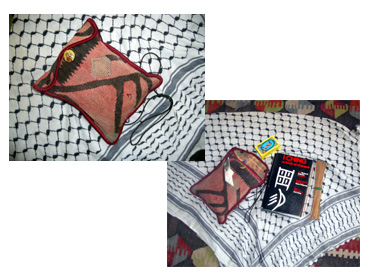
My Spiritual Kit Bag with psychic technological backups, to be used in case of emergency sailing to Nauru!

A  few days later I visited Palmyra, about 100 miles east of Damascus, near the border of Iraq. Palmyra has the best preserved Roman ruins in the world. The stone buildings all have a rose tint and you feel like you are entering a Roman city with rose tinted sunglasses on.

Here’s a picture or two of what I saw. Another time, another story.
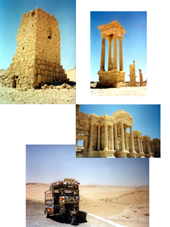
Palmyra, Syria. That little taxi takes you everywhere.


Free Gaza Movement >> Why We Care

June 2, 2010

Why we Care

Written by Free Gaza Movement    

From the Free Gaza Movement Website

April 2009

“This is not a natural disaster. It is a man-made disaster created by policies that are not humane.”
John Ging, director of the U.N. Relief and Works

Agency in Gaza.

The Gaza Strip is one of the most densely populated places on Earth. A 25-mile-long narrow coastal plain wedged between Israel and Egypt, Gaza is home to 1.5 million Palestinians, over half of them children. Most of its population are refugees or their descendants, driven out of Israel during its founding in 1948. Surrounded by 40-foot high walls of iron and steel, Gaza has only 3 points of entry or exit: the Erez border crossing with Israel, the Rafah crossing with Egypt, and the sea.

Israel has occupied Gaza since 1967, maintaining complete control over Gaza’s air space and territorial waters, imports and exports, and travel into or out of the territory. Since January 2006, Israel has subjected the Gaza Strip to an increasingly severe blockade, restricting Gaza’s ability to import fuel, spare parts, and other necessary materials. Compared to December 2005, less than 20 percent of the supplies needed for normal trade are allowed into Gaza by Israel, and foreign investment has fallen off by over 95 percent. As a result, the economy has completely collapsed. Most of Gaza’s industrial plants have been forced to close, casing steep increases in unemployment, poverty and childhood malnutrition rates.

 The siege has led to massive shortages that have rippled through the economy and society. Shortages in fuel have caused gasoline prices to spiral out of control, leading to sustained power cuts. Hospitals, dependent on diesel-powered generators, regularly lose power for several hours a day. Unable to operate irrigation pumps, farmers experience significant loss of crops. Most family homes have running water for less than six hours a day, and almost a third of homes have no running water at all.

Sewage treatment centers no longer function properly. Millions of liters of raw sewage have been pumped into heavilypopulated neighborhoods, and tens-of-billions of liters of untreated and only partially treated sewagehave been released into the Mediterranean. Gaza’s fishermen state that the sewage has killed off most of the sea life in the immediate vicinity.

In December 2008, Israel broke a ceasefire with Gaza and began a three week campaign of bombings, home invasions, and general destruction. During this massacre, homes, schools, mosques, and UN centers were all attacked by Israel. Thirteen Israelis, including 4 Israeli civilians, lost their lives, while over 1,300 Palestinian men, women, and childrenwere slaughtered. Since the end of the massacre it has become harder than ever to bring in humanitarianrelief, reconstruction aid, or developmental supplies.

The siege continues, and the humanitarian condition of the one and a half million human beings illegally incarcerated in Gaza is now at its worst point in the last forty years of Israeli occupation.

Help the Freedom Flotilla

Chilling Testimony from a Marmara passenger


Submissions for current Refugee Issues UNHCR >> Dadaab Refugee Camp

May 27, 2010

Hi

I received this today. Those who can please send in a submission for the Dadaab refugees.

Below the reminder is the document and submission form.

stavros

============================================================

A reminder that the Australian Refugee Rights Alliance (ARRA) is calling for brief submissions from individuals and refugee community groups regarding current issues of concern to refugee populations in and from the Asia Pacific, Middle East and Africa regions.

The due date for submissions is 31 May. Please see the attached information sheet for further details on making a submission. Feel free to distribute this information to your networks. If you have any queries, please feel free to contact me as per the details below.

We look forward to receiving your submissions!

Kind regards, Lucy Morgan Information & Membership Officer Refugee Council of Australia

Suite 4A6, 410 Elizabeth Street Surry Hills NSW 2010 Phone: 61 2 9211 9333 Fax: 61 2 9211 9288 email: info@refugeecouncil.org.au

www.refugeecouncil.org.au

====================================================

INVITATION FOR SUBMISSIONS

TO THE UNHCR- NGO CONSULTATIONS

The Australian Refugee Rights Alliance (ARRA) is calling for brief submissions from individuals and refugee community groups regarding current issues of concern to refugee populations in and from the Asia Pacific, Middle East and Africa regions.

ARRA is a coalition of Australian NGOs, refugee advocates and academics. Organisations involved in ARRA include the Centre for Refugee Research of University of NSW, Refugee Council of Australia, Amnesty International and Act for Peace (National Council of Churches).  Each year, representatives from ARRA travel to Geneva to participate in the United Nations High Commissioner for Refugees’ NGO consultations.

Prior to the UNHCR meetings, the group prepares a comprehensive set of documents addressing policy issues of shared concern. This process enables more effective advocacy at the meetings by ensuring coordinated and targeted action by the Australian delegation. In 2010, the meetings will occur in late June.

Individuals and refugee community groups are invited to make submissions on issues they would like to recommend that ARRA put forward during the meetings with UNHCR.

ARRA is particularly interested in current issues of concern to refugee populations in the Asia Pacific, Middle East and Africa regions, however issues of concern to refugee populations in other regions of the world are also invited.

 Some possible themes you may choose to use include:

  • Women at Risk
  • Protracted Refugee Situations
  • Xenophobia/Racism 
  • Families at Risk
  • Urban Refugee Policy

 How Can I Contribute to the UNHCR NGO Consultations?

You can submit a brief submission to us, focusing on any current issue, but it should be limited to one page in length.  We will then read your submission contact you for more information if required and do our best to include your issues in our papers for discussion at the UNHCR in late June. 

 Please return submission application form with your submission to Lucy Morgan at the Refugee Council of Australia (RCOA).

 All submissions must be received by 31 May.

Submissions must be received by 31 MayVia post or email:  
ATT: Lucy MorganRefugee Council of Australia (RCOA)  
Suite 4A6, 410 Elizabeth Street,Surry Hills NSW 2010

Tel: 02 9211 9333

Fax: 02 9211 9288

 
Email: info@refugeecouncil.org.au  


Submission Form        


Name:  
Organisation (if applicable):  


Contact Information:


Address:  
Email:  
Contact Phone Number:  
Country of Origin:  


Topic of Submission:


Regional Focus (Asia, Africa, Middle East, other)  
Country Focus:  


Issues Covered in Submission:
1.2

3.

4.

Recommendations to UNHCR  
1.2.

3


* * Please Attach your 1-page Submission


21st Century – Baptism in Electromagnetic Mist?

May 22, 2010


If anything the twentieth century will be remembered as the century that matter disappeared according to our high priests of Science. Twentieth Century physics has dematerialised matter before our eyes and under our touch. Further it has given a pattern of nothing as the source of the dematerialised matter. When I write “nothing” I’m referring to “no thing”. While we prang our dematerialised cars and battle over dematerialised resources nature continues to create and make life with her templates. These templates aren’t material, unless you consider subatomic vibrations matter. These templates are more like magnetic resonances – wavicles, perhaps, that influence and direct the exteriorization of the tree, the flower and the emu. These morphic resonances, as Rupert Sheldrake calls them, operate in the region of no matter, inside nothing.

As we witness the shift from a material world to the immaterial world we are also experiencing a fracturing of the idea of specific location in space – telecommunications in all its diversity is bringing the globe to one’s home. Video conferencing in virtual rooms with participants from all over the world are a reality now. The next step is to produce a lifesize holographic moving image – holographic TV – with global video conferencing capabilities. Chat Rooms on the internet screen will change to Chat Rooms in your living room with cyber holographic avators for company. The idea that you can’t be in two places at once will be even more untrue.

So, we have one trend that is dematerialising and another that compresses distance.

We also have the trend that the above two is potentially true only for a small proportion of humanity and practically true only for a smaller proportion of this group. This double small proportion of humanity who has access to this knowledge and technology also uses up most of the planet’s resources while the greater majority of humanity is undernourished and living in poverty. In this case we have the trend of concentration of power in the hands of the few and the dematerialisation – the dying of the many.

This is true from a global view.

The global nervous system (that is in one of its foetal stages) of telecommunications has connected all continents and every square inch of the earth’s surface has been traced by geostationary satellites. Google is photographing every street and house being used as locations on their Global Map. GPS enabled mobile phones and in car mapping shows that we are now immersed in an electromagnetic mist of data.

If earth is denser than water, and water is denser than air, and air is more dense than heat, then it is easy to see that heat and air are more dense than the electrographic data that is now sparking through the global nervous electrographic system.

We walk on earth, we drink water, breathe air, need the heat of the Sun – what is the experience of electrographic data ( telephone, TV, internet, GPS, satellite communications etc) ? We don’t eat it, drink it or breathe it and yet it is an element of our experience and it is permeating our being more everyday. What are the implications of our immersion in this “matter”.

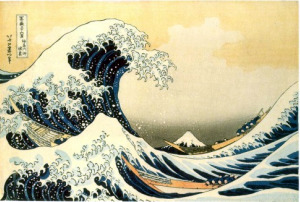
Hokusai

There is baptism by water and by fire. What is this baptism in electronic – data mist?

stavros


Turning Inwards

April 27, 2010


This is a transcript of a talk I gave in Darlinghurst, Sydney quite a few years ago. It is my understanding of the need for Self Observation and Self Remembering which can only truly begin when we turn inwards.  Everything written below is based on my understanding of the Gurdjieff Work. I gave the talk as part of the Sydney Group.

Stavros

=============================================================================

 We always imagine ourselves to be much higher than we actually are. We take it for granted that we are individuals, that we have consciousness and that we can ‘DO’. But there are moments in our life when events and situations might shock us into recognition that we do not know where we are going and that our own efforts to control and direct our lives have been in vain. In these moments we feel an emptiness, a void which cannot be filled by social position, friends or wealth.

It is in moments like these that we are given an opportunity to re-evaluate our so called individuality, consciousness and will, in other words, to re-evaluate the image we have of ourselves. If we are sincere in these moments we recognise that the image we have of ourselves is not us at all but rather a mask which we very rarely see through. Life through our sincerity has brought us to the question of ourselves. If we are not individuals with the power to be conscious of our actions and thus direct our lives, then who and what are we? Who am I? What is my place in the scheme of existence? In the face of such questions, we realise that we have a need to know ourselves for ourselves and through ourselves.

 If I wish to know myself and through this knowledge to know the real world, how do I begin? How do I make the right effort to turn inwards to myself and what is the right effort? It is at this point of our own search that we recognise the necessity to study the methods of self-study, which lead to understanding and eventually knowledge of ourselves. Whether alone or with others we have found ourselves in unfamiliar territory. In this region of the unknown we may hope that the forces active on this level will send us the help we need.

To have any chance of reaching our goal of self-knowledge without losing ourselves we need a guide. Here, as elsewhere, we must learn from those who know and accept to be guided by those who have already trodden the same path.

The guide cannot walk our journey for us, the guide cannot turn my attention inwards to myself. All that the guide may do is to point out the pitfalls and obstacles which lie along our path and whether we understand the methods of self-study. On this path understanding is our only currency and our only means by which we may pay for the help we need. The understanding spoken of here is completely different to the intellectual knowledge which our modern science has accustomed us to. It is for this reason that real self-knowledge requires a school. It cannot be found in books, which can give only theoretical data, mere information, leaving the whole of the real work still to be done – to turn inwards towards our own inner experience and transform information into understanding through consciously living what we are.

 If the turning we are speaking of is not only of the mind, but the whole of us, and if we realise that we are not the image we have of ourselves then what can the words ‘the whole of us’ mean? Here we come across our own doubts, confusion and resistance. The words come easy but the turning required is not as easy as hearing and saying the words. We listen, we speak, but over and over again we are taken by the disorder of outer activity and find ourselves falling prey to doubts, fantasies and sterile words. This is the beginning. It is this awareness which will provide the experience of a real wish to resolve this inner confusion.

When we try to observe ourselves we see that we have to remain attentive both to ourselves and to a particular aspect of ourselves. We realise that this turning is not given to us spontaneously and that the attempt to turn with the whole of ourselves is dependent up the participation of three factors or forces. These are ‘I’ who observe face to face with what ‘I’ observe within myself and the third factor which connects the two – our attention.

Taking these three factors into consideration we will speak firstly about attention. Our usual state of attention is one in which we lose our identity in some activity – be it reading a book, talking to a friend, listening to music, hammering a nail, or just simply daydreaming. This is known as identification. Identification has different ways of manifesting within ourselves depending upon the activity. One of these ways is when we drift from object to object, from sight to sound to thought to a sensation with no apparent aim, no apparent direction: it is automatic. Or, our attention is attracted by something which exercises a strong hold – an argument, a beautiful face, a memory of some place or person. In this way we are drawn by our interest and the situation takes over ourselves. Another way in which our attention is spent is when we direct it by a simple effort for a certain time intentionally – making something, studying, playing a musical instrument, cooking, sewing. The common element we find in each of these ways of paying attention is that we are aware only of one thing at a time. This is our ordinary state. We can be aware either of the person we are talking to, or of our own words, of a pain in my body, of a scene, or of my thoughts about the scene. But, except on very rare occasions, we are not aware simultaneously of our own words and the person we are addressing, of my own pain and someone else’s, of a scene and my thoughts about it, of my situation and my feelings of it. The attention which is needed to turn inwards so that a self study may begin is such a divided attention.

 Divided attention is from another level within ourselves. It is the attention which at the same time of observation takes into account everything we are. This two way attention requires an attitude very different from our usual one. When we first make the effort to turn inwards our attention goes one way, then another, sometimes towards what I observe in myself, alternating at a faster or slower speed. This happens as easily in one direction as another. Though this attention is not given to us naturally, the attempt to observe oneself generates the energy for divided attention artificially. This very attempt is an exercise which develops the needed attention and makes it possible so that it can grow to the point where self-study may begin. In the beginning there is no stable support on which our attention can be based. Real self-observation appears to us to depend as much on this support as on the attention itself. From this we understand that the three forces that must be present are closely interdependent.

The second factor is “who” observes. We said earlier that self-observation requires “the whole of ourselves” and not just our analytical mind and we realise that with our usual attention and attitude we become identified with the situation at hand. When we are identified we are not present to the situation. We become totally attached and there is no space for the sense of myself. With our normal attention there is no ‘I’ which is the stable support to observe particular aspects of my life. For real self-observation to be possible ‘I’ must be present while the observation is going on. The sense of ‘all of me’ is the ‘I’ which is able to take into account in the field of attention directed toward myself a greater number of elements. The ‘I’ who observes has a field of vision analogous to that seen through a fish eye lens which has a more global perspective when compared to the normal natural view.

When ‘I’ is not present (which is our normal state) we forget ourselves almost uninterruptedly. In us things do themselves – speaking, laughing, feeling, acting – but they do it automatically and we ourselves are not there to witness. One part of ourselves laughs, another speaks, another acts.

There is no feeling that: I speak, I laugh, I act, I observe. Nothing that is done in this way can be integrated into a whole. Life lives itself through us and we are not there to partake of it. From this we understand that what we truly seek is more abundant life.

If our usual state is one of forgetting ourselves then the need to have a stable presence of ‘I’ may be fulfilled by trying to remember ourselves.

 This stable presence is not given to us by merely knowing about it. It can be acquired after long work on ourselves but even now we can have a relative degree of presence, a certain coherence of all that we can collect in ourselves.

Self-remembering is the attempt to have global awareness of oneself. It is the state where I am conscious that I am here in these surroundings and feel a connection with the surroundings around me in the overall presence of something higher. This sense of something higher is connected with the valuation of our own essential question. It may be our own aim in the light of our search, it may be the Sun from which all life on this planet has its on-gen, it may be our own meaning of God, or our own teacher. What is important in this effort to remember oneself is that it must be attempted by the sense of “the whole of ourselves and not just thought about. It is only when we try to make this effort that real self-observation can begin. When we try it we discover that without it we are constantly changing, constantly taken by events both within and without. We discover that all that we have gathered within ourselves is dispersed at the slightest distraction. We also find that in practice nothing is more difficult for us than to be there with enough stability for an observation.

The third factor which is needed to turn inwards is the object of our ob¬servation – the elements of ourselves, what we are. These elements constantly change and escape us altogether.Though the elements are in constant change the field in which these elements move is always there. When we notice other people we see their external behaviour which we all perform as a response to the demands of life. This external behaviour is directed by the functional structures comprising the field towards which our attention is directed. These functional structures are the same in all circumstances and are the result of what we are and what life has made of them. We see through our eyes and hear through our ears, we don’t see through our ears or hear through our eyes. The seeing and hearing are the functional structures of our eyes and ears respectively. Likewise, within ourselves certain behaviours, such as thinking, emotionalising and moving, are possible due to the functional structures which allow them to happen. However, the way things take place in us, the interaction of our functions and the manner in which they associate to produce our personalities and responses, all this goes on in the dark with out our knowing it. So, to observe the elements of ourselves we must do something special to make them visible.

When we strike a match against the chemically treated part of a matchbox the friction between the two creates a spark which becomes a flame, and we have light. For us to see the elements of ourselves we must likewise have friction between the ‘I’ who observes and the field which contains the elements.This inner friction is the struggle against the automatic aspects of ourselves: those moment by moment personages which are always there. The struggle is against the habits which give us the false image of ourselves.

 This struggle arouses the light of double attention which we need and forces us to confront those habits which keep us asleep, automated and engulfed in constant self-forgetfulness.

Self-forgetfulness, sleep, is our lot without struggle with our automatic selves. Mechanicalness and dreams replace our true birthright of freedom and reality. What am I saying?

I will illustrate with an example. I find myself waiting for a bus to take me to the bank. After buying the bus ticket my hands begin fidgeting. Soon my fingers begin to fold the ticket over, and over again, until it is a tiny cube like they have done hundreds of times before in the same manner. My head and left arm, in perfect synchronisation, move to the exact spot where my eyes can see the time on my watch. There is no real need to know the time since a moment earlier this same action was performed. My head is full of associations which whirl by in a random manner – a half-eaten memory of words exchanged over the breakfast table, an image of a television commercial, a song picked up from, I don’t know where, provides the background muzak. The bus arrives. Find my self at the middle of the bus bumping a man who grunts at me. Anger rises – there is no rebuke in words but my posture and face express it all the same. Sitting down, the realisation dawns that the bus ticket is no longer in my hand. My hands search my pockets, my eyes search the floor directly beneath my feet, my body is in all sorts of positions looking for the bus ticket. Simultaneously, the thoughts and emotions race through to the tune of “What will I say if the ticket inspector boards this bus?” No ticket. Soon memories float by and that time on the beach in North Queensland returns. While daydreaming I miss my stop because I find myself two blocks further than the bank which was my original destination. The button is pressed and the bus stops.

The above is what is meant by mechanicalness and sleep. This is how we are living most of our lives, and this state of consciousness which we call ‘normal’, is what we have sold our birthright for. Where is the man here? Where is the ‘I’ which if present and active would make my life real? Below is a description of what struggle with oneself may be.

I find myself on the street. I begin walking back towards the bank, I remember what happened on the bus. From somewhere within me the feeling ari¬ses that there is something wrong with myself. I, who can create grandiose plans for my future life, even to the place beyond the grave, can’t even re¬member to get off the bus in time. The words of Gurdjieff cut through my as¬sociations, ‘Life is Real Only Then When I Am.’ It is remembered with my mind that it is possible to turn inwards so that I may live and be present to my life. I see that I am not present but I know that I can be present. What I am can be remembered by who I am. The matchbox can be struck by the match. Oh! But it is so pleasant, so easy, to remain within my automatic nature, fully asleep to myself and the world. The effort required to struggle with myself is something more than the effort to earn my physical livelihood. Besides, it is an effort not required for my physical survival so why should I bother. Let me sleep on. And yet, if there is no effort, no struggle, to be . I am dead and only an automaton of flesh, bones and memory exists. I wish to live. I – the all of me – wish to be. The emptiness of what I am is passive – it is easily comforted with illusions and imagination that already I am and that I can do.

I long for life but where this longing stems from I don’t know and what this ‘life’ is which is longed for, I don’t know. This longing, this yearning for something which is unknown draws a part of my attention away from the surface associations and for a moment the heat of the sun is sensed on my face and hands. I have a body which is real, concrete and here and now. My body is the anchor of my longing. It is possible to turn inwards. The walking continues back to the bank. The longing for life is now expressed by a wish to see through my own eyes, to sense with my own skin, to hear through my own ears, to feel the ground beneath my own feet. I wish to move with my own whole body.

 It is remembered that the easiest functional structure to attempt to study is the moving part of myself. I wish to be, I wish to struggle with myself, I wish to slow down my walking pace so that the walking part of myself can be seen. My hand reaches for my coat pocket searching for a cigarette. That part of myself which longs for life gives the strength to say no to my hand but I promise a cigarette later if it allows presence to fill it. My mind is once again occupied with associations which pass through it automatically. I struggle to place in my mind a conscious image of myself being fully present at the entrance of the bank. My walking becomes faster. To be present at the entrance of the bank my walking pace must slow down again. Intimations of the shoe around my foot, sensation of heel touching ground, then the front part of shoe, slight pressure of my trousers around my knee as it bends, the sensation of my collar around my neck comes and goes, a breeze returns my face to myself via sensation. My pace is slower. Emotion arises – it is connected with what happened on the bus – anger with myself. My mind reminds me a little later that the only way to struggle with emotions at first is not to express negative ones. Associations arise with this thought, my mind continues in its deviation from the conscious image of myself being present at the bank’s entrance but the awareness of my walking and the growing sensation of my body keeps some attention on the elements of what I am.

 My body reminds me of the Sun for its heat is once again sensed on my hands and face. The longing, the wish to be, now evokes a decision to try with the whole of myself, with the awareness of my walking, with the denial of the cigarette, with the struggle against self-pity and anger, with the effort to control my thoughts, I now try with the whole of myself to place and feel myself and the immediate surroundings of the street under the Sun. For a split second time slows down and something which connects me and the external world opens and within the traffic noise, within the milk bar sandwich sign, within the garbage bin beside me, within the shop windows displaying goods and the people around me, within my footsteps and the body that senses the clothes on it, within the associations running through the mind, within it all the sense of another realm, a realm which seems to give Life to life enters and the question “Who am I?” echoes back to myself. This sense leaves me with the memory of an otherness and I find myself at the entrance of the bank understanding that I know nothing when it comes to the Real World.

With this effort of struggling with our habitual nature we must remember that the original aim for making the effort is so that the elements of what we are become visible. This is of fundamental importance because at this point lies one of the biggest obstacles on the path of return to ourselves. For something to become visible means that it becomes seen and nothing more. So with turning inwards all that is required at the beginning is that we see ourselves and simply record what we see and nothing more. Within the more lies the obstacle and this more is manifested within us when we try to analyse what we see. This analysis is the deviation of our attention from the whole of ourselves towards the relatively small part of ourselves we call the mind. Once we begin to analyse what we see we cease to observe and begin to imagine that we are observing.

We must also be careful that in hearing about the process of turning inwards and the methods of self-study that we do not fall into the trap of the rational, logical mind and reduce the real meaning of the words self-study, self-observation and self-remembering to mere psychologising. These words are signs on the path back to ourselves and since we do not know who we are, have meaning which goes beyond what contemporary psychology may imbue them with. It is for this reason that Vaysse in his Towards Awakening calls self-observation the secret ally. In a similar vein Don Juan tells Carlos Castaneda that the warrior who follows the path of the heart has an ally which is a power a man could bring into his life to help him and give him the strength necessary to perform certain actions. This ally, Don Juan says will make a man see and understand things about which no human being could possibly enlighten him.

At the beginning of this talk we saw that life through certain circumstances brought about a shock which forced us into recognising the futility of living from a false image of ourselves. We have seen that by making certain efforts we may turn inwards consciously. This turning inwards is dependent upon our own essential need and longing for our true home. Sincerity is the key which unlocks the door to ourselves and this door becomes visible through turning inwards. By turning inwards we see what we are and through this seeing we are given the help with which the search for who we are may begin anew with renewed strength and real hope.

 I finish this talk with the words of Rene Daumal which, I believe trace the journey from the false image of ourselves towards the values of our real self:

 I am dead because I lack desire

I lack desire because I think I possess

 I think I possess because I do not try to give

In trying to give, you see that you have nothing

Seeing you have nothing, you try to give of yourself

 Trying to give of yourself, you see you are nothing

Seeing you are nothing, you desire to become

In desiring to become, you begin to live.

stavros

PS Check out the 3 pointed attention idea in my post on Kites and Attention

https://dodona777.wordpress.com/?s=kites+attention


George Orwell >> Notes on the Way

April 16, 2010

Notes on the Way – George Orwell

Reading Mr Malcolm Muggeridge’s brilliant and depressing book, The Thirties, I thought of a rather cruel trick I once played on a wasp. He was sucking jam on my plate, and I cut him in half. He paid no attention, merely went on with his meal, while a tiny stream of jam trickled out of his severed œsophagus. Only when he tried to fly away did he grasp the dreadful thing that had happened to him. It is the same with modern man. The thing that has been cut away is his soul, and there was a period — twenty years, perhaps — during which he did not notice it. 

George Orwell

It was absolutely necessary that the soul should be cut away. Religious belief, in the form in which we had known it, had to be abandoned. By the nineteenth century it was already in essence a lie, a semi-conscious device for keeping the rich rich and the poor poor. The poor were to be contented with their poverty, because it would all be made up to them in the world beyound the grave, usually pictured as something mid-way between Kew gardens and a jeweller’s shop. Ten thousand a year for me, two pounds a week for you, but we are all the children of God. And through the whole fabric of capitalist society there ran a similar lie, which it was absolutely necessary to rip out. 

Consequently there was a long period during which nearly every thinking man was in some sense a rebel, and usually a quite irresponsible rebel. Literature was largely the literature of revolt or of disintegration. Gibbon, Voltaire, Rousseau, Shelley, Byron, Dickens, Stendhal, Samuel Butler, Ibsen, Zola, Flaubert, Shaw, Joyce — in one way or another they are all of them destroyers, wreckers, saboteurs. For two hundred years we had sawed and sawed and sawed at the branch we were sitting on. And in the end, much more suddenly than anyone had foreseen, our efforts were rewarded, and down we came. But unfortunately there had been a little mistake. The thing at the bottom was not a bed of roses after all, it was a cesspool full of barbed wire. 

It is as though in the space of ten years we had slid back into the Stone Age. Human types supposedly extinct for centuries, the dancing dervish, the robber chieftain, the Grand Inquisitor, have suddenly reappeared, not as inmates of lunatic asylums, but as the masters of the world. Mechanization and a collective economy seemingly aren’t enough. By themselves they lead merely to the nightmare we are now enduring: endless war and endless underfeeding for the sake of war, slave populations toiling behind barbed wire, women dragged shrieking to the block, cork-lined cellars where the executioner blows your brains out from behind. So it appears that amputation of the soul isn’t just a simple surgical job, like having your appendix out. The wound has a tendency to go septic. 

The gist of Mr Muggeridge’s book is contained in two texts from Ecclesiastes: ‘Vanity of vanities, saith the preacher; all is vanity’ and ‘Fear God, and keep His comandments: for this is the whole duty of man’. It is a viewpoint that has gained a lot of ground lately, among people who would have laughed at it only a few years ago. We are living in a nightmare precisely because we have tried to set up an earthly paradise. We have believed in ‘progress’. Trusted to human leadership, rendered unto Caesar the things that are God’s — that approximately is the line of thought. 

Unfortunately Mr Muggeridge shows no sign of believing in God himself. Or at least he seems to take it for granted that this belief is vanishing from the human mind. There is not much doubt that he is right there, and if one assumes that no sanction can ever be effective except the supernatural one, it is clear what follows. There is no wisdom except in the fear of God; but nobody fears God; there fore there is no wisdom. Man’s history reduces itself to the rise and fall of material civilizations, one Tower of Babal after another. In that case we can be pretty certain what is ahead of us. Wars and yet more wars, revolutions and counter-revolutions, Hitlers and super-Hitlers — and so downwards into abysses which are horrible to contemplate, though I rather suspect Mr Muggeridge of enjoying the prospect. 

It must be about thirty years since Mr Hilaire Belloc, in his book The Servile Sate, foretold with astonishing accuracy the things that are happening now. But unfortunately he had no remedy to offer. He could conceive nothing between slavery and a return to small-ownership, which is obviously not going to happen and in fact cannot happen. There is [little] question now of averting a collectivist society. The only question is whether it is to be founded on willing cooperation or on the machine-gun. The Kingdom of Heaven, old style, has definitely failed, but on the other hand ‘Marxist realism’ has also failed, whatever it may achieve materially. Seemingly there is no alternative except the thing that Mr Muggeridge and Mr F.A. Voigt, and the others who think like them, so earnestly warn us against: the much-derided ‘Kingdom of Earth’, the concept of a society in which men know that they are mortal and are nevertheless willing to act as brothers. 

Brotherhood implies a common father. Therefore it is often argued that men can never develop the sense of a community unless they believe in God. The answer is that in a half-conscious way most of them have developed it already. Man is not an individual, he is only a cell in an everlasting body, and he is dimly aware of it. There is no other way of explaining why it is that men will die in battle. It is nonsense to say that they do it only because they are driven. If whole armies had to be coerced, no war could ever be fought. Men die in battle — not gladly, of course, but at any rate voluntarily — because of abstractions called ‘honour’, ‘duty’, ‘patriotism’ and so forth. 

All that this really means is that they are aware of some organism greater than themselves, stretching into the future and the past, within which they feel themselves to be immortal. ‘Who dies if England live?’ sounds like a piece of bombast, but if you alter ‘England’ to whatever you prefer, you can see that it expresses one of the main motives of human conduct. People sacrifice themselves for the sake of fragmentary communities — nation, race, creed, class — and only become aware that they are not individuals in the very moment when they are facing bullets. A very slight increase of consciousness and their sense of loyalty could be transferred to humanity itself, which is not an abstraction. 

Mr Aldous Huxley’s Brave New World was a good caricature of the hedonistic Utopia, the kind of thing that seemed possible and even imminent before Hitler appeared, but it had no relation to the actual future. What we are moving towards at this moment is something more like the Spanish Inquisition, and probably far worse, thanks to the radio and the secret police. There is very little chance of escaping it unless we can reinstate the belief in human brotherhood without the need for a ‘next world’ to give it meaning. It is this that leads innocent people like the Dean of Canterbury to imagine that they have discovered true Christianity in Soviet Russia. No doubt they are only the dupes of propaganda, but what makes them so willing to be deceived is their knowledge that the Kingdom of Heaven has somehow got to be brought on to the surface of the earth. We have not to be the children of God, even though the God of the Prayer Book no longer exists. 

The very people who have dynamited our civilization have sometimes been aware of this, Marx’s famous saying that ‘religion is the opium of the people’ is habitually wrenched out of its context and given a meaning subtly but appreciably different from the one he gave it. Marx did not say, at any rate in that place, that religion is merely a dope handed out from above; he said that it is something the people create for themselves to supply a need that he recognized to be a real one. ‘Religion is the sigh of the soul in a soulless world. Religion is the opium of the people.’ What is he saying except that man does not live by bread alone, that hatred is not enough, that a world worth living in cannot be founded on ‘realism’ and machine-guns? If he had foreseen how great his intellectual influence would be, perhaps he would have said it more often and more loudly. 

1940 

THE END 

____BD____
George Orwell: ‘Notes on the Way’
First published: Time and Tide. — GB, London. — March 30 and April 6, 1940.  

Reprinted:
— ‘The Collected Essays, Journalism and Letters of George Orwell’. — 1968.

Help Make the Free Gaza Flotilla a Reality

April 9, 2010

Hi

I received this message today and it reminded me of the efforts made to make the Flotillas of Hope to Nauru a reality. Every little bit counts, every positive thought form focussed on manifesting the intention helps, every dollar and every dialogue that concerns this project helps make it a reality.

Please help make this Free Gaza Flotilla a Reality, support the Free Gaza Movement.

http://www.freegaza.org/de/donate

Why we care – written by Free Gaza Movement, April, 2009

stavros

=============================================================================

Our four boats are purchased or refurbished, flagged and registered. The cargo ship is now named the MV Rachel Corrie with the blessing of the Corrie family. Children in Gaza and the occupied West Bank will name the other two boats, and we will let you know what they chose.

The Free Gaza Cargo Ship "MV Rachel Corrie"

We are hard at work collecting the cargo… cement, books for children and universities, paper for printing books, water filtration equipment, and medical equipment, all being denied the people of Gaza by Israel’s brutal blockade.

So we ask one last time for a $25.00-$100.00 donation from each of you, a donation that will be used for our operating costs. It is not enough to buy, register and insure the boats. We need fuel for all vessles, crew expenses, supplies for all four boats, a crane to add to the cargo ship to offload the cargo, and miscellaneous expenses that always appear at the last minute.

Please go to http://www.freegaza.org/de/donate and help us raise the final 20%. You can donate in the U.S. by writing a tax-deductible check to our fiscal sponsor in DC, donate through our two PayPal accounts, one in Cyprus and one in the U.S. or wire an amount into our Free Gaza account in Cyprus. The website provides all of the detail for you.  

With your help, our final $100,000 can be raised in the next month as we get ready to leave Europe on May 3 and begin our voyage to Gaza. More than 5000 of you now follow our voyages; you have signed up for our TWITTER account, you have joined our newsletter, and you are members of many Free Gaza lists. Please donate, send our plea to your own lists, then watch our journey as we make our way across the sea to Gaza.

Thank you from all of us at Free Gaza. Every one of you has made this flotilla a reality.


The Triumph of Triviality – John Schumaker (from New Internationalist)

March 31, 2010

The triumph of triviality

John F Schumaker asks if consumer society is too shallow to deal with the deepening crises facing the planet.

The results of the cultural indoctrination stakes are not yet in but there is a definite trend – triviality leads, followed closely by superficiality and mindless distraction. Vanity looks great while profundity is bringing up the rear. Pettiness is powering ahead, along with passivity and indifference. Curiosity lost interest, wisdom was scratched and critical thought had to be put down. Ego is running wild. Attention span continues to shorten and no-one is betting on survival.

It wasn’t supposed to be this way. Half a century ago, humanistic thinkers were heralding a great awakening that would usher in a golden age of enlightened living. People like Erich Fromm, Carl Rogers, Abraham Maslow, Rollo May and Viktor Frankl were laying the groundwork for a new social order distinguished by raised consciousness, depth of purpose and ethical refinement. This tantalizing vision was the antithesis of our society of blinkered narcissists and hypnogogic materialists. Dumbness was not our destiny. Planetary annihilation was not the plan. By the 21st century, we were supposed to be the rarefied ‘people of tomorrow’, inhabiting a sagacious and wholesome world.

Today, the demand for triviality has never been higher and our tolerance for seriousness has never been lower

Erich Fromm’s 1955 tome, The Sane Society, signalled the début of the one-dimensional ‘marketing character’ – a robotic, all-consuming creature, ‘well-fed, well-entertained… passive, unalive and lacking in feeling’. But Fromm was also confident that we would avoid further descent into the fatuous. He forecast a utopian society based on ‘humanistic communitarianism’ that would nurture our higher ‘existential needs’.

In his 1961 book, On Becoming a Person, Carl Rogers wrote: ‘When I look at the world I am pessimistic, but when I look at people I am optimistic.’ While acknowledging consumer culture’s seductive dreamland of trinkets and desire, he believed that we – those ‘people of tomorrow’ – would minister over a growth-oriented society, with ‘growth’ defined as the full and positive unfolding of human potential.

We would be upwardly driven toward authenticity, social equality and the welfare of coming generations. We would revere nature, realize the unimportance of material things and hold a healthy scepticism about technology and science. An anti-institutional vision would enable us to fend off dehumanizing bureaucratic and corporate authority as we united to meet our ‘higher needs’.

One of the most famous concepts in the history of psychology is Maslow’s ‘Hierarchy of Needs’, often illustrated by a pyramid. Once widely accepted, it was also inspired by a faith in innate positive human potential. Maslow claimed that human beings naturally switch attention to higher-level needs (intellectual, spiritual, social, existential) once they have met lower-level material ones. In moving up the pyramid and ‘becoming’, we channel ourselves toward wisdom, beauty, truth, love, gratitude and respect for life. Instead of a society that catered to and maintained the lowest common denominator, Maslow imagined one that prospered in the course of promoting mature ‘self-actualized’ individuals.

But something happened along the way. The pyramid collapsed. Human potential took a back seat to economic potential while self-actualization gave way to self-absorption on a spectacular scale. A pulp culture flourished as the masses were successfully duped into making a home amidst an ever-changing smorgasbord of false material needs.

Operating on the principle that triviality is more profitable than substance and dedicating itself to unceasing material overkill, consumer culture has become a fine-tuned instrument for keeping people incomplete, shallow and dehumanized. Materialism continues to gain ground, even in the face of an impending eco-apocalypse.

Pulp culture is a feast of tinsel and veneer. The ideal citizen is an empty tract through which gadgets can pass quickly, largely undigested, so there is always space for more. Reality races by as a blur of consumer choices that never feel quite real. We know it as the fast lane and whip ourselves to keep apace.

Rollo May described it accurately in his 1953 book, Man’s Search for Himself:

‘It’s an ironic habit of human beings to run faster when they have lost their way.’ So it’s largely business-as-usual even as the sky is falling.

Some critics did predict the triumph of the trivial. In his 1957 essay, ‘A Theory of Mass Culture’, Dwight MacDonald foresaw our ‘debased trivial culture that voids both the deep realities and also the simple spontaneous pleasures’, adding that ‘the masses, debauched by several generations of this sort of thing, in turn come to demand trivial cultural products’.

Today, the demand for triviality has never been higher and our tolerance for seriousness has never been lower.

In this dense fog the meaningful and meaningless can easily get reversed. Losers look like winners and the lofty and ludicrous get confused. The caption under a recent ad for men’s underwear read: ‘I’ve got something that’s good for your body, mind and soul.’ Fashion statements become a form of literacy; brand names father pride and celebrity drivel becomes compelling.

Not even God has been spared. Once a potent commander of attention and allegiance, God has been gelded into a sort of celestial lapdog who fetches our wishes for this-world success. Nothing is so great that it can’t be reconceived or rephrased in order to render it insubstantial, non-threatening or – best of all – entertaining.

The age of trivialization has left its mark on marriage, family and love. In a recent AC Nielsen survey, when asked to choose between spending time with their fathers and watching television, 54 per cent of American 4-6 year-olds chose television. The same study reported that American parents spend an average of 3.5 minutes per week in ‘meaningful conversation’ with their children, while the children themselves watch 28 hours of television a week. To which we can add cellphones, computer games and other techno-toys that are inducing a state of digital autism in our young people.

Out of this cock-up comes the most pressing question of our age. Can a highly trivialized culture, marooned between fact and fiction, dizzy with distraction and denial, elevate its values and priorities to respond effectively to the multiple planetary emergencies looming? Empty talk and token gestures aside, it doesn’t appear to be happening.

Some of the great humanists felt that there are limits to a culture’s ability to suppress our higher needs. They assumed that we are ethical creatures by nature and that we’ll do the right thing when necessary – we will transcend materialism given the freedom to do so. That seems far-fetched given the ethical coma in which we now find ourselves. Yet the ultimate test is whether or not we can do the right thing by the planet and for future generations.

Ethics and politics have never sat well together. When ‘citizens’ changed into ‘consumers’, political life became an exercise in keeping the customer happy. The imperfect democracies we have today have never been tested with planetary issues like global warming and climate change, which demand radical and unsettling solutions. In the race against the clock, politicians appear almost comical as they try not to disturb the trivial pursuits propping up our dangerously obsolete socio-economic system.

Global calamity is forcing us into a post-political era in which ethically driven individuals and groups race ahead of the political class. Soon centre-stage will belong to culture-change strategists who are able to inspire leaps of consciousness independently of hapless follow-the-leader politics. One such person is Jan Lundberg (www.culturechange.org). Lundberg is an environmental activist and a long-standing voice for pre-emptive culture change. He understands that hyper-consumerism trivializes reality and numbs people, even to prospects of their own destruction. In his essay ‘Interconnections of All in the Universe’, he writes: ‘Unless we broaden and deepen our perception of both the universe and our fellow members of society, we all may perish in persisting to manipulate each other and our ecosystem with materialism and exploitation.’

Culture-change strategists all agree about the urgent need to promote ‘global consciousness’ or ‘cosmic consciousness’ – a broad worldview with a high awareness of the inter-relatedness and sacredness of all living things. It is thought that such a universality of mind leads not only to intellectual illumination, but also to heightened moral sensibilities, compassion and greater community responsibility.

Behind the scenes some noteworthy organizations are working toward the goal of global consciousness, including the World Commission on Global Consciousness and Spirituality (www.globalspirit.org), whose members include Nobel laureates, culture theorists, futurists and spiritual leaders like the Dalai Lama. The group points out the huge backlog of positive human potential that is ready to unleash itself once we assume control and carve healthier cultural pathways for people’s energies. According to their mission statement, the fate of humankind and the ecosystem lies in our ability over the next couple of decades actively to revise our cultural blueprints in order to foster global consciousness and create new, more ‘mindful’ political and economic models.

Global calamity is forcing us into a post-political era in which ethically driven individuals and groups race ahead of the political class

Even in the formal education system, a small but growing number of teachers are incorporating a ‘global awareness’ perspective into the curriculum, aimed at dissolving cultural barriers and building a sense of global community (www.globalawareness.com). Some are even encouraging a ‘global grammar’ that links students both to other human beings and to the entire planet.

In the war against trivialization some groups speak of ‘planetization’ – an expansive worldview that can slow our cultural death march. It was the French philosopher, palaeontologist and Jesuit priest, Pierre Teilhard de Chardin, who coined this term in calling for a global mind that fused our ecological, spiritual and political energies, and thereby paved the way for harmonious living and lasting peace. The organization Planetization Rising (www.planetization.com) sees this next phase as the only means by which we can ascend to a higher knowledge and thereby find a life-sustaining path for ourselves and the Earth: ‘It’s the next watershed mark in our evolutionary journey which alone can provide us with the empowerment and insight needed to overcome the gathering forces of ecological devastation, greed and war which now threaten our survival.’

The cultural indoctrination race is not over. The losers are still winning and the odds for a revolution in consciousness are no more than even. But is there an alternative – other than to drown in our own shallowness?

John F Schumaker is a US-born clinical psychologist living in Christchurch, New Zealand/Aotearoa. His latest book is In search of happiness: understanding an endangered state of mind (Penguin, 2006).

also by…
THIS AUTHOR

The happiness conspiracy
What does it mean to be happy in a modern consumer society? John F Schumaker argues that the elusive state has more to do with culture than genetics.

In greed we trust
John F Schumaker takes on the philosophers of greed.

Dead zone
John F Schumaker now lives and works in Aotearoa/New Zealand. But on a recent trip back home he came face-to-face with the monster of American consumer culture. The sobering encounter left him questioning both human greed and the pursuit of materialism.


A Voice from the Voiceless >> Dadaab Refugee Camps Kenya

March 9, 2010

Hi

I received the following message from some African refugee workers I am in contact with in my day job. This is stuff you won’t see on ABC, BBC, PBS or written about in UN Reports. It is a Call from those whose voice has been voiceless in Dadaab, Kenya. I have not corrected any grammar, syntax or spelling. I am posting this as I received it.

stavros

================================================================

Dear All the concerned Memebers,

With humble respect, on behalf of the refugees living in the camps of Dadaab, we would like to share our grievances with the world and ask for you to help us find our way to freedom.

Our lives in the camps are far worse than you can imagine. We live in an open prison, far away from justice and humanity. We talk, but our voices are never heard. We move, but only inside a cage. We have many skills and talents, but we are denied our chance to maximize our potential. We are chained to a life full of stress and despair; a life for which many would prefer death. We are denied opportunities for education and employment. We live in a condition without adequate water, food, or health facilities. We are arbitrarily beaten or detained by police within the confines of the camp. We lack the ability to freely express ourselves or have control over the decisions affecting our lives.

For those of us lucky enough to obtain employment with the agencies, we are exploited through the payment of mere “incentive” wages, while national and international staff receive much greater payment and benefits. How can you force us to live in a certain place that denies us our human rights and our basic needs?

 This note wishes to express some of the challenges we face here in the refugee camps of Dadaab in the hopes that we will be given a chance to have greater control over our lives, and have our fundamental human rights fulfilled. Although the challenges and abuses we face are numerous, we will only briefly mention some of our main grievances, including restricted movement, exploitative working conditions, poor service deliver, and false information and abuse by UNHCR and other agencies operating in the camps.

For many of us, the restrictions on movement and the conditions in our forced confinement have caused more psychological, economical, and health problems than diseases and wars have caused.

We ask the Kenyan government, the other governments of Africa, and the people of the world to hear our voices, see our condition, and look further into our situation. We only want our chance to thrive, to live our lives, to visit our family members, to attend school, to receive medical treatment, to help support our families, and to have control over the economic and policy making decisions affecting our lives. We only want the chance to live as other human beings live, with a hope for the future.

Please hear our cries, allow us to move freely from this open prison, and provide us the opportunity to live our lives, support ourselves, and pursue our dreams!

Restricted Movement

Some of us have faced the imprisonment of the refugee camps of Dadaab since 1991, while others of us are newly arriving. Although there have been changes and developments over the past nineteen years, our restricted movement has caused and continues to cause our underdevelopment and deterioration. Many people have died from simple diseases because they could not move to get treatment in Garissa (a town only 90 km from Dadaab). Many parents have remained separated from their children who disappeared from the camps because they could not move to search for them or inquire of their whereabouts. Many students have missed their chances for educational opportunities, have failed to take their final examinations, or have been unable to obtain education certificates earned because they could not receive the permission to move. Many people have been forced into greater poverty by being denied the chance to work and by having to pay three times the price of goods in other regions because they can not move to get cheaper goods for consumption or business. Perhaps worse still, many who have tried to move have been beaten, arrested, detained, and/or forced to pay heavy bribes or fines of large amounts of money they never imagined.

Exploitative Working Conditions

Ever since the creation of the refugee camps of Dadaab in 1991 and 1992 and thereafter, UNHCR and the agencies operating in the refugee camps of Dadaab have relied for their operations on the exploited labor of the refugee communities. Whether skilled or unskilled labor, refugee staff members have worked in conditions and received wages that are in violation of national and international labor laws. While many of the refugee staff in the agencies work tirelessly for the agencies and their fellow refugees, they still merely receive “incentives” for their hard work and dedication. Even highly experienced individuals, some of whom have graduated from Universities, colleges, and secondary schools in Kenya, Somalia, Ethiopia, Congo, Sudan, etc., receive unlivable wages, let alone wages commensurate with their experience. In addition to the dreadfully low, unlivable wage, refugee staff members are discriminated against in their payment. Specifically, although refugee staff members work as many hours and complete as many or more tasks as national or some international staff members, refugee staff members are paid significantly lower amounts and are called the derogatory name of “incentive” staff members receiving not wages or a salary but “incentives.” Indeed, though the work load given refugee staff members often exceeds that national/international staff members, refugee staff members are not given their proper respect or payment.

In a related manner, refugee staff often face harsh and discriminatory treatment by national and international staff of UNHCR and the agencies. Several national and international staff frequently use harsh commands and create a difficult work environment, and are given titles of officers even though they do not have as much experience or strong work ethic as the refugee staff members. As an example of the unfair treatment of refugee staff members, these staff members often have to queue for long hours simply to receive their payments and such long lines often cause staff members to miss the limited opportunities to receive their payment and in turn delay their receipt of their hard earned payments. As another example, refugee staff members have great difficulty receiving transportation services of the agencies, sometimes even when travel is required by their jobs. Also, refugee staff members are often not given opportunities for training or scholarships, or even if they do receive such opportunities they are not given work permits at the end of even multiple degrees. Moreover, refugee staff members are not allowed to take part in decision making about the refugee programmes ironically that the refugee staff members usually must implement and that are intended to benefit refugee beneficiaries. Similarly, refugee staff members are not afforded an opportunity to participate in planning, writing project proposals, or otherwise participating in any other management functions despite in many circumstances years of experience and knowledge about the refugee communities who are supposedly the beneficiaries of the agencies’ programs and the conditions in which they live and operate. Indeed, refugee staff members are not even provided meaningful opportunities to present feedback that is received, considered, and/or implemented. Incentive Wages At the heart of the exploitation of refugee staff members lies the entire system of “incentive workers.”

The agencies in the camps of Dadaab divide staff into three main categories:

§ International staff

§ National staff

§ Incentive staff

While national and international staff have relatively similar salaries, working conditions, and privileges, the so-called incentive staff are barely paid, are discriminated against, and are often treated with disrespect. The national and international staff members have every thing required for the fulfillment of the respective work such as transport, office tools and equipment, refreshments etc. at their disposal. At the same time, the refugee staff generally have no such access despite the fact that the national and international staff often greatly depend upon the refugee staff in order to carry out their duties, gain access to and understand the refugee communities, and break through language barriers and cultural differences. Yet, while the incentive staff are indeed the back bone of the agency operations in the camps, the relationship between these two sets of staff and the treatment of refugee staff members is horrible.

 The agencies and UNHCR continue to simply pay only meager incentives, which are minimal amounts in and of themselves and are not accompanied by any significant bonuses, benefits, allowances, pensions, separation payments, or other components of standard national and international staff contracts even for refugee staff members that have been working for over a decade. An incentive worker will earn as little as 50 – 90 USD per month, regardless of the number of years of experience, seniority in employment or academic qualifications. Indeed, the skills, academic credentials, and experiences varies significantly across the work force of refugees, ranging from primary school leavers to those with multiple Masters degrees and diplomas who have worked for more than a decade. Yet all are subject to harsh conditions and meager payment. In addition, the ill treatment and lack of respect for refugee staff and their tireless efforts has taken its physical and emotional toll on many staff members, and in fact some young professionals have developed psychological problems due to the frustrations they face while others have chosen to even risk their lives to return to their respective homelands in the hopes of finding an adequate means of survival for themselves and their families. Moreover, the vast disparities between refugee staff and national/international staff continues to create envy and hatred among the staff of the same agency.

 The incentive system is often claimed to be necessary because of limited budgetary resources and because refugee staff members are not allowed to officially work under Kenyan law. However, in actuality, these supposed justifications serve only as mere excuses for the agencies to hide behind so that they can continue to exploit refugee labor. With respect to the limited resources, first of all limited resources can not serve as an excuse for exploiting refugee labour. Moreover, the amount of money that is wasted if not skimmed off the top by the agencies reaches huge amounts; if there are indeed limited resources, the agencies could shift resources away from ineffective trainings, corrupted individuals, and high paid national and international staff in order to adequately pay incentive staff members.

In a related manner, in line with the problem noted above of not including refugee staff in decision-making and managerial tasks: the agencies should “open the books” and allow refugee staff members to be a part of resource allocation decisions. With respect to the inability for refugees to work under Kenyan law, again the agencies and not the Kenyan government are setting the amounts of the incentive wages and if the agencies are able to legally provide incentives at all then the agencies can not point the finger at anyone other than themselves with respect to the exploitative amounts that are arbitrarily set by UNHCR and the agencies. Moreover, UNHCR and agencies are able to obtain work permits for refugee staff members in Nairobi and elsewhere when they deem it appropriate. Further, it is the obligation of UNHCR to advocate on behalf of refugees’ right to work and pressure the government of Kenya to follow its obligations under the Refugee Convention to allow for such rights.

We ask members of the international community to step up for this matter and come forward to help us refugee staff members regain our human dignity and equality and fairness for all in terms wage earning, working conditions and decision-making. Furthermore, we ask that international human rights bodies and the International Labor Organization study and scrutinize the years in which our talents, skills and services have been exploited and abused by the agencies in Dadaab. The title “incentive worker” The title given to the refugees working with the humanitarian agencies is itself exploitative and demeaning. Literally the word incentive means something given to some in order that he/she keeps the same spirit in the course of an operation; however the magnitude of the incentive in the camps of Dadaab is negligible. Considering the workload carried out by the staff or employees drawn from the refugee community, it is the case that refugee workers form the backbone of the humanitarian operations in the Dadaab camps. Indeed, without these workers, the agencies would suffer an acute shortage of human resources. Given the fact that the title “incentive” does not actually sound proper, the refugee workers often feel discouraged and humiliated to be called an incentive worker, which even can weaken the productivity and output of the workers. Furthermore the title incentive widens the already expansive gap between the refugee workers and the national and international staff, which further hinders the cooperation necessary to achieve the important goals of the humanitarian operations in Dadaab.

The more favorable the working conditions, the more efficient an employee will be in her/his daily undertakings, and the more cooperative relations amongst different categories of staff members, the more likely the operations in general will be successful. Thus, if only from the point of view of improving operations in Dadaab, the title of the refugee staff should be changed, the disparity in wages must be closed, and the working conditions must be improved. Harmonization Incentive Document for 2010 A memo concerning the “harmonization of refugees incentive workers wages” was developed by UNHCR in collaboration with all of the NGOs working in the refugee camps; some of the NGOs have shown skepticism about the effects of the document but the policy has been passed without adequate input or consideration of the viewpoints of current refugee staff members. While we recognize the potential positive effect of raising the wages of those agencies paying the lowest amounts, harmonization should only result in a harmonization upward. Moreover, we believe that individuals should be paid wages that are both living wages and appropriate for their jobs and their level of expertise and experience. The document is totally contradicting the conventions to the refuges. Indeed this is a practical evidence that UNHCR is violating the international conventions and protocols relating to the provisions and service of the refuges instead of promoting, it.

Furthermore, the UNHCR has not increased a sigle coin to the refguee workers and what it done was a cheating withno consultation to the concerned parties; indeed the amount that was dedected from the fellow refugee workers were increased for the other fellow refguee workers thus, creating envy and hatered among the working refguee workers!. In this world it has never been noticed that somesone’s pay is lowered without proper justifications.

Despite the fact that many other irrlguralies that can not be not be summarized is ongoing on daily, weekly, monthly or annually basses within the confines of the refugee camps of Dadaab.

Poor Service Delivery

The Dadaab refugee camps were established in the wake the devastating civil wars and persecution in neighboring countries, such as Somalia, Ethiopia, Rwanda, Sudan, Uganda, Burundi, Congo, and Eritrea. While we are grateful for the support that has been provided to those who have had to flee from their home countries, it is incredible that nearly twenty years after their adoption, their remains terrible problems in the service delivery and operations of the various agencies operating in the Dadaab camps: UNHCR, WFP, CARE, NRC LWF, IRC GTZ –IS, WINDLE TRUST KENYA, DRC HI, MSF, etc. The food distribution sector, the education sector, the medical care sector, the water and sanitation sector, and the land allocation and shelter sectors provide just a few of the many examples of the continuing and sometimes worsening poor service delivery. Food While the refugees in the Dadaab camps do appreciate the relentless efforts of the international community to ensure that the refugees in the Dadaab camps are given food, we ask the international community if a three (03) kilograms of maize and 50 grams of oil is enough to feed a person for a period of 15 days. This meager amount does not meet international standards. Worse still, a quarter of the amount claimed to be given is often stolen during food distribution, in large part because the workers of the food distribution are not adequately paid and are thus encouraged to steal from the beneficiaries. How can refugees be forced to remain in camps, told for twenty years that they are not allowed to work and raise their own livelihood, and then not be given enough food to feed themselves and their families?

Education

Education in the camps consists of several primary schools and secondary schools and other adult learning literacy institutions. While education, especially at the primary level, is a basic need and right, various factors have limited the quantity and quality of education provided in the camps of Dadaab. At the most basic level, the camps’ population has swollen thrice in recent years, while the capacity has only minimally increased. The focal organization for education in the camps, CARE international in Kenya, has not done a good enough job at increasing the education capacity. Poor quality education is matched with poor infrastructure, as many of the buildings remain the same as those built in 1992 to accommodate some 97,000 refugees while the population has currently grown to nearly 300,000. We have 18 primary schools across the three camps with an average of 3500 pupils per school. These large numbers of learners face many challenges in school. The general ratio of teachers to pupils is 1:80; a situation that has forced many learners to become dropouts, ending up on the market streets. All the 18 mentioned primary school are registered as Kenyan National examination centers while the learners in grade 8 (standard eight) must sit for the national exams in November of each year. The Kenya national examination law states that for a school to be a centre for national examination, there should be a least one trained teacher per class in that school; contrary to this law the schools in Dadaab do not have adequately trained P1 teachers. Yet the ministry of education of the government of Kenya officially has accepted this situation, which has resulted in poor performance in all these 18 schools. Another factor affecting education is the issue of payment. A teacher who is expected to serve as a role model, shape the study and character of various children, and teach the next generation of students, receive some of the lowest wages, lower even than donkey cart riders. The low payment causes more qualified individuals to seek other jobs, and for those who remain as teachers to have little motivation to do a good job in their work. Another problematic feature of the education system is that although as many as 4000 pupils sit for their national exams (KCPE), only roughly 120 students from each camp will have the opportunity to move on to secondary school, and even fewer of those who complete secondary school will have opportunities for further education after high school. Courses in Kenya University and colleges, despite funding by the international community, remains limited.

Medical Care

Medical conditions and nutrition have declined since 1992; down the line diseases are increasing while the interventions are relatively minimal compared to the number of patients in the hospital. In addition, as a result of acute malnutrition in the camps and anemia, child mortality rate is on the rise.

Further, due to ongoing fighting in neighboring Somalia, many refugees continue to come to the camps with numerous diseases, injuries, mental sickness, skin diseases and birth defects, many of which are not able to receive medical attention and are told that their ailment is too complicated to be attended to in the camps. As result many patients will converge at UNHCR field offices for their medical concerns but unfortunately UNHCR protection unit staff will keep refugees waiting and only refer them to the same doctors, nurses, and medical facilities that are already stretched too thins Which are expected to assist roughly three hundred deliveries per month in each of the camps. Currently, we have three medical charity organizations in camps MSF SWIZ in Dagahaley, IRC in Hagadera, and GTZ-IS in Ifo. Yet, especially due to the overcrowding, the medical facilities simply do not meet the incredible medical needs in the camps. Some of the most basic issues in the medical care sector include: – Lack of qualified personnel in hospitals – Lack of medicine/ procured – Lack of emergency equipment / ambulance theatre – Lack of adequate facilities or equipment to deal with many of the ailments Water and Sanitation Water and sanitation services are basic and essential; there are 15 boreholes in the camps which supply safe water to the refugee population since water is chlorinated before being supplied. Those boreholes are managed by borehole attendants or incentive workers who work from 6:30am to 6:30pm ever day, even on weekends or public holidays, since water is needed every hour of the day, and yet only earn minimal wages. Similarly, sanitation, waste management, and carcass collection and disposal, as well meat inspections/hygiene promotion are carried out incentives staff while the national staff seem to sit in the office browsing the internet and pretending to be busy in the offices. (Issues of latrine are handled by NRC whiles other sanitary and hygiene activities are done by CARE – RAP Watsan). In addition, the water crisis in the deeply populated Dadaab camps often results in fighting at the tap stands among families, village mates, and block mates. Sanitation and waste management is also worrying. The current network of latrines is hardly maintained and there are not nearly enough latrines for the Dadaab refugees in general. The latrine system in Dadaab camps is far below internationally accepted and minimum standards, such as 1 latrine for every 20 people.

Land Allocation and Shelter

For security reasons and because of the deterioration of the humanitarian situation in Somalia, many Somali refugees flee and escape ordeals in the war torn Somalia and seek protection in the Dadaab camps. Yet upon arrival in Dadaab, new arrivals often receive little guidance, orientation, or support to find land, obtain food, seek medical screening or vaccinations, etc. For instance, when a family comes to Dagahaley camp, where registration has been undertaken since 2005, the only thing they receive form UNHCR is a food ration card after waiting for around 10 days.

Finding shelter is often left to the good will of the refugees already living in the camps, despite the fact that severe overcrowding and congestion already exists in the camps. Most of the new arrivals simply build make-shift shelters that are susceptible being washed away by the heavy rains, or they resort to a living under the trees or a “house” where they are exposed to the elements. New arrivals thus face problems related to security, cold, wild animals, poor sanitation, etc. In addition, after registration the new arrivals often do not get non food items that they are intended to receive such as plastic sheeting, a cooking set, Jeri cans, and blankets; even accessing food is hard for new arrivals as they will start getting food from WFP up to 10 days after obtaining registration from UNHCR.

False Information Provided to Community Representatives and Visitors

Although there are the above problems and many more in the refugee camps of Dadaab, often visitors come to Dadaab and are shown a very different picture than the actual reality. Indeed, visitors of various high positions and organizations visit the worlds’ largest refugee camps of Dadaab in north eastern Kenya. Dadaab has in some ways become like a circus display or tourist attraction, with so many visitors coming in and out to see the camps and meet with refugees. Most visitors come with the intention of evaluating how the funds they have donated have been implemented for the target refugees. Visitors who individually only infrequently and occasionally pay visits to the refugee camps are thoroughly misguided about the real information on the ground. Visitors are often taken to pre-arranged places and meet with special people organized to supposedly speak on behalf of the refugees, who often give information that does not inform the visitors of the real circumstances of refugees’ conditions. It is believed that some agency staff members use bribery and other means of influence with refugee leaders whom they think can give substantial and fabricated information to the visitors that will protect and promote the agencies and their supposedly humanitarian work. It is believed that some agency staff members make false promises to such leaders, such as offering resettlement opportunities or contracts in order to entice these leaders to hide the true information about how agencies deal with refugees when high profile visitors come to the refugee camps. In addition, often when high profile visitors come to the camps, their time is scheduled such that they do not meet with many of the true leaders, intellectuals, young leaders, women’s groups and other stakeholders from the refugee community to hear and know from them directly without the presence of the Agency’s representatives. Moreover, the security guards (AGK) are given instructions to be on high alert and only allow those who had been chosen by the agencies to meet with the visitors. For instance during a recent visit by 17 embassies to the refugees camps, our community leaders, intellectual, young leaders and other stakeholders from the refugee community were only given an opportunity to present all of their pressing problems in a mere 45 Minutes, with agency representatives present who could note which refugees spoke and potentially deal harshly with those who spoke after the visitors had left. In addition, on the onset of the arrival of various visitors, agencies attempt to undertake various preparations intended to deceive visitors about the situation in the camps, such as intensive cleaning campaigns, having even senior officers wade through the rubbish, adding new/temporary infrastructure of all sorts (tables, seats, wall hangings/messages, computers, etc.), painting walls, putting up boards and signs to show orgnanized residential and office compounds, and so forth. As but one example, when some high profile visitors were coming to visit the camps in mid-2009, new buildings were constructed, walls were painted, old equipment was hidden, and intense cleaning efforts were undertaken at a surface level in order to deceive the visitors. If the amount of hard work that was taken to make these preparations was done on a daily basis to actually address the problems facing those in the camps rather than simply providing surface level window dressing to please visiting donors and officials, the situation in the camps could much improve. As another example, when an envoy of ambassadors visited the WFP food distributed centre, all of the former containers used for distributing food (which had been cut in size in order to limit the amount of food given to each refugee) were set aside and every individual was allowed to receive a full ration. But these measures only existed during the few minutes when the visitors were present.

 Taken together, the agencies make significant efforts to hide the truth of the situation of refugees in the camps of Dadaab when visitors arrive. We therefore make a heartfelt request to the Intentional Community, high profile visitors, media, government officials, human rights bodies, independent journalists and other concerned parties to always think beyond the box while visiting the Dadaab refugee camps, to be skeptical of what they are being shown, to try to ensure that they take some time to talk privately to a number of different refugees, and to visit unplanned areas in order to uncover the true living situation of the refugees and hear their voices longing to determine their uncertain future! Abuse from UNHCR Officers in Dadaab against refugee youth advocating for their rights. National and international staff members of UNHCR and other agencies in the camps of Dadaab often attempt to harass and intimidate refugees who advocate for their own rights. As a recent example, the UNHCR Head of Sub Office, in the presence of elder witnesses, threatened various refugee youth who intended to attend a meeting at his office, shouting that in case any youth came into his (UNHCR) office he would call the police and arrest them. Similarly, the senior Protection Officer has often failed to protect the rights of the refugees while allegations of harassment and human rights abuses flood his office in Dadaab. If UNHCR jeopardizes and denies the basic rights of the refugees in Dadaab Refugee Camps and denies the opportunity for refugees to advocate for their own rights; who will then advocate for the rights of the thousands of the disadvantaged societies in Dadaab camps? It can only be concluded that the UN and other agencies do not wish to see a community who can manage their own affairs independently. It can only also be concluded that the agencies in Dadaab are more political agencies than they are humanitarian agencies, with many agencies undertaking similar tasks and doing little to actually assist refugees as they claim. Moreover, the reports shared by the agencies with the donors often provide false information and figures, including but not limited to false information about living conditions, security, service delivery, movement, education, development, health, water and sanitation, food, and services they allegedly provide but often either do in a sub-standard manner or never have even undertaken at all. While agency staff often argue that refugees have no right to complain because the services they receive are free, it must be noted that agency staff also receive free of charge much better services than the refugees receive, including in the areas of water, medical care, food, housing, electricity, etc. We request from the international community and other concerned parties to help us mange our own affairs and that affect us by giving us a chance to get the jobs we can do for own selves.

Conclusion

 In sum, we wish to reiterate that we hope that the international community will hear our cries and undertake efforts to end the exploitation and abuse we face by pressing for an end to restricted movement, a reform of exploitative labor policies, an improvement in service provision, a greater allowance for participation in decisions about service provision to the refugee communities and refugee staff members, and the end to the deception and abusive practices of the Kenyan government, UNHCR, and the other agencies operating in the camps of Dadaab toward the refugees and the international community. Furthermore, the International community and the concerned goverments should watchout carefully the actions of the govermentof kenya, UNHCR and the other Agenceis opertaing in the region decissively and should held account for any inhuman acts. Thanks and looking forward to your immediate durable solutions.

Kind Regards,

Refugee Silent Welfare Committees


Awakening To The Tao, by Liu I-Ming…an excerpt

February 25, 2010


If a lamp has no cover a draft will put it out, but if the lamp is enclosed in a cover, it will not go out even if there is a gust of breeze. If a brazier has no screen it will get dusty, but if the brazier is screened it will not be fouled even by flying dust.

What I realize as I observe this is the Tao of safeguarding the foundation of consciousness. Our conscious awareness is like a lamp or a brazier; awareness of reality is like a lamp glass or a brazier screen. If conscious awareness is not covered and protected by awareness of reality, the discriminating spirit will use consciousness to produce illusions, so it will be influenced by objects. Then the artificial will be in charge, the real will withdraw; aberrant energy will cover up sane energy. Like a lamp being extinguished, like a brazier being fouled, we lose our original selves. If conscious awareness is mated with awareness of reality, and awareness of reality is used to control conscious awareness while conscious awareness is used to follow awareness of reality, then the discriminating spirit has no way to emerge, the energy of consciousness has no way to fly. When the root basis is firm and stable, it may enter water without drowning, enter fire without burning. No pernicious external influences can harm it. This is like when a lamp has a cover and so does not go out, like a brazier that has a screen and so is not fouled by flying dust.

 — excerpted from Awakening To The Tao, by Liu I-Ming