Help Make the Free Gaza Flotilla a Reality

April 9, 2010

Hi

I received this message today and it reminded me of the efforts made to make the Flotillas of Hope to Nauru a reality. Every little bit counts, every positive thought form focussed on manifesting the intention helps, every dollar and every dialogue that concerns this project helps make it a reality.

Please help make this Free Gaza Flotilla a Reality, support the Free Gaza Movement.

http://www.freegaza.org/de/donate

Why we care – written by Free Gaza Movement, April, 2009

stavros

=============================================================================

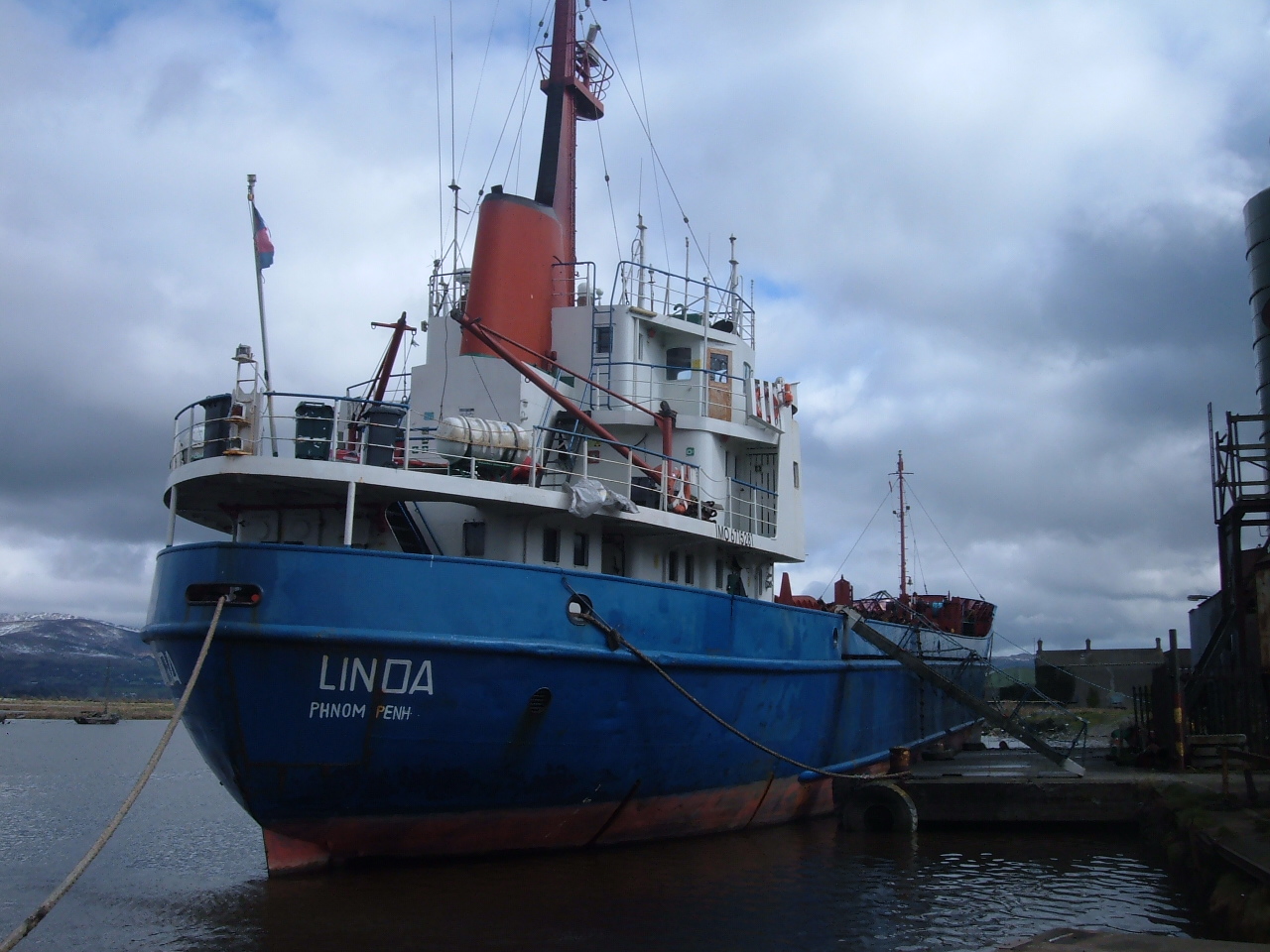
Our four boats are purchased or refurbished, flagged and registered. The cargo ship is now named the MV Rachel Corrie with the blessing of the Corrie family. Children in Gaza and the occupied West Bank will name the other two boats, and we will let you know what they chose.

The Free Gaza Cargo Ship "MV Rachel Corrie"

We are hard at work collecting the cargo… cement, books for children and universities, paper for printing books, water filtration equipment, and medical equipment, all being denied the people of Gaza by Israel’s brutal blockade.

So we ask one last time for a $25.00-$100.00 donation from each of you, a donation that will be used for our operating costs. It is not enough to buy, register and insure the boats. We need fuel for all vessles, crew expenses, supplies for all four boats, a crane to add to the cargo ship to offload the cargo, and miscellaneous expenses that always appear at the last minute.

Please go to http://www.freegaza.org/de/donate and help us raise the final 20%. You can donate in the U.S. by writing a tax-deductible check to our fiscal sponsor in DC, donate through our two PayPal accounts, one in Cyprus and one in the U.S. or wire an amount into our Free Gaza account in Cyprus. The website provides all of the detail for you.  

With your help, our final $100,000 can be raised in the next month as we get ready to leave Europe on May 3 and begin our voyage to Gaza. More than 5000 of you now follow our voyages; you have signed up for our TWITTER account, you have joined our newsletter, and you are members of many Free Gaza lists. Please donate, send our plea to your own lists, then watch our journey as we make our way across the sea to Gaza.

Thank you from all of us at Free Gaza. Every one of you has made this flotilla a reality.


The Triumph of Triviality – John Schumaker (from New Internationalist)

March 31, 2010

The triumph of triviality

John F Schumaker asks if consumer society is too shallow to deal with the deepening crises facing the planet.

The results of the cultural indoctrination stakes are not yet in but there is a definite trend – triviality leads, followed closely by superficiality and mindless distraction. Vanity looks great while profundity is bringing up the rear. Pettiness is powering ahead, along with passivity and indifference. Curiosity lost interest, wisdom was scratched and critical thought had to be put down. Ego is running wild. Attention span continues to shorten and no-one is betting on survival.

It wasn’t supposed to be this way. Half a century ago, humanistic thinkers were heralding a great awakening that would usher in a golden age of enlightened living. People like Erich Fromm, Carl Rogers, Abraham Maslow, Rollo May and Viktor Frankl were laying the groundwork for a new social order distinguished by raised consciousness, depth of purpose and ethical refinement. This tantalizing vision was the antithesis of our society of blinkered narcissists and hypnogogic materialists. Dumbness was not our destiny. Planetary annihilation was not the plan. By the 21st century, we were supposed to be the rarefied ‘people of tomorrow’, inhabiting a sagacious and wholesome world.

Today, the demand for triviality has never been higher and our tolerance for seriousness has never been lower

Erich Fromm’s 1955 tome, The Sane Society, signalled the début of the one-dimensional ‘marketing character’ – a robotic, all-consuming creature, ‘well-fed, well-entertained… passive, unalive and lacking in feeling’. But Fromm was also confident that we would avoid further descent into the fatuous. He forecast a utopian society based on ‘humanistic communitarianism’ that would nurture our higher ‘existential needs’.

In his 1961 book, On Becoming a Person, Carl Rogers wrote: ‘When I look at the world I am pessimistic, but when I look at people I am optimistic.’ While acknowledging consumer culture’s seductive dreamland of trinkets and desire, he believed that we – those ‘people of tomorrow’ – would minister over a growth-oriented society, with ‘growth’ defined as the full and positive unfolding of human potential.

We would be upwardly driven toward authenticity, social equality and the welfare of coming generations. We would revere nature, realize the unimportance of material things and hold a healthy scepticism about technology and science. An anti-institutional vision would enable us to fend off dehumanizing bureaucratic and corporate authority as we united to meet our ‘higher needs’.

One of the most famous concepts in the history of psychology is Maslow’s ‘Hierarchy of Needs’, often illustrated by a pyramid. Once widely accepted, it was also inspired by a faith in innate positive human potential. Maslow claimed that human beings naturally switch attention to higher-level needs (intellectual, spiritual, social, existential) once they have met lower-level material ones. In moving up the pyramid and ‘becoming’, we channel ourselves toward wisdom, beauty, truth, love, gratitude and respect for life. Instead of a society that catered to and maintained the lowest common denominator, Maslow imagined one that prospered in the course of promoting mature ‘self-actualized’ individuals.

But something happened along the way. The pyramid collapsed. Human potential took a back seat to economic potential while self-actualization gave way to self-absorption on a spectacular scale. A pulp culture flourished as the masses were successfully duped into making a home amidst an ever-changing smorgasbord of false material needs.

Operating on the principle that triviality is more profitable than substance and dedicating itself to unceasing material overkill, consumer culture has become a fine-tuned instrument for keeping people incomplete, shallow and dehumanized. Materialism continues to gain ground, even in the face of an impending eco-apocalypse.

Pulp culture is a feast of tinsel and veneer. The ideal citizen is an empty tract through which gadgets can pass quickly, largely undigested, so there is always space for more. Reality races by as a blur of consumer choices that never feel quite real. We know it as the fast lane and whip ourselves to keep apace.

Rollo May described it accurately in his 1953 book, Man’s Search for Himself:

‘It’s an ironic habit of human beings to run faster when they have lost their way.’ So it’s largely business-as-usual even as the sky is falling.

Some critics did predict the triumph of the trivial. In his 1957 essay, ‘A Theory of Mass Culture’, Dwight MacDonald foresaw our ‘debased trivial culture that voids both the deep realities and also the simple spontaneous pleasures’, adding that ‘the masses, debauched by several generations of this sort of thing, in turn come to demand trivial cultural products’.

Today, the demand for triviality has never been higher and our tolerance for seriousness has never been lower.

In this dense fog the meaningful and meaningless can easily get reversed. Losers look like winners and the lofty and ludicrous get confused. The caption under a recent ad for men’s underwear read: ‘I’ve got something that’s good for your body, mind and soul.’ Fashion statements become a form of literacy; brand names father pride and celebrity drivel becomes compelling.

Not even God has been spared. Once a potent commander of attention and allegiance, God has been gelded into a sort of celestial lapdog who fetches our wishes for this-world success. Nothing is so great that it can’t be reconceived or rephrased in order to render it insubstantial, non-threatening or – best of all – entertaining.

The age of trivialization has left its mark on marriage, family and love. In a recent AC Nielsen survey, when asked to choose between spending time with their fathers and watching television, 54 per cent of American 4-6 year-olds chose television. The same study reported that American parents spend an average of 3.5 minutes per week in ‘meaningful conversation’ with their children, while the children themselves watch 28 hours of television a week. To which we can add cellphones, computer games and other techno-toys that are inducing a state of digital autism in our young people.

Out of this cock-up comes the most pressing question of our age. Can a highly trivialized culture, marooned between fact and fiction, dizzy with distraction and denial, elevate its values and priorities to respond effectively to the multiple planetary emergencies looming? Empty talk and token gestures aside, it doesn’t appear to be happening.

Some of the great humanists felt that there are limits to a culture’s ability to suppress our higher needs. They assumed that we are ethical creatures by nature and that we’ll do the right thing when necessary – we will transcend materialism given the freedom to do so. That seems far-fetched given the ethical coma in which we now find ourselves. Yet the ultimate test is whether or not we can do the right thing by the planet and for future generations.

Ethics and politics have never sat well together. When ‘citizens’ changed into ‘consumers’, political life became an exercise in keeping the customer happy. The imperfect democracies we have today have never been tested with planetary issues like global warming and climate change, which demand radical and unsettling solutions. In the race against the clock, politicians appear almost comical as they try not to disturb the trivial pursuits propping up our dangerously obsolete socio-economic system.

Global calamity is forcing us into a post-political era in which ethically driven individuals and groups race ahead of the political class. Soon centre-stage will belong to culture-change strategists who are able to inspire leaps of consciousness independently of hapless follow-the-leader politics. One such person is Jan Lundberg (www.culturechange.org). Lundberg is an environmental activist and a long-standing voice for pre-emptive culture change. He understands that hyper-consumerism trivializes reality and numbs people, even to prospects of their own destruction. In his essay ‘Interconnections of All in the Universe’, he writes: ‘Unless we broaden and deepen our perception of both the universe and our fellow members of society, we all may perish in persisting to manipulate each other and our ecosystem with materialism and exploitation.’

Culture-change strategists all agree about the urgent need to promote ‘global consciousness’ or ‘cosmic consciousness’ – a broad worldview with a high awareness of the inter-relatedness and sacredness of all living things. It is thought that such a universality of mind leads not only to intellectual illumination, but also to heightened moral sensibilities, compassion and greater community responsibility.

Behind the scenes some noteworthy organizations are working toward the goal of global consciousness, including the World Commission on Global Consciousness and Spirituality (www.globalspirit.org), whose members include Nobel laureates, culture theorists, futurists and spiritual leaders like the Dalai Lama. The group points out the huge backlog of positive human potential that is ready to unleash itself once we assume control and carve healthier cultural pathways for people’s energies. According to their mission statement, the fate of humankind and the ecosystem lies in our ability over the next couple of decades actively to revise our cultural blueprints in order to foster global consciousness and create new, more ‘mindful’ political and economic models.

Global calamity is forcing us into a post-political era in which ethically driven individuals and groups race ahead of the political class

Even in the formal education system, a small but growing number of teachers are incorporating a ‘global awareness’ perspective into the curriculum, aimed at dissolving cultural barriers and building a sense of global community (www.globalawareness.com). Some are even encouraging a ‘global grammar’ that links students both to other human beings and to the entire planet.

In the war against trivialization some groups speak of ‘planetization’ – an expansive worldview that can slow our cultural death march. It was the French philosopher, palaeontologist and Jesuit priest, Pierre Teilhard de Chardin, who coined this term in calling for a global mind that fused our ecological, spiritual and political energies, and thereby paved the way for harmonious living and lasting peace. The organization Planetization Rising (www.planetization.com) sees this next phase as the only means by which we can ascend to a higher knowledge and thereby find a life-sustaining path for ourselves and the Earth: ‘It’s the next watershed mark in our evolutionary journey which alone can provide us with the empowerment and insight needed to overcome the gathering forces of ecological devastation, greed and war which now threaten our survival.’

The cultural indoctrination race is not over. The losers are still winning and the odds for a revolution in consciousness are no more than even. But is there an alternative – other than to drown in our own shallowness?

John F Schumaker is a US-born clinical psychologist living in Christchurch, New Zealand/Aotearoa. His latest book is In search of happiness: understanding an endangered state of mind (Penguin, 2006).

also by…
THIS AUTHOR

The happiness conspiracy
What does it mean to be happy in a modern consumer society? John F Schumaker argues that the elusive state has more to do with culture than genetics.

In greed we trust
John F Schumaker takes on the philosophers of greed.

Dead zone
John F Schumaker now lives and works in Aotearoa/New Zealand. But on a recent trip back home he came face-to-face with the monster of American consumer culture. The sobering encounter left him questioning both human greed and the pursuit of materialism.


A Voice from the Voiceless >> Dadaab Refugee Camps Kenya

March 9, 2010

Hi

I received the following message from some African refugee workers I am in contact with in my day job. This is stuff you won’t see on ABC, BBC, PBS or written about in UN Reports. It is a Call from those whose voice has been voiceless in Dadaab, Kenya. I have not corrected any grammar, syntax or spelling. I am posting this as I received it.

stavros

================================================================

Dear All the concerned Memebers,

With humble respect, on behalf of the refugees living in the camps of Dadaab, we would like to share our grievances with the world and ask for you to help us find our way to freedom.

Our lives in the camps are far worse than you can imagine. We live in an open prison, far away from justice and humanity. We talk, but our voices are never heard. We move, but only inside a cage. We have many skills and talents, but we are denied our chance to maximize our potential. We are chained to a life full of stress and despair; a life for which many would prefer death. We are denied opportunities for education and employment. We live in a condition without adequate water, food, or health facilities. We are arbitrarily beaten or detained by police within the confines of the camp. We lack the ability to freely express ourselves or have control over the decisions affecting our lives.

For those of us lucky enough to obtain employment with the agencies, we are exploited through the payment of mere “incentive” wages, while national and international staff receive much greater payment and benefits. How can you force us to live in a certain place that denies us our human rights and our basic needs?

 This note wishes to express some of the challenges we face here in the refugee camps of Dadaab in the hopes that we will be given a chance to have greater control over our lives, and have our fundamental human rights fulfilled. Although the challenges and abuses we face are numerous, we will only briefly mention some of our main grievances, including restricted movement, exploitative working conditions, poor service deliver, and false information and abuse by UNHCR and other agencies operating in the camps.

For many of us, the restrictions on movement and the conditions in our forced confinement have caused more psychological, economical, and health problems than diseases and wars have caused.

We ask the Kenyan government, the other governments of Africa, and the people of the world to hear our voices, see our condition, and look further into our situation. We only want our chance to thrive, to live our lives, to visit our family members, to attend school, to receive medical treatment, to help support our families, and to have control over the economic and policy making decisions affecting our lives. We only want the chance to live as other human beings live, with a hope for the future.

Please hear our cries, allow us to move freely from this open prison, and provide us the opportunity to live our lives, support ourselves, and pursue our dreams!

Restricted Movement

Some of us have faced the imprisonment of the refugee camps of Dadaab since 1991, while others of us are newly arriving. Although there have been changes and developments over the past nineteen years, our restricted movement has caused and continues to cause our underdevelopment and deterioration. Many people have died from simple diseases because they could not move to get treatment in Garissa (a town only 90 km from Dadaab). Many parents have remained separated from their children who disappeared from the camps because they could not move to search for them or inquire of their whereabouts. Many students have missed their chances for educational opportunities, have failed to take their final examinations, or have been unable to obtain education certificates earned because they could not receive the permission to move. Many people have been forced into greater poverty by being denied the chance to work and by having to pay three times the price of goods in other regions because they can not move to get cheaper goods for consumption or business. Perhaps worse still, many who have tried to move have been beaten, arrested, detained, and/or forced to pay heavy bribes or fines of large amounts of money they never imagined.

Exploitative Working Conditions

Ever since the creation of the refugee camps of Dadaab in 1991 and 1992 and thereafter, UNHCR and the agencies operating in the refugee camps of Dadaab have relied for their operations on the exploited labor of the refugee communities. Whether skilled or unskilled labor, refugee staff members have worked in conditions and received wages that are in violation of national and international labor laws. While many of the refugee staff in the agencies work tirelessly for the agencies and their fellow refugees, they still merely receive “incentives” for their hard work and dedication. Even highly experienced individuals, some of whom have graduated from Universities, colleges, and secondary schools in Kenya, Somalia, Ethiopia, Congo, Sudan, etc., receive unlivable wages, let alone wages commensurate with their experience. In addition to the dreadfully low, unlivable wage, refugee staff members are discriminated against in their payment. Specifically, although refugee staff members work as many hours and complete as many or more tasks as national or some international staff members, refugee staff members are paid significantly lower amounts and are called the derogatory name of “incentive” staff members receiving not wages or a salary but “incentives.” Indeed, though the work load given refugee staff members often exceeds that national/international staff members, refugee staff members are not given their proper respect or payment.

In a related manner, refugee staff often face harsh and discriminatory treatment by national and international staff of UNHCR and the agencies. Several national and international staff frequently use harsh commands and create a difficult work environment, and are given titles of officers even though they do not have as much experience or strong work ethic as the refugee staff members. As an example of the unfair treatment of refugee staff members, these staff members often have to queue for long hours simply to receive their payments and such long lines often cause staff members to miss the limited opportunities to receive their payment and in turn delay their receipt of their hard earned payments. As another example, refugee staff members have great difficulty receiving transportation services of the agencies, sometimes even when travel is required by their jobs. Also, refugee staff members are often not given opportunities for training or scholarships, or even if they do receive such opportunities they are not given work permits at the end of even multiple degrees. Moreover, refugee staff members are not allowed to take part in decision making about the refugee programmes ironically that the refugee staff members usually must implement and that are intended to benefit refugee beneficiaries. Similarly, refugee staff members are not afforded an opportunity to participate in planning, writing project proposals, or otherwise participating in any other management functions despite in many circumstances years of experience and knowledge about the refugee communities who are supposedly the beneficiaries of the agencies’ programs and the conditions in which they live and operate. Indeed, refugee staff members are not even provided meaningful opportunities to present feedback that is received, considered, and/or implemented. Incentive Wages At the heart of the exploitation of refugee staff members lies the entire system of “incentive workers.”

The agencies in the camps of Dadaab divide staff into three main categories:

§ International staff

§ National staff

§ Incentive staff

While national and international staff have relatively similar salaries, working conditions, and privileges, the so-called incentive staff are barely paid, are discriminated against, and are often treated with disrespect. The national and international staff members have every thing required for the fulfillment of the respective work such as transport, office tools and equipment, refreshments etc. at their disposal. At the same time, the refugee staff generally have no such access despite the fact that the national and international staff often greatly depend upon the refugee staff in order to carry out their duties, gain access to and understand the refugee communities, and break through language barriers and cultural differences. Yet, while the incentive staff are indeed the back bone of the agency operations in the camps, the relationship between these two sets of staff and the treatment of refugee staff members is horrible.

 The agencies and UNHCR continue to simply pay only meager incentives, which are minimal amounts in and of themselves and are not accompanied by any significant bonuses, benefits, allowances, pensions, separation payments, or other components of standard national and international staff contracts even for refugee staff members that have been working for over a decade. An incentive worker will earn as little as 50 – 90 USD per month, regardless of the number of years of experience, seniority in employment or academic qualifications. Indeed, the skills, academic credentials, and experiences varies significantly across the work force of refugees, ranging from primary school leavers to those with multiple Masters degrees and diplomas who have worked for more than a decade. Yet all are subject to harsh conditions and meager payment. In addition, the ill treatment and lack of respect for refugee staff and their tireless efforts has taken its physical and emotional toll on many staff members, and in fact some young professionals have developed psychological problems due to the frustrations they face while others have chosen to even risk their lives to return to their respective homelands in the hopes of finding an adequate means of survival for themselves and their families. Moreover, the vast disparities between refugee staff and national/international staff continues to create envy and hatred among the staff of the same agency.

 The incentive system is often claimed to be necessary because of limited budgetary resources and because refugee staff members are not allowed to officially work under Kenyan law. However, in actuality, these supposed justifications serve only as mere excuses for the agencies to hide behind so that they can continue to exploit refugee labor. With respect to the limited resources, first of all limited resources can not serve as an excuse for exploiting refugee labour. Moreover, the amount of money that is wasted if not skimmed off the top by the agencies reaches huge amounts; if there are indeed limited resources, the agencies could shift resources away from ineffective trainings, corrupted individuals, and high paid national and international staff in order to adequately pay incentive staff members.

In a related manner, in line with the problem noted above of not including refugee staff in decision-making and managerial tasks: the agencies should “open the books” and allow refugee staff members to be a part of resource allocation decisions. With respect to the inability for refugees to work under Kenyan law, again the agencies and not the Kenyan government are setting the amounts of the incentive wages and if the agencies are able to legally provide incentives at all then the agencies can not point the finger at anyone other than themselves with respect to the exploitative amounts that are arbitrarily set by UNHCR and the agencies. Moreover, UNHCR and agencies are able to obtain work permits for refugee staff members in Nairobi and elsewhere when they deem it appropriate. Further, it is the obligation of UNHCR to advocate on behalf of refugees’ right to work and pressure the government of Kenya to follow its obligations under the Refugee Convention to allow for such rights.

We ask members of the international community to step up for this matter and come forward to help us refugee staff members regain our human dignity and equality and fairness for all in terms wage earning, working conditions and decision-making. Furthermore, we ask that international human rights bodies and the International Labor Organization study and scrutinize the years in which our talents, skills and services have been exploited and abused by the agencies in Dadaab. The title “incentive worker” The title given to the refugees working with the humanitarian agencies is itself exploitative and demeaning. Literally the word incentive means something given to some in order that he/she keeps the same spirit in the course of an operation; however the magnitude of the incentive in the camps of Dadaab is negligible. Considering the workload carried out by the staff or employees drawn from the refugee community, it is the case that refugee workers form the backbone of the humanitarian operations in the Dadaab camps. Indeed, without these workers, the agencies would suffer an acute shortage of human resources. Given the fact that the title “incentive” does not actually sound proper, the refugee workers often feel discouraged and humiliated to be called an incentive worker, which even can weaken the productivity and output of the workers. Furthermore the title incentive widens the already expansive gap between the refugee workers and the national and international staff, which further hinders the cooperation necessary to achieve the important goals of the humanitarian operations in Dadaab.

The more favorable the working conditions, the more efficient an employee will be in her/his daily undertakings, and the more cooperative relations amongst different categories of staff members, the more likely the operations in general will be successful. Thus, if only from the point of view of improving operations in Dadaab, the title of the refugee staff should be changed, the disparity in wages must be closed, and the working conditions must be improved. Harmonization Incentive Document for 2010 A memo concerning the “harmonization of refugees incentive workers wages” was developed by UNHCR in collaboration with all of the NGOs working in the refugee camps; some of the NGOs have shown skepticism about the effects of the document but the policy has been passed without adequate input or consideration of the viewpoints of current refugee staff members. While we recognize the potential positive effect of raising the wages of those agencies paying the lowest amounts, harmonization should only result in a harmonization upward. Moreover, we believe that individuals should be paid wages that are both living wages and appropriate for their jobs and their level of expertise and experience. The document is totally contradicting the conventions to the refuges. Indeed this is a practical evidence that UNHCR is violating the international conventions and protocols relating to the provisions and service of the refuges instead of promoting, it.

Furthermore, the UNHCR has not increased a sigle coin to the refguee workers and what it done was a cheating withno consultation to the concerned parties; indeed the amount that was dedected from the fellow refugee workers were increased for the other fellow refguee workers thus, creating envy and hatered among the working refguee workers!. In this world it has never been noticed that somesone’s pay is lowered without proper justifications.

Despite the fact that many other irrlguralies that can not be not be summarized is ongoing on daily, weekly, monthly or annually basses within the confines of the refugee camps of Dadaab.

Poor Service Delivery

The Dadaab refugee camps were established in the wake the devastating civil wars and persecution in neighboring countries, such as Somalia, Ethiopia, Rwanda, Sudan, Uganda, Burundi, Congo, and Eritrea. While we are grateful for the support that has been provided to those who have had to flee from their home countries, it is incredible that nearly twenty years after their adoption, their remains terrible problems in the service delivery and operations of the various agencies operating in the Dadaab camps: UNHCR, WFP, CARE, NRC LWF, IRC GTZ –IS, WINDLE TRUST KENYA, DRC HI, MSF, etc. The food distribution sector, the education sector, the medical care sector, the water and sanitation sector, and the land allocation and shelter sectors provide just a few of the many examples of the continuing and sometimes worsening poor service delivery. Food While the refugees in the Dadaab camps do appreciate the relentless efforts of the international community to ensure that the refugees in the Dadaab camps are given food, we ask the international community if a three (03) kilograms of maize and 50 grams of oil is enough to feed a person for a period of 15 days. This meager amount does not meet international standards. Worse still, a quarter of the amount claimed to be given is often stolen during food distribution, in large part because the workers of the food distribution are not adequately paid and are thus encouraged to steal from the beneficiaries. How can refugees be forced to remain in camps, told for twenty years that they are not allowed to work and raise their own livelihood, and then not be given enough food to feed themselves and their families?

Education

Education in the camps consists of several primary schools and secondary schools and other adult learning literacy institutions. While education, especially at the primary level, is a basic need and right, various factors have limited the quantity and quality of education provided in the camps of Dadaab. At the most basic level, the camps’ population has swollen thrice in recent years, while the capacity has only minimally increased. The focal organization for education in the camps, CARE international in Kenya, has not done a good enough job at increasing the education capacity. Poor quality education is matched with poor infrastructure, as many of the buildings remain the same as those built in 1992 to accommodate some 97,000 refugees while the population has currently grown to nearly 300,000. We have 18 primary schools across the three camps with an average of 3500 pupils per school. These large numbers of learners face many challenges in school. The general ratio of teachers to pupils is 1:80; a situation that has forced many learners to become dropouts, ending up on the market streets. All the 18 mentioned primary school are registered as Kenyan National examination centers while the learners in grade 8 (standard eight) must sit for the national exams in November of each year. The Kenya national examination law states that for a school to be a centre for national examination, there should be a least one trained teacher per class in that school; contrary to this law the schools in Dadaab do not have adequately trained P1 teachers. Yet the ministry of education of the government of Kenya officially has accepted this situation, which has resulted in poor performance in all these 18 schools. Another factor affecting education is the issue of payment. A teacher who is expected to serve as a role model, shape the study and character of various children, and teach the next generation of students, receive some of the lowest wages, lower even than donkey cart riders. The low payment causes more qualified individuals to seek other jobs, and for those who remain as teachers to have little motivation to do a good job in their work. Another problematic feature of the education system is that although as many as 4000 pupils sit for their national exams (KCPE), only roughly 120 students from each camp will have the opportunity to move on to secondary school, and even fewer of those who complete secondary school will have opportunities for further education after high school. Courses in Kenya University and colleges, despite funding by the international community, remains limited.

Medical Care

Medical conditions and nutrition have declined since 1992; down the line diseases are increasing while the interventions are relatively minimal compared to the number of patients in the hospital. In addition, as a result of acute malnutrition in the camps and anemia, child mortality rate is on the rise.

Further, due to ongoing fighting in neighboring Somalia, many refugees continue to come to the camps with numerous diseases, injuries, mental sickness, skin diseases and birth defects, many of which are not able to receive medical attention and are told that their ailment is too complicated to be attended to in the camps. As result many patients will converge at UNHCR field offices for their medical concerns but unfortunately UNHCR protection unit staff will keep refugees waiting and only refer them to the same doctors, nurses, and medical facilities that are already stretched too thins Which are expected to assist roughly three hundred deliveries per month in each of the camps. Currently, we have three medical charity organizations in camps MSF SWIZ in Dagahaley, IRC in Hagadera, and GTZ-IS in Ifo. Yet, especially due to the overcrowding, the medical facilities simply do not meet the incredible medical needs in the camps. Some of the most basic issues in the medical care sector include: – Lack of qualified personnel in hospitals – Lack of medicine/ procured – Lack of emergency equipment / ambulance theatre – Lack of adequate facilities or equipment to deal with many of the ailments Water and Sanitation Water and sanitation services are basic and essential; there are 15 boreholes in the camps which supply safe water to the refugee population since water is chlorinated before being supplied. Those boreholes are managed by borehole attendants or incentive workers who work from 6:30am to 6:30pm ever day, even on weekends or public holidays, since water is needed every hour of the day, and yet only earn minimal wages. Similarly, sanitation, waste management, and carcass collection and disposal, as well meat inspections/hygiene promotion are carried out incentives staff while the national staff seem to sit in the office browsing the internet and pretending to be busy in the offices. (Issues of latrine are handled by NRC whiles other sanitary and hygiene activities are done by CARE – RAP Watsan). In addition, the water crisis in the deeply populated Dadaab camps often results in fighting at the tap stands among families, village mates, and block mates. Sanitation and waste management is also worrying. The current network of latrines is hardly maintained and there are not nearly enough latrines for the Dadaab refugees in general. The latrine system in Dadaab camps is far below internationally accepted and minimum standards, such as 1 latrine for every 20 people.

Land Allocation and Shelter

For security reasons and because of the deterioration of the humanitarian situation in Somalia, many Somali refugees flee and escape ordeals in the war torn Somalia and seek protection in the Dadaab camps. Yet upon arrival in Dadaab, new arrivals often receive little guidance, orientation, or support to find land, obtain food, seek medical screening or vaccinations, etc. For instance, when a family comes to Dagahaley camp, where registration has been undertaken since 2005, the only thing they receive form UNHCR is a food ration card after waiting for around 10 days.

Finding shelter is often left to the good will of the refugees already living in the camps, despite the fact that severe overcrowding and congestion already exists in the camps. Most of the new arrivals simply build make-shift shelters that are susceptible being washed away by the heavy rains, or they resort to a living under the trees or a “house” where they are exposed to the elements. New arrivals thus face problems related to security, cold, wild animals, poor sanitation, etc. In addition, after registration the new arrivals often do not get non food items that they are intended to receive such as plastic sheeting, a cooking set, Jeri cans, and blankets; even accessing food is hard for new arrivals as they will start getting food from WFP up to 10 days after obtaining registration from UNHCR.

False Information Provided to Community Representatives and Visitors

Although there are the above problems and many more in the refugee camps of Dadaab, often visitors come to Dadaab and are shown a very different picture than the actual reality. Indeed, visitors of various high positions and organizations visit the worlds’ largest refugee camps of Dadaab in north eastern Kenya. Dadaab has in some ways become like a circus display or tourist attraction, with so many visitors coming in and out to see the camps and meet with refugees. Most visitors come with the intention of evaluating how the funds they have donated have been implemented for the target refugees. Visitors who individually only infrequently and occasionally pay visits to the refugee camps are thoroughly misguided about the real information on the ground. Visitors are often taken to pre-arranged places and meet with special people organized to supposedly speak on behalf of the refugees, who often give information that does not inform the visitors of the real circumstances of refugees’ conditions. It is believed that some agency staff members use bribery and other means of influence with refugee leaders whom they think can give substantial and fabricated information to the visitors that will protect and promote the agencies and their supposedly humanitarian work. It is believed that some agency staff members make false promises to such leaders, such as offering resettlement opportunities or contracts in order to entice these leaders to hide the true information about how agencies deal with refugees when high profile visitors come to the refugee camps. In addition, often when high profile visitors come to the camps, their time is scheduled such that they do not meet with many of the true leaders, intellectuals, young leaders, women’s groups and other stakeholders from the refugee community to hear and know from them directly without the presence of the Agency’s representatives. Moreover, the security guards (AGK) are given instructions to be on high alert and only allow those who had been chosen by the agencies to meet with the visitors. For instance during a recent visit by 17 embassies to the refugees camps, our community leaders, intellectual, young leaders and other stakeholders from the refugee community were only given an opportunity to present all of their pressing problems in a mere 45 Minutes, with agency representatives present who could note which refugees spoke and potentially deal harshly with those who spoke after the visitors had left. In addition, on the onset of the arrival of various visitors, agencies attempt to undertake various preparations intended to deceive visitors about the situation in the camps, such as intensive cleaning campaigns, having even senior officers wade through the rubbish, adding new/temporary infrastructure of all sorts (tables, seats, wall hangings/messages, computers, etc.), painting walls, putting up boards and signs to show orgnanized residential and office compounds, and so forth. As but one example, when some high profile visitors were coming to visit the camps in mid-2009, new buildings were constructed, walls were painted, old equipment was hidden, and intense cleaning efforts were undertaken at a surface level in order to deceive the visitors. If the amount of hard work that was taken to make these preparations was done on a daily basis to actually address the problems facing those in the camps rather than simply providing surface level window dressing to please visiting donors and officials, the situation in the camps could much improve. As another example, when an envoy of ambassadors visited the WFP food distributed centre, all of the former containers used for distributing food (which had been cut in size in order to limit the amount of food given to each refugee) were set aside and every individual was allowed to receive a full ration. But these measures only existed during the few minutes when the visitors were present.

 Taken together, the agencies make significant efforts to hide the truth of the situation of refugees in the camps of Dadaab when visitors arrive. We therefore make a heartfelt request to the Intentional Community, high profile visitors, media, government officials, human rights bodies, independent journalists and other concerned parties to always think beyond the box while visiting the Dadaab refugee camps, to be skeptical of what they are being shown, to try to ensure that they take some time to talk privately to a number of different refugees, and to visit unplanned areas in order to uncover the true living situation of the refugees and hear their voices longing to determine their uncertain future! Abuse from UNHCR Officers in Dadaab against refugee youth advocating for their rights. National and international staff members of UNHCR and other agencies in the camps of Dadaab often attempt to harass and intimidate refugees who advocate for their own rights. As a recent example, the UNHCR Head of Sub Office, in the presence of elder witnesses, threatened various refugee youth who intended to attend a meeting at his office, shouting that in case any youth came into his (UNHCR) office he would call the police and arrest them. Similarly, the senior Protection Officer has often failed to protect the rights of the refugees while allegations of harassment and human rights abuses flood his office in Dadaab. If UNHCR jeopardizes and denies the basic rights of the refugees in Dadaab Refugee Camps and denies the opportunity for refugees to advocate for their own rights; who will then advocate for the rights of the thousands of the disadvantaged societies in Dadaab camps? It can only be concluded that the UN and other agencies do not wish to see a community who can manage their own affairs independently. It can only also be concluded that the agencies in Dadaab are more political agencies than they are humanitarian agencies, with many agencies undertaking similar tasks and doing little to actually assist refugees as they claim. Moreover, the reports shared by the agencies with the donors often provide false information and figures, including but not limited to false information about living conditions, security, service delivery, movement, education, development, health, water and sanitation, food, and services they allegedly provide but often either do in a sub-standard manner or never have even undertaken at all. While agency staff often argue that refugees have no right to complain because the services they receive are free, it must be noted that agency staff also receive free of charge much better services than the refugees receive, including in the areas of water, medical care, food, housing, electricity, etc. We request from the international community and other concerned parties to help us mange our own affairs and that affect us by giving us a chance to get the jobs we can do for own selves.

Conclusion

 In sum, we wish to reiterate that we hope that the international community will hear our cries and undertake efforts to end the exploitation and abuse we face by pressing for an end to restricted movement, a reform of exploitative labor policies, an improvement in service provision, a greater allowance for participation in decisions about service provision to the refugee communities and refugee staff members, and the end to the deception and abusive practices of the Kenyan government, UNHCR, and the other agencies operating in the camps of Dadaab toward the refugees and the international community. Furthermore, the International community and the concerned goverments should watchout carefully the actions of the govermentof kenya, UNHCR and the other Agenceis opertaing in the region decissively and should held account for any inhuman acts. Thanks and looking forward to your immediate durable solutions.

Kind Regards,

Refugee Silent Welfare Committees


Awakening To The Tao, by Liu I-Ming…an excerpt

February 25, 2010


If a lamp has no cover a draft will put it out, but if the lamp is enclosed in a cover, it will not go out even if there is a gust of breeze. If a brazier has no screen it will get dusty, but if the brazier is screened it will not be fouled even by flying dust.

What I realize as I observe this is the Tao of safeguarding the foundation of consciousness. Our conscious awareness is like a lamp or a brazier; awareness of reality is like a lamp glass or a brazier screen. If conscious awareness is not covered and protected by awareness of reality, the discriminating spirit will use consciousness to produce illusions, so it will be influenced by objects. Then the artificial will be in charge, the real will withdraw; aberrant energy will cover up sane energy. Like a lamp being extinguished, like a brazier being fouled, we lose our original selves. If conscious awareness is mated with awareness of reality, and awareness of reality is used to control conscious awareness while conscious awareness is used to follow awareness of reality, then the discriminating spirit has no way to emerge, the energy of consciousness has no way to fly. When the root basis is firm and stable, it may enter water without drowning, enter fire without burning. No pernicious external influences can harm it. This is like when a lamp has a cover and so does not go out, like a brazier that has a screen and so is not fouled by flying dust.

 — excerpted from Awakening To The Tao, by Liu I-Ming


The Corporatisation & Destruction of TAFE – History Rhymes

November 7, 2009

Below is an article I wrote “History may not repeat itself, but it sure does Rhyme!” in 2008 while I was working in TAFE as the TAFE Teachers Association (Hunter Institute) Peace Officer. Peace Officer? Well, it was a title given so that Management couldn’t hassle me because I was representing the Union. I was aggravating Management with some of my communications questioning the Corporate Culture that was infecting Public Education – especially TAFE.

It’s primary intention was to record the history of the corporatization of TAFE for the younger teachers who would never get to know TAFE as a public education provider. TAFE was the greatest social justice and equity mechanism in the world because it gave hope and education to those who were disadvantaged and poor. Those educated and trained through TAFE could then get jobs that would alleviate their disadvantage. TAFE did not only cater for the needy but it’s Access and Equity programs and policies ensured that the needy were supported.

It was obvious to me that the plan to corporatize TAFE and gradually get rid of Access and Equity programs and policies was created at least in the early 1990’s. It was also obvious to me that the government wanted to privatize Vocational Education and Training (VET). We all knew it. In NSW we saw what happened in Victoria, Queensland and Tasmania. We would never let that happen in NSW? Well, we did allow it to happen and now we are witnessing TAFE’s destruction.

Knowing that the Senior Executive Service doesn’t strategise by the 6 monthly semester or even annually but at least a decade ahead I tried to organize Save TAFE Festivals and a website which would highlight the corrosive effect that corporatization was having. The website would include every Institutes’ offering with the numbers of vacant teaching positions NOT filled – by Faculty and Campus. It would also show the stupid, mindless restructures that happened over the years which were done to destroy TAFE staff’s morale. For some unknown to me reason TAFE TA didn’t support the idea. They didn’t support the Save TAFE Festivals idea either. I had two Institutes’ teachers showing interest with over 100 staff in both stating they would support the idea. I asked the Union for the email address database of all NSW members which they refused to give me. I asked that they forward the emails to all NSW members which they refused to do.

I was told that some Union Council members were against both the Save TAFE Festivals and exposing / dobbing in website because if they were successful it would show management that there was no need for extra resources because TAFE teachers could do so much just by organizing and donating their time and expertise. What the fuck! But that is what I was told.

I was also told by Council members that my ideas were far too radical and that most Union members only care about their salary and conditions. I couldn’t accept that baby boomers who were about to retire wouldn’t do as much as possible to Save TAFE because they had nothing to lose. They were superannuated and tenured so they couldn’t be sacked and even if they were hassled so what? They only had one to five years of not being liked by management. But no – in their smugness and complacency, in their relaxed and comfortable slumber they let TAFE be destroyed.

I left TAFE in 2010 because I was getting bitter towards my fellow teachers and Union members. We had a great  strike turn out for our conditions earlier but to SAVE TAFE – only very few gave a shit. I didn’t want a bitter heart while remaining in TAFE for a few more years. The way it turned out, I need not have worried because all those jobs disappeared! I must admit some schadenfreude  when I heard that most of my Managers & some of the teachers who told me I was over the top paranoid about the future of TAFE lost their jobs.

Now we are witnessing the wholesale destruction of TAFE – many of us saw it coming but few wanted to do anything about it.

The current Managers of TAFE should be ashamed of themselves for they are accomplices in the greatest destruction of world best mechanism for social justice and equity.

The following was originally sent as an attachment then I put it up on a cloud as a PDF document. I’m now including it here so that when needed I can send link via Twitter.

Right at the end of the History Repeats article is a post I put up about 6 months before I left TAFE. Since I couldn’t get a website going through the Union I did my little bit on this blog. The egroup & Save TAFE blog no longer exist.

Stavros

January, 2016

========================================================================

UPDATE >> 29 June, 2018 Read this and weep! EVERYTHING predicted in this post has come to be. 

New figures quantify the extent of the TAFE disaster
http://stoptafecuts.com.au/blog/new-figures-quantify-extent-tafe-disaster

========================================================================

UPDATE >> 21 November, 2017 Letter to the Editor, Sydney Morning Herald

Vocational Education a mere shadow of its former self.

TAFE Eviscerated

===========================================================================

Sometime in 2008

History may not repeat itself, but it sure does Rhyme!

Hello Everyone,

Greetings from your Hunter TAFETA Peace Officer.

I morphed into this role a few weeks ago during a TAFETA Branch Meeting at Newcastle Campus and I wasn’t even there! I accepted the nomination and here I am writing to you. I figure that I’m better placed than that poor bloke in Franz Kafka’s story,“Metamorphosis” where he woke up one morning to find he had morphed into a cockroach. At least in this role, I can communicate … and that is what this TAFETA role is about….. I think.

I have lived long enough to have experienced as a teenager the first landing on the moon by a human and a time when a single computer occupied an entire building. Now I live in a time, when other solar systems are being discovered in our galaxy and a silicon chip is in every home and office, if not in your pocket. I have also lived long enough to see Public Service change from serving the public to marketing to customers. In DET, students have become clients and in TAFE, we lost our Principals to get Managers and we are now in the process of losing our principles and teachers for trainers.

The document, TAFE NSW Doing Business in the 21st Century, arrived in my inbox and the thought crossed my mind that it’s important the history of what happened since 1988 to TAFE should be recorded. When we, the Great Demographic Blimp of Baby Boomers, leave TAFE over the next few years, this knowledge will disappear.

History may not repeat itself but I reckon it rhymes.

Rhyming patterns may be discerned in this 20 year history. These in turn may resonate into the future. Younger TAFETA members will tune into echoes and hear the rhymes of crimes, the chimes in the times. They will be prepared to project from these rhymes of history possible “new” beginnings and probable lies.

So instead of looking towards the future I turned around and saw a hazy scene, a kind of otherworldly reminiscence. Like an eagle gliding above, I saw over 50,000 teachers from schools and TAFE colleges converging and congregating at Hyde Park in 1988. I remember having travelled by bus from Wagga, along with many others from across NSW, to protest the fundamental change in direction for public education which was being pushed by the then Greiner Liberal State Government.

Terry Metherill, the Education Minister at the time, decided that it was time for Public Education to walk the path (plank?) of economic and cultural redemption. As a matter of historical record, Nick Greiner was a disciple of Margaret Thatcher’s Gospel of Economic Rationalism, she of the “there is no society” fame. He took it upon himself to transplant the Corporate Business Culture (CBC), structure and processes into the Public Service.

You may ask, “What is wrong with Corporate Culture?” Well, it may be fine if the prime purpose of an organisation is to make money at the expense of everything else. In fact, if a human was a Corporation their psychology would be diagnosed as psychopathic. A book by Joel Bakan called “The Corporation – the Pathological Pursuit of Profit and Power” outlines these features and why the Corporate model is dangerous for a Public Service.

Educational service exists for reasons that transcend making a profit, so if you transplant a culture and model – of being from an entity which exists solely to make money onto education you have created an organisation creaking with tensions and contradictions. These tensions are exacerbated because Corporate goals contradict Teaching goals, no matter how many Mission and Quality Value Statements are made in glossy brochures.

Anyway, Terry Metherill, Nick Greiner’s loyal Education Minister began his major restructure of Education to make it Corporate. He didn’t explain why, he just didit because it was a matter of economic rationalist faith – a user pay doctrine of an irrational ideology.

So how did we arrive where we are now? What did these Economic Rationalists do? Why did we educators, teachers and citizens protest in 1988 and have gone quiet since then?

Well, the first thing Greiner and Metherill did was to create the Senior Executive Service SES. The Corporate Business Model dictated an SES which was separate from the rest of the organisation and placed on 3 – 5 year contracts. They could earn bonuses too if they performed according to the specifications of their contract. So, if they could demonstrate that under their watch they came in under budget they would get a bonus.

No longer were the Heads of Public Service organisations permanent with tenure andthus could advise and run their organisation according to the needs of the public withoutfear or favour but had to perform according to the dictates of their political masters or face the sack. Greiner had politicised the State Public Service which Howard would later do tothe Commonwealth Public Service in a much more sinister way. The best example of this was the break up of Commonwealth Employment Service (CES) to Jobnet Private Providers.

About a year or so later, Greiner set up the Scott Report and then the Predl Report which had to review all of the Access and Equity Services. When Scott and Predl reported that the Access and Equity Services were excellent and needed more funding rather than be dismantled, Greiner and Metherill weren’t too pleased.

The next step was to impose a “Managerial” culture onto the Principals and Teachers. They got rid of all Principals and in their place created Managers. I remember talking with a few of the Principals who had lost their jobs because of the restructure and how they felt about the changes. They felt that Corporate Accounting Procedures were central to their new role rather than pedagogy and educational guidance. They lamented the loss of true educational leadership and the rise of the Corporate Manager within an educational institution.

One feature of this Corporate Managerialism is that no longer is it expected those in management roles in Faculties have to have expertise in the Faculty’s skill base they manage. In fact, they don’t even need to have been teachers. All that is needed are generic management skills where the manager does not have to know anything about the educational content of the faculty, just how to manage budgets and human resources, preferably with an MBA. So, an accountant would be ideal to be a Faculty Director of Access and General Education.

One thing that was pivotal in creating the “Corporate Business Culture” in TAFE was to ensure that there was a separation in working conditions between Principals and Teachers. This meant that the new Managers did not have the same conditions as Teachers which guaranteed that no longer would there be “solidarity” between Principals and Teachers. The first Institute Managers (IM’s) were restructured into these positions from their previous educational leadership positions. They had no choice but to take up what was on offer or lose their jobs.

A friend who was forced into becoming an IM told me that when he complained to the Institute Director (ID) about the situation the ID said, “You’ve got a job, haven’t you? Don’t complain.”

In the 1990’s we witnessed a change from TAFE Regions to Networks. In fact our Institute was separated into three networks Newcastle Urban Network, Hunter Network and Central Coast were part of North Sydney Network. Along with these Networks came new signage, new stationery and new offices. In the Network model it was believed that Network Administration offices had to be separate from the “business” of the campus. This meant that money was spent in creating new office space away from the campuses. A little later another restructure saw the creation of Hunter Institute of Technology. Only a few of the TAFE Institutes were Institutes of Technology, the majority were Institutes of TAFE. This entailed spending money on NEW signage and stationery. The new signage evenwitnessed new logos for each Institute. Then there was another restructure where all Institutes became Institutes of TAFE and with one brand sign TAFE, NSW.

All the while the Marketing areas of these restructured organisations gained in powerand status. To emphasize the new Corporate Hierarchy, palatial offices were created to house the CEO’s, the Institute Directors. Meanwhile, classes and programs were cut and new “Centres of Excellence” were created which rationalised the delivery of programs away from local campus provision to one place within the Institute. So students who attended a Muswellbrook course in Automotive Engineering would now have to travel to Glendale Campus which was the ONLY campus offering the course.

I do not know if there has ever been a cost benefit analysis of all these restructures but I imagine that the cost would be in the order of millions. How many classes could have been run for the cost of these failed restructures? Has anyone reviewed the Senior Executive Service structure to see if it is beneficial to the community?

I don’t know if Teachers Federation has researched and reviewed the restructures involved. Maybe I’m a little naive about this but it seems to me that whenever there has been a review and then a restructure we just go along with the ride. WHY?

Sure salary and conditions are important, but who is responsible for the “culture” of an educational organisation, if not us teachers? The effect is that we now have the Managerial Culture infecting head teacher positions where the main work seems to be compliance and accounting of the budget.

In another decade we may find that TAFE will become TVT Technical and Vocational Training, where Head Teachers will be Program Managers on 3 – 5 year contracts responsible for hiring “trainers” casually or on short term contracts. These Program Managers may also be offered bonuses if they perform according to their contracts. In other words, they will have similar work conditions to the Senior Executive Service but with much less pay and less responsibility.

We may even find that online education will do away with buildings so that TAFE campuses become smaller and in regional areas non existent. Private providers may rent these ghost buildings for bugger all and if students need practical training they can come in for a few days per year. Impossible? Improbable? Let’s see.

Already the powers that be, have decided that TAFE teachers do not need a Diploma of Education, just a Training Certificate will do, since we all have Cert 4’s to satisfy Registered Training Organisation (RTO) status. Do you remember your initial response when told that you have to do the Certificate 4 in Workplace Training? I bet it was something like, “Why? I’ve already got a Dip Ed. I can’t see why I have to get a lower qualification because you say so.” But most of us did it and now we find that TAFE Management doesn’t want your Dip Ed because they want trainers NOT teachers. Don’t forget, trainers are cheaper than teachers and in this competitive market place private providers use trainers, so what chance have teachers got? Why has our Union gone along with this? Beats me! I refuse to do the Certificate 4 – and so should all of us.

TAFE lost its Principals in the 1990’s to get Managers, now it looks like TAFE will lose its Teachers to get Trainers in the 21 st Century.

 I remember a few years ago when I was visiting Bethlehem in Palestine, sitting on a bench in Nativity Square. Along came an old man with an Arafat like profile who sat next to me. When he realized that while I was of Middle Eastern appearance, I didn’t speak Arabic but only Greek and English, we began speaking in that half telepathic, half verbal way in English that happens sometimes between people of different backgrounds when they want to communicate.

Anyway, he found out that I was a teacher and he said something which has touched me to the core ever since. He said, “In our culture a Teacher is a Lamp because a Teacher brings the light of knowledge to the darkness of ignorance.” Note, not a trainer but a Teacher. The two roles are completely different and now Management wants to get rid of Teachers in TAFE.

How many restructures have we had since the late eighties? What happens when an organisation is in a constant state of restructuring? One thing that is obvious is that there is an ambience of uncertainty. People worry about their positions and their jobs. As anyone with a modicum of common sense knows, people do not innovate and create when they are scared and insecure. We have had a culture of fear and uncertainty for about 20 years and I don’t think having an Institute Manager position Director of Innovation will create the psychological space for creativity to be born. It appears that we have been surviving in the Realm of the Perpetual Restructure.

While I’m sympathetic to the Buddhist concept that the only constant in the world is Change, I do not feel that these constant restructures are based on a sense of the sacred.

I believe that the Equity Units of TAFE are what makes TAFE uniquely different to any private provider. In many ways the Equity Units are TAFE’s sensitive antennae picking up trends and subtle changes in the scales of social justice. What happens to Equity Units happens to everyone else in DET, sooner or later. Right now all Equity Units are going through another review and there is talk about creating a new Social Inclusion Unit. However, before you younger ones cheer, please understand that 20 years ago the Central Equity Units had more than 60 people and now have about 20. If we go by what has happened in the past, why wouldn’t we believe that the Central Equity Units will become a Social Inclusion Unit with three, if not one member of staff?

Hunter Institute’s Multicultural Education Unit won a Quality Award in 2007 for the work it is doing with African refugees. This is great, good work is being acknowledged but when you consider that the category in which the Quality Award was given, it kind of changes one’s feelings. The Award states: “The African Experience” Business Relationships. Yes, a social justice project that worked closely with the local community did not have a category called “Social Justice” or “Community Relations” to call home. To fulfil the Corporate ethos this spherical, “Whole of Life” project had to be put into a corporate cube.

History may not repeat but it sure does rhyme!

After the consultations for the Doing Business in the 21st Century are over, you can bet, like clockwork, there will be another Restructure, Realignment Re – whatever word they will use for it. Why don’t we have a Review of the “Restructurers”? I sometimes wonder if these Managers who order restructures do it just to be seen to be doing something. It is often easier to dismantle and restructure than to create and build.

Maybe, I’m having an attack of nostalgia for a world that has disappeared and a paranoid fantasy that in TAFE’s place, a 21st Century TVT Corporation is coming. Assuming that there will be another restructure, whatever name or spin they put to it, what will happen? What needs to happen? Can we do anything about it?

I believe that Teachers Federation is like a sleeping giant. I don’t mean to take away any of our great achievements as a Union but I would love to see the sleeping giant wake up and say “enough is enough” with the corporatisation of our educational service. We can do it if we have the will. However, I am inclined to feel that as we older ones leave TAFE, the younger ones who have not known a non corporate TAFE culture, will go along with the changes because that is all they know and recognise.

What if we do wake up collectively, what can we do?

Well, being a Peace, Love and Hope kind of bloke, I believe that if enough of us have a vision and if this vision is rooted in pure intention, that Magic can happen, that serendipity and synchronicity are not just long words but mean something vital, that Leonard Cohen was right when he wrote, “God is alive, Magic is afoot”, that, Kev Carmody and Paul Kelly are right that “From Little Things Big Things Grow”. However, saying this does not preclude organising collectively. We can organise locally by forming affinitygroups / clusters of action.

To do what?

We need to take individual responsibility and to join with other like minded members to develop and create new strategies that arise from locally relevant issues. As a start, every time our Managers tell us to do something we can ask

“WHY?” and keep asking “Why?” and not be satisfied with answers that allude to “because that is the way it is” or “because we have been told to”. Keep onpushing through to the essence of what is being directed by asking the simple question “why?” I have been surprised how far this question has taken me into the realm of the human instead of the wasteland of the corporate.

Here’s some other stuff we can do:

If asked for a student tally, refer the manager to CLAMS; for a budget summary, tell them to see Buddy; for FCPS, say, “Here’s my current provision, for next semester’s, ask me then.” You all know that these “tools” do not help us, they are a burden. Yet we do them. Then the managers ask us for simple info instead of using the tools created for their use! Don’t forget that as we use these “tools” we embed the “managerial” culture into our positions and we acquiesce and then comply in the corporatisation of education.

If you want you can reply with some feedback which I can use to create a threadand send to TAFETA members. You may wish to share your own experiences of “corporatisation” and ways of taking it on. Keep sending your input to the Doing Business in the 21 st Century people, if it’s still open.

This may not sound like much but when you consider how many of us there are I’m certain that our combined imagination and creativity will come up with countless strategies to “decorporatise” our TAFE. Or, we can simply do nothing, roll over and sleep until we are superannuated out. The choice is ours.

For the younger members, at least you now have a story of how TAFE became corporatised before it became TVT Corp and maybe you will be able to recognise that historical rhyme when you hear it and thus be prepared.

All the best

stavros

Your Peace Officer

===========================================================================

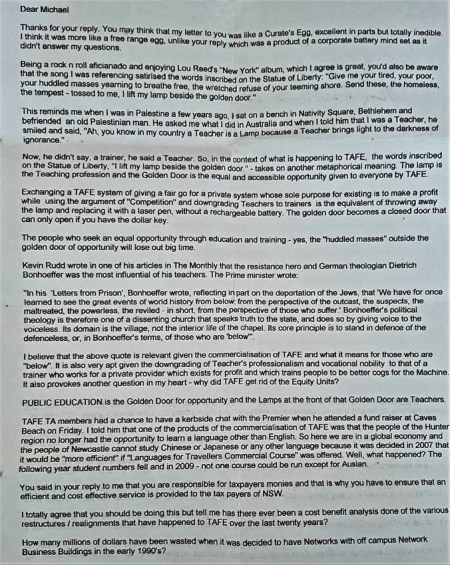
I found a printed copy of an email I sent the then Director General of Education & TAFE, Michael Crouts-Trotter. I couldn’t find the last paragraph but this is the main part o the email. I think it was written around 2006. Anyway, reading it now in 2020 I realise how idealistic I was. So, here it is, a copy of the printed email made by my mobile phone camera.

Reply to Michael Cotts Trouter


The Devil’s Secret

October 16, 2009


The following quote comes from ” The Conference of the Birds”   a beautiful Sufi Persian Book of Poems written in 1177 by  Farid ud – Din Attar.

During the 1970’s it was adapted into a play by Peter Brook and  Jean-Claude Carriere which Brook took on a tour through parts of wild Africa and performed in the streets and later to Western audiences in New York, Paris and in Sydney. I was lucky at the time because I was living in Sydney and saw it. The play communicated at a very subliminal level in that it didn’t really matter if you understood rationally what the actors were saying because the “meaning” was transmitted almost viscerally through the movements and the sounds that emanated from the stage.

The devil’s secret:

       God said to Moses once:  “Go out and find                        

       The secret truth that haunts the devil’s mind,”

       When Moses met the devil that same day

       He asked for his advice and heard him say:

       “Remember this, repeat it constantly,

       Don’t speak of ‘me’, or you will be like me.”

       If life still holds you by a single hair,

       The end of  all your toil will be despair;

       No matter how you prosper, there will rise

       Before your face a hundred smirking “I”s.

                              The Conference of the Birds 

Conference_of_the_birds

“Manteq at-Ṭayr” (“Conference of the Birds”)


Disorderly genius: How chaos drives the brain

September 27, 2009

This is an interesting article that made me feel better about my messy desk and my generally chaotic thinking processes. Sure, it all looks so smooth and organised here on the screen with a blog and its “machinery” to make it all look so “together”. The reality is that I put this stuff up here so that it doesn’t get lost in my personal chaos I call my study. The computer helps a lot to make things seem so organised but I can assure you that what appears pre planned and strategically placed to direct your thinking in a certain way, is purely “chance”….well, you know if you’ve been reading my posts here that I don’t believe in chance but rather in synchronicity.

Anyway, read this article and you who are as chaotic as me and have a messy exterior like me may crack a smile and feel a little better about yourself. Even if you are kidding yourself, because the article is about all human brains 🙂

Oh yeh, the reason I’ve put the text of the article here on my blog is because I just want it contextualised with the other stuff I have here. In other words, I’m using the blog’s  “machinery” to organise my chaos…cool huh? If you click on the link, the New Scientist page will show you videos and all sorts of interesting add ons.

Disorderly genius: How chaos drives the brain
New Scientist 29 June 2009 by David Robson

HAVE you ever experienced that eerie feeling of a thought popping into your head as if from nowhere, with no clue as to why you had that particular idea at that particular time? You may think that such fleeting thoughts, however random they seem, must be the product of predictable and rational processes. After all, the brain cannot be random, can it? Surely it processes information using ordered, logical operations, like a powerful computer?

Actually, no. In reality, your brain operates on the edge of chaos. Though much of the time it runs in an orderly and stable way, every now and again it suddenly and unpredictably lurches into a blizzard of noise.

Neuroscientists have long suspected as much. Only recently, however, have they come up with proof that brains work this way. Now they are trying to work out why. Some believe that near-chaotic states may be crucial to memory, and could explain why some people are smarter than others.

In technical terms, systems on the edge of chaos are said to be in a state of “self-organised criticality”. These systems are right on the boundary between stable, orderly behaviour – such as a swinging pendulum – and the unpredictable world of chaos, as exemplified by turbulence.

The quintessential example of self-organised criticality is a growing sand pile. As grains build up, the pile grows in a predictable way until, suddenly and without warning, it hits a critical point and collapses. These “sand avalanches” occur spontaneously and are almost impossible to predict, so the system is said to be both critical and self-organising. Earthquakes, avalanches and wildfires are also thought to behave like this, with periods of stability followed by catastrophic periods of instability that rearrange the system into a new, temporarily stable state.

Self-organised criticality has another defining feature: even though individual sand avalanches are impossible to predict, their overall distribution is regular. The avalanches are “scale invariant”, which means that avalanches of all possible sizes occur. They also follow a “power law” distribution, which means bigger avalanches happen less often than smaller avalanches, according to a strict mathematical ratio. Earthquakes offer the best real-world example. Quakes of magnitude 5.0 on the Richter scale happen 10 times as often as quakes of magnitude 6.0, and 100 times as often as quakes of magnitude 7.0.

These are purely physical systems, but the brain has much in common with them. Networks of brain cells alternate between periods of calm and periods of instability – “avalanches” of electrical activity that cascade through the neurons. Like real avalanches, exactly how these cascades occur and the resulting state of the brain are unpredictable.

It might seem precarious to have a brain that plunges randomly into periods of instability, but the disorder is actually essential to the brain’s ability to transmit information and solve problems. “Lying at the critical point allows the brain to rapidly adapt to new circumstances,” says Andreas Meyer-Lindenberg from the Central Institute of Mental Health in Mannheim, Germany.

Disorder is essential to the brain’s ability to transmit information and solve problems. The idea that the brain might be fundamentally disordered in some way first emerged in the late 1980s, when physicists working on chaos theory – then a relatively new branch of science – suggested it might help explain how the brain works.

The focus at that time was something called deterministic chaos, in which a small perturbation can lead to a huge change in the system – the famous “butterfly effect”. That would make the brain unpredictable but not actually random, because the butterfly effect is a phenomenon of physical laws that do not depend on chance. Researchers built elaborate computational models to test the idea, but unfortunately they did not behave like real brains. “Although the results were beautiful and elegant, models based on deterministic chaos just didn’t seem applicable when looking at the human brain,” says Karl Friston, a neuroscientist at University College London.

In the 1990s, it emerged that the brain generates random noise, and hence cannot be described by deterministic chaos. When neuroscientists incorporated this randomness into their models, they found that it created systems on the border between order and disorder – self-organised criticality.

More recently, experiments have confirmed that these models accurately describe what real brain tissue does. They build on the observation that when a single neuron fires, it can trigger its neighbours to fire too, causing a cascade or avalanche of activity that can propagate across small networks of brain cells. This results in alternating periods of quiescence and activity – remarkably like the build-up and collapse of a sand pile.

Neural avalanches
In 2003, John Beggs of Indiana University in Bloomington began investigating spontaneous electrical activity in thin slices of rat brain tissue. He found that these neural avalanches are scale invariant and that their size obeys a power law. Importantly, the ratio of large to small avalanches fit the predictions of the computational models that had first suggested that the brain might be in a state of self-organised criticality (The Journal of Neuroscience, vol 23, p 11167).

To investigate further, Beggs’s team measured how many other neurons a single cell in a slice of rat brain activates, on average, when it fires. They followed this line of enquiry because another property of self-organised criticality is that each event, on average, triggers only one other. In forest fires, for example, each burning tree sets alight one other tree on average – that’s why fires keep going, but also why whole forests don’t catch fire all at once.

Sure enough, the team found that each neuron triggered on average only one other. A value much greater than one would lead to a chaotic system, because any small perturbations in the electrical activity would soon be amplified, as in the butterfly effect. “It would be the equivalent of an epileptic seizure,” says Beggs. If the value was much lower than one, on the other hand, the avalanche would soon die out.

Beggs’s work provides good evidence that self-organised criticality is important on the level of small networks of neurons. But what about on a larger scale? More recently, it has become clear that brain activity also shows signs of self-organised criticality on a larger scale.

As it processes information, the brain often synchronises large groups of neurons to fire at the same frequency, a process called “phase-locking”. Like broadcasting different radio stations at different frequencies, this allows different “task forces” of neurons to communicate among themselves without interference from others.

The brain also constantly reorganises its task forces, so the stable periods of phase-locking are interspersed with unstable periods in which the neurons fire out of sync in a blizzard of activity. This, again, is reminiscent of a sand pile. Could it be another example of self-organised criticality in the brain?

In 2006, Meyer-Lindenberg and his team made the first stab at answering that question. They used brain scans to map the connections between regions of the human brain and discovered that they form a “small-world network” – exactly the right architecture to support self-organised criticality.

Small-world networks lie somewhere between regular networks, where each node is connected to its nearest neighbours, and random networks, which have no regular structure but many long-distance connections between nodes at opposite sides of the network (see diagram). Small-world networks take the most useful aspects of both systems. In places, the nodes have many connections with their neighbours, but the network also contains random and often long links between nodes that are very far away from one another.

For the brain, it’s the perfect compromise. One of the characteristics of small-world networks is that you can communicate to any other part of the network through just a few nodes – the “six degrees of separation” reputed to link any two people in the world. In the brain, the number is 13.

Meyer-Lindenberg created a computer simulation of a small-world network with 13 degrees of separation. Each node was represented by an electrical oscillator that approximated a neuron’s activity. The results confirmed that the brain has just the right architecture for its activity to sit on the tipping point between order and disorder, although the team didn’t measure neural activity itself (Proceedings of the National Academy of Sciences, vol 103, p 19518).

That clinching evidence arrived earlier this year, when Ed Bullmore of the University of Cambridge and his team used brain scanners to record neural activity in 19 human volunteers. They looked at the entire range of brainwave frequencies, from 0.05 hertz all the way up to 125 hertz, across 200 different regions of the brain.

Power laws again

The team found that the duration both of phase-locking and unstable resynchronisation periods followed a power-law distribution. Crucially, this was true at all frequencies, which means the phenomenon is scale invariant – the other key criterion for self-organised criticality.

What’s more, when the team tried to reproduce the activity they saw in the volunteers’ brains in computer models, they found that they could only do so if the models were in a state of self-organised criticality (PLoS Computational Biology, vol 5, p e1000314). “The models only showed similar patterns of synchronisation to the brain when they were in the critical state,” says Bullmore.

The work of Bullmore’s team is compelling evidence that self-organised criticality is an essential property of brain activity, says neuroscientist David Liley at Swinburne University of Technology in Melbourne, Australia, who has worked on computational models of chaos in the brain.

But why should that be? Perhaps because self-organised criticality is the perfect starting point for many of the brain’s functions.

The neuronal avalanches that Beggs investigated, for example, are perfect for transmitting information across the brain. If the brain was in a more stable state, these avalanches would die out before the message had been transmitted. If it was chaotic, each avalanche could swamp the brain.

At the critical point, however, you get maximum transmission with minimum risk of descending into chaos. “One of the advantages of self-organised criticality is that the avalanches can propagate over many links,” says Beggs. “You can have very long chains that won’t blow up on you.”

Self-organised criticality also appears to allow the brain to adapt to new situations, by quickly rearranging which neurons are synchronised to a particular frequency. “The closer we get to the boundary of instability, the more quickly a particular stimulus will send the brain into a new state,” says Liley.

It may also play a role in memory. Beggs’s team noticed that certain chains of neurons would fire repeatedly in avalanches, sometimes over several hours (The Journal of Neuroscience, vol 24, p 5216). Because an entire chain can be triggered by the firing of one neuron, these chains could be the stuff of memory, argues Beggs: memories may come to mind unexpectedly because a neuron fires randomly or could be triggered unpredictably by a neuronal avalanche.

The balance between phase-locking and instability within the brain has also been linked to intelligence – at least, to IQ. Last year, Robert Thatcher from the University of South Florida in Tampa made EEG measurements of 17 children, aged between 5 and 17 years, who also performed an IQ test.

The balance between stability and instability in the brain has been linked with intelligence, at least as measured by scores on an IQ test. He found that the length of time the children’s brains spent in both the stable phase-locked states and the unstable phase-shifting states correlated with their IQ scores. For example, phase shifts typically last 55 milliseconds, but an additional 1 millisecond seemed to add as many as 20 points to the child’s IQ. A shorter time in the stable phase-locked state also corresponded with greater intelligence – with a difference of 1 millisecond adding 4.6 IQ points to a child’s score (NeuroImage, vol 42, p 1639).

Thatcher says this is because a longer phase shift allows the brain to recruit many more neurons for the problem at hand. “It’s like casting a net and capturing as many neurons as possible at any one time,” he says. The result is a greater overall processing power that contributes to higher intelligence.

Hovering on the edge of chaos provides brains with their amazing capacity to process information and rapidly adapt to our ever-changing environment, but what happens if we stray either side of the boundary? The most obvious assumption would be that all of us are a short step away from mental illness. Meyer-Lindenberg suggests that schizophrenia may be caused by parts of the brain straying away from the critical point. However, for now that is purely speculative.

Thatcher, meanwhile, has found that certain regions in the brains of people with autism spend less time than average in the unstable, phase-shifting states. These abnormalities reduce the capacity to process information and, suggestively, are found only in the regions associated with social behaviour. “These regions have shifted from chaos to more stable activity,” he says. The work might also help us understand epilepsy better: in an epileptic fit, the brain has a tendency to suddenly fire synchronously, and deviation from the critical point could explain this.

“They say it’s a fine line between genius and madness,” says Liley. “Maybe we’re finally beginning to understand the wisdom of this statement.”

David Robson is a junior editor at New Scientist


As I write this ……

September 17, 2009

twitter-snake-handAs I write this and you consider the meaning of what I write I doubt that you will take the factual, scientific way to understand what I write.
The scientific “objective” way dictates that you look at only the empirically observable and measurable to ascertain meaning. This means, taking it “literally” (and this is the only scientific way to take it) that you will look at the scribbles or the type, analyze the chemical constituents of the ink, the angle of pressure of the scribble or the level of impact pressure of the fonts, consider the type of ball point pen, fountain pen, pencil or printer or screen. If you are considering a hand written piece, you will consider the forces that pushed the pen, the fingers attached to the hand. You may perhaps even analyse the skin and the temperature which surrounded the hand when the writing occurred.

In short, you would have looked at all the physically observable items and still would not get to the MEANING. I write, “The sky is blue.” You can verify the statement only after understanding its meaning by looking up at the sky. However, if you only analysed the ink, my fingers and room temperature, you would not get the MEANING.

Now, taking this one step or leap further, perhaps our life is a kind of writing, a kind of story written in flesh and blood and its MEANING is not measured with scientific rulers and scales but something else. Perhaps the lineaments of meaning are drawn between synchronous events, which may be called chance or even coincidence. When does chance, coincidence become synchronicity? It does so when we put in our own individual subjective feeling / understanding to it ie our MEANING.

Science has no place in this sacred space of MAKING MEANING.

Carl G Jung originally wrote the "philosophical" understanding of synchronicity.

Carl G Jung originally wrote the “philosophical” understanding of synchronicity.


Guerilla Ontology – Robert Anton Wilson

September 12, 2009

A great quote:

Robert Anton Wilson (1932 - 2007)

Robert Anton Wilson (1932 – 2007)

‘I don’t trust the people as much as anarchists do.” He states that all Belief Systems are just that: BS:

“The Western World has been brainwashed by Aristotle for the last 2,500 years. The unconscious, not quite articulate, belief of most Occidentals is that there is one map which adequately represents reality. By sheer good luck, every Occidental thinks he or she has the map that fits. Guerrilla ontology, to me, involves shaking up that certainty. I use what in modern physics is called the “multi-model” approach, which is the idea that there is more than one model to cover a given set of facts. As I’ve said, novel writing involves learning to think like other people. My novels are written so as to force the reader to see things through different reality grids rather than through a single grid. It’s important to abolish the unconscious dogmatism that makes people think their way of looking at reality is the only sane way of viewing the world. My goal is to try to get people into a state of generalized agnosticism, not agnosticism about God alone, but agnosticism about everything. If one can only see things according to one’s own belief system, one is destined to become virtually deaf, dumb, and blind. It’s only possible to see people when one is able to see the world as others see it. That’s what guerilla ontology is — breaking down this one-model view and giving people a multi-model perspective.”

Robert Anton Wilson


From the Archives – Newcastle, Australia becomes a Welcome Town for Refugees

September 11, 2009


Way back in 2002 I was part of two groups which had a focus on human rights and refugee issues.

The more “operational” and lobbying aspect had expression in the group Newcastle Action for Refugee Rights (NARR). My more “cultural jamming” and “Situationist – Anarchist” aspect had its expression in HOPE Caravan. It was through HOPE Caravan that I was involved in the Easter Actions at Woomera Detention Centre in 2002 and Baxter Detention Centre in 2003. It was also as part of HOPE Caravan that the Flotillas of Hope found expression.

Hope Caravan logo we used on our now absent website.

Hope Caravan logo we used on our now absent website. The drawing was based on an original pencil drawing made by a prisoner at Woomera Detention Centre. He gave us permission to use it.

As part of NARR, I, along with others presented a proposal to Newcastle City Council to make Newcastle, Australia, an official Welcome Town for Refugees. Here’s the link to the whole proposal we presented at Newcastle City Council >> Welcome Town Presentation – thanks Jack for taking the time to make it available on your website.

Now that the dark years of the John Howard’s Decade is over in Australia, it is important that we are reminded that there were people in Australia (many, many of us) that were ashamed at the opportunistic tickling of the xenophobic underbelly of the Australian people that Howard’s genius did. People say that he was not a racist. Maybe he wasn’t in a way that Hitler was, but his myopic vision and policies that demonised innocent people who were seeking a new life were.

Anyway, I don’t want to go on about him here, suffice to say that there were Australians around during the Dark Howard Decade who stood against his crap.

My social conscience is clear and I’m proud to say that I was one of them.

NARR conducted a sympathy fast with the hunger strikers at Woomera Detention Centre in 2002. This is the tent we lived in at Civic Park, Newcastle. The head on the corner is a paper mache of Philip Ruddock, the Immigration Minister at the time.

NARR conducted a sympathy fast with the hunger strikers at Woomera Detention Centre in 2002. This is the tent we lived in at Civic Park, Newcastle. The head on the corner is a paper mache of Philip Ruddock, the Immigration Minister at the time.