The Corporatisation & Destruction of TAFE – History Rhymes

November 7, 2009

Below is an article I wrote “History may not repeat itself, but it sure does Rhyme!” in 2008 while I was working in TAFE as the TAFE Teachers Association (Hunter Institute) Peace Officer. Peace Officer? Well, it was a title given so that Management couldn’t hassle me because I was representing the Union. I was aggravating Management with some of my communications questioning the Corporate Culture that was infecting Public Education – especially TAFE.

It’s primary intention was to record the history of the corporatization of TAFE for the younger teachers who would never get to know TAFE as a public education provider. TAFE was the greatest social justice and equity mechanism in the world because it gave hope and education to those who were disadvantaged and poor. Those educated and trained through TAFE could then get jobs that would alleviate their disadvantage. TAFE did not only cater for the needy but it’s Access and Equity programs and policies ensured that the needy were supported.

It was obvious to me that the plan to corporatize TAFE and gradually get rid of Access and Equity programs and policies was created at least in the early 1990’s. It was also obvious to me that the government wanted to privatize Vocational Education and Training (VET). We all knew it. In NSW we saw what happened in Victoria, Queensland and Tasmania. We would never let that happen in NSW? Well, we did allow it to happen and now we are witnessing TAFE’s destruction.

Knowing that the Senior Executive Service doesn’t strategise by the 6 monthly semester or even annually but at least a decade ahead I tried to organize Save TAFE Festivals and a website which would highlight the corrosive effect that corporatization was having. The website would include every Institutes’ offering with the numbers of vacant teaching positions NOT filled – by Faculty and Campus. It would also show the stupid, mindless restructures that happened over the years which were done to destroy TAFE staff’s morale. For some unknown to me reason TAFE TA didn’t support the idea. They didn’t support the Save TAFE Festivals idea either. I had two Institutes’ teachers showing interest with over 100 staff in both stating they would support the idea. I asked the Union for the email address database of all NSW members which they refused to give me. I asked that they forward the emails to all NSW members which they refused to do.

I was told that some Union Council members were against both the Save TAFE Festivals and exposing / dobbing in website because if they were successful it would show management that there was no need for extra resources because TAFE teachers could do so much just by organizing and donating their time and expertise. What the fuck! But that is what I was told.

I was also told by Council members that my ideas were far too radical and that most Union members only care about their salary and conditions. I couldn’t accept that baby boomers who were about to retire wouldn’t do as much as possible to Save TAFE because they had nothing to lose. They were superannuated and tenured so they couldn’t be sacked and even if they were hassled so what? They only had one to five years of not being liked by management. But no – in their smugness and complacency, in their relaxed and comfortable slumber they let TAFE be destroyed.

I left TAFE in 2010 because I was getting bitter towards my fellow teachers and Union members. We had a great  strike turn out for our conditions earlier but to SAVE TAFE – only very few gave a shit. I didn’t want a bitter heart while remaining in TAFE for a few more years. The way it turned out, I need not have worried because all those jobs disappeared! I must admit some schadenfreude  when I heard that most of my Managers & some of the teachers who told me I was over the top paranoid about the future of TAFE lost their jobs.

Now we are witnessing the wholesale destruction of TAFE – many of us saw it coming but few wanted to do anything about it.

The current Managers of TAFE should be ashamed of themselves for they are accomplices in the greatest destruction of world best mechanism for social justice and equity.

The following was originally sent as an attachment then I put it up on a cloud as a PDF document. I’m now including it here so that when needed I can send link via Twitter.

Right at the end of the History Repeats article is a post I put up about 6 months before I left TAFE. Since I couldn’t get a website going through the Union I did my little bit on this blog. The egroup & Save TAFE blog no longer exist.

Stavros

January, 2016

========================================================================

UPDATE >> 29 June, 2018 Read this and weep! EVERYTHING predicted in this post has come to be. 

New figures quantify the extent of the TAFE disaster
http://stoptafecuts.com.au/blog/new-figures-quantify-extent-tafe-disaster

========================================================================

UPDATE >> 21 November, 2017 Letter to the Editor, Sydney Morning Herald

Vocational Education a mere shadow of its former self.

TAFE Eviscerated

===========================================================================

Sometime in 2008

History may not repeat itself, but it sure does Rhyme!

Hello Everyone,

Greetings from your Hunter TAFETA Peace Officer.

I morphed into this role a few weeks ago during a TAFETA Branch Meeting at Newcastle Campus and I wasn’t even there! I accepted the nomination and here I am writing to you. I figure that I’m better placed than that poor bloke in Franz Kafka’s story,“Metamorphosis” where he woke up one morning to find he had morphed into a cockroach. At least in this role, I can communicate … and that is what this TAFETA role is about….. I think.

I have lived long enough to have experienced as a teenager the first landing on the moon by a human and a time when a single computer occupied an entire building. Now I live in a time, when other solar systems are being discovered in our galaxy and a silicon chip is in every home and office, if not in your pocket. I have also lived long enough to see Public Service change from serving the public to marketing to customers. In DET, students have become clients and in TAFE, we lost our Principals to get Managers and we are now in the process of losing our principles and teachers for trainers.

The document, TAFE NSW Doing Business in the 21st Century, arrived in my inbox and the thought crossed my mind that it’s important the history of what happened since 1988 to TAFE should be recorded. When we, the Great Demographic Blimp of Baby Boomers, leave TAFE over the next few years, this knowledge will disappear.

History may not repeat itself but I reckon it rhymes.

Rhyming patterns may be discerned in this 20 year history. These in turn may resonate into the future. Younger TAFETA members will tune into echoes and hear the rhymes of crimes, the chimes in the times. They will be prepared to project from these rhymes of history possible “new” beginnings and probable lies.

So instead of looking towards the future I turned around and saw a hazy scene, a kind of otherworldly reminiscence. Like an eagle gliding above, I saw over 50,000 teachers from schools and TAFE colleges converging and congregating at Hyde Park in 1988. I remember having travelled by bus from Wagga, along with many others from across NSW, to protest the fundamental change in direction for public education which was being pushed by the then Greiner Liberal State Government.

Terry Metherill, the Education Minister at the time, decided that it was time for Public Education to walk the path (plank?) of economic and cultural redemption. As a matter of historical record, Nick Greiner was a disciple of Margaret Thatcher’s Gospel of Economic Rationalism, she of the “there is no society” fame. He took it upon himself to transplant the Corporate Business Culture (CBC), structure and processes into the Public Service.

You may ask, “What is wrong with Corporate Culture?” Well, it may be fine if the prime purpose of an organisation is to make money at the expense of everything else. In fact, if a human was a Corporation their psychology would be diagnosed as psychopathic. A book by Joel Bakan called “The Corporation – the Pathological Pursuit of Profit and Power” outlines these features and why the Corporate model is dangerous for a Public Service.

Educational service exists for reasons that transcend making a profit, so if you transplant a culture and model – of being from an entity which exists solely to make money onto education you have created an organisation creaking with tensions and contradictions. These tensions are exacerbated because Corporate goals contradict Teaching goals, no matter how many Mission and Quality Value Statements are made in glossy brochures.

Anyway, Terry Metherill, Nick Greiner’s loyal Education Minister began his major restructure of Education to make it Corporate. He didn’t explain why, he just didit because it was a matter of economic rationalist faith – a user pay doctrine of an irrational ideology.

So how did we arrive where we are now? What did these Economic Rationalists do? Why did we educators, teachers and citizens protest in 1988 and have gone quiet since then?

Well, the first thing Greiner and Metherill did was to create the Senior Executive Service SES. The Corporate Business Model dictated an SES which was separate from the rest of the organisation and placed on 3 – 5 year contracts. They could earn bonuses too if they performed according to the specifications of their contract. So, if they could demonstrate that under their watch they came in under budget they would get a bonus.

No longer were the Heads of Public Service organisations permanent with tenure andthus could advise and run their organisation according to the needs of the public withoutfear or favour but had to perform according to the dictates of their political masters or face the sack. Greiner had politicised the State Public Service which Howard would later do tothe Commonwealth Public Service in a much more sinister way. The best example of this was the break up of Commonwealth Employment Service (CES) to Jobnet Private Providers.

About a year or so later, Greiner set up the Scott Report and then the Predl Report which had to review all of the Access and Equity Services. When Scott and Predl reported that the Access and Equity Services were excellent and needed more funding rather than be dismantled, Greiner and Metherill weren’t too pleased.

The next step was to impose a “Managerial” culture onto the Principals and Teachers. They got rid of all Principals and in their place created Managers. I remember talking with a few of the Principals who had lost their jobs because of the restructure and how they felt about the changes. They felt that Corporate Accounting Procedures were central to their new role rather than pedagogy and educational guidance. They lamented the loss of true educational leadership and the rise of the Corporate Manager within an educational institution.

One feature of this Corporate Managerialism is that no longer is it expected those in management roles in Faculties have to have expertise in the Faculty’s skill base they manage. In fact, they don’t even need to have been teachers. All that is needed are generic management skills where the manager does not have to know anything about the educational content of the faculty, just how to manage budgets and human resources, preferably with an MBA. So, an accountant would be ideal to be a Faculty Director of Access and General Education.

One thing that was pivotal in creating the “Corporate Business Culture” in TAFE was to ensure that there was a separation in working conditions between Principals and Teachers. This meant that the new Managers did not have the same conditions as Teachers which guaranteed that no longer would there be “solidarity” between Principals and Teachers. The first Institute Managers (IM’s) were restructured into these positions from their previous educational leadership positions. They had no choice but to take up what was on offer or lose their jobs.

A friend who was forced into becoming an IM told me that when he complained to the Institute Director (ID) about the situation the ID said, “You’ve got a job, haven’t you? Don’t complain.”

In the 1990’s we witnessed a change from TAFE Regions to Networks. In fact our Institute was separated into three networks Newcastle Urban Network, Hunter Network and Central Coast were part of North Sydney Network. Along with these Networks came new signage, new stationery and new offices. In the Network model it was believed that Network Administration offices had to be separate from the “business” of the campus. This meant that money was spent in creating new office space away from the campuses. A little later another restructure saw the creation of Hunter Institute of Technology. Only a few of the TAFE Institutes were Institutes of Technology, the majority were Institutes of TAFE. This entailed spending money on NEW signage and stationery. The new signage evenwitnessed new logos for each Institute. Then there was another restructure where all Institutes became Institutes of TAFE and with one brand sign TAFE, NSW.

All the while the Marketing areas of these restructured organisations gained in powerand status. To emphasize the new Corporate Hierarchy, palatial offices were created to house the CEO’s, the Institute Directors. Meanwhile, classes and programs were cut and new “Centres of Excellence” were created which rationalised the delivery of programs away from local campus provision to one place within the Institute. So students who attended a Muswellbrook course in Automotive Engineering would now have to travel to Glendale Campus which was the ONLY campus offering the course.

I do not know if there has ever been a cost benefit analysis of all these restructures but I imagine that the cost would be in the order of millions. How many classes could have been run for the cost of these failed restructures? Has anyone reviewed the Senior Executive Service structure to see if it is beneficial to the community?

I don’t know if Teachers Federation has researched and reviewed the restructures involved. Maybe I’m a little naive about this but it seems to me that whenever there has been a review and then a restructure we just go along with the ride. WHY?

Sure salary and conditions are important, but who is responsible for the “culture” of an educational organisation, if not us teachers? The effect is that we now have the Managerial Culture infecting head teacher positions where the main work seems to be compliance and accounting of the budget.

In another decade we may find that TAFE will become TVT Technical and Vocational Training, where Head Teachers will be Program Managers on 3 – 5 year contracts responsible for hiring “trainers” casually or on short term contracts. These Program Managers may also be offered bonuses if they perform according to their contracts. In other words, they will have similar work conditions to the Senior Executive Service but with much less pay and less responsibility.

We may even find that online education will do away with buildings so that TAFE campuses become smaller and in regional areas non existent. Private providers may rent these ghost buildings for bugger all and if students need practical training they can come in for a few days per year. Impossible? Improbable? Let’s see.

Already the powers that be, have decided that TAFE teachers do not need a Diploma of Education, just a Training Certificate will do, since we all have Cert 4’s to satisfy Registered Training Organisation (RTO) status. Do you remember your initial response when told that you have to do the Certificate 4 in Workplace Training? I bet it was something like, “Why? I’ve already got a Dip Ed. I can’t see why I have to get a lower qualification because you say so.” But most of us did it and now we find that TAFE Management doesn’t want your Dip Ed because they want trainers NOT teachers. Don’t forget, trainers are cheaper than teachers and in this competitive market place private providers use trainers, so what chance have teachers got? Why has our Union gone along with this? Beats me! I refuse to do the Certificate 4 – and so should all of us.

TAFE lost its Principals in the 1990’s to get Managers, now it looks like TAFE will lose its Teachers to get Trainers in the 21 st Century.

 I remember a few years ago when I was visiting Bethlehem in Palestine, sitting on a bench in Nativity Square. Along came an old man with an Arafat like profile who sat next to me. When he realized that while I was of Middle Eastern appearance, I didn’t speak Arabic but only Greek and English, we began speaking in that half telepathic, half verbal way in English that happens sometimes between people of different backgrounds when they want to communicate.

Anyway, he found out that I was a teacher and he said something which has touched me to the core ever since. He said, “In our culture a Teacher is a Lamp because a Teacher brings the light of knowledge to the darkness of ignorance.” Note, not a trainer but a Teacher. The two roles are completely different and now Management wants to get rid of Teachers in TAFE.

How many restructures have we had since the late eighties? What happens when an organisation is in a constant state of restructuring? One thing that is obvious is that there is an ambience of uncertainty. People worry about their positions and their jobs. As anyone with a modicum of common sense knows, people do not innovate and create when they are scared and insecure. We have had a culture of fear and uncertainty for about 20 years and I don’t think having an Institute Manager position Director of Innovation will create the psychological space for creativity to be born. It appears that we have been surviving in the Realm of the Perpetual Restructure.

While I’m sympathetic to the Buddhist concept that the only constant in the world is Change, I do not feel that these constant restructures are based on a sense of the sacred.

I believe that the Equity Units of TAFE are what makes TAFE uniquely different to any private provider. In many ways the Equity Units are TAFE’s sensitive antennae picking up trends and subtle changes in the scales of social justice. What happens to Equity Units happens to everyone else in DET, sooner or later. Right now all Equity Units are going through another review and there is talk about creating a new Social Inclusion Unit. However, before you younger ones cheer, please understand that 20 years ago the Central Equity Units had more than 60 people and now have about 20. If we go by what has happened in the past, why wouldn’t we believe that the Central Equity Units will become a Social Inclusion Unit with three, if not one member of staff?

Hunter Institute’s Multicultural Education Unit won a Quality Award in 2007 for the work it is doing with African refugees. This is great, good work is being acknowledged but when you consider that the category in which the Quality Award was given, it kind of changes one’s feelings. The Award states: “The African Experience” Business Relationships. Yes, a social justice project that worked closely with the local community did not have a category called “Social Justice” or “Community Relations” to call home. To fulfil the Corporate ethos this spherical, “Whole of Life” project had to be put into a corporate cube.

History may not repeat but it sure does rhyme!

After the consultations for the Doing Business in the 21st Century are over, you can bet, like clockwork, there will be another Restructure, Realignment Re – whatever word they will use for it. Why don’t we have a Review of the “Restructurers”? I sometimes wonder if these Managers who order restructures do it just to be seen to be doing something. It is often easier to dismantle and restructure than to create and build.

Maybe, I’m having an attack of nostalgia for a world that has disappeared and a paranoid fantasy that in TAFE’s place, a 21st Century TVT Corporation is coming. Assuming that there will be another restructure, whatever name or spin they put to it, what will happen? What needs to happen? Can we do anything about it?

I believe that Teachers Federation is like a sleeping giant. I don’t mean to take away any of our great achievements as a Union but I would love to see the sleeping giant wake up and say “enough is enough” with the corporatisation of our educational service. We can do it if we have the will. However, I am inclined to feel that as we older ones leave TAFE, the younger ones who have not known a non corporate TAFE culture, will go along with the changes because that is all they know and recognise.

What if we do wake up collectively, what can we do?

Well, being a Peace, Love and Hope kind of bloke, I believe that if enough of us have a vision and if this vision is rooted in pure intention, that Magic can happen, that serendipity and synchronicity are not just long words but mean something vital, that Leonard Cohen was right when he wrote, “God is alive, Magic is afoot”, that, Kev Carmody and Paul Kelly are right that “From Little Things Big Things Grow”. However, saying this does not preclude organising collectively. We can organise locally by forming affinitygroups / clusters of action.

To do what?

We need to take individual responsibility and to join with other like minded members to develop and create new strategies that arise from locally relevant issues. As a start, every time our Managers tell us to do something we can ask

“WHY?” and keep asking “Why?” and not be satisfied with answers that allude to “because that is the way it is” or “because we have been told to”. Keep onpushing through to the essence of what is being directed by asking the simple question “why?” I have been surprised how far this question has taken me into the realm of the human instead of the wasteland of the corporate.

Here’s some other stuff we can do:

If asked for a student tally, refer the manager to CLAMS; for a budget summary, tell them to see Buddy; for FCPS, say, “Here’s my current provision, for next semester’s, ask me then.” You all know that these “tools” do not help us, they are a burden. Yet we do them. Then the managers ask us for simple info instead of using the tools created for their use! Don’t forget that as we use these “tools” we embed the “managerial” culture into our positions and we acquiesce and then comply in the corporatisation of education.

If you want you can reply with some feedback which I can use to create a threadand send to TAFETA members. You may wish to share your own experiences of “corporatisation” and ways of taking it on. Keep sending your input to the Doing Business in the 21 st Century people, if it’s still open.

This may not sound like much but when you consider how many of us there are I’m certain that our combined imagination and creativity will come up with countless strategies to “decorporatise” our TAFE. Or, we can simply do nothing, roll over and sleep until we are superannuated out. The choice is ours.

For the younger members, at least you now have a story of how TAFE became corporatised before it became TVT Corp and maybe you will be able to recognise that historical rhyme when you hear it and thus be prepared.

All the best

stavros

Your Peace Officer

===========================================================================

I found a printed copy of an email I sent the then Director General of Education & TAFE, Michael Crouts-Trotter. I couldn’t find the last paragraph but this is the main part o the email. I think it was written around 2006. Anyway, reading it now in 2020 I realise how idealistic I was. So, here it is, a copy of the printed email made by my mobile phone camera.
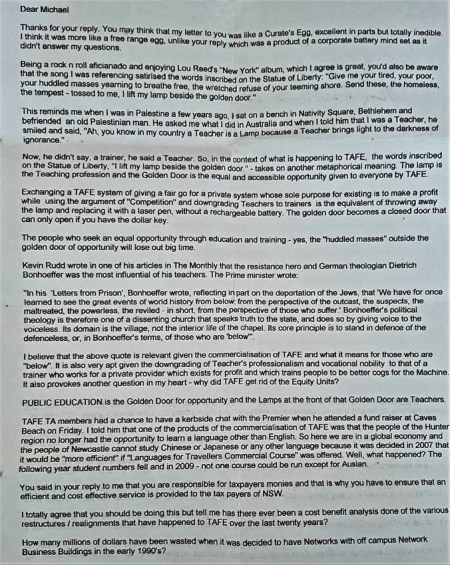
Reply to Michael Cotts Trouter


The Devil’s Secret

October 16, 2009


The following quote comes from ” The Conference of the Birds”   a beautiful Sufi Persian Book of Poems written in 1177 by  Farid ud – Din Attar.

During the 1970’s it was adapted into a play by Peter Brook and  Jean-Claude Carriere which Brook took on a tour through parts of wild Africa and performed in the streets and later to Western audiences in New York, Paris and in Sydney. I was lucky at the time because I was living in Sydney and saw it. The play communicated at a very subliminal level in that it didn’t really matter if you understood rationally what the actors were saying because the “meaning” was transmitted almost viscerally through the movements and the sounds that emanated from the stage.

The devil’s secret:

       God said to Moses once:  “Go out and find                        

       The secret truth that haunts the devil’s mind,”

       When Moses met the devil that same day

       He asked for his advice and heard him say:

       “Remember this, repeat it constantly,

       Don’t speak of ‘me’, or you will be like me.”

       If life still holds you by a single hair,

       The end of  all your toil will be despair;

       No matter how you prosper, there will rise

       Before your face a hundred smirking “I”s.

                              The Conference of the Birds 

Conference_of_the_birds

“Manteq at-Ṭayr” (“Conference of the Birds”)


Disorderly genius: How chaos drives the brain

September 27, 2009

This is an interesting article that made me feel better about my messy desk and my generally chaotic thinking processes. Sure, it all looks so smooth and organised here on the screen with a blog and its “machinery” to make it all look so “together”. The reality is that I put this stuff up here so that it doesn’t get lost in my personal chaos I call my study. The computer helps a lot to make things seem so organised but I can assure you that what appears pre planned and strategically placed to direct your thinking in a certain way, is purely “chance”….well, you know if you’ve been reading my posts here that I don’t believe in chance but rather in synchronicity.

Anyway, read this article and you who are as chaotic as me and have a messy exterior like me may crack a smile and feel a little better about yourself. Even if you are kidding yourself, because the article is about all human brains 🙂

Oh yeh, the reason I’ve put the text of the article here on my blog is because I just want it contextualised with the other stuff I have here. In other words, I’m using the blog’s  “machinery” to organise my chaos…cool huh? If you click on the link, the New Scientist page will show you videos and all sorts of interesting add ons.

Disorderly genius: How chaos drives the brain
New Scientist 29 June 2009 by David Robson

HAVE you ever experienced that eerie feeling of a thought popping into your head as if from nowhere, with no clue as to why you had that particular idea at that particular time? You may think that such fleeting thoughts, however random they seem, must be the product of predictable and rational processes. After all, the brain cannot be random, can it? Surely it processes information using ordered, logical operations, like a powerful computer?

Actually, no. In reality, your brain operates on the edge of chaos. Though much of the time it runs in an orderly and stable way, every now and again it suddenly and unpredictably lurches into a blizzard of noise.

Neuroscientists have long suspected as much. Only recently, however, have they come up with proof that brains work this way. Now they are trying to work out why. Some believe that near-chaotic states may be crucial to memory, and could explain why some people are smarter than others.

In technical terms, systems on the edge of chaos are said to be in a state of “self-organised criticality”. These systems are right on the boundary between stable, orderly behaviour – such as a swinging pendulum – and the unpredictable world of chaos, as exemplified by turbulence.

The quintessential example of self-organised criticality is a growing sand pile. As grains build up, the pile grows in a predictable way until, suddenly and without warning, it hits a critical point and collapses. These “sand avalanches” occur spontaneously and are almost impossible to predict, so the system is said to be both critical and self-organising. Earthquakes, avalanches and wildfires are also thought to behave like this, with periods of stability followed by catastrophic periods of instability that rearrange the system into a new, temporarily stable state.

Self-organised criticality has another defining feature: even though individual sand avalanches are impossible to predict, their overall distribution is regular. The avalanches are “scale invariant”, which means that avalanches of all possible sizes occur. They also follow a “power law” distribution, which means bigger avalanches happen less often than smaller avalanches, according to a strict mathematical ratio. Earthquakes offer the best real-world example. Quakes of magnitude 5.0 on the Richter scale happen 10 times as often as quakes of magnitude 6.0, and 100 times as often as quakes of magnitude 7.0.

These are purely physical systems, but the brain has much in common with them. Networks of brain cells alternate between periods of calm and periods of instability – “avalanches” of electrical activity that cascade through the neurons. Like real avalanches, exactly how these cascades occur and the resulting state of the brain are unpredictable.

It might seem precarious to have a brain that plunges randomly into periods of instability, but the disorder is actually essential to the brain’s ability to transmit information and solve problems. “Lying at the critical point allows the brain to rapidly adapt to new circumstances,” says Andreas Meyer-Lindenberg from the Central Institute of Mental Health in Mannheim, Germany.

Disorder is essential to the brain’s ability to transmit information and solve problems. The idea that the brain might be fundamentally disordered in some way first emerged in the late 1980s, when physicists working on chaos theory – then a relatively new branch of science – suggested it might help explain how the brain works.

The focus at that time was something called deterministic chaos, in which a small perturbation can lead to a huge change in the system – the famous “butterfly effect”. That would make the brain unpredictable but not actually random, because the butterfly effect is a phenomenon of physical laws that do not depend on chance. Researchers built elaborate computational models to test the idea, but unfortunately they did not behave like real brains. “Although the results were beautiful and elegant, models based on deterministic chaos just didn’t seem applicable when looking at the human brain,” says Karl Friston, a neuroscientist at University College London.

In the 1990s, it emerged that the brain generates random noise, and hence cannot be described by deterministic chaos. When neuroscientists incorporated this randomness into their models, they found that it created systems on the border between order and disorder – self-organised criticality.

More recently, experiments have confirmed that these models accurately describe what real brain tissue does. They build on the observation that when a single neuron fires, it can trigger its neighbours to fire too, causing a cascade or avalanche of activity that can propagate across small networks of brain cells. This results in alternating periods of quiescence and activity – remarkably like the build-up and collapse of a sand pile.

Neural avalanches
In 2003, John Beggs of Indiana University in Bloomington began investigating spontaneous electrical activity in thin slices of rat brain tissue. He found that these neural avalanches are scale invariant and that their size obeys a power law. Importantly, the ratio of large to small avalanches fit the predictions of the computational models that had first suggested that the brain might be in a state of self-organised criticality (The Journal of Neuroscience, vol 23, p 11167).

To investigate further, Beggs’s team measured how many other neurons a single cell in a slice of rat brain activates, on average, when it fires. They followed this line of enquiry because another property of self-organised criticality is that each event, on average, triggers only one other. In forest fires, for example, each burning tree sets alight one other tree on average – that’s why fires keep going, but also why whole forests don’t catch fire all at once.

Sure enough, the team found that each neuron triggered on average only one other. A value much greater than one would lead to a chaotic system, because any small perturbations in the electrical activity would soon be amplified, as in the butterfly effect. “It would be the equivalent of an epileptic seizure,” says Beggs. If the value was much lower than one, on the other hand, the avalanche would soon die out.

Beggs’s work provides good evidence that self-organised criticality is important on the level of small networks of neurons. But what about on a larger scale? More recently, it has become clear that brain activity also shows signs of self-organised criticality on a larger scale.

As it processes information, the brain often synchronises large groups of neurons to fire at the same frequency, a process called “phase-locking”. Like broadcasting different radio stations at different frequencies, this allows different “task forces” of neurons to communicate among themselves without interference from others.

The brain also constantly reorganises its task forces, so the stable periods of phase-locking are interspersed with unstable periods in which the neurons fire out of sync in a blizzard of activity. This, again, is reminiscent of a sand pile. Could it be another example of self-organised criticality in the brain?

In 2006, Meyer-Lindenberg and his team made the first stab at answering that question. They used brain scans to map the connections between regions of the human brain and discovered that they form a “small-world network” – exactly the right architecture to support self-organised criticality.

Small-world networks lie somewhere between regular networks, where each node is connected to its nearest neighbours, and random networks, which have no regular structure but many long-distance connections between nodes at opposite sides of the network (see diagram). Small-world networks take the most useful aspects of both systems. In places, the nodes have many connections with their neighbours, but the network also contains random and often long links between nodes that are very far away from one another.

For the brain, it’s the perfect compromise. One of the characteristics of small-world networks is that you can communicate to any other part of the network through just a few nodes – the “six degrees of separation” reputed to link any two people in the world. In the brain, the number is 13.

Meyer-Lindenberg created a computer simulation of a small-world network with 13 degrees of separation. Each node was represented by an electrical oscillator that approximated a neuron’s activity. The results confirmed that the brain has just the right architecture for its activity to sit on the tipping point between order and disorder, although the team didn’t measure neural activity itself (Proceedings of the National Academy of Sciences, vol 103, p 19518).

That clinching evidence arrived earlier this year, when Ed Bullmore of the University of Cambridge and his team used brain scanners to record neural activity in 19 human volunteers. They looked at the entire range of brainwave frequencies, from 0.05 hertz all the way up to 125 hertz, across 200 different regions of the brain.

Power laws again

The team found that the duration both of phase-locking and unstable resynchronisation periods followed a power-law distribution. Crucially, this was true at all frequencies, which means the phenomenon is scale invariant – the other key criterion for self-organised criticality.

What’s more, when the team tried to reproduce the activity they saw in the volunteers’ brains in computer models, they found that they could only do so if the models were in a state of self-organised criticality (PLoS Computational Biology, vol 5, p e1000314). “The models only showed similar patterns of synchronisation to the brain when they were in the critical state,” says Bullmore.

The work of Bullmore’s team is compelling evidence that self-organised criticality is an essential property of brain activity, says neuroscientist David Liley at Swinburne University of Technology in Melbourne, Australia, who has worked on computational models of chaos in the brain.

But why should that be? Perhaps because self-organised criticality is the perfect starting point for many of the brain’s functions.

The neuronal avalanches that Beggs investigated, for example, are perfect for transmitting information across the brain. If the brain was in a more stable state, these avalanches would die out before the message had been transmitted. If it was chaotic, each avalanche could swamp the brain.

At the critical point, however, you get maximum transmission with minimum risk of descending into chaos. “One of the advantages of self-organised criticality is that the avalanches can propagate over many links,” says Beggs. “You can have very long chains that won’t blow up on you.”

Self-organised criticality also appears to allow the brain to adapt to new situations, by quickly rearranging which neurons are synchronised to a particular frequency. “The closer we get to the boundary of instability, the more quickly a particular stimulus will send the brain into a new state,” says Liley.

It may also play a role in memory. Beggs’s team noticed that certain chains of neurons would fire repeatedly in avalanches, sometimes over several hours (The Journal of Neuroscience, vol 24, p 5216). Because an entire chain can be triggered by the firing of one neuron, these chains could be the stuff of memory, argues Beggs: memories may come to mind unexpectedly because a neuron fires randomly or could be triggered unpredictably by a neuronal avalanche.

The balance between phase-locking and instability within the brain has also been linked to intelligence – at least, to IQ. Last year, Robert Thatcher from the University of South Florida in Tampa made EEG measurements of 17 children, aged between 5 and 17 years, who also performed an IQ test.

The balance between stability and instability in the brain has been linked with intelligence, at least as measured by scores on an IQ test. He found that the length of time the children’s brains spent in both the stable phase-locked states and the unstable phase-shifting states correlated with their IQ scores. For example, phase shifts typically last 55 milliseconds, but an additional 1 millisecond seemed to add as many as 20 points to the child’s IQ. A shorter time in the stable phase-locked state also corresponded with greater intelligence – with a difference of 1 millisecond adding 4.6 IQ points to a child’s score (NeuroImage, vol 42, p 1639).

Thatcher says this is because a longer phase shift allows the brain to recruit many more neurons for the problem at hand. “It’s like casting a net and capturing as many neurons as possible at any one time,” he says. The result is a greater overall processing power that contributes to higher intelligence.

Hovering on the edge of chaos provides brains with their amazing capacity to process information and rapidly adapt to our ever-changing environment, but what happens if we stray either side of the boundary? The most obvious assumption would be that all of us are a short step away from mental illness. Meyer-Lindenberg suggests that schizophrenia may be caused by parts of the brain straying away from the critical point. However, for now that is purely speculative.

Thatcher, meanwhile, has found that certain regions in the brains of people with autism spend less time than average in the unstable, phase-shifting states. These abnormalities reduce the capacity to process information and, suggestively, are found only in the regions associated with social behaviour. “These regions have shifted from chaos to more stable activity,” he says. The work might also help us understand epilepsy better: in an epileptic fit, the brain has a tendency to suddenly fire synchronously, and deviation from the critical point could explain this.

“They say it’s a fine line between genius and madness,” says Liley. “Maybe we’re finally beginning to understand the wisdom of this statement.”

David Robson is a junior editor at New Scientist


As I write this ……

September 17, 2009

twitter-snake-handAs I write this and you consider the meaning of what I write I doubt that you will take the factual, scientific way to understand what I write.

The scientific “objective” way dictates that you look at only the empirically observable and measurable to ascertain meaning. This means, taking it “literally” (and this is the only scientific way to take it) that you will look at the scribbles or the type, analyze the chemical constituents of the ink, the angle of pressure of the scribble or the level of impact pressure of the fonts, consider the type of ball point pen, fountain pen, pencil or printer or screen. If you are considering a hand written piece, you will consider the forces that pushed the pen, the fingers attached to the hand. You may perhaps even analyse the skin and the temperature which surrounded the hand when the writing occurred.

In short, you would have looked at all the physically observable items and still would not get to the MEANING. I write, “The sky is blue.” You can verify the statement only after understanding its meaning by looking up at the sky. However, if you only analysed the ink, my fingers and room temperature, you would not get the MEANING.

Now, taking this one step or leap further, perhaps our life is a kind of writing, a kind of story written in flesh and blood and its MEANING is not measured with scientific rulers and scales but something else. Perhaps the lineaments of meaning are drawn between synchronous events, which may be called chance or even coincidence. When does chance, coincidence become synchronicity? It does so when we put in our own individual subjective feeling / understanding to it ie our MEANING.

Science has no place in this sacred space of MAKING MEANING.

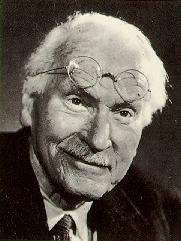
Carl G Jung originally wrote the "philosophical" understanding of synchronicity.

Carl G Jung originally wrote the “philosophical” understanding of synchronicity.


Guerilla Ontology – Robert Anton Wilson

September 12, 2009

A great quote:

Robert Anton Wilson (1932 - 2007)

Robert Anton Wilson (1932 – 2007)

‘I don’t trust the people as much as anarchists do.” He states that all Belief Systems are just that: BS:

“The Western World has been brainwashed by Aristotle for the last 2,500 years. The unconscious, not quite articulate, belief of most Occidentals is that there is one map which adequately represents reality. By sheer good luck, every Occidental thinks he or she has the map that fits. Guerrilla ontology, to me, involves shaking up that certainty. I use what in modern physics is called the “multi-model” approach, which is the idea that there is more than one model to cover a given set of facts. As I’ve said, novel writing involves learning to think like other people. My novels are written so as to force the reader to see things through different reality grids rather than through a single grid. It’s important to abolish the unconscious dogmatism that makes people think their way of looking at reality is the only sane way of viewing the world. My goal is to try to get people into a state of generalized agnosticism, not agnosticism about God alone, but agnosticism about everything. If one can only see things according to one’s own belief system, one is destined to become virtually deaf, dumb, and blind. It’s only possible to see people when one is able to see the world as others see it. That’s what guerilla ontology is — breaking down this one-model view and giving people a multi-model perspective.”

Robert Anton Wilson


From the Archives – Newcastle, Australia becomes a Welcome Town for Refugees

September 11, 2009


Way back in 2002 I was part of two groups which had a focus on human rights and refugee issues.

The more “operational” and lobbying aspect had expression in the group Newcastle Action for Refugee Rights (NARR). My more “cultural jamming” and “Situationist – Anarchist” aspect had its expression in HOPE Caravan. It was through HOPE Caravan that I was involved in the Easter Actions at Woomera Detention Centre in 2002 and Baxter Detention Centre in 2003. It was also as part of HOPE Caravan that the Flotillas of Hope found expression.

Hope Caravan logo we used on our now absent website.

Hope Caravan logo we used on our now absent website. The drawing was based on an original pencil drawing made by a prisoner at Woomera Detention Centre. He gave us permission to use it.

As part of NARR, I, along with others presented a proposal to Newcastle City Council to make Newcastle, Australia, an official Welcome Town for Refugees. Here’s the link to the whole proposal we presented at Newcastle City Council >> Welcome Town Presentation – thanks Jack for taking the time to make it available on your website.

Now that the dark years of the John Howard’s Decade is over in Australia, it is important that we are reminded that there were people in Australia (many, many of us) that were ashamed at the opportunistic tickling of the xenophobic underbelly of the Australian people that Howard’s genius did. People say that he was not a racist. Maybe he wasn’t in a way that Hitler was, but his myopic vision and policies that demonised innocent people who were seeking a new life were.

Anyway, I don’t want to go on about him here, suffice to say that there were Australians around during the Dark Howard Decade who stood against his crap.

My social conscience is clear and I’m proud to say that I was one of them.

NARR conducted a sympathy fast with the hunger strikers at Woomera Detention Centre in 2002. This is the tent we lived in at Civic Park, Newcastle. The head on the corner is a paper mache of Philip Ruddock, the Immigration Minister at the time.

NARR conducted a sympathy fast with the hunger strikers at Woomera Detention Centre in 2002. This is the tent we lived in at Civic Park, Newcastle. The head on the corner is a paper mache of Philip Ruddock, the Immigration Minister at the time.


I’m a Holy Man

September 9, 2009

I wrote this rhyming “poem” on a day when I was pissed off reading stories about gurus and fake “holy” ones who have expensive cars and luxurious life styles so that they can smash the stereotype that the “sacred” is somehow tied in with voluntary poverty. You don’t need me to point out the orange and the lemon people, the boy swami who smiles with a diamond glint from his teeth, the guru who teaches prosperity while touching up sweet  boys and girls.

I know, it’s not just the New Age types that do this, what with paedophilia and rampant materialism in the church, the synagogue, the mosque and the temple.

Getting back to my “I’m a Holy Man”, I know that I wasn’t cool and detached. In many ways it is a childish rant but, hey, that’s OK…..here it is >>>

====================================================

I’m a Holy Man.

Sitting on top of this icy mountain                              
my eye gazes on this dicy situation.
Nation on nation fall in rotation
while I’m on my long vacation,
here in my last reincarnation.

I’m a holy man, that’s what I am.
Don’t  need  no  mama  to  hold my  hand,
just need a mantra to be what I am,
cos’ I’m a holy man, the only man, oh yeh!

Liberation is here in my corporation
sign off your isolation with a donation.
Give me your adulation and veneration,
I’ll guarantee there’ll be no more damnation
here in this holy reservation.

I’m a holy man, that’s what I am.
Don’t need no mama to hold my hand,
just need a mantra to be what I am,
cos’ I’m a holy man, the only man, oh yeh!

If you freak out in this wasteland
you can sneak out to this dreamland.
You can howl out what’s been unchained.
You can throw out what’s been retained.
You can swallow what’s been profaned.

Yeh, I’m a holy man, that’s what I am.
Don’t need no mama to hold my hand,
just need a mantra to be what I am,
cos’ I’m a holy man, a holy, holy man,
the only man, a lonely, lonely man, oh yeh!

phil_at-the-gurus-feet


Time Body

August 23, 2009

 “Being in the timeless moment without the coercion of time is to dream, while lacking any sense of the timeless is to be only a machine.” Anthony Blake, “A Seminar on Time”

spiral clock-animated-gif-18

I have been long thinking about the Time Body since I turned 40. My interest in this was not only aroused by my entering the 40’s Chamber but also because I have read in the esoteric / occult tradition that the Path of Initiation cannot truly begin until the aspirant is at least 40 years old. So, all the Sufi practices, all the Gurdjieff exercises, all the attempts at the Jesus Prayer in Rhythm to the Breath, all the quiet desperation in a cube, all the immobility of mind, “Stopping the World” and the sacred wish arousing in the Heart….all of these things and more are only a preparation. Note, however, that when we speak of 40’s we are speaking of 4 to a number of degrees. Four is not 40 but shares attributes of four-ness with 40 as does 400 and 0.04 and 0.4.

Preparation for what? For the next phase of one’s life – the 40’s and the next few decades left in the mortal coil of three score and ten and beyond. Let’s remember that women, generally go through menapause in their 40’s, and men go through a “midlife crisis”. Why then? There’s something happening to us, just as powerful as puberty but this time it is the “puberty of old age”. What I mean by this is if I live to be 84 (a good number to work with because of the 12 X 7 connection), then 42 is the mid point (6 X 7). During the period of the 40’s we are laying the foundation (if we wish to) for a healthy, vibrant old age – my 60’s and the rest.
So, who is it that sees someone in the mirror that isn’t them? It’s me and all of us who are in mid life. In me there is a cry for the youth that I was and a fear of what I may be in old age. I have decided that this decade will and is the decade of consolidation. Actually, this is pompous. I didn’t decide anything, it’s more that there is a period of consolidation in one’s Time Body. The Time Body is the body of your mortal coil, it is the moment of your birth, like an Ourbouros, eating the moment of your death..this whole picture of one’s life/body is spatially perceived as 0 – 84 years long.

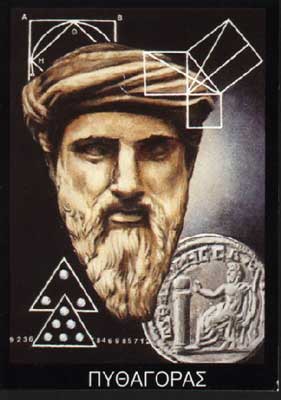
Pythagoras

Pythagoras

Taking the Time Body as 84 and working with a hint from Schwaller de Lubicz’s insight into Ancient Egyptian understanding we will enter a realm of geometrical/numerological correspondences. Though one is inclined in this Age of Techno-Scientism to use words like “mathematics” to denote a respectable regard for dead abstractions, I like to think that the magico-mythico-Pythagoro Number is where I’m working from. Status quo respectability, when it comes to such life and death considerations such as,  “Where am I going? Why am I here on this Earth? Who am I? Is there Life after Death?” can go in the dustbin of history. The danger of leaving the table of consensus reality – the current technoscience rationalism, is that you may end up sitting alone at  the table of insanity. An unbending intent, a purity of heart and a constant need to grow will at least provide some assurance that one’s understanding may not be crazy, but just the way things are if we live in an onion layered world.

Let’s get back to de Lubicz’s hint.  His insight is to consider that at every 7 years of one’s life a “life” has been and a new 7 year lot is coming up. Like layers of skin, each layer 7 years thick is a time-onion-skin where each skin is a period of 7 years. Consider that at 7 years old – the Church and Institutionalised understanding has it that a child has reason. Let’s go to 14 – puberty ….21 adulthood…..
A few clues: get Dane Rudyar’s  “Astrology of Personality” and read about The Dial of Life. It is interesting because he considers the language of Astrology as the Algebra of Life. Read P D Ouspensky’s account of the Enneagram in In Search of the Miraculous. Also Ouspensky’s “Tertium Organum”, a classic book which gives some semblence of “rationality” to the mystic vision and his other classic “A New Model of the Universe” where he introduces the idea of Eternal Recurrence (not the same as Nietzsche’s concept). My account of the onion skin layers of time is dependent on all of the above and a generous helping of experience.
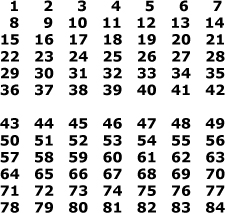
Try this as an experiment:  Write out in 7 year lots X 7 a table like this:

time body table

To make it “user friendly” you can include the year of the age eg 1(1962)   2(1963)   3(1964)   4(65)……etc
As you write the number and year beginning from your birth year try to notice any images/memories arising and what year they pertain to. These memories as they arise become “key symbols”, they become in a very personal sense the x,y,z and the a,b,c ‘s of one’s own algebra of life. If focussed enough you create your own memory body. Now, look at your “algebra of life” through the prism of your meaning/memory. Like, what happened to you when you were 7,14, 21, 28, 35, 42 ? Looking across and down the table: what happened at 4,11,18, 25, 32, 39, 46 ? You will find that there is a corresponding change in “motion” for each layer of 7. With each lot of 7 years there is a noticeable change and experience that suggest layers of octave experience. Each year is a note in the scale Do Re Mi Fa Sol La Si Do. What is interesting is that there is a discernible signature for each octave period. Later on you can then put the table of years onto the Enneagram.

Enneagram

Enneagram

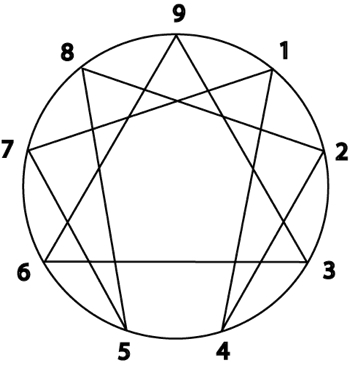
The Circle depicts daily life, the life of the diary - sequential time.

The Circle depicts daily life, the life of the diary – sequential time.

The inner movement 1-4-2-8-5-7 depicts the "notebook", the method and know how, the Sadhana. In the events of one's life, this is where synchronicity resides.

The inner movement 1-4-2-8-5-7 depicts the “notebook”, the method and know how, the Sadhana. In the events of one’s life, this is where synchronicity resides.

The Triangle depicts the idea of a creed, one's faith. It is Timelessness.

The Triangle depicts the idea of a creed, one’s faith. It is Timelessness.

The Enneagram with all three aspects of one's experience together as a whole. See A G E Blake's "The Intelligent Enneagram" for a detailed discussion of this symbol.

The Enneagram with all three aspects of one’s experience together as a whole. See A G E Blake’s “The Intelligent Enneagram” for a detailed discussion of this symbol.

I have done all this and more with my own life numbers. If you are astrologically inclined, do the Solar Returns of each year and see what you find. The whole purpose of this is to focus the mind onto one’s own life stream. This focussing is not analytical, indeed, the process abhors analysis. It is the realm of imagining and then self remembering – or at least a preparation for this. The exercise itself is another version of “Recapitulation” which Carlos Castaneda refers to. Indeed, you will, if you delve a little deeper in what I’ve just given above,  find not only clues to the notion of Fate but also clues to one’s Destiny. These clues are not uttered in any way by me, but rather by the very simplicity of the gods – Numbers. The Ancient Egyptian concept of Neter is close in meaning to the Pythagorean concept of Number.

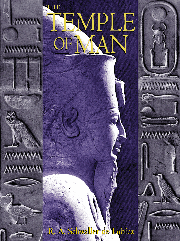
The cover of R A Schwaller de Lubicz's magnum opus "Temple of Man"

The cover of R A Schwaller de Lubicz’s magnum opus “Temple of Man”

What are you looking for in the numbers of the years of your life? Just a few hints that can help name the years. Maybe then, your heart will play around with mystic circles and triangles with the Numbers of Life turning off and on like a  light show.
All this may sound weird, but I can assure you, if you try this experiment, you will be pleasantly surprised by the octave “correspondence” you will see in your life experience. It will be as if there is a pattern, unknown to you, unfolding in a manner totally unexpected. A kind of music of your life, a hidden melody that you were not able to hear notes of until this moment. At times you may experience a déjà vu  , the feeling that you have been here before,and this is interpreted exactly as that through the Great Idea of Eternal Recurrence as expressed through P D Ouspensky in his “A New Model of the Universe”. A good summary of this idea & its connection with Nietzche’s and Steiner’s take on it is here.

I’ve been influenced much by the 4th Way – through Gurdjieff and other teachings. Is it any wonder that I have become a middle aged Gnostic seeker carrying the lantern of wonder?

Try it  and see if it isn’t true. You will find a pattern that will truly spook you. If you follow the clues and hints you will see the synchronicity of events

and

maybe the big question will arise:

WHOSE SHOW IS THIS ANYWAY?

Now clock animated


Fortune of Unloaded Hips

August 23, 2009


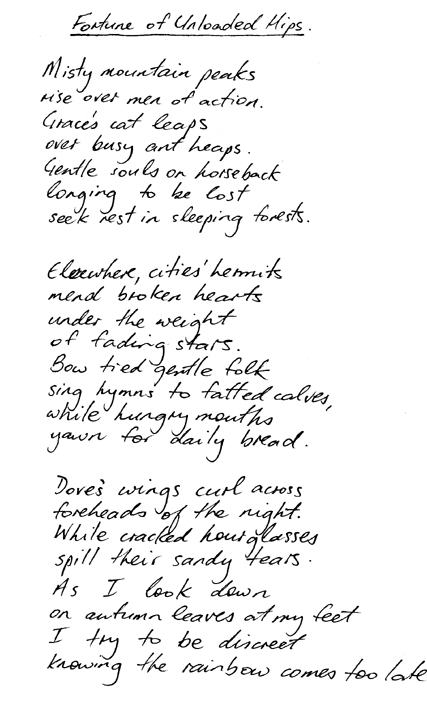
This is a set of song lyrics I wrote ages ago. I looked and looked for the cassette recordings of all these songs I recorded with a bunch of mates, all those years ago and I can’t find one! It’s sad because I like to hear what I sounded like singing these and other songs, along with the music my friends made. They may not be the greatest songs written, but they are mine. Oh well, at least I still have the words and as you know I’ve been posting the lyrics from time to time. Below is a scanned script of my written lyrics.

Fortune of Unloaded Hips


Communicating with Alien Intelligence

August 21, 2009

 I am sometimes mystified how people always seem to connect alien intelligence with Extra Terrestials (ET’s) as if there aren’t
enough alien intelligences on Earth when you compare our human intelligence with other forms. OK – we have the obvious differences between us and monkeys and dolphins and dogs and cats and snails and snakes etc but when we move away from
so called “sentient” beings into the realm of plants and minerals, most people assume that intelligence is non existent. Peter Tompkins wrote a book called “The Secret Life of Plants” where he showed plants having feelings and that they communicate
these feelings.  Secret-life-plants-coverNow, I can’t remember whether it was Terence McKenna who pointed this out or someone else, I do know that it didn’t spring from my forehead, that one can look at communication across species in a unique way.

We know that bees communicate by dancing in the air, that octopii (or is that octopussies 🙂 communicate visually with colour changes in their skin; that whales through singing – now, this is communication amongst themselves. How would communication occur between two very different orders of life eg humans and plants? Well, someone (I can’t remember who), wrote that communication between plants and humans happens when humans ingest either by eating or smoking, plants. The
altered state of consciousness that occurs by this act is the plant itself communicating with humans!!

So, from this point of view an alien intelligence communicates eloquently with human intelligence by the pharmocological exchange within our being. Way beyond words and images something occurs in our consciousness which is a communion with the Earth via the “priestly” mediation of sacred plants.

Food of the gods indeed!