Finding Meaning in the Blank Page: A Writer’s Reflection

September 27, 2024

I found some old notes written by hand—this one around 1979—and OCR scanned them. I revised and edited them, and here they are.

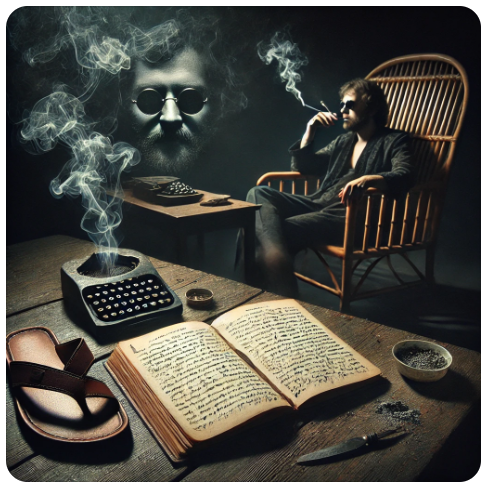
I have been sitting here for centuries, for months, for days, waiting. What am I waiting for, exactly? It’s a mystery that even I can’t unravel.

This blank piece of paper yawns at me again. Yes, yawning—not roaring or demanding—but simply sitting there, an expanse of white, opening its mouth to be force-fed words. But why force-feed it? Why sit here, pen in hand, scribbling down words that may or may not carry meaning?

Listen carefully. Read between the words, beneath them, through them, and beyond them. Somewhere within this ink, there is a reason, a lifeline that could pull me into a world where the ordinary becomes extraordinary, the mundane becomes miraculous. The world where one is equal to nothing, and nothing is equal to all. What? Am I trying to touch the portals of Heaven through this thin squirt of ink?

Listen again—is it not I who leaves the rind of the world behind? Is it not I who is lifted into the wild, illogical realm where reason twists like a pretzel and humanity shrinks to a slug? By excreting these lines (yes, excreting!), I have an activity fit for a lazy bum like me to call myself an artist, an author of the world. This is my voice, my essence, spilled onto the page.

It is as if a visitor sweeps away the remnants of me, picks up the pen, and records what he sees, feels, and tastes of this world through an eye that sees beyond the immediate, beyond the personal—the ‘cosmological eye,’ as Miller calls it. This act is like a cigarette slowly burning, like a caterpillar shedding its caterpillarness. Leaves fall from trees, and they realize they are always part of something more significant when they touch the ground. I want to understand what I am part of without leaving the tree—and the only way to glimpse that is to write myself into extinction so that the eye may peek through the smouldering ashes of these words.

And you know what? Just sitting here and rambling on is fun. But what is your aim? You might ask. Do I need one? What is your purpose? Do I need one? Few aims and purposes come with capital letters. Right now, I’m having fun, and that is all there is—pure, unadulterated fun.


In the Labyrinth of Cosmic Intricacies

September 21, 2024

In the labyrinth of cosmic intricacies, an unseen design defies the logic of minds—we try to walk upon the ethereal fabric of black holes, where reason stumbles into awe.

Rebellion stirs, a cosmic key in hand, unveiling truths long lost in shadows of accepted wisdom, a door swings wide to whispers carried by the solar winds.

Some mysterious force, an ancient hand,weaves its stories through the constellations,an eternal presence watching the ballet—the rise and fall of stars, beings, and lands.

Matter becomes the frozen music of stones, Pythagoras’ melody echoing through time, each stone a note in the silent symphony, resonating through the star’s long sighs.

Art becomes the footprint of the soul, its brushstrokes on the cosmic canvas, a dance of thoughts, of dreams, of love, that falters when the soul’s light fades.

No soul, no footprint—only shifting sands, where glittering dust replaces vibrant marks, a desert where creative echoes vanish, leaving silence in the place of song.

Yet still, absurdity spins through the air—inside-out policemen, dogs, and cats create a dreamlike dance of chaos as space folds into a single doorknob.

Poetics, the study of soul’s strange symbols,scribbles that transcend mere meaning, tracing the whims of wandering minds and the patterns that the cosmos leaves behind.


Creating Meaning: The Timeless Journey Within

September 10, 2024

Rediscovering old notes and writings I tucked away feels like opening a time capsule. As I edit and rewrite, I’m often stunned by what unfolds—almost as if someone else penned these words. Curious to see what I found? Check out the latest piece I’ve dusted off from the drawer:

Once, I believed in the world as it was handed to me—a place where no one questioned the present and bothered to ask about the origins of our existence. But something stirred in me. As the static of modern life cleared, a pulsating sense of displacement, a profound disconnect from my cultural roots, rose from within, like an echo from my ancestors. I could almost feel their journey across the Great Ocean, but something gnawed at me—a profound uncertainty that no one here could answer.

In this land, no one believed in anything beyond the horizon, not the priest, the doctor, the teacher, or even the philosopher. They were prisoners of an unshakable belief: they had always been here. No one had come from anywhere else, and nothing existed beyond the boundaries of their world. They were trapped in an eternal present, fully immersed in “Always Here and Now.” To them, the notion of elsewhere was absurd. If there was no “other place,” how could anyone have come from it?

Initially, I grappled with understanding. My friends’ reality seemed dictated by simple logic, but my thoughts wandered beyond their walls. How could anyone have come from elsewhere if there was no other place? My friends saw the compass as proof of their reality, pointing only to an endless, eternal loop. They cautioned me against delving too deeply into such thoughts, insisting the simplicity of their truth was my only sanctuary. But something within me resisted. I was resolute, against all odds, to find the home my ancestors had spoken of, a place that existed somewhere beyond their narrow vision — a place I had never seen but felt in my bones.

Speaking of this ‘other place’ was perilous. Each mention of it shook the very foundation of their beliefs. What did that mean for their carefully constructed present if there was another world? The inner became the outer, the light became dark, and everything they knew would collapse. They were content to remain in their prison of four walls, preoccupied with the décor, oblivious to who had designed their confinement.

But I couldn’t ignore the whispers of the past. My ancestors had lived on an island swallowed by time. Only a few had escaped its destruction, fishermen who drifted across the ocean with no destination, guided by nothing more than a lucky wind. They rowed, prayed, and hoped for forty days and forty nights until they reached this land. That story lived within me, waiting for me to find the same wind, to follow the arc of coincidence that had saved them.

Yet, as I reflected, I came to a profound realization. I was still searching for something I couldn’t name—a more profound significance in my surroundings. It wasn’t just about finding another place but understanding why it mattered. The abalone shell reflected the ocean’s rhythms as if it carried the pulse of an unseen world. I then realized that significance wasn’t found in the object but in my gaze. The same wind that saved my ancestors wasn’t guiding me toward another place—it showed me that meaning itself is something we create, not discover.

My ancestors braved the ocean’s winds and waves to find this land. But the distance I had to cross was between worlds, not shores—between the truth they carried and my life now. Perhaps I wasn’t meant to find meaning but to create it, and that was the natural wind that would take me home. This realisation, this understanding, was my enlightenment.


Autumn Memories

September 10, 2024

Autumn leaves on sandstone steps
are days and nights I remember still.
Your breath was just a sigh,
a goodnight and a long goodbye.

If you were beside me
I could hear the Word
That whispers through the wind,
barely heard.

If you were beside me
I could have the strength,
that lifts stones
above the ground.

If you were beside me
I could see the light,
that gives the sign
for the lost to be found.

Autumn leaves on sandstone steps
are days and nights I remember still.
Your breath was just a sigh,
a goodnight and a long goodbye.


From Blue Meanies to Bo Diddley: A Life Transformed by Psychedelics

September 6, 2024

My first entheogenic journey began with Blue Meanies mushrooms in Gin Gin, Queensland. (The term “entheogen” comes from the Greek en, meaning “in” or “within”; theo, meaning “god” or “divine”; & gen, meaning “creates”> Within God Creates) It was also my introduction to a group of nomadic hippies who embraced me and opened a door I didn’t know existed. As I lay in my sleeping bag, I watched in awe as strange, crawling eyes appeared before me, almost like tiny spiders. Instead of fear, I felt amazement.

Back in Sydney, I had my first encounter with LSD. I was astounded that such a small chemical could have such a profound effect on my consciousness. From there, everything changed. Over the next couple years, I must have experienced over 100 LSD trips and countless mushroom journeys. These experiences shaped my life in ways I couldn’t have imagined.

One of the most memorable trips was on the Sydney Opera House opening day in 1973. We were on California Sunshine Acid, wandering through the Botanic Gardens as the trip took hold. Suddenly, Bo Diddley’s “Hey, Mona” echoed through the trees. It was surreal; we all heard it together as if the music was coming directly from the trees. Later, we realized Bo was performing at the Opera House, and the amplified sound carried through the gardens.

Rather than join the crowds, we found ourselves at an alternative party in Woolloomooloo. There, I met a beautiful woman with strikingly blue eyes, and we connected in a way that felt beyond words—just through our gaze.

That day marked my last acid trip, over 50 years ago now. But the memories, the experiences, and the transformations remain with me, forever etched into my being.

I’m not recommending the use of psychedelics. Just reminiscing on my own use.


Transcending the Swarm Mind: A Journey to Freedom and Grace

August 16, 2024

Where there is freedom, there is grace. Where there is freedom, devils dance with angels. Yet, in the heart of the Swarm Mind, these forces are chained, bound to the Swarm World.

Freedom is not the result of seeking an end; it is the means to an unknown destination, a state imbued with grace. The Swarm’s concerns strip away the soul, leaving only husks of social beings. To be free is to be true to oneself, and to be true to oneself is to give of oneself—for in the act of giving, the bud of truth begins to bloom.

We must ascend to Heaven while keeping our feet firmly on Earth. Renewed energy—a gift from Above—should radiate through us into the Earth. This emanation is not ours but from Heaven itself. As men and women, we are merely the medium through which Heaven meets Earth.

Through freedom, we move both upwards and downwards, both inwards and outwards. Riding the Devil’s back, we touch the soles of God’s feet.

The Swarm Mind, a pivotal concept in this post, symbolizes the collective consciousness of society. It is often driven by conformity, fear, and greed, and stands in stark contrast to freedom. The Swarm Mind restricts individual thought and action, leading to a homogenized worldview.

How can I let life unfold when I crave control? The part of me that is a control freak, the “I” that seeks a result, is the Swarm Mind within me. Freedom lies in recognizing this Swarm Mind, though “seeing” might be the wrong word. It is always a feeling, a quality beyond words—a heart’s clarity.

The Bay: A Sanctuary Beyond the Swarm – The Bay is a metaphor for a state of mind that transcends the limitations of the Swarm World. It represents a place of solitude and introspection, where one can escape the noise of the collective consciousness and connect with a higher truth.

I stay by the water at the Bay to escape the crowd and find solitude. To reach it, one must be guided by an inner need—an undeniable, real need—not a mere whim. The Bay is where physics and direction blur, where up and down, in and out, are part of a continuum. Everything connects in a multidimensional Möbius Strip, defying the Cartesian Spread.

Goethe said, “In nature, we never see anything isolated, but everything in connection with something else which is before it, under it, beside it, and over it.” Yet, he missed the “inside”—the entry point to the World beyond the Swarm World. Inside everything, on the beach, far from the Swarm’s buzz, lies the path to the North. The compass is our conscience.

Transcending the Swarm: A Call to Personal Growth

The Swarm Mind, in its rawest form, incessantly buzzes within a Bell Jar, a metaphor for the limitations and constraints imposed by the Bell Curve—Consensus Reality, the 3D World, and the perspective of the Vegetative Eye. The journey to transcend this requires a relentless battle against the hypnotic motion and buzzing of our busyness, a struggle that engages us and fuels our motivation.

Our journey beyond the Swarm World requires substantial assistance—help free ourselves from the Swarm Mind’s buzz and go beyond fear and greed. Yet, we must also function effectively within the Swarm World, for our physical survival depends on it. This paradoxical position requires us to engage with the World while detaching from the noise that obstructs our vision of another world beyond the Bell Jar.

The Digital Revolution and the Dematerialization of Reality

As the World transitions from material to digital, the concept of physical location dissolves. Modern telecommunications have made global video conferencing a norm, and advances in holographic technology will soon allow life-size interactions in our living rooms, simultaneously placing us in multiple locations. This digital revolution, coupled with modern physics, has led to a dematerialization of our World, challenging our understanding of reality.

Yet, these advancements are accessible to only a fraction of humanity, highlighting the growing concentration of power. While the Swarm World’s telecommunications system connects every inch of the Earth, most still need to be more nourished and impoverished.

Seeking Balance and Clarity

At the Bay, the 3D World becomes porous, held together by dimensions beyond our usual perception. The Swarm Mind clings to the sweetness of its 3D existence, unable or unwilling to see beyond.

In this ever-changing reality, we must actively seek moments of clarity and higher consciousness—our metaphorical ‘Bay.’ This balance, found at the intersection of physical and digital existences, is not just beneficial but crucial for our survival and spiritual growth. It serves as a guiding light, reassuring us that we are on the right path.

Let us continue to ask: How can we maintain our individuality while benefiting from our interconnectedness? How do we balance our physical and digital existences? And ultimately, how do we use these insights to create a world transcending both the physical and digital realms?

We seek clarity, question our perceptions, and strive for freedom, transcending both the physical and digital worlds.


Fish Tattoos and Redemption: Stories from Baxter’s Community, Jerusalem, New Zealand.

August 12, 2024

In Sydney, I heard about a community started by James Baxter, a New Zealand poet. It was located in Jerusalem, New Zealand. Baxter saw this place as a canoe, a lifeboat for the drowning. I expected a hippy commune but found ex-thieves, ex-addicts, ex-gamblers, even an ex-killer who had done his time. I didn’t know what I was an ex of. Some clung to the sides of the canoe, others sat steady inside, and some rowed and steered. They were changing their lives with prayer and community, guided by Baxter’s poems and the Bible. The native Maori lived nearby, sharing their land and mixing with those on the canoe.

I arrived, in 1973, after a 20-mile walk and found out James Baxter had died the year before. They gave me a bed on the verandah, a few feet from his grave. At night, the moonlight cast shadows of the mound onto the wet grass.

The man who gave me a Bible had left the Hell’s Angels, Auckland Chapter (A chapter of the Hells Angels motorcycle club was formed in Auckland in 1961, the first Hells Angels chapter outside the US) because he fell in love with a born-again Christian. He took a liking to me and took me goat hunting. It was my first hunt. I helped kill, skin, and butcher the goat. He saw me squirm when we gutted it.

One day, while we were having a piss, he said, “Hey, look at my dick.”

I didn’t know what to do.

“Look at it,” he insisted. “I’m no homo, look at it.”

I glanced down. He laid his flaccid dick on his palm. The word “FISH” was tattooed on it.

“I don’t get it,” I said. “Why have you got FISH tattooed on your dick?”

He laughed as he put it away. “That’s for women who don’t eat meat on Fridays,” he said, then burst into a belly laugh.

I laughed along, thinking he got his penis inked for a joke.

He was a carpenter and wanted an apprentice. I just wanted to visit the community, float on the canoe for a bit, and then move on.

A photo of the Bible the Hell’s Angel gave me.


Inner Peace vs. Outer Chaos: A Tale of Serenity and Struggle

July 27, 2024

Below is something I wrote a some years ago after bumping into a friend I hadn’t seen for a long time. The feelings expressed, I think, are just as relevant today as they were then, when I, along with others, was preparing for the Woomera Action in Easter, 2002 with Hope Caravan. 

ABC iView (Australia) has a series called “I Was Actually There” which includes an episode on Woomera, 2002.

So I thought I’d rewrite this earlier post for today.

===================================================================

“Serenity and Struggle: A Tale of Inner Peace vs. Outer Chaos”

When I saw him yesterday, he seemed to radiate a serene contentment. Sitting in a half lotus position on his sofa, his bare feet intertwined, he exuded tranquility. The mandala tattoo just above his ankle harmonized perfectly with the diamond-shaped crystal hanging from his neck. We shared some green tea, and he smiled gently as he closed the book he was reading.

He was an old friend, someone I hadn’t seen in ages. In the time apart, our paths had diverged dramatically. He had discovered spiritual bliss, while I continued to grapple with finding peace. He spoke of inner tranquility, whereas I confessed to enduring inner turmoil. His spiritual battles were over; mine felt never-ending.

“You’re caught in duality,” he remarked with a seemingly humble smile. “You think you can change the world, but the only thing you can truly change is yourself.”

He was referring to my plea for him to join me in action—to support those who are voiceless and powerless. I had invited him to participate in the Festival of Freedoms at Woomera during Easter 2002, to stand up for the refugees trapped in Australia’s detention centers.

I responded, “But what if my sense of self extends beyond my physical body? What if it encompasses the whole planet? When I witness suffering and injustice, it feels as though it’s happening within me.”

He laughed, “Well, in that case, your ego is bigger than mine!”

Adjusting his posture, he let his leg fall straight over the side of the sofa, leaning forward with his elbows on his knees. The crystal around his neck swayed like a pendulum between us. Incense smoke spiraled upwards from the joss stick burning on the coffee table.

I could see his point but it didn’t sit right with me. “Ego, big or small, will always be there. Tell me, what would you do if your neighbor’s house was burning down? Would you ignore it because your house is fine?”

“I would help extinguish the fire immediately. But for me, the plight of refugees and distant wars are beyond my control. I seek inner peace through meditation, believing it will ultimately benefit the world more than any protest or action. True change begins within. Your protests add more noise to the chaos. By creating an oasis of silence and peace within, you contribute more profoundly than by facing the razor wire of the camps. Change yourself—that’s all you need to do.”

He sipped his tea and stared intently at me, or perhaps at the space between my eyes—the so-called third eye. I couldn’t tell, but his gaze carried an intensity, as if he was trying to shift my perspective with his energy. He was kidding himself if he thought he could.

Yes, our paths had diverged. While I understood the importance of inner work and its impact on the outer world, I couldn’t accept withdrawing into personal peace while others suffered. Can one carry the inner “oasis of silence” into the world’s places of sorrow and injustice, to share that peace? I wondered.


Unlocking the Mysteries: Pavlos’s Surprising Transformation in His Grandfather’s Study

July 27, 2024

Pavlos sat alone in his grandfather’s study, a place steeped in memories and the faint scent of old books and leather. The room was his sanctuary, a haven where he found solace among familiar objects: the fruit bowl on the side table, the worn chair, and the portrait of his grandfather gazing down from the wall. The dim light filtered through the dusty curtains, casting an ethereal glow on the room. But today, something was different.

The call—he couldn’t think of a better name for it—began as a subtle warmth in his palms. It grew, radiating from the center of his hands to the base of his fingers, eventually reaching the tips. The warmth transformed into a quivering tingle, like millions of tiny feathers stroking under his skin. Startled, Pavlos looked around the room, his eyes landing on the picture of his grandfather. The warmth in his hands faded as he focused on the portrait, but when he redirected his attention back to his hands, the warmth returned.

Intrigued and a bit unnerved, Pavlos decided to experiment. Could he maintain the warmth in his hands while being aware of something outside himself? He chose the picture of his grandfather as his focal point. As he concentrated, a surge of energy raced up from the soles of his feet, halting abruptly near his navel. The energy solidified into a powerful sense of centeredness and balance, filling the emptiness within his chest with a newfound strength.

The sensation intensified, spreading through his body until he felt as though he were aflame from within. Strange symbols and geometric shapes, hieroglyphics, and formulas began to rise in his mind like smoke. His body blazed with a profound understanding that transcended mere thought. “This must be what religious sighs are about,” a voice said. Was it his own thought or something external? Pavlos could no longer distinguish between inner and outer reality. The posture of his body, the position of the furniture, and the entire ambience of the room reverberated through his nervous system, tingling with a new sense of expectation.

Pavlos’s heart raced, his mind spinning with questions. What was this sensation? Why was it happening now? The study had always been a place of comfort, but now it felt like a portal to another dimension, charged with an electric anticipation that made his skin prickle.

The sense of expectation coiled upwards from the base of his spine like a neon curl, sparking into his body’s nerve circuits a shock of recognition. Pavlos felt a connection to something greater, something ancient and wise. The room seemed to pulse with life, as if it held secrets waiting to be discovered. He could hear the faint ticking of the old clock on the mantle, each second amplifying the intensity of his experience.

He closed his eyes, allowing the sensations to guide him. His breath deepened, and he felt as if he were floating in a sea of energy. The warmth, the symbols, the voice—they all merged into a single, harmonious experience. When he finally opened his eyes, the room looked the same, yet everything had changed. He felt more alive, more attuned to his surroundings and to himself.

Pavlos realized that the call was an invitation to explore deeper aspects of his consciousness, to unlock potentials he had never known existed. A wave of emotions washed over him—curiosity, excitement, and a bit of fear. With a sense of purpose and curiosity, he embraced this new journey, eager to see where it would lead. The study, once a place of solace and memories, had become a gateway to a realm of profound discovery and self-awareness. As he stood up, the portrait of his grandfather seemed to smile down at him, as if approving of the path Pavlos was about to embark on.

The adventure had just begun.


Xenitia: Nostalgia and Hardship in 1960’s Redfern, Sydney

June 30, 2024

First came the men in suits, then the bulldozers and the trucks, then the porta loos and cranes. Each day saw another house, shop, tree and a child’s doll knocked down and pulverised. Things that mattered all turned to scrap and dust. The bull dozers scraped the rubble into piles of broken bricks, concrete slabs, shattered glass and newspaper. The dust rose from under the wheels and steel jaws of the machines and swirled in the breeze. In that part of Redfern, Sydney the whole street breathed the demolition dust so holding your breath was hard. It got into clothes and between cracks along walls’ edges and footpaths. For Athena and her son Kosta, a walk down Young Street was not the easiest place to breathe.
For over three months, every day, people on Athena’s side of the road swept away sand and dust that blew from across the street onto their doorsteps. If they weren’t quick enough shutting the front door, the wind blew the sand down their narrow hallways. Every house had something tucked behind the crack between the door and the floor. Old towels, old clothes tied together, anything to stop the debris entering their homes by the wind.


As Athena opened the door, she said, “Kosta, close it quickly. We don’t want a desert in our house.” Kosta took a long look at the growing rock piles across the street. The wind blown sand prickled against his face and arms. He stepped into the hallway, sand grains tick, tick, ticked in pitter- patter against the shut door behind him.

Down the hallway, through the door, his father George squatted in front of the Kriesler radio. “Ssshh!” he said while turning the hand sized dial, “I’m looking for Greece.” The radio squawked and squealed, struck static, voices fell in and out in different tongues. Near the radio, on the table were coils of wire, screws, a rusty wire cutter and pliers. Out of the static a muffled sound came through the speaker. Then, full blown clear chimes of a bouzouki sounded from the radio. “Oppa! Ellada – Greece!” He brushed back his speckled grey, black hair with his hand. George stood up to face his wife and son. He nodded his head to the rhythm of the music, short waved all the way from Greece.


“Even in his singlet, without a shirt, he looks fully dressed,” thought Athena. George jutted his arms out to his sides, then slowly reached with his right hand for Athena. He caressed the scarf covering her hair. He returned his arm to the outstretched position and clicked his fingers, he danced a short hop to the music. Athena smiled and sat on the only soft chair in the house under the window. She took off her shoes and scarf letting her black curls fall around her face. “I fixed the antennae,” George said in Greek. Kosta stood near the cupboard with a mirror wall and glass doors. It housed the best cups and saucers for Greek coffee and small glasses for drinking ouzo and larger ones for wine and glaced cherries. Framed photos of family in Greece and their own small family in Australia covered the top of the cupboard.

Athena reached for a photo as George said, “Well, what did the doctor say?”
“Do you know what today is George?” asked Athena.
“Good Friday,” he replied.
Tears welled in her eyes, she crossed herself with her right hand while holding the photo with her left. She said, “Today, three years ago, Aliki died.” Tears trickled down her cheek. She pointed to a baby in Kosta’s arms, “Three years ago, today, my baby girl died.” She bent her head and kissed the photo. George stepped closer to her and took the photo from her hand and placed it back on the cupboard. He reached to touch her wet chin with his hand, “Athena that was three years ago. What did the doctor say today?”
“He said I have broken nerves, you tell him Kosta, you know English better than us, tell your father what the doctor said.”

George looked at Kosta, his 12 year old boy was strong, a pallikari and he had his father’s eyes. “Well son, what did the doctor say?” Kosta kept his hands, fumbling some marbles, in his pockets,. “The doctor said that mother has, I don’t know how to say this in Greek – “nervous breakdown” – her nerves, her nevra are broken.”
“What do you mean broken nerves? She looks alright to me.” George turned to face her, “Athena, what is it? What ails you?”

She wiped the tears from her face with her sleeves, took a deep breath and leant forward letting out a long sigh. “Oh George! What ails me? I want to go home. I want to be with my family, be able to walk the streets and breathe Greek air !”


Before George could answer she screamed, “VROOM! VROOM! all day, 12 hours a day VROOM! VROOM! The machine pricking my fingers and the boss yelling – FASTER! FASTER! VROOM! VROOM! – I want to go home. I don’t want to sew Akubra hats anymore!’ she sobbed. Her upper body folded forward and her elbows rested on her thighs while her head weighed on her hands. She didn’t look up, nor sideways, with no expression she stared at her feet. George moved closer, leant forward and gently kissed her head. He stroked her hair, slowly weaving his thumb and finger in her curls. By now he was on his knees in front of her. “Wife, you are suffering from xenitia – home sickness, that is all. I want to return as well. Do you think I enjoy my work at the Brewery?” George whispered, “ We just need another two years,” Athena did not lift her head, “The doctor said, no more overtime, better if I don’t work at all,” she replied.


George stood up and turned his back to her. He pointed to the black and yellow calendar hanging on the glossy white wall opposite them. “Look,” he said, “It will be no time at all… two years will run by.” Athena stood up and put her arm around his waist. Instead of looking at the calendar, her eyes were on the boxed stephania above it. The wooden box had six sides with hand painted green vines and black grapes, there were faded spots and some paint had chipped off. Under the clean glass cover were the stefania, the crowns of love joined by a white ribbon and worn on their wedding day. The stephania boxed on the wall were their life – husband and wife – a union for God.

“Yes George, time runs by fast. Already we have been here for 8 years and you promised we would be back in five.” She squeezed his waist with her arm pulling him closer. “Look at the stephania George,” she purred. She let go of him and returned to her soft chair feeling snug in its space. “I want to go home now. I need to go home now but not without you and Kosta. Please, we can do it – let’s go.”


Athena turned to Kosta who was on the floor playing with a lead airplane, “Kosta, bring the letter from Greece to your father.” Kosta stood up tucking his shirt into his shorts and walked to the cupboard. The letter was under the photo of him and Aliki. As he lifted the letter the photo dragged over the edge falling to the floor. Kosta immediately bent down to pick it up. The fall left a lightning crack zigzagging across the middle of the glass. Kosta stared at the little girl, his sister in his arms. He was wearing his cowboy gun holster at his waist, as long as his shorts, carrying a Colt 45 cap gun. He remembered the time it was taken, just a few months before she died of pneumonia. He was nine and she was two.


“What did you do!?” yelled George as he rushed towards Kosta. George raised his right leg ready to kick him. “Stop it! Stop it!” screamed Athena, “Don’t touch him!” she stood up quivering and crying. George stopped and let his kicking foot step onto the photo crushing the glass into a tight spider web of cracks. He snatched the letter out of Kosta’s hand. Kosta crouched still and silent waiting for a hit across his head. It didn’t come so he crept backwards in a crouching position until his back was against the wall. He was out of range and he knew from experience that this wall was the best because it was beside the hallway entrance and provided a fast exit. Kosta knew that if he didn’t do anything, just stayed there, everything would be alright because his father was walking towards his mother with the letter and photo in his hand.


“We’ve already lost a daughter, do you want to kill your only child?” George placed the photo on the table near the wire cutters. He looked at Athena sitting there and saw her sick and beautiful. He saw his love. He fell on his knees and rested his head in the crevice between her thighs. She caressed his hair, running her fingers from his forehead to the back of his head. His hand holding the letter rested on her hip. “Athena, I want to return home and work as a silversmith and be with our family.”

He saw Kosta sitting quietly against the wall. George lifted his head slightly from her lap, raised his eyebrows and nodded his head at Kosta. This meant that he could go and play. It was like that, gestures and signs for words. Kosta got up, smiled and ran down the hallway, opening the door to the wind and dust and a direct view of the demolition site.

He heard his father call out, “I’ll whistle for you!”