Portal of Enigmatic Shapes

December 29, 2023

The room was dimly lit, the only source of illumination being the soft glow of the street lights filtering through the half-closed blinds. A man sat at a cluttered desk, his fingers dancing with a pen over a blank page. At first, the shapes that came from his fingers were geometrical doodles, spirals that began anticlockwise but ended up snaking clockwise. Now a triangle that grew into a star. The shapes flowed from his pen as if the pen itself inscribed the signs. Still, the scribble continued, now over half the page from the center was filled with shapes and lines.

The stars on the page weren’t even noticeable, only the light blue of the sky ran down the page making a huge teardrop. As he picked up the page with the letterhead, he noticed that the stars had grown a little brighter. He held the piece of paper up to face the window, as he did light streamed through the stars as if they were holes. He touched the spot where a star was, and he knew that it wasn’t a hole. The star, in fact, seemed to radiate more heat. Leaving it on the desk, he picks up the phone and calls Tony. No answer.

He sat down and began to scribble on a piece of paper he found on the shelf. It’s not as if he had a message for anyone in particular. In fact, he didn’t even know how he came to be in this room. The scribbles continued, forming a maze of lines and shapes that seemed to have a life of their own. The room, now filled with a quiet tension, held the secrets of the man at the desk and the enigmatic symbols he was creating. Tony walked in, the door creaking slightly as it opened.

“What’s going on, Joe?” Tony asked, eyeing the chaotic patterns on the paper.

“I don’t know, Tony. It just started. The shapes, the symbols. They won’t stop,” Joe replied, his eyes fixed on the mesmerizing dance of ink on paper.

Tony took a moment to study the page, then looked around the room. “It’s like you’ve opened a portal to another world in here.”

“Yeah, a world of shapes and lines,” Joe mumbled, almost to himself.

The two men sat in silence, watching as the scribbles unfolded. Joe pulled the blinds open. The stars outside the window seemed to pulse with an otherworldly energy, casting an ethereal glow on the room. The air was charged with mystery, and the wall between reality and imagination blurred.

As the night deepened, Joe continued to sketch, and Tony remained, captivated by the unfolding spectacle. The shapes on the paper seemed to tell a story, a story that transcended the boundaries of ordinary existence. The room became a sanctuary of creativity, a realm where the ordinary transformed into the extraordinary.

And so, in the dimly lit room, surrounded by the enigmatic symbols and the soft hum of the city outside, Joe and Tony witnessed the birth of something beyond comprehension, that defied the constraints of the mundane.


Honey Bees about to become extinct

March 26, 2009

Honey Bee

Below is an entry from “The Herder Symbol Dictionary” on what the humble honey bee signifies. Then follows an article about the possible extinction of the honey bee.

I believe that events in life may also be symbolic of portending events. OK, I’m talking about omens and signs. Now, if honey bees face extinction, what does it mean for us?

stavros

Bee:

It is an insect that primarily symbolizes diligence, social organization, and cleanliness (since it avoids everything dirty and lives from the fragrance of flowers).

In Chaldea and imperial France, the bee was a regal symbol (for a long time the queen bee was thought to be a king); it is possible that the fleur-de-lis of the House of Bourbon developed from the bee symbol.

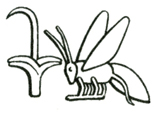
In Egypt the bee and the sun were associated, and the bee was considered to be a symbol of the soul.

In Greece it was considered a priestly creature (the priestesses of Eleusis and Ephesus were called bees, probably with reference to the virginity of the worker bees).

The bee, which appears to die in winter and return in spring, is sometimes a symbol of death and rebirth (e.g., of Persephone, Christ).

 Because of  its untiring work, the bee is a Christian symbol of hope. For Bernard of Clairvaux the bee signifies the Holy Ghost. The bee is a Christ symbol as well. Its HONEY represents Christ’s gentleness and compassion; its stinger symbolizes Christ as judge of the world.

Since according to ancient tradition bees do not hatch their own young but collect them from blossoms, bees were symbols in the Middle Ages of the Immaculate Conception.

The bee is also symbolic of honey-sweet eloquence, intelligence, and poetry.


Honey bees in US facing extinction

The rush and the bee, hieroglyphs from the royal title signifying King of Upper and Lower Egypt.

The rush and the bee, hieroglyphs from the royal title signifying King of Upper and Lower Egypt.


Albert Einstein once predicted that if bees were to disappear, man would follow only a few years later.

That hypothesis could soon be put to the test, as a mysterious condition that has wiped half of the honey bee population the United States over the last 35 years appears to be repeating itself in Europe.

Experts are at a loss to explain the fall in honey bee populations in America, with fears of that a new disease, the effects of pollution or the increased use of pesticides could be to blame for “colony collapse disorder”. From 1971 to 2006 approximately one half of the US honey bee colonies have vanished.

Now in Spain, hundreds of thousands of colonies have been lost and beekeepers in northern Croatia estimated that five million bees had died in just 48 hours this week. In Poland, the Swietokrzyskie beekeeper association has estimated that up to 40 per cent of bees were wiped out last year. Greece, Switzerland, Italy and Portugal have also reported heavy losses.

The depopulation of bees could have a huge impact on the environment, which is reliant on the insects for pollination. If taken to the extreme, crops, fodder – and therefore livestock – could die off if there are no pollinating insects left.

In France in 2004, the government banned the pesticide Fipronil after beekeepers in the south-west blamed it for huge losses of hives. The manufacturers denied their products were harmful to bees. Polish beekeeper associations claimed that the losses in their country could be connected to cheap sugar substitutes used in mass honey production.

However, experts at the largest honey bee health company in the world, Vita, based in Basingstoke, said the cause was still unknown, and therefore neither was the cure.

The company’s technical director, Dr Max Watkins, said: “If it turns out to be a disease we will probably find a cure. But if it turns out to be something different, like environmental pollution, then I do not know what can be done.

“At the moment, all we know is colonies are dying and we simply don’t know why. It could be a new disease or a combination of factors. And of course it could turn out what we are seeing here in Europe is different to what has been reported in America, although at the moment they look very, very similar.”

Dennis van Engelsdorp, of the Pennsylvania Department of Agriculture, said: “Preliminary work has identified several likely factors that could be causing or contributing to CCD. Among them are mites and associated diseases, some unknown pathogenic disease and pesticide contamination or poisoning.”

Initial studies of dying colonies in America revealed a large number of disease organisms present, with no one disease being identified as the culprit, van Engelsdorp added.

German bee expert Professor Joergen Tautz from Wurzburg University said: “Bees are vital to bio diversity. There are 130,000 plants for example for which bees are essential to pollination, from melons to pumpkins, raspberries and all kind of fruit trees – as well as animal fodder – like clover.

“Bees are more important than poultry in terms of human nutrition. Bees from one hive can visit a million flowers within a 400 square kilometre area in just one day.

“It is not a sudden problem, I has been happening for a few years now. Five years ago in Germany there were a million hives, now there are less than 800,000. If that continues there will eventually be no bees.”

“Bees are not only working for our welfare, they are also perfect indicators of the state of the environment. We should take note.”

By Michael Leidig in Vienna