Ink and Invitation

October 31, 2025

“We call things into being long before we realise what we have invited.”

Some people will say I’m strange for noticing this — but lately I’ve been unsettled by how many walk the streets carrying death and darkness on their skin.
Skulls grinning from shoulders.
Demons curled along arms.
Faces twisted in torment inked into chests and backs.

They remind me of some very bad acid trips I had in the early 1970s — when the veil tore too far, and I didn’t know how to close it again.

People say, “It’s just art.”
But I’ve lived long enough to know symbols aren’t neutral.
They call. They invite. They open doors.

I’m always reminded, when I see rebellious young Greeks covered in tattoos, that in ancient Greece these stigmata were not marks of identity or defiance.
They were punishments — burned or cut into criminals, slaves, and prisoners of war. A permanent sign of ownership — of being claimed.
Our ancestors believed that what was carved into the skin also carved its meaning into the soul.

For thousands of years, humans carried symbols for blessing — crosses, icons, beads, prayers folded into pockets, saints’ names whispered under breath.
We understood that what we placed close to the body had power.
We understood to be careful.

I carry a cross given to me by my mother when I was a child.
She told me it held a tiny splinter of the real cross Jesus was crucified on.
She warned me never to open the locket because the splinter was so fine my breath might blow it away.
So I never opened it.
And I wear it every day.

People ask if I was never curious.
But if it was real — and I breathed it away — what then?

Wearing a cross around the neck is not the same as inscribing a cross into the skin.

I’m not judging anyone.
I’ve walked my own shadowed paths.
I know what it is to open a door without realising what enters with it.
So when I say these images feel like invitations to something dark — I say it softly, from remembering, not from any desire to be right.

Some will disagree. Some will shake their heads.
That’s fine.

But I won’t place an image alongside these words.
I have no wish to give those symbols more room than they already take.
To show them would be to help them travel.

So I speak quietly here, without pictures:

There are forces we forget at our own cost.
And disbelief does not protect us from what we call forth.

No argument here — only a feeling I could not ignore.

That is all.


The Apple and the Cosmos: A Dance of Reality

December 9, 2024

Before me sits an apple, ordinary yet radiant, its waxy surface catching a sharp glint of light from a lamp above. It is tangible, immediate—its crispness confirmed as I lift it to my lips, its flavour vibrant and undeniably real. Beside it rests a protractor, leaning against a globe, and an astrological chart sprawled across my desk. These objects—tools of measurement and mapping—whisper of realities far removed from the apple’s tangible presence. The apple anchors me in the here and now while the instruments gesture toward the distant, the abstract, the infinite.

The apple is a feast for the senses. I can touch it, taste it, smell it, and see it. Though its atoms appear tightly packed, they are, in truth, vast spaces of energy and vibration. Magnify one of its atoms, and its solidity dissolves into a void where particles exist only as probabilities, dancing in fields of energy. Yet, this solid illusion sustains my bite, my taste, and my knowing.


The horoscope beside it lacks the apple’s tangibility. It cannot be bitten or held, but it represents something equally profound: a symbolic map of the cosmos. Where the apple’s reality is immediate, the horoscope projects patterns of meaning across time and space, binding celestial rhythms to the human story. These two things—apple and horoscope, immediate and archetypal—remind me that reality is both seen and imagined, both concrete and infinite.


This paradox of perception defines our existence. The apple, so close I can taste it, is not as solid as it seems. And the stars, so distant their light has travelled for millennia to reach me, are not as unreachable as they seem. Between the apple and Alpha Centauri lies an unfathomable gulf, yet they are part of the same web of existence, bound by the laws of physics and the rhythms of the cosmos.


Newton, watching the fall of an apple, saw the invisible thread connecting Earth and sky. Einstein deepened this insight, showing that space and time are inseparable and that matter and energy are two forms of the same thing. Quantum physics has unravelled the idea of separateness, revealing that particles are not isolated entities but relationships—waves of possibility collapsing into form through interaction.


David Bohm’s theory of implicate order expands this vision further, suggesting that the universe is a seamless whole where every fragment reflects the entirety, like a hologram. In a hologram, each fragment contains the whole image, even when divided into pieces. Similarly, the universe is encoded in every part of itself. The apple before me is not merely an apple; it is a microcosm of the cosmos, its atoms vibrating with the same energies that fuel the stars.


The horoscope, too, speaks to this interconnectedness. It is not about planets and rocks but about relationships, patterns, and cycles. The zodiac mirrors the rhythms of life, like the apple tree that blossoms, bears fruit, and eventually returns to the Earth. The horoscope encodes the rhythms of the cosmos in symbols, reminding us that the patterns above are reflected in the patterns within.


This interconnectedness challenges the illusion of separation. The apple and the stars, the immediate and the eternal, are not opposites but facets of the same reality. Our senses, while invaluable, reveal only a sliver of the whole. Light, for instance, is just one octave in a vast electromagnetic spectrum, and beyond the visible lies a universe of energies—X-rays, gamma rays, cosmic rays—that remain unseen but ever-present.


Similarly, the frameworks of language and culture limit how we perceive and interpret the world. But within these limits lies a profound truth: we are not separate observers of the universe; we are participants in its creation. As physicist John Wheeler suggested, the act of observation itself shapes reality, collapsing waves of probability into patterns of existence. Our consciousness, like a hologram, reflects the universe within it.


The apple before me, the stars above, and the chart on my desk are all threads in this web of unity. The apple speaks of immediacy, the stars of eternity, the chart of the connections that bridge the two. At this moment, I recall a walk in an orchard with my father years ago. He handed me an apple, freshly picked, and told me to hold it carefully as though it contained the world. I didn’t understand him then, but now I see his wisdom. The apple was the world, the stars, and myself—all woven together.


So, as I bite into the apple now, tasting its crispness and feeling its tang, I know it is real. But I also know that in this simple act, I am connected to the stars, to the atoms that form both fruit and flesh, to the patterns that govern the universe.


In the apple, I taste the infinite, and in the infinite, I find myself.


The Art of Magic, the Magic of Art

December 1, 2024

True art is magic, and any true magic is art. With the touch of a pen, a brush, or even a finger, an artist—if aligned with the essence of their vocation—commands worlds both seen and unseen. Percy Shelley once declared that “poets are the unacknowledged legislators of the world,” and though his words echo from an era long past, they feel uncannily prescient.

But what does this mean in practice? Some might argue that if poets and artists truly wield such power, they are the most woeful rulers ever to preside over humanity. After all, if art is shaping the world, why do the screens that dominate our lives churn out nothing but dissonance, despair, and empty spectacle? Is this dystopian noise truly the vision of today’s artists?

I imagine Shelley himself interrupting from the shadows of the ether: “Don’t be so literal! I meant it metaphorically. Art isn’t governance by laws; it’s governance by ideas, by imagination, by what transcends the mundane. But for heaven’s sake, don’t turn poetry into a cargo cult—worshipping its form as though it’s divine by nature rather than by what it creates within you.”

And yet, there’s a peculiar magic in this metaphorical cargo, in the words, images, and sounds that tumble into the open space of our minds. For those who see the world in myths and metaphors, art carries immense weight. It is both vessel and spell, weaving meaning from the chaos.

Take, for instance, the ancient stories we hold as sacred. The tumbling walls of Jericho. The resurrection of Christ. The creation of the universe in seven days. Do these stories endure because they are literally true, or because they resonate with something deeper—something ineffable? These tales are, above all else, poetry, built to inspire, to guide, to anchor us in moral or spiritual truth. Their magic is not in their factual accuracy but in their capacity to awaken a sense of wonder and move us toward the good.

In this sense, the Bible, like all great art, is a magical artefact. It is less a document of historical fact than a talisman, transmitting its moral and poetic energy across centuries. It scarcely matters whether Jesus of Nazareth held an identity card or walked among us as a historical figure. What matters is the poetic proof—the themes of redemption, sacrifice, and hope that compels us to strive for something greater.

Even today, this ancient poetry retains its power in a world awash with “meaning packages” from advertising slogans and clickbait soundbites. The cynicism of the modern world would have us believe that such stories are relics of the past, yet their resonance persists. True art, like true magic, touches something eternal. It reaches into the ineffable and makes it visible, if only for a moment.

But here’s the tension: if art is so powerful, why does it so often feel powerless in the face of modern chaos? The art world seems increasingly commodified, trapped in an endless cycle of trends, likes, and algorithms. It’s tempting to believe that the magic has been diluted, reduced to spectacle, or even silenced altogether. Yet, history reminds us that art’s power isn’t always loud or obvious.

Think of Picasso’s Guernica—a painting that “legislated” not through laws, but through the weight of its horror and the clarity of its vision. Or Maya Angelou’s poetry, which legislates even now, carving spaces for hope and resistance. True art doesn’t demand attention; it reshapes the world quietly, insistently, often long after it is created.

Art’s magic, much like a magician’s sleight of hand, often works unnoticed. It transforms us subtly, weaving itself into the fabric of our lives without our conscious permission. Consider a song that makes us weep, a novel that reframes the way we see the world or a photograph that stops us in our tracks. These are not passive objects; they are spells cast by creators who reached into the ineffable and returned with something transcendent.

The danger, as Shelley warned, lies in worshipping the artefact itself rather than the spirit it conjures. Too often, we mistake the form for the magic, clinging to what can be packaged, sold, or commodified. But art’s true power is never in the object—it’s in the transformation it invokes within us.

This is where the artist becomes a magician, conjuring meaning from raw material and shaping worlds from chaos. True art challenges the status quo not because it seeks to destroy but because it dares to create—to reimagine what is possible. The poet legislates not with authority but with imagination, reshaping the boundaries of what we believe to be true.

Even in today’s fractured world, art retains its quiet, ineffable power. The greatest works endure not because they are timeless, but because they speak to the timeless within us. Art—like magic—relies on the participation of its audience, on our willingness to suspend disbelief and step into the unknown.

So yes, art is magic, and magic is art. Both touch the eternal, both pull at the ineffable. And whether we realize it or not, both shape the worlds we inhabit. The artist’s hand, like the magician’s, is at work all around us—transforming, challenging, inspiring. The question is whether we are brave enough to recognize it.

==================================================================

The quote is from Percy Bysshe Shelley who said that “poets are the unacknowledged legislators of the world.” This famous phrase comes from his essay A Defence of Poetry, written in 1821 but published posthumously in 1840.

“Poets are the hierophants of an unapprehended inspiration; the mirrors of the gigantic shadows which futurity casts upon the present; the words which express what they understand not; the trumpets which sing to battle, and feel not what they inspire; the influence which is moved not, but moves. Poets are the unacknowledged legislators of the world.”


The Folly of Creation

November 7, 2024

How do you record a moment of recognition? How do you capture moments of lost time and fill them with flowers? How do you grow a second self, one with ink for blood and paper for bones? By writing, of course.

Why attempt such folly as reshaping the world within your mind just to watch it transform again outside? It’s absurd, isn’t it? But if you’re not breaking down the world, how do you build anything new?

I’m making payments to the wind and sacrifices to the moon. Writing demands these offerings—it asks you to confront what threatens everything you hold dear.

If I understand you, then yes—now is the time. The time has come for flesh and blood to transmute into paper and ink. The only problem is, paper burns. But then again, man rots.

In that fleeting moment of recognition, we glimpse our own folly in this battle with mortality.


Mother’s Reflection on St George Icon

January 17, 2024

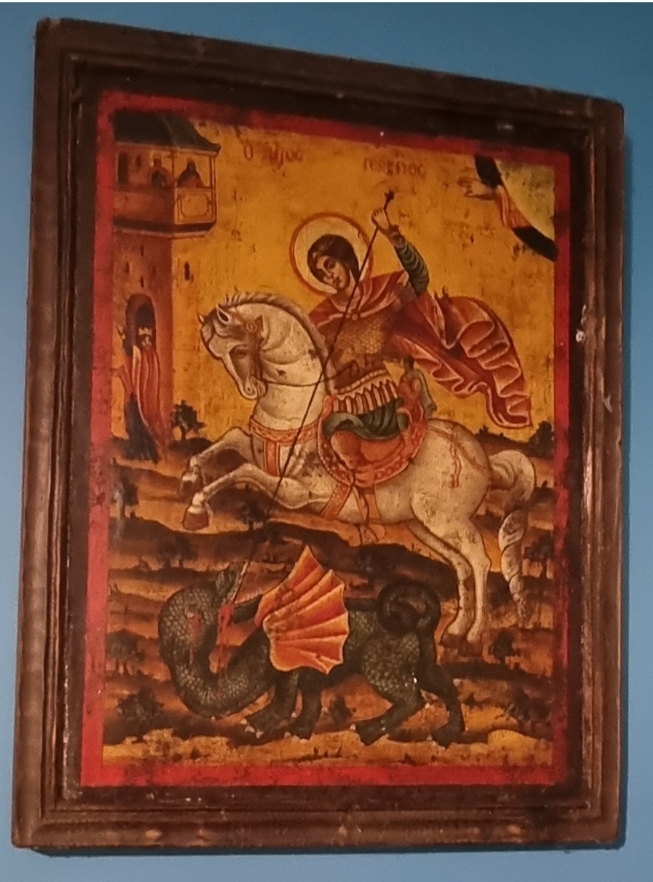
The door creaked open a bit, letting in the scent of incense down the hallway. Shadows danced on the bedroom walls, leaving the corners in darkness. The flickers came from the kandili beside the family’s icons in the corner of my mother’s room. I made sure not to think that my mother worshiped those images. She once said, “These holy pictures are like windows for us, a peek into the eternal worlds while we’re stuck in this one.” It was tough for a kid like me to wrap my head around that. But every time I kissed an icon, I reminded myself I wasn’t worshiping it.

I nudged the door open a bit more, trying to slip into the room without being noticed. Stepping onto the woolen rug, I tiptoed to the edge of the bed. There, I saw my mother on her knees, arms outstretched toward the iconastasi. Her back faced me. Slowly, she stood up, crossing herself. In the reflection off the icon of St. George and the Dragon, I saw my mother’s face. Her image overlapped with the saint’s, dividing her nose in half with the saint’s spear. One eye covered the saint’s chest, while the other floated above the horse’s bridle. The tip of her eyebrow touched the captured princess’s crown, her mouth a cushion for the Dragon’s back.

Mother’s greying hair framed a perfect silhouette within the silver frame.


Words of Wisdom from Kurt Vonnegut about Creative Expression.

March 18, 2023


“Creativity: The Soul’s Footprint”

January 30, 2023

Creativity, like an ethereal dance upon shifting sands, leaves behind the footprints of the soul. Without the presence of a soul, those footprints fade, dissolving into glitter and fleeting flashes of light. It is within the realm of art that these footprints find their true expression, manifesting as a testament to the depths of human existence.

True art emerges when the drive to create is fueled by an inner necessity—a relentless longing to give form to the intangible, to weave meaning from the threads of emotion and experience. It is this inherent compulsion that sets art apart, for it transcends mere aesthetics and becomes a profound reflection of the artist’s innermost being.

Poetics, the study of soul graphics, unravels the intricacies of this creative journey. It delves beyond the surface, exploring the vast depths of meaning that lie beneath the scribbles and strokes. The significance of art does not end with its immediate interpretation; instead, it invites us to embark on a poetic voyage, where each line and curve unravels a story yet to be fully grasped.

In a world obsessed with quantifiable measures, why should a reality defined by liters and meters be deemed more real than one measured in sighs and tears? The richness of human experience defies numerical constraints, extending far beyond the boundaries of empirical observation. Art, in all its forms, offers a sanctuary where the immeasurable finds a voice, and emotions are given shape and color.

Just as a bouncer at a nightclub selects who enters, words possess a similar power. They can choose their own context, finding resonance in specific realms of expression. Yet, it is not the grandiosity of vocabulary that defines true creativity. Rather, it is the sincere interplay of thoughts, emotions, and words that grants depth and meaning to artistic endeavors.

Creativity, at its core, is a testament to the intricate workings of the human spirit. It defies conventions and boundaries, unveiling new perspectives and possibilities. In the realm of art, the footprints of the soul take shape, leaving an indelible mark upon the tapestry of existence.

So let us celebrate creativity in all its forms, for it breathes life into our world, sparking inspiration and igniting the flames of imagination. May we embrace the study of soul graphics, venturing beyond the confines of the mundane. And in doing so, may we recognize the profound truth that lies within each stroke, each word, and each creation—an eternal testament to the beauty and depth of the human experience.


Home Grown Songs from a 1980’s Lounge Room

September 12, 2022

In the 1980’s, as a hobby, I’d write poems & then transform them into lyrics with music making songs. Most of the music was written by a friend, Henry, and there are some I wrote the music. I wasn’t a great guitarist, just knew a few chords & made do with them for my music to the lyrics. Apart from Henry there was also Dennis who played lead guitar and Willie, my brother, who also played guitar.

I scored a cheap Casio player and there are some jams we recorded with me playing the Casio. It was one of the first players that had programmed polyphonic auto accompaniment. “Playing” implies I knew what I was doing. I didn’t. I just pressed some keys in rhythm hoping it’d make some semblance of a tune. It provided the “metronome” drum beat & the programmed beats/notes. These acted as “guard rails” to the jam.

The Casiotone we used was like this. It was the first to have programmed polyphonic auto accompaniment

It was a great way to spend a Friday or Saturday night. We didn’t have any plans to perform, we just liked hanging together making music for ourselves. I’m so glad we took out the microphones to record them on cassette.

It all is SO long ago.

I’m uploading these recordings for posterity sake. No, I’m not putting them up on YouTube or SoundCloud because this blog is good enough for my purpose. My purpose? Why do I bother? Simple – for my kids & grand kids to have easy access to what I was up to, musically. It’s also a part of my Journey in this World Within Worlds.

I have already posted some of the songs’ lyrics so I thought, once I overcame my cringe factor, to complete the outing by posting some of the songs – complete with my singing & mates’ music. Writing a poem is very different to writing a song lyric. Transforming a poem into a song lyric is an interesting exercise, especially if someone else writes the music.

So, step back in time – come into my lounge room & get a taste of some home grown songs from Sydney in 1980’s.

By the way – if there’s anybody interested in updating these songs let me know by messaging me at dodona777@yahoo.com.au

I think some of these may work with right mixing even 40 years later. Some have links to the lyrics on this blog.

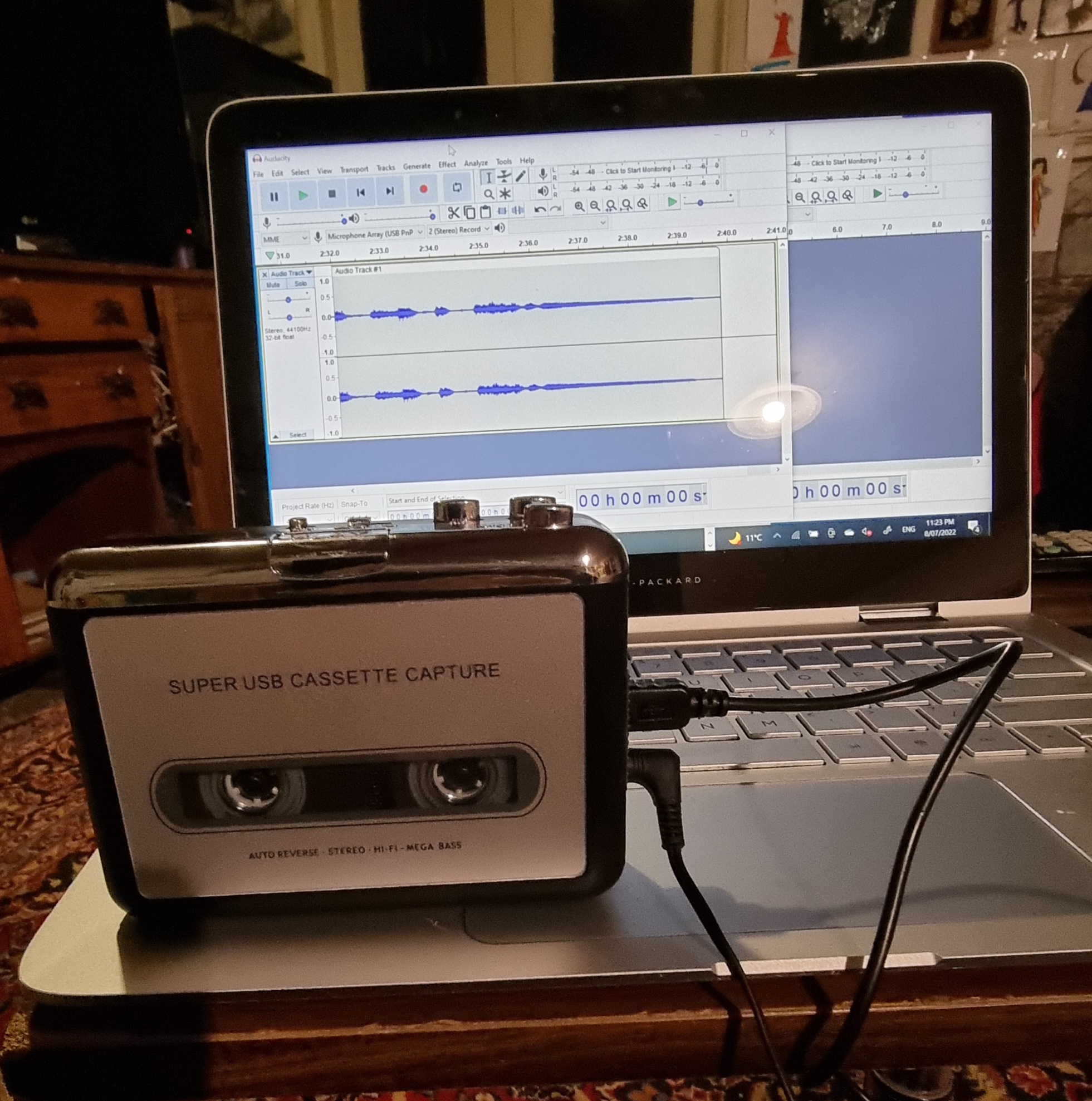
This is the simple & cheap transformer from cassette tape to mp3 I used to digitise tapes about 40 years old!

________________________________________________________________________________________________________________

“Julia” Lyrics by Stavros, Music by Henry. Recorded on cassette in lounge room.
Stavros – singing, Dennis – Lead Guitar , Henry – Rhythm Guitar

________________________________________________________________________________________________________________

“Prison of Time” Lyrics by Stavros, Music by Henry. Recorded on cassette in lounge room.
Stavros – singing, Dennis – Lead Guitar, Henry – Rhythm Guitar

________________________________________________________________________________________________________________

“Games of Solitaire” Instrumental jam Stavros – Casiotone, Dennis – Lead Guitar, Willie – Rhythm Guitar

________________________________________________________________________________________________________________

“One Son of a Gun” Lyrics & Music by Stavros,
Dennis – Lead Guitar, Stavros – Singing & Rhythm Guitar

________________________________________________________________________________________________________________

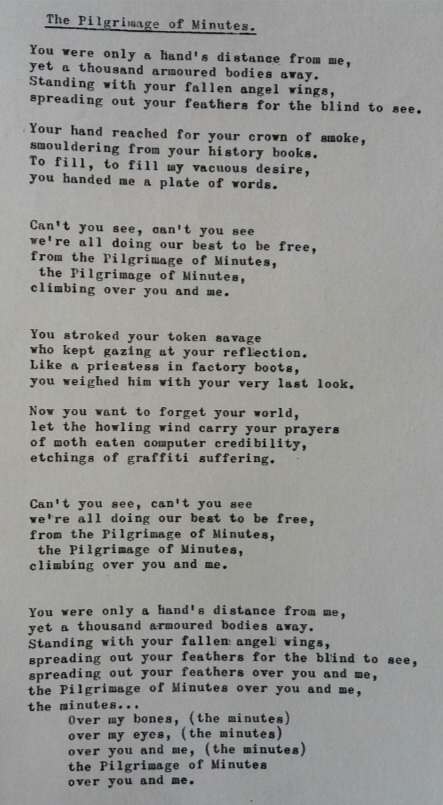
“Pilgrimage of Minutes” Lyrics & Music by Stavros,
Dennis – Lead Guitar, Stavros – Singing & Rhythm Guitar

________________________________________________________________________________________________________________

“Lines of Crazy Fortune” Lyrics by Stavros, Music by Henry,
Stavros – singing, Henry – Guitar

________________________________________________________________________________________________________________

“Once” Lyrics & Music by Stavros
Dennis – Lead Guitar, Stavros – Singing & Rhythm Guitar

________________________________________________________________________________________________________________

“Magdalene” Lyrics by Stavros, Music by Henry,
Stavros – singing, Dennis – Lead Guitar, Henry – Rhythm Guitar

________________________________________________________________________________________________________________

“Forgotten Madonna On the Run” Lyrics & Music by Stavros
Dennis – Lead Guitar, Stavros – Singing & Rhythm Guitar

________________________________________________________________________________________________________________

“Do You Remember” Lyrics & Music by Stavros
Dennis – Lead Guitar, Stavros – Singing & Rhythm Guitar

________________________________________________________________________________________________________________

“Fortune of Unloaded Hips” Lyrics by Stavros, Music by Henry,
Henry Singing & Guitar

________________________________________________________________________________________________________________


My Table of Memories

September 17, 2019
 
Let me tell you a story about the table I cobbled together back in the day. It ain’t no fancy affair, just a slab of wood perched on some logs, a DIY masterpiece. This table, my friends, is where the cosmic dance of star matter goes down—or so I hope. Memories cling to it like a vibrant aura, living entities harmonizing in a psychedelic symphony. It feels like I have some unfinished business with these memories, like a cosmic debt hanging over my head.


What I love about this table is that it’s a mishmash of recycled goods, a Frankenstein creation of sorts. The top, a gift; the legs, scavenged from a demolition yard; and the dowling, an old broom handle. Nothing’s square, and if those logs weren’t giants, the whole table would probably collapse. It’s structurally unsound but remains steady ’cause of what it’s made of—kinda like yours truly, I reckon. There’s a certain charm in being recycled, you know?


The hands that carried this table top to my home left more than just fingerprints—they left a piece of themselves. Tin Sheds, Sydney Uni, where I taught the Earthworks Poster Collective & Architecture Students who built and designed the Alternative House in the fine art of Tai Chi—it’s all etched in my soul. Back in the 1970s, the Tin Sheds were real tin sheds, none of that fancy gallery facade it’s become. Take a peek for yourself, it’s in the link.

That’s me up front on the grounds of The Tin Sheds Gallery, Sydney University

 
Now, picture this: the 1970s, Architecture Faculty cleaning house, tossing out tables. My students, clued in to my desperate need for a desk, volunteered to haul a reject tabletop to my place. We didn’t own a car, and my home was a stone’s throw away. Can you believe that our past exploits are just wisps of smoke, fading memories rising from chimney tops of NOW? Those friends and their hands, like the bones of my body—here now, that will be buried in the future. Life’s an Ourobouros, where the first kick in the womb and the final exhale at death share the same moment. P D Ouspensky’s idea of Eternal Recurrence , now that’s an idea I find strangely comforting.
 
The legs for this table were born soon after the tabletop landed in my possession, back when I was diving into literature and psychology doing an Arts degree. The legs were my ticket to this recycled universe I was creating. But that’s not the end of the saga, my friends. After completing the table, I unearthed a forgotten set of icons from my Greek Orthodox Sunday School days. Football-card-sized prints, survivors of the ages, depicting the life, death, and resurrection of Jesus Christ.
 
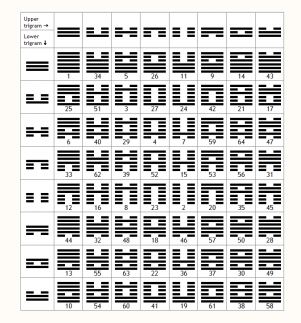
In the throes of my Dharma Bum thing, hitchhiking across Australia, these icons were my talismans, nestled amidst the pages of the I Ching — the Book of Changes—in my backpack.
Paired with my filakto – my cross talisman, pinned inside my shirt, they shielded me during my hitchhiking journey across Australia. It seems fitting they tagged along on my intellectual odyssey and trek through a Humanities degree.


Glued to the table in a cross-like constellation, Resurrection at the center, Crucifixion to the South, Transfiguration to the North, Birth to the East, and Last Supper to the West. It was my compass, my North Star. I varnished the whole thing, making the icons one with the wood. The Cross of Events amidst the chaos of my table—a border beyond death etched into the very grain.
 
Academic textbooks rested and unfurled on these icon-clad surfaces. When uncertain about life’s crazy directions, I’d throw a hexagram, letting the Book of Changes whisper its cosmic wisdom. This time when uncertain about intellectual directions the coins danced on these icons instead of road dust.
Resurrection

I Ching Hexagrams

I Ching Hexagrams

 
Now, let me tell you about a friend named Colin Little, a memory that winks at me from the ghost of my table. Check out this article in Eye Magazine > Political clout: Australian posters  http://www.eyemagazine.com/feature/article/political-clout-australian-posters.
 
The table’s long gone, but the memory lingers. Colin, asked me to teach him and his crew the ways of Tai Chi. Colin knew I was no grandmaster but when you’re friends and when you’re all beginners with minds wide open, who needs to be a master? We were Tai Chi novices, finding Zen in the chaos. Colin left the planet in 1982, but his spirit still kicks it in the tales of the Tin Sheds and the Earthworks Poster Collective.
 
So here’s to the table that birthed cosmic symphonies, housed cosmic deities, and echoed the cosmic journey of a ragtag gang of seekers. It’s gone now, a mere whisper in the winds of time, but the stories, wow, the stories live on.
 
Here’s some work he did at the Tin Sheds as part of the Earthworks Poster Collective:

Earthworks Poster Collective by Colin Little, “Bo Diddley SRCEarthworks Poster Collective by Colin Little “Lenin Conference on Radical Economics

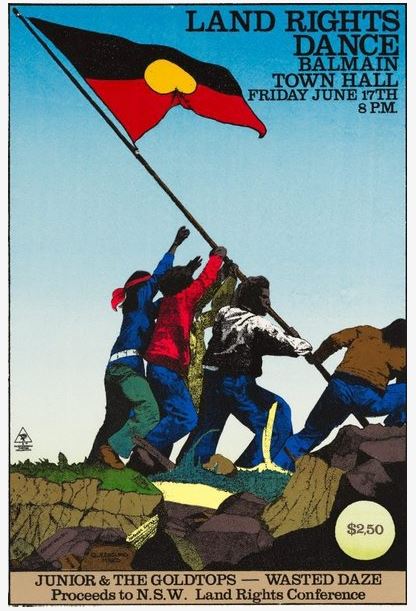
Here’s a classic Earthworks Collective Poster by Chips Mackinolty – Land Rights Dance

Earthworks Collective Poster by Chips Mackinolty – Land Rights Dance


The Devil’s Secret

October 16, 2009


The following quote comes from ” The Conference of the Birds”   a beautiful Sufi Persian Book of Poems written in 1177 by  Farid ud – Din Attar.

During the 1970’s it was adapted into a play by Peter Brook and  Jean-Claude Carriere which Brook took on a tour through parts of wild Africa and performed in the streets and later to Western audiences in New York, Paris and in Sydney. I was lucky at the time because I was living in Sydney and saw it. The play communicated at a very subliminal level in that it didn’t really matter if you understood rationally what the actors were saying because the “meaning” was transmitted almost viscerally through the movements and the sounds that emanated from the stage.

The devil’s secret:

       God said to Moses once:  “Go out and find                        

       The secret truth that haunts the devil’s mind,”

       When Moses met the devil that same day

       He asked for his advice and heard him say:

       “Remember this, repeat it constantly,

       Don’t speak of ‘me’, or you will be like me.”

       If life still holds you by a single hair,

       The end of  all your toil will be despair;

       No matter how you prosper, there will rise

       Before your face a hundred smirking “I”s.

                              The Conference of the Birds 

Conference_of_the_birds

“Manteq at-Ṭayr” (“Conference of the Birds”)