Dear TAFE Colleague

August 21, 2015

It’s great hearing from you.  You asked me how I am so here goes ….

I’m sitting here ruminating about stuff.  Kinda like reviewing a movie, a film called “My Brilliant Career in TAFE”.  It has been 5 years since I left TAFE. In the first year images of TAFE World – faces, encounters, engagements, conversations and meetings kept flashing across my mind.  Scenes  rose like steam from a drying towel in the sun. Rather than in a sequence, my mind made it all appear like one of William Burrough’s cut up stories.

When TAFE got rid of Principals it also got rid of access and equity principles. From a college it became a Corporation. My nervous system became programmed to corporate tunes that had nothing to do with education. TAFE gradually became a health hazard to my hopes, dreams and life. Sure, working there helped pay   the mortgage and bills but  I feel  I am still rehabilitating from the “brilliant career”. After   5 years away I am a lot more relaxed and do not feel the need to “perform” to some KPI. Yes, I remember some of those acronyms.

I am getting to know me again.

I remember how afraid I was to leap into the world of university study. Fear may be too strong a word, but I felt I was going to lose my “mindful” innocence,  that the systemic conditioning of my thinking into the University Academic  Mould, would destroy my individuality – my soul.  Yes, it was my own Blakean song of innocence and experience.  It was my own small town version of Paradise Lost. Whatever I feared at the beginning of university became a tool of remembrance   for my  efforts  to work on myself in the Fourth Way. Fourth Way? Yeah, something I couldn’t talk about with any of you.

That’s the other thing. I wanted to tell you that one of the reasons I had to leave when I did was to ensure I didn’t have my second Saturn Return while still working in TAFE.  If I stayed my life patterns showed it would be a disaster   because I didn’t have the courage to follow my heart. I felt I couldn’t say this to you because you and others in the system would just laugh. Little did any of you know how often I used Astrology and the I Ching to strategize and coordinate projects that won national and state quality  awards. In case you’re interested here’s an example that helped introduce English for Specific Purposes Program in the BHP Workplace. No one knew except me and my muse 🙂   This is not the place to explain  Saturn Returns but if you’re interested let me know.

The old Zen images of enlightened Mind  –  “Chop wood, Carry water” and “No Moon, no water” are now hovering around my attitude.  I’m getting something nutritious in just chopping and splitting  logs for our evening fire, painting the new sleeper pine wood pegola and garden boxes with decking oil, planting seeds, cooking, reading and writing.

I’m reading drafts of many unfinished works and instead of flogging myself with guilt that they exist and NOT finished, I’m just reading them. I’m playing around with ideas and don’t know where it will take me except that I’m enjoying just catching up with my stuff…….catching up with me.

Yes, I know it all sounds narcissistic, and maybe it is,   but I feel  I need to nurture that part of me the Corporate World could not and did not value.

How are you?

Stavros


Giordano Bruno and the Sclerotic Consciousness of an Aussie Talk Back Shock Jock

November 18, 2012

I don’t often write posts about Australian politics here because I don’t see this blog’s purpose as a day by day commentary on Down Under politics. However, I think this post is relevant to the general vibe of Journeys and Star Gazing.

=====================================================

For Australians, Alan Jones epitomises the worst of talk back shock jocks – well, at least for most Aussies. However, for some he is the Talk Back Messiah – the delusional Australian Tea Bag who hides his sexuality behind ultra right wing tirades against anyone or anything that has a slight aroma of progressive policy.

Recently he caused quite a stir when he stated that the Australian Prime Minister’s father died of shame because of her.   When he was forced to apologise by social media outrage his apology became another excuse to justify his right wing rantings.

The man is an embarrassment to Australia.

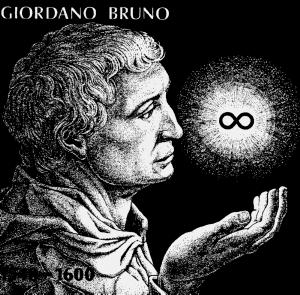
Giordano Bruno was the bold harbinger of a new cosmology during the Italian Renaissance. Illustration by James S. Arthur

Giordano Bruno ( born 1548 died 1600) was an Italian philosopher, mathematician and astronomer of the Renaissance. His cosmology went way beyond Copernicus where he suggested that the Sun was a star like other stars. Just click on this link where you will get essential information about him.

Now what does a mystical mathematician and geometer, a genius of mnemonic systems and a heretic burnt to death by the Catholic Church have to do with this creep Alan Jones? It is not generally known that the Sydney radio station which carries the virus memes spouting from Alan Jones’s mouth, 2GB, is named after Giordano Bruno. Yes, 2GB stands for 2 Giordano Bruno. If I tried to invent a more diametrically opposed polarity of consciousness and expression I couldn’t. On one end of the spectrum of consciousness we have a being whose awareness and courage extends way beyond our Solar System and the other we have a being whose awareness is even smaller in circumference than a London toilet bowl.

So, how has this juxtaposition happened?

In 1926 the radio station 2GB began broadcasting. Its operator was Theosophical Broadcasting Station Pty Ltd, owned by interests associated with the local branch of Theosophical Society – Adyar.

Later the station was bought and sold a number of times until now it is operated by purely commercial interests.

Here we are, just over an 80 year time span, where we have the spiritual and artistic aspirations of the Theosophical Society emanating from 2GB to the devolution of a radio station transmitting material from a limited and fractured ego of a materialistic and shameless mouth piece – Alan Jones.


Oracles, Shadows and the Wind

July 19, 2012
A 3D projection of an tesseract performing an ...

A 3D projection of an tesseract performing an isoclinic rotation. (Photo credit: Wikipedia)

How do we know that there aren’t beings that live in other multidimensional worlds that penetrate this one? So, from our senses they are invisible and inaudible and yet they may be walking through us or blowing time bubbles and we don’t even know it.

What if we didn’t rely on images, thoughts and sounds that are solely earth bound, totally in bed with the senses – maybe we would think in a new way. Maybe we could see beyond the skin of time and space and commune with other beings who are not constrained to linear history. If we didn’t think in sense bound ways we may become aware of the movement of higher dimensional beings.

Let us try to imagine how a higher being may manifest their will. For one thing, since they’re beyond our sense bound time – space they could make use of our world. They could use events and materials of this 3 D World in such a way that the desired result is achieved without the process seeming miraculous. These higher beings could manipulate the stuff of life and do something within our 3 D world. They could use time and space, our coordinates of self as an instrument to achieve an end. If this is the case then coincidence plays a major role in discerning the foot prints of the gods.

Coincidence may be seen as one trace of the higher dimensional beings in our midst. Coincidence could be the crack between the worlds. Through this crack, forces speak through oracles, shadows and the wind.


A Mullah Nassr Eddin Quote

March 31, 2012

” I’ll have you hanged,” said a cruel and ignorant king,  who had heard of Nassr Eddin’s powers, “if you don’t  prove that you are a mystic.”

“I see strange things,” said Nassr Eddin at once;  “a golden bird in the sky, demons under the earth.”

“How can you see through solid objects?  How can  you see far into the sky?”

“Fear is all you need.”


Emergence and freedom – what a beautiful picture!

February 25, 2012

This image is beautiful! I think it says it all when we are attempting to emerge with our own individuality from any mass mind. When we work for an institution we are obliged to merge our sense of self with that organisation. It is difficult to break free psychologically and spiritually so that one emerges like a butterfly to express what is within. I know all about this process because I left my job from a huge public service organisation where I merged my identity with its educational and training goals. Along the way I lost my sense of self. Now I feel I am emerging. Where am I in this process when I look at this wonderful picture? I think at the third stage. However, I could still be cemented in the first stage with my dreams of being free and this comment is one of many illusions I carry in my bag of ego, see the First Initiation post below.
This is the first time I have reblogged so I am not certain if the original blog address is shown. But here it is anyway : http://geerthofman.wordpress.com/2012/02/24/breaking-free/ .

GeertH's avatarGeert Hofman


Heya!

The first time I saw this picture on facebook: I was blown away. What an expression of liberating oneself from…., from what exactly? From some kind of casting mould it seems. The statue depicts a person who expresses a deeply felt connection with his higher purpose, He celebrates being an integral and indispensible part of the universe, ready to fully and unconditionally participate in the perpetual process of co-creation. Allowing himself to wonder, to enjoy life, to laugh, to love and to be free. Free and yet connected to everything else in the universe. An individual yet part of the collective wisdom and intuition of the universe. Free of the shackles of forced uniformity dictated by an obsolete worldview, free from being told what to do by everyone and all. Free from living a life which is not his. Free to accept responsibility for himself and the context in which he…

View original post 207 more words


Australian Mining Industry wants to take over our Media

February 4, 2012

It wasn’t enough that they convinced the Australian people that a tax on their super profits was a bad thing because it was far more important that Gina Rhinehart and the others get super rich rather than give the Australian people funds to help the disabled, funds to give Australians Dental Care along the lines of Medicare, funds for hospitals and schools …..no, their $20 million advertising war chest wasn’t enough. Well, it was enough to get rid of a Prime Minister – Kevin Rudd, and for his replacement to water down the original idea. The original Mining Tax would have given the Australian people enough extra money to fund much of the above.

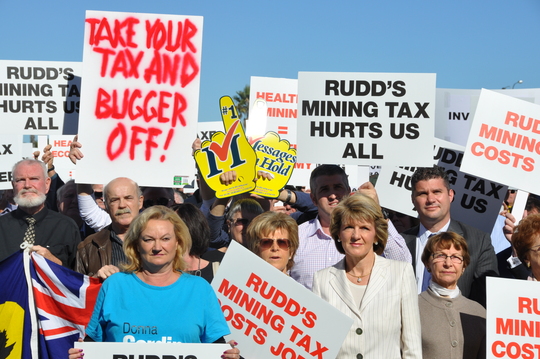
I remember the image on TV, these billionaires chanting, sounding like, “Billionaires united, we’d never be defeated!!” with all these pathetic little people carrying pristine clean, fresh off the printing press placards supporting the billionaires. Unbelievable! Until you remember the same kind of images of Tea Partiers in the USA. The Tea Party, it would be OK if they used the word Tea to mean what it meant in the 1950’s, the street name for marijuana because it would be a joke. Alas, it doesn’t mean that and when they talk about the movement being a grass roots one, well, it has now been called an astroturf movement. The right wing in Australia has taken any lessons from the Tea Party and have imported them into the Australian context.

The truth has just come out via a video recording about what the Australian 1% really are planning. They want a Fox News kind of media that is a propaganda machine for the 1% super rich and right wing free market believers. In many ways they already have it in Australia with Murdoch owning over 70% of news outlets. However, this isn’t enough. They want to take over Fairfax which runs the Sydney Morning Herald, The Age and the Australian Financial Review. This means that the 1% (actually we are talking about mining magnates that are probably in the top 0.0000001%) will have ALL media outlets sympathetic to climate change denialists and billionaires who believe that corporations are people.

One of the most worrying aspects to all this is the following quote :

“Fascism should more properly be called corporatism because it is the merger of state and corporate power.” — Benito Mussolini

This is happening in the USA, UK and now most of Europe. In Australia it is beginning to do so in a big way and if the conservative Liberal/National Coalition wins the next election it will be done. Corporatism / Corporatocracy / Fascism does not necessarily have to embrace racism, though it does most of the time. As long as there is access to cheap labour, the transnational corporations are happy. This is why Gina Rhinehart and her buddies are keen to have temporary visa holder workers in their mines.

Watch the video below and see why Rhinehart is buying Fairfax shares. Watch it and make a vow that you will do whatever you can, in a peaceful way to stop them. Labor are you listening?

https://www.getup.org.au/campaigns/mining/monckton/monckton-speaks-to-mining-industry-share-this-video

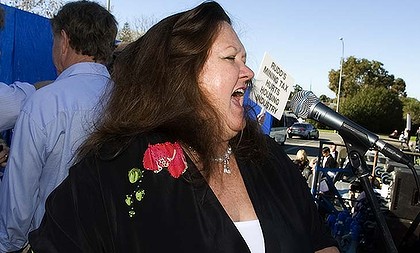
Gina Rhinhart at the Billionaires' Demo Against the Mining Super Profit Tax

Billionaires United Will Never Be Defeated!!! Mining Tax Rally in Perth, Western Australia


Standing at the Gate – Haruki Murakami

February 3, 2012

I’m having issues with my writing. In particular with the novel I’ve been working on. Haruki Murakami’s quote below reminds me that I am always a beginner, in a Zen way when I write. The quote below also reminds me that whatever comes out of me, if it is a genuine expression of my deeper nature, will always have an unknown and magical quality.

“…in China today there are lots of wonderful gates still standing. Do you know how the Chinese built these gates? People would take carts out to old battlefields and gather the bleached bones that were buried there or lay scattered about. China’s a pretty ancient country– lots of old battlegrounds– so they never had to search far. At the entrance to the city they’d construct a huge gate and seal the bones up inside. They hoped that by commemorating the dead soldiers in this way they would continue to guard their town. There’s more. When the gate was finished they’d bring several dogs over to it, slit their throats, and sprinkle their blood on the gate. Only by mixing fresh blood with the dried-out bones would the ancient souls of the dead magically revive. At least that was the idea.     Writing novels is much the same. You gather up bones and make your gate, but no matter how wonderful the gate might be, that alone doesn’t make it a living, breathing novel. A story is not something of this world. A real story requires a kind of magical baptism to link the world on this side with the world on the *other* side.”

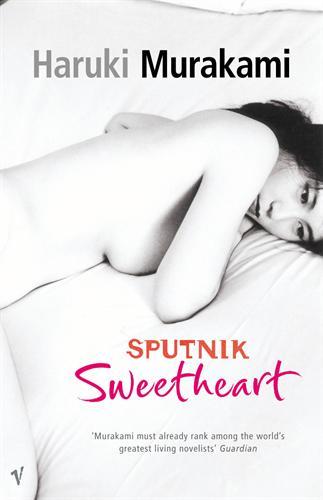
Haruki Murakami, from Sputnik Sweetheart


4 days to freeze Mubarak’s billions!

February 16, 2011

I don’t normally send a message asking you to respond by email for any organisation. However, I’m doing so now because it sickens me that a dictator who has been receiving billions of dollars of aid from the USA has used it to line his own pockets rather than help his own people. Yes, I’m talking about Mubarak.

Please sign the following petition below and we may find that he has all his funds frozen. With any luck he may even be charged with corruption.

==============================================================

Dear friends,

Mubarak may have stolen $70 billion from Egyptians — one third of their national income! The new Egyptian government is calling on the world to get it back. Sign the emergency petition for world leaders to immediately freeze his assets before the funds disappear, and then forward this message!

Egypt’s people have forced Mubarak out, but he may take unimaginable wealth out with him. Estimates of his stolen fortune range as high as $70 billion, more than a third of the annual Egyptian national income!

The new government is calling on the world to immediately freeze his assets in foreign banks, and a new UN Convention requires that stolen funds be returned to the country. Switzerland has already frozen his finances, and some EU leaders have offered to help — but only a massive outcry will get all governments to stop the Mubarak billions from vanishing into a maze of obscure bank accounts.

The G20 finance ministers meet this weekend — that gives us 4 days to call on leaders to freeze the accounts and ensure that Egypt’s money is returned to the people. If we reach 500,000 signatures by Friday, the petition will be delivered in Paris — sign now and spread the word!

http://www.avaaz.org/en/freeze_mubaraks_stolen_fortune/?vl

Millions of Egyptians live on less than $2US per day — yet experts say that corruption costs Egypt more than $6 billion in public money per year. The Mubaraks themselves have benefited massively from a web of business deals, crony-capitalist privatization schemes, and state-guaranteed investments throughout Mubarak’s 30 years as president. Estimates of their wealth run from a “mere” $2-3 billion to the staggering $70 billion figure, which would make Hosni Mubarak the world’s richest man. And 25 senior government officials are already under investigation for amassing fortunes while serving under him.

But the days may finally be over when corrupt rulers can escape with their fortunes intact. The new United Nations Convention Against Corruption explicitly calls for the return of corruptly-gained assets to the countries of origin, and Egypt’s military government has already asked European Union governments to freeze Mubarak’s fortune. The key question now is whether action will come fast enough: all the laws in the world won’t help if the Mubarak billions are shuffled out of sight before authorities can seize them.

Our voices as citizens can help the people of Egypt make good on the promise of their revolution. Join the call for Egyptian wealth to go back to the people of Egypt:

http://www.avaaz.org/en/freeze_mubaraks_stolen_fortune/?vl

As millions of Egyptians risked — and even gave — their lives for democracy, there was little that we around the world could do beyond send our hopes and solidarity. But now, in the aftermath of Mubarak’s ouster, we have a special responsibility: to ensure that our banks do not profit from the corruption of Mubarak’s government, and to do our utmost to restore the national property stolen by a dictatorship that our own governments tolerated for far too long. The people of Egypt are ready now to build a new nation. Let’s play our part to see to it that they regain the resources that were once taken from them, as they create the future that few dared to dream possible.

With hope,

Ben, Alex, Ricken, Mia, Rewan, David, and the whole Avaaz team

SOURCES

Washington Post: “Egyptians focus their attention on recovering the nation’s money”
http://www.washingtonpost.com/wp-dyn/content/article/2011/02/12/AR2011021203767.html

Egypt’s Mubarak Likely to Retain Vast Wealth; Mubarak Family May Have as Much as $70 Billion Stashed Away, Experts Estimate
http://abcnews.go.com/Business/egypt-mubarak-family-accumulated-wealth-days-military/story?id=12821073

Seize Money Stolen by Mubarak and Return it to Egypt
http://www.aljazeerah.info/Opinion%20Editorials/2011/February/15%20o/Seize%20Money%20Stolen%20by%20Mubarak%20and%20Return%20it%20to%20Egypt%20By%20Paul%20Dunk.htm

EU looking to freeze assets of Egyptian regime
http://euobserver.com/?aid=31805

The United Nations Convention Against Corruption
http://www.unodc.org/unodc/en/treaties/CAC/convention-highlights.html#Asset_recovery

Support the Avaaz community! We’re entirely funded by donations and receive no money from governments or corporations. Our dedicated team ensures even the smallest contributions go a long way — donate here.


Lost in Damascus, Syria….

June 17, 2010

A month after leaving Mount Athos in Greece (May, 2000) I arrived in Damascus, Syria. I left my bag in the hotel and found my way to the Jordan Embassy. I needed a visa to get across the border to Jordan and I arrived five minutes late. The embassy officer was adamant I had to return the next day before 11.00AM. I was frustrated and irritated but I decided rather than give vent to my negativity I’d just walk in any direction to see what happened.

I walked streets with only Arabic signs and scripts.

My travel guide book gave the street names in English only. I walked by houses with concrete veneers and gardens on terraces, vines entwining telephone polls and wires across a lane making an arch of leaves, palm trees swaying in the dry breeze rooted in concrete pavements, lurid red and blue posters of the latest film shows on billboards and walls. I kept walking sensing the Syrian sun on my face and discovering I had no marker, no point of direction back to my hotel.

I was lost in the streets of Damascus.

There were flashes of deja vu, definite sensations and feelings I had been there before – a familiarity on the tip of the tongue. Maybe I was here in a previous life. I was lost in a place that felt like a long forgotten home. My stomach rumbled and I saw a restaurant with vats and tables outside on the street. I went in and found a seat at a table with four other men, one much older sat beside me. He began speaking to me in Arabic. When I replied, “Yunan, English” meaning Greek or English he spoke even louder so that others from tables nearby turned their heads towards us. I repeated, “La (no) Arabic – Yunan (Greek), English” pointing to my mouth. The old man had a short white beard that seemed to brighten when he shook his head. The others around our table stared at me.

I said, “I’m Australian – Australos – English or Greek – Yunan.”

A few tables away a man with a black moustache called out, “You from Australia?”

I said, “Yes”.

“Then why this?” He pointed to his face and drew a circle around it in the air and then pointed at me. Shrugging his shoulders he extended his arms in front of him.

He was saying in hand talk, “How come you look Syrian but claim to be Australian?”

I said, cradling an imaginary baby in my arms, “Baba, Yunanistan,” then I made my fingers walk in the air saying, “Australia.” I went to Australia as a baby from Greece. The others in the restaurant, even the owner were watching this exchange. They smiled and the man who asked the questions said, “Hey, I come and be with you.”

He was in his late thirties, slim with a certain earnestness about him as he walked towards my table. He squeezed between the two men sitting opposite me. By now his presence had made my table invisible again.

He said, “You from Australia? I know a little English.” I told him about my trip from Greece via Turkey, to Egypt and that I’d be leaving very soon for Jordan.

He asked,

“Where are you going now?”

“The old souq (market). I have lost my way and stopped to eat here.”

“Ah, good. I’m going to a library and the souq is on the way. I will show you where to go.”

There was a certain radiance about him, as if there was a tiny grain of the sun burning in his chest. He nodded, “I understand much better in English than I speak.” Something in the way he said “understand” touched me.

For no apparent reason I said, “One of my wishes while travelling through your land is to meet someone who is wise in the way of the Sufi,” I paused and in the silence I added, “I visited Rumi’s tomb in Konya, Turkey, how I dearly wish to visit Ibn Arabi’s tomb in Syria.”

“You know Ibn Arabi?” he asked surprised, “you know of our saints?”

“Yes, only a very little. I have read about Ibn Arabi in English. What little I know of him has touched my heart. I wish to pay him my respects.”

He said, “Come, let’s go. I want to take you to a special place, a surprise place for you.”

There was this instant trust between us. As we walked under a concrete bridge near a busy intersection he said, “You’re not a tourist just going click, click, click with a camera. You know something of my culture. Islam?”

The way he said “Islam” prompted me to reply, “I’m a Christian and I believe that all religions speak of one truth but in different tongues and styles. I’m searching for truth and anywhere I can find it I value it.”

“I will take you to Ibn Arabi’s tomb.”

“What here in Damascus?”

“Yes, just around the corner. You must not speak. Just copy everything I do. You look Syrian, only your tongue gives you away.”

I wondered why I had to pretend to be Syrian and not speak when we arrived at the saint’s tomb. I figured that it was a very small price to pay – to be silent. We passed some men sitting on wooden boxes playing backgammon on a small table. One of the players smiled at me revealing a toothless mouth. The streets of Damascus are mostly narrow and crooked. Saint Paul lived on Straight Street near where we were. We turned a corner going down a narrow lane and finally arrived at a small door in a stone wall of a mosque. As we entered we  climbed down some narrow stairs that lead to a silver cage enclosing a small tomb. It looked like a big beautiful bird cage on the floor.

Others already there were prostrating on their knees and lifting their torsos up while silently moving their lips to prayer. My friend indicated that I stay beside him and as he went down on his knees I copied his movements. I bowed and touched the floor near Ibn Arabi’s body. I was amazed that I was there in front of his tomb, a tomb that has been there for hundreds of years.

Muhyiddin Ibn Arabi (1165 – 1240) was at the centre of an extraordinary flourishing and cross fertilization of Jewish, Christian and Islamic thought in the Moorish culture of Andalusian Spain. He was a Spanish mystic who had a huge and subtle influence on both East and West. In his early childhood he was recognized and taught by two women saints, Yasmin of Marchena and Fatima of Cordoba. Dante’s “Divine Comedy” was influenced by Ibn Arabi’s work.

As I looked through the cage, the more I saw, the less I knew. Who am I? Why am I here? I smelt a delicate fragrance in the swirls of prayer around me. After about a quarter of an hour we arose and left. While climbing the stairs I took one final look at the small tomb of a great man. I felt my own smallness and my own limitations as a “man”. Somehow, even though his body had lay there for so long I felt something emanating from the space that contained Ibn Arabi’s remains. I wondered whether it was his own emanations that remained there or if the people who came to offer their respects and prayers left “soul stuff” that gradually accreted over the years so that one could feel a palpable presence in this small space. Maybe it was both and was it the same in other sacred places?

Mahmoud told me that it was Ibn Arabi’s special mission to scatter Sufi seeds onto diverse contemporary fields of learning accepted by the people so that they would come to recognise the One Love behind everything.

“Now, let us go to the special place I promised I will show you,” Mahmoud said with a grin.

“I thought Ibn Arabi’s tomb was the special place.”

“Yes, it is special and this other place is special in a different way. I won’t go to the library today, it can wait. I will spend time with you.”

I was curious as to what special place he had in mind. As we walked we mentioned various authors and books to each other and we were amazed that we recognised each other’s references. The theme was the search for truth and the miraculous. I was excited by the prospect of meeting a Damascus local who may have contact with people who understood the inner essence of Islam and who could sense or know the same essence in Christianity.

After a while he said, “You know that Christians, Moslems and Jews are cousins? Abraham was our common ancestor, our common source.”

We were at the large courtyard of the Omayyad Mosque. Mahmoud said,”It is interesting that this mosque was built on land that was sacred before Mohammed. It was used as a place of worship 3,000 years ago by the ancient Syrians. Then it was a pagan temple for Jupiter during the Roman era. Then it was… no, wait for the surprise.”

Omayyad Mosque, Damascus, Syria

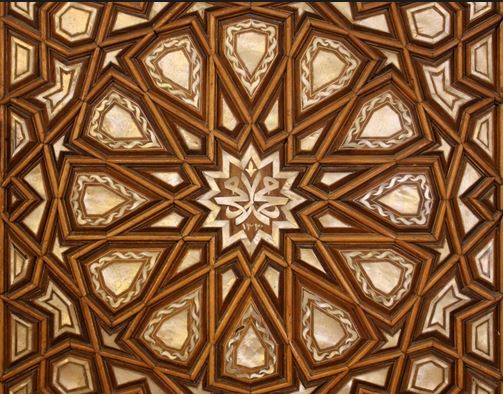
We walked on beautiful geometric patterned tiles. These patterns were repeated on some of the façade and walls. The doors also had hand carved patterns that looked like they were lifted from crystal reflections. I felt as if I walked into a world of lattices, a net of lines, a web of relationships numerical in kind and geometric in shape. I took my shoes off and entered the main door. Inside was a cavernous space, Mahmoud pointed out a section of the wall with mosaic panels made of coloured and gilded glass. He told me that all the walls were decorated like this centuries ago. The prayer hall had a small domed shrine near where we stood.

Lost in Damascus Umayyad Mosque geometric

Omayyed Mosque

Approaching the shrine, Mahmoud said, “This is the surprise. The shrine contains St John the Baptist’s head and maybe his body!” Surrounding the shrine were Moslem people bowing and praying. I asked, ”Why the prayers for St John the Baptist? Why is his tomb here in a mosque?” Mahmoud delighted, said, ”Yes, I knew it would surprise you. This place of worship many centuries ago had divine services for both Christians and Moslems. The Christians worshipped in one half of the space and Moslems worshipped in the other half. Together Christians and Moslems worshipped under this same roof.”

I paid my respects to St John the Baptist, this time crossing myself the Greek Orthodox way. No one took exception to me for doing so and as we left I felt a real connection between our two faiths. Mahmoud explained to me that Jesus was a prophet and Mary his mother was revered in Islam. He told me that St John the Baptist was revered by Moslems as a saint. Mahmoud was right, this place was a special place and that it would surprise me. He invited me to his home which meant that we had to catch one of the many small service taxis (mini buses) that were everywhere on Damascus roads. Road rules didn’t seem to count here as our bus swerved in and out of lanes with no indication and turned corners without slowing down. While our bodies moved this way and that in concert with the bus I was curious as to how Mahmoud would take my experience at Rumi’s tomb in Konya, Turkey.

I said, “While I was visiting Rumi’s tomb I felt that I could only pay my respects as an Orthodox Christian but could only do this in a hidden way. I couldn’t externally pray like the Moslems around because I’m not Moslem and at the same time I couldn’t pray as a Christian outwardly because I did not want to offend those around me. So I held my hands together in front of me and inwardly I imagined my right hand making the shape of a cross. In my faith, the thumb stands for the Father, the index for the Son and the next finger, the Holy Spirit – the Holy Trinity. My ring finger curled into my palm signifies the divine nature of Christ and the little finger is the human nature.” I showed him the tripod of fingertips and my curling fingers. I continued, “So, in a manner of speaking my hand reflects the whole of my faith. I move my right hand with the thumb and my first two fingers joined together. Firstly to my forehead, then to my belly, then to the right of my heart and then to the left of my heart – three times. I did this inwardly while silently chanting a prayer. Outwardly I was standing with my head bowed and hands together but inwardly I was actively praying in the Christian way. Tell me Mahmoud, did I do the right thing for Rumi?”

We jolted forward as the bus swerved around another corner. Mahmoud said, “My friend it is obvious to me that your intentions were pure. You were in pure heart and so whatever you do in such a state is pure. You can do what you will and it would not be wrong because of your state of mind and heart. So, you did the right thing.” He stopped and looked at me eye ball to eye ball.

“By the way,” he said,”did you know that Sufis, the People of the Path are also called esoteric Christians?”

“No,” I said, “What of our cousins the Jews?”

“Rabbi Jesus is also revered by Jews in touch with the hidden stream.” He smiled and gently touched my hand, “You and I are seekers of truth and as such we are not caught in the literal meanings of scripture and sacred texts. It is these literal, fundamental meanings, dogmas that create misunderstanding between our religions and ways of being in the world.”

I couldn’t agree more but this didn’t mean that individual and unique differences that make up a particular set of beliefs were obliterated. No, it seems to me that seeking the essential truth behind the formal, literal truths was a way of freeing one self from narrow mindedness and the razor wire of fundamentalism. And I don’t just mean religious. To name a few – scientific, economic, political, psychological, philosophical, artistic ….in fact, name an activity and it can be done and thought of in a fundamentalist way.

Mahmoud lived in one of the many concrete and cement apartments in down town Damascus, right under the arc traced by missiles from Israel. He was very lucky he told me because he had a ground floor apartment with some earth for plants. A wooden door from the street set in a large wall was the entrance to his home.

He introduced me to his wife and two daughters, his father and mother and his brother as “Stavros from Australia”. His wife Jamil brought some tea in glass tumblers and sat next to me. She said, “Pleased to meet you and welcome. I want to show you a book. I am learning English.” I was touched by the effort she put in saying this to me in English.

We were sitting around a wooden table in the enclosed area behind the wall facing the street. Mahmoud pointed to a fountain and pool, the size of a bathtub on our right . He said,”I and my brother made this fountain.” It was made of cement with inlaid patterns of shells, coral and pebbles. The shape was more like a cumulus cloud than rigid lines of concrete blocks. The water spouted from a bowl in the centre while the spirals, circles, squares and triangles of the fountain’s container looked on with mosaic eyes. I walked over to it and admired the detail of their work.

Meanwhile Mahmoud’s father, mother and brother brought cucumbers, tomatoes, shallots, radishes, cheese, bread and boiled eggs to the table. Soon after, falafals, humous, fried eggplant, cinnamon beans and dips were added to the table. Everybody sat around the table with the young girls at one corner each. We each had a plate on which we placed what we wanted from the dishes before us. Everybody was interested in this stranger from the other side of the planet – Australia. In my shoulder bag I carried postcards of Australia to give to new friends. I pulled some out and passed them around – pictures of kangaroos, koalas, Sydney Opera House, Uluru and Sydney Harbour Bridge. Everybody recognised the kangaroos.

Jamil brought over a book on the English language. She was studying English on her own using this book and some tapes. Her husband Mahmoud helped when he could but he was not fluent in English either. She said,” Please, may I read and you tell me if sounds true? Please?” She read some dialogue between two people. One was asking for directions and the other answered. The only thing missing in her delivery was confidence.

As I sat there with this Syrian family I thought about philoxenia, “Friend of the Stranger” the Greek word for “hospitality” which in the original denotes something sacred and more open than “hospitality”. It is mentioned in Homer’s “The Odyssey” where Odysseus experienced philoxenia often in his travels. My new friends expressed philoxenia in such a way that it brought tears to my eyes. I was a stranger in their midst and they offered me friendship, food and comfort. A bond grew between us that had its strength in our common humanity and the fact that everyone is a stranger away from home. Mahmoud and his brother asked me what hotel I was staying at and then phoned for a taxi to take me there.

While waiting for the taxi Mahmoud said, “I want you to have this.” In his hand were some worry beads. I showed him the worry beads my uncle gave me in Greece. The Greek ones I had were more solid and heavier with round beads. Mahmoud’s were smaller and the beads were like long brown rice grains. We compared them.

He smiled, “Well you now have Syrian worries to keep your Greek ones company!”

Mahmoud and his brother rode with me to my hotel in the taxi. They would not allow me to pay for the fare. They just wanted to make sure that I was taken to the right place.

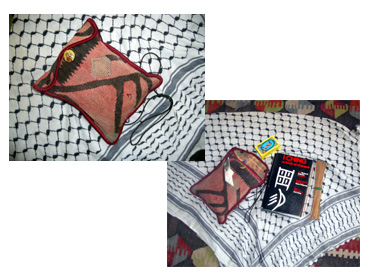
In Damascus, Syria, I found true philoxenia not xenophobia. Now I had a paper boat from the Holy Mountain and a set of worry beads from the Middle East to take with me back to Australia. When I returned to Australia I put these in a special bag where I kept other important things like hand made amulets, pellets of rose incense, a smooth stone from Dodona, crystals, a small wooden cross from Jerusalem, a tiny rock from Mt Sinai, a stone from an Aboriginal Elder in Australia and some holy oil from a small monastery of nuns near the birthplace of my father in Greece.

The bag, made of an old Turkish rug remnant was wrapped in a Palestinian keffiyeh from Bethlehem, along with the Chinese “Book of Changes” – the I Ching and Tarot cards. These four items were my psychic technology backup; just knowing they were there helped me on my journey to Nauru four years later. When we returned from Nauru the last item to be put into my special bag was the frayed remainder of the Southern Cross flag that flew on Eureka, the boat I sailed on. It was placed on top of the other things soon after we left South Bellona Reef on our way to Nauru.

My Spiritual Kit Bag with psychic technological backups, to be used in case of emergency sailing to Nauru!

A  few days later I visited Palmyra, about 100 miles east of Damascus, near the border of Iraq. Palmyra has the best preserved Roman ruins in the world. The stone buildings all have a rose tint and you feel like you are entering a Roman city with rose tinted sunglasses on.

Here’s a picture or two of what I saw. Another time, another story.
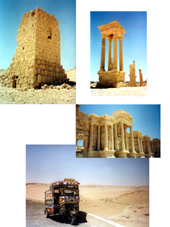
Palmyra, Syria. That little taxi takes you everywhere.


Submissions for current Refugee Issues UNHCR >> Dadaab Refugee Camp

May 27, 2010

Hi

I received this today. Those who can please send in a submission for the Dadaab refugees.

Below the reminder is the document and submission form.

stavros

============================================================

A reminder that the Australian Refugee Rights Alliance (ARRA) is calling for brief submissions from individuals and refugee community groups regarding current issues of concern to refugee populations in and from the Asia Pacific, Middle East and Africa regions.

The due date for submissions is 31 May. Please see the attached information sheet for further details on making a submission. Feel free to distribute this information to your networks. If you have any queries, please feel free to contact me as per the details below.

We look forward to receiving your submissions!

Kind regards, Lucy Morgan Information & Membership Officer Refugee Council of Australia

Suite 4A6, 410 Elizabeth Street Surry Hills NSW 2010 Phone: 61 2 9211 9333 Fax: 61 2 9211 9288 email: info@refugeecouncil.org.au

www.refugeecouncil.org.au

====================================================

INVITATION FOR SUBMISSIONS

TO THE UNHCR- NGO CONSULTATIONS

The Australian Refugee Rights Alliance (ARRA) is calling for brief submissions from individuals and refugee community groups regarding current issues of concern to refugee populations in and from the Asia Pacific, Middle East and Africa regions.

ARRA is a coalition of Australian NGOs, refugee advocates and academics. Organisations involved in ARRA include the Centre for Refugee Research of University of NSW, Refugee Council of Australia, Amnesty International and Act for Peace (National Council of Churches).  Each year, representatives from ARRA travel to Geneva to participate in the United Nations High Commissioner for Refugees’ NGO consultations.

Prior to the UNHCR meetings, the group prepares a comprehensive set of documents addressing policy issues of shared concern. This process enables more effective advocacy at the meetings by ensuring coordinated and targeted action by the Australian delegation. In 2010, the meetings will occur in late June.

Individuals and refugee community groups are invited to make submissions on issues they would like to recommend that ARRA put forward during the meetings with UNHCR.

ARRA is particularly interested in current issues of concern to refugee populations in the Asia Pacific, Middle East and Africa regions, however issues of concern to refugee populations in other regions of the world are also invited.

 Some possible themes you may choose to use include:

  • Women at Risk
  • Protracted Refugee Situations
  • Xenophobia/Racism 
  • Families at Risk
  • Urban Refugee Policy

 How Can I Contribute to the UNHCR NGO Consultations?

You can submit a brief submission to us, focusing on any current issue, but it should be limited to one page in length.  We will then read your submission contact you for more information if required and do our best to include your issues in our papers for discussion at the UNHCR in late June. 

 Please return submission application form with your submission to Lucy Morgan at the Refugee Council of Australia (RCOA).

 All submissions must be received by 31 May.

Submissions must be received by 31 MayVia post or email:  
ATT: Lucy MorganRefugee Council of Australia (RCOA)  
Suite 4A6, 410 Elizabeth Street,Surry Hills NSW 2010

Tel: 02 9211 9333

Fax: 02 9211 9288

 
Email: info@refugeecouncil.org.au  


Submission Form        


Name:  
Organisation (if applicable):  


Contact Information:


Address:  
Email:  
Contact Phone Number:  
Country of Origin:  


Topic of Submission:


Regional Focus (Asia, Africa, Middle East, other)  
Country Focus:  


Issues Covered in Submission:
1.2

3.

4.

Recommendations to UNHCR  
1.2.

3


* * Please Attach your 1-page Submission